
Stanley Kubrick | 137 mins | Blu-ray | 1.66:1 | UK & USA / English | 18 / R
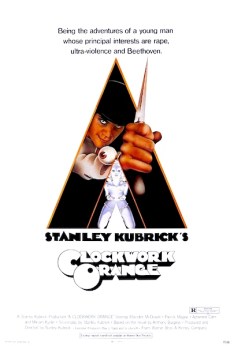 Yet more dystopian sci-fi! Who doesn’t love some dystopian sci-fi? Here we’re in the ’70s, though (makes a change from the ’80s), with writer-director Stanley Kubrick adapting Anthony Burgess’ novel into a film so controversially violent the director himself eventually banned it from release in the UK for decades. Almost 45 years on, it’s testament to the film’s power that it is still in parts shocking.
Set in a glum future Britain, the film follows eloquent juvenile delinquent Alex (Malcolm McDowell), whose violent acts eventually catch up with him when he’s imprisoned. Being the cocky little so-and-so that he is, he manages to get himself on a programme for rehabilitation and release… though that may not be all it’s cracked up to be.
The first half-hour or so of A Clockwork Orange is brilliant. I think there’s a reason this is the part that the majority of clips used when discussing the movie are lifted from, and it’s not just to do with spoilers: here is where the best imagery, and the most potent examinations of violence and the male group psyche, are to be found. It’s shocking and uncomfortable at times, funny and almost attractive at others (hence the perceived need for the ‘ban’), but the cumulative effect is precise and striking.
However, everything from Alex’s admission to prison onwards could do with tightening, in my view. It may be sacrilege to say this, but I think the film would benefit from having a good 15 to 20 minutes chopped out. All the prison bureaucracy stuff is funny, but is it relevant? “Relevance” isn’t the only deciding factor about what goes into a film, of course, but I feel like we’ve seen plenty of red-tape spoofing elsewhere. Maybe that’s just an 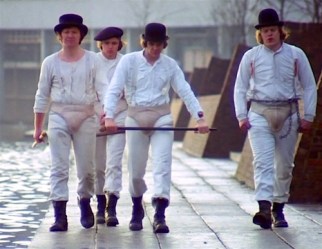 unfortunate byproduct of the film’s age. Other parts just go on a bit too long for my taste — there’s barely a sequence after Alex’s arrest that I didn’t feel would benefit from getting a wriggle on. I don’t think this is me bringing a youth-of-today “everything must be fast cut” perspective to the film, I just found it needlessly languorous at times. Maybe I was missing a point.
McDowell’s performance is fantastic throughout. I’ve seen Alex referred to as a villain (not often, but by at least one person), which strikes me (and, I’m sure, many others) as remarkably reductionist and point-missing. He’s not a hero, certainly — a mistake I think some critics of the film made, in part because the use of voiceover invites us to identify with him, and I guess anyone other than the hero having a voiceover narration was fairly new 45 years ago (feel free to correct me on that point). But he’s not a villain, especially when he comes up against the terrifying forces of the establishment. McDowell’s performance, and Kubrick/Burgess’ storytelling, is thankfully more complex than that.
That continues right through to the ending, which is quite different in the novel and film — though I say this as someone who’s not read the book, so apologies if this is off base. Reportedly Burgess ends with Alex moving away from violence of his own free will, primarily because he’s grown up and grown out of it; the point basically being that all young men go through a violent phase (even if Alex’s is extreme) and then grow out of it.  Kubrick ends on a much more ambiguous note… so ambiguous, I’m not really sure what it’s saying… or even what all the ambiguities actually are…
A Clockwork Orange remains a striking film, and not just because of the ultra-violence. It’s at its best early on, with the remainder not always working for me, but it’s a fascinating experience nonetheless.

A Clockwork Orange was viewed as part of my What Do You Mean You Haven’t Seen…? 2015 project, which you can read more about here.
This review is part of the 100 Films Advent Calendar 2015. Read more here.
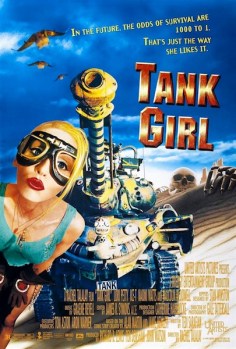 Critically derided, this anarchic adaptation of the rebellious comic has become a cult fave. You can see why: a ramshackle plot allows for plenty of outré zaniness, including a big musical number to a punky Cole Porter cover, and surely no one predicted the bizarre truth about the Rippers!
 Bolt is the 48th film in Disney’s animated canon (whatever the official name for that is these days), from their CG-only era that filled most of the ’00s. It’s a period already remembered as When Disney Lost Its Way, after the second (or is it third? I forget) ‘golden era’ of the early ’90s; the time that produced flops like
 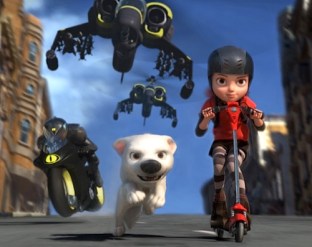 Also noteworthy are the action sequences. Far from being perfunctory attempts at liveliness, these are properly exciting, making full use of 3D CGI to create exciting and dynamic sequences. I’m not just talking about the couple we get from the TV-series-within-the-film either, but also the ‘real world’ ones as Bolt, Mittens and Rhino jump onto trains, out of moving vans, escape from a pound, etc. Of course, the TV-series-within-the-film is completely implausible — like you could film a TV show with massive action sequences in such a way that you only ever do a single take, never mind achieve all those effects on a TV budget. But then this is a film where a talking dog, cat and hamster work together to travel from New York to Hollywood entirely of their own volition — I think it’s safe to say no one’s aiming for documentary levels of realism.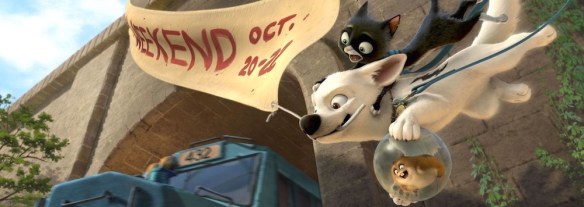
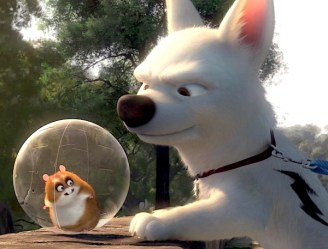 It would be easy to dismiss Bolt as part of Disney’s CG folly, especially as it stars Miley Cyrus and is immediately followed by their return to 2D animation, but I think that would be a mistake. It’s a fast-paced and fun adventure, with accurately-captured animals meaning it’s especially likely to appeal to dog lovers. Disney’s next golden era just might begin here.
 100Films.co.uk