
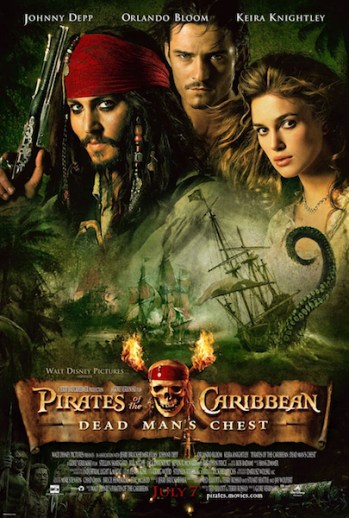
Here’s the first in a sporadic new series of posts, inspired by my 100 Favourites entries, which I’ll be using to plug some of the gaps in my review archive. As a good starting example, this is the only Pirates of the Caribbean film I haven’t covered before.

Country: USA
Language: English
Runtime: 151 minutes
BBFC: 12A
MPAA: PG-13
Original Release: 6th July 2006 (UK & others)
US Release: 7th July 2006
Budget: $225 million
Worldwide Gross: $1.066 billion
Stars
Johnny Depp (Edward Scissorhands, Alice in Wonderland)
Orlando Bloom (The Lord of the Rings, Kingdom of Heaven)
Keira Knightley (Pride & Prejudice, The Imitation Game)
Bill Nighy (Love Actually, The Best Exotic Marigold Hotel)
Director
Gore Verbinski (The Ring, Rango)
Screenwriters
Ted Elliott (The Mask of Zorro, The Lone Ranger)
Terry Rossio (Shrek, Godzilla vs. Kong)
Based on
Pirates of the Caribbean, a theme park ride at Disneyland.
The Story
On their wedding day, Will Turner and Elizabeth Swann are arrested for piracy. To secure a pardon, all they have to do is bring in Captain Jack Sparrow. Meanwhile, the aforementioned pirate captain is hunting for a key that he can use to unlock a chest that contains leverage he may be able to use to escape a debt to the horrifying Davy Jones…
Our Heroes
Jack Sparrow (or, as half the characters pronounce it, Jack Sparrah), the pirate captain who looks like a drunken fool but is actually in possession of a sharp mind. Also Will Turner, the swashbuckling ex-blacksmith determined to prevent the execution of himself and his beloved. That would be Elizabeth Swann, the governor’s daughter who is altogether more capable than would be expected of a woman from this era.
Our Villains
The pirate-hating East India Company is represented by the scheming Cutler Beckett, who seeks to rid the seas of pirates. To do so, he intends to control Davy Jones, captain of the Flying Dutchman. A tentacled terror, Jones seeks primarily to add more damned souls to his crew — including one Jack Sparrow…
Best Supporting Character
Will Turner’s father, Bootstrap Bill, was condemned to the ocean’s depths, where he ended up committing himself to servitude on Davy Jones’ ship. Well, unless Will can find a way to set him free…
Memorable Quote
Elizabeth Swann: “There will come a time when you have a chance to do the right thing.”
Jack Sparrow: “I love those moments. I like to wave at them as they pass by.”
Memorable Scene
A large chunk of the climax is a set of interconnected sword fights that most famously include three men duelling each other inside a runaway waterwheel. And while that’s good, my favourite bit has always been Elizabeth, Pintel and Ragetti fighting off Davy Jones’ crew while sharing two swords (and a chest) between the three of them.
Truly Special Effect
Davy Jones is an incredible creation, the writing mass of CGI tentacles that make up his face conveying a slimy physicality that remains impressive even as some of the film’s other computer-generated effects begin to show their age.
Previously on…
Inspired by a Disney theme park ride, nobody expected much of Pirates of the Caribbean — or, as it was hastily subtitled once someone at Disney realised this could be the start of a franchise, The Curse of the Black Pearl. As that someone knew, it turned out to be something very special. Dead Man’s Chest retrofits it into being the first part of a trilogy.
Next time…
The aforementioned trilogy concludes with At World’s End, which was shot back-to-back with Dead Man’s Chest and so wraps up its many dangling plot threads. The series continued with standalone instalment On Stranger Tides, while this year’s Dead Men Tell No Tales, aka Salazar’s Revenge, looks as if it seeks to tie the whole shebang together.
Awards
1 Oscar (Visual Effects)
3 Oscar nominations (Art Direction, Sound Mixing, Sound Editing)
1 BAFTA (Special Visual Effects)
4 BAFTA nominations (Production Design, Costume Design, Sound, Make Up & Hair)
1 Saturn award (Special Effects)
4 Saturn nominations (Fantasy Film, Supporting Actor (Bill Nighy), Costume, Make-Up)
1 World Stunt Award (Best Fight — see “Memorable Scene”)
The Pirates sequels have all come in for a lot of criticism ever since their first release. It was inevitable, really: the first is basically a perfect blockbuster action-adventure movie, something any follow-up would struggle to live up to. However, I think Dead Man’s Chest has improved with age. It lacks the freshness and elegant simplicity of its forebear, true, but it still has inventive sequences, memorable characters, impressive effects, and a generally fun tone, even as it’s setting up masses of mythology that will only be fully paid off in the next instalment. That also means it doesn’t quite function as a standalone adventure. But if you readjust your focus slightly, so that the film isn’t about beating Davy Jones, but instead about finding the chest and settling Jack’s debt to Jones, it’s more self-contained than it appears.

The fifth Pirates of the Caribbean movie, under whichever subtitle they’ve chosen for your country, is in cinemas from today.
 Kenneth Branagh, who once used to direct films based on Shakespeare and opera and that kind of thing, seems to have carved himself a place as a jobbing blockbuster director so far this decade: it started with a spot in Marvel’s then-burgeoning universe, adapting
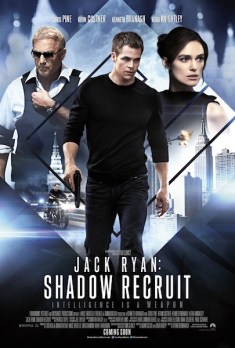
 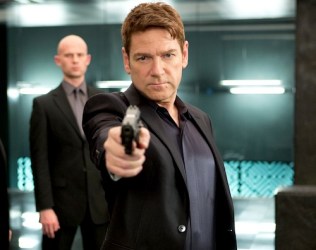 he comes up against oligarch Viktor Cherevin (Kenneth Branagh), the architect of the plan, which will be instigated by a massive terrorist attack on US soil. Unless Ryan can stop him, of course — with the help of his handler (Kevin Costner), and his fiancée Cathy (Keira Knightley), who’s followed him to Russia because she thinks he’s having an affair. I mean, he was sneaking around a lot…
 a little different to the action-thriller norm. Ryan has skills leftover from his military days, but he’s not a one-man army like Bond or Bourne — he needs help both on the ground and from tech guys behind the scenes, who play a vital role in… well, I was going to say “the climax”, but it’s “the bit just before the climax”. The climax is a chase around New York, because of course you have to end with a chase.

 Score:




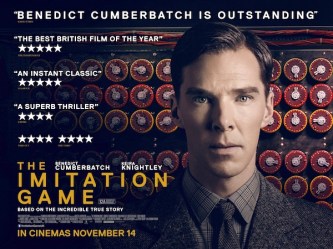 Alan Turing was a war hero: he led a team of cryptologists who managed to break the Germans’ Enigma encryption, thereby giving the Allies access to tonnes of vital information that (historians estimate) helped shorten the war by up to four years. This information was beyond top secret — so much so that they created a new designation for it, “ultra secret” — so when the war was over, Turing & co’s contribution went unrecognised for decades. Alan Turing was also a homosexual in an era when that was illegal. When he was caught, he was sentenced to chemical castration, which caused (or at least contributed) to him taking his own life. Fine way to treat a war hero, but that’s what you get with discriminatory attitudes.
 The screenplay by newcomer Graham Moore topped the Black List in 2011, so it’s probably of little surprise that it went on to win an Oscar, but I think it’s fair to say its quality, while good, isn’t that good. The use of three concurrently-told timelines seems to be too much for Moore and/or director Morten Tyldum to handle at times, occasionally flitting to a different era with little purpose beyond “it’s about time we told more of that storyline”. That’s not to say a wholly chronological telling would’ve been more effective — though perhaps it would’ve placated critical viewers who expected (and retrospectively demand) a cryptography-based wartime thriller — but the period juggling clouds the point as often as it illuminates it.
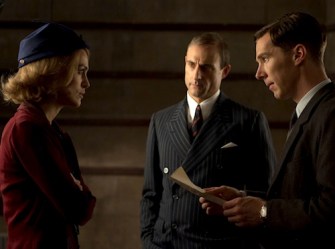 Also up for the golden man was Knightley, who does give one of her better turns as Turing’s sort-of-sidekick. The pair have a fairly complex relationship — both halves are key to conveying that, and they both do. At least as remarkable as either is young Alex Lawther, who arguably gets the film’s stand-out acting moment in his final scene, where a tumult of emotion is contained beneath a stiff-upper-lip surface in a tight close-up. On the strength of this, an actor to watch out for. The rest of the cast don’t get the same depth of material, but Charles Dance and Mark Strong provide exceptional value, as always, and Rory Kinnear does his best to bring some nuance and interest to a part he’s overqualified for.
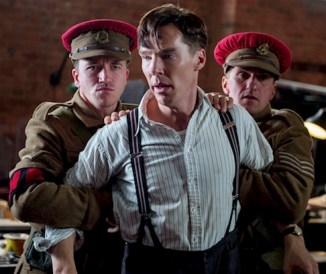 Perhaps that just stems from a frustration at some of the film’s other issues. It clearly has a flexible relationship with historical accuracy — well, what biopic doesn’t? Without wanting to spoil plot developments, some viewers feel the film suggesting Turing knew of the spy at Bletchley Park is insulting to his memory, because in real-life he didn’t even know the individual. Alternatively, is it not a way to integrate that part of the Enigma story into a film that otherwise wouldn’t have a satisfactory way to touch on it? Everyone’s mileage will vary on whether that should’ve been done or not.
 Without meaning to sound too judgemental (though when has that ever stopped me?), those factors making me think this is the kind of film “normal people” will probably love a lot more than “film fans” — which probably explains why it’s in the IMDb Top 250 but all the most-liked reviews on Letterboxd have exceptionally low scores. Personally, I’m going to side with the populous: not everything has to be a groundbreaking feat of Cinema to be a story worth telling and told well, and if it is indeed some kind of “historical revisionism” to say that there’s nothing wrong with being gay and the way Turing was treated post-war was horrendous, well, I’m OK with that revisionism.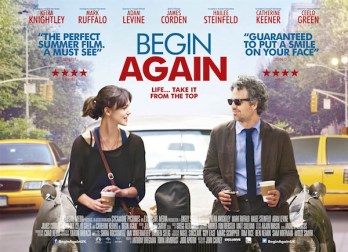
 This melancholic apocalyptic comedy wasn’t too well received, which is a shame because I thought it was absolutely brilliant.
 is an overwhelming sense of melancholy. It’s a hard feeling for films to evoke, I think — more complex than happiness or sadness, or excitement, or even fear. It comes to a head in an ending that actually brought a tear to my eye, a rare enough feat that it cemented a five-star rating.
 Is Cut an advert or is it a film?
 100Films.co.uk