
Trey Edward Shults | 88 mins | streaming (HD) | 2.40:1 | USA / English | 15 / R
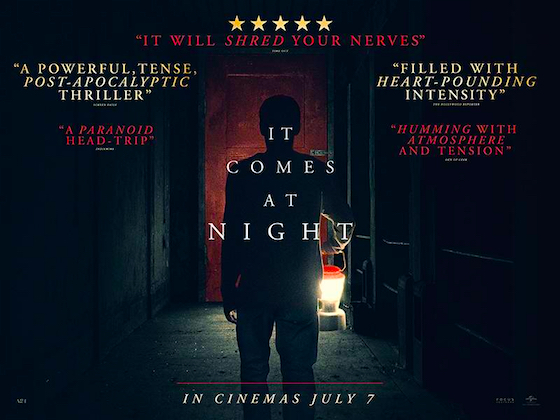
Described by Kim Newman in his Empire review as “existing between a Sundance and a FrightFest film”, which is a neat way of putting “arthouse horror”, It Comes at Night went down very poorly with many viewers, seemingly because it was mis-sold by its trailers. As someone who went in pretty much cold, however, I thought it was very good.
Sometime after some kind of contagion has wiped out civilisation, we’re introduced to a family — Paul (Joel Edgerton), his wife Sarah (Carmen Ejogo), and their teenage son Travis (Kelvin Harrison Jr.) — who’ve sequestered themselves in a secure house deep in the woods. But their existence is disrupted by the arrival of a couple (Christopher Abbott and Riley Keough) and their young son seeking refuge. Although Paul is deeply distrustful, he agrees to take them in. But is there some one, or some thing, else waiting for them in the woods?
Well, I should be careful there, lest I slip into doing what the trailers did. I watched one after the movie, and it certainly wasn’t a great representation of the film. So was it wrong to advertise it as a horror movie? Yes and no. I mean, it’s not your typical horror flick, but it is moody and creepy and tense, and scary because of it. I’m tempted to compare it to something like The VVitch, though their styles do diverge as they go on (I could say how, exactly, but it might be construed as a spoiler). It partly depends how you define genre. You could argue It Comes at Night is actually a psychological thriller with a dash of sci-fi (thanks to its post-apocalyptic setting) — and it definitely is those things — but, functionally, it’s a horror movie. It’s built to unnerve and scare you. It’s only really once those immediate terrors are out of the way — i.e. when the film ends — that what it leaves you to chew over is its commentary on paranoia and trust.
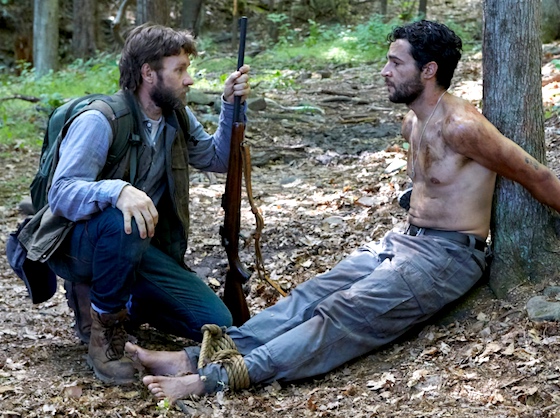
In the case of the latter, and the way it executes its sci-fi-ish setting, it all feels very realistic and plausible. That realism is underscored by the pace, structure, and characterisation. The combination of the writing and an array of good performances mean all the characters come across as believable, supportable people — there are no clear heroes and villains here. And even things that look like clues to solving some mystery turn out to be, if not red herrings, then functional dead ends.
It’s a very well-made film on the whole. The cinematography by Drew Daniels looks incredible. Well, some of the daytime stuff just has a grainy, handheld, documentary-ish feel, which is appropriate and well done if fundamentally unremarkable; but everything in the house after dark — seemingly lit only by handheld lanterns and torches — looks fantastic. And all that darkness is suitably scary, of course. Plus film grammar nerds are going to love something subtle the visuals do later on, if they even notice it — it’s that low-key that it might pass you by, but it’s really effective. (Writer-director Trey Edward Shults discusses what it is, and why they did it, in this interview. I had so much of that article copied into my notes for this review that I decided I may as well just share the whole thing.) I also liked the score by Brian McOmber. Sometimes it feels a mite familiar from other movies of this style, but it remains highly effective — not overblown, but atmospheric, without being a mere background hum.
The best way to see It Comes at Night is as cold as possible — perhaps off the back of a positive, accurate review, say. A lot of the low viewer scores and negative comments do seem to stem from being mis-sold by the trailers, and I hope that, divorced from that, the film will be able to latterly find an appreciative audience; one not interested in gore and jump scares, but in tension, paranoia, and the psychology of fear.




 I’m not sure I’d even heard the name Jeff Nichols before Midnight Special came along, at which point most of the gushing reviews that followed seemed to mention him with cult-like reverence. He’s the writer and director, by the way, for anyone still in the dark, and unbeknownst to me (and, I rather suspect, most people outside certain cinephile circles) he’d amassed something of a following over his first three movies (
 straight-up Spielberg rehashes we’ve seen over the past four decades; conversely, a strand of wilful obscurity means it may be ultimately less satisfying. Again, some people derive satisfaction explicitly from that lack of resolution or explanation, while others will find it damagingly frustrating. Even more than Spielberg, I felt the thing most evoked by this structure was
  I thought they perfectly conveyed what they were intending to convey — usually, just a kind of otherworldly light. It’s not like it’s even over-stretching its means, like so many network TV series or
 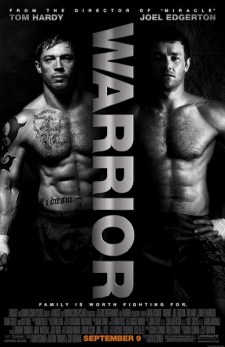 Two estranged brothers (Tom Hardy and Joel Edgerton), who’ve taken very different paths in life to escape their alcoholic and abusive father (Nick Nolte), wind up entering the mixed martial arts tournament to end all mixed martial arts tournaments, their eyes on the unprecedentedly massive cash prize — one to save his house and family, the other to help the widow of his Army chum. As they separately go up against an array of more experienced opponents, who could possibly end up in the final bout? Hm, I wonder…
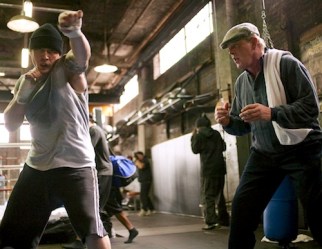 I think they’re being a bit harsh but I can see where they’re coming from. Now, I’m almost loath to give it 4 because I don’t agree with the consensus. And it’s a particularly strange consensus: everyone seems to acknowledge it’s terribly clichéd, but then give it a pass on that. Why? Why don’t you show the same leniency to the tonnes of other movies you rip to shreds for their clichés?
 though I’m not sure his character arc actually reaches any kind of ending. The rest of the cast are adequate: Joel Edgerton is decent as an upstanding family man; Jennifer Morrison has little to do as his wife; Frank Grillo is convincing as a trainer who bases his philosophy on classical music; Kevin Dunn gets some amusing moments as Edgerton’s school principal. Other people sometimes say words.
 At some point during the process of remaking John Carpenter’s seminal 1982 sci-fi/horror
  Of course, it isn’t as good. There are many reasons for this, one of which is the fact that, because they haven’t just remade the other film, every homage/rip-off they come up with is inferior. So the blood testing scene from the ’82 film is replaced by shining a torch in someone’s mouth to see if they have fillings. God help you if you’ve taken care of your dental hygiene. The climax is typically overblown — this isn’t a spoiler, I’m preparing you if you’ve not seen it: the survivors venture into the alien’s spacecraft to stop it taking off. Some people get a kick out of getting to see inside the ship, and I suppose you could say that at least the remake-makers are trying to offer something new. Unfortunately, new is exactly what it’s not. The Thing is a bizarre creature, growing and morphing and warping in disgusting ways — what strange kind of spaceship would it call home? A bog-standard metal-corridors kind of one, apparently. The lack of imagination is staggering.
 The other element the making-of material is keen to underline is just how much effort was put in to make sure this ties back to its predecessor. Essentially, they looked at what was revealed about the Norwegian base in Carpenter’s film and used that to reverse engineer the events that had to occur in this film. However, the final result could’ve made some of these connections more explicit. For example, we don’t see when the guy who slit his throat performs that act. The moment is actually included among the disc’s deleted scenes, but why did they cut it?! The movie’s final scene, which directly links the two films, is intercut with the end credits — why?! It comes across as apologetic, like they’d rather it wasn’t there but feel it has to be. Either put the scene in the film proper, or put it as an after-credits easter egg for die hard fans; the halfway-house used in the final cut is just messy. If someone’s argument was, “casual viewers will find those linking scenes meaningless”, then watch your own movie! The helicopter being away for refuelling is referenced earlier in the film; Joel Edgerton’s character says they didn’t kill Lars but never says what they did do with him; and the last time we see Colin he’s alive (until a single shot of his frozen corpse, that is). To put it another way: they’ve done a bang-up job of making those things matter within the film itself, as well as in the context of linking up to the ’82 film, so why were they deleted or included only as an embarrassed afterthought?
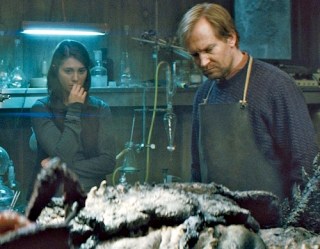 Or maybe they wouldn’t, because The Thing 2011 is a lesser film than the original. It does still offer some suitably gross effects work, albeit lessened by it being obvious CGI rather than gruesomely physical constructions, but there are still some resultantly tense sequences. Heck, it’s the first film in I-don’t-know-how-long that actually made me jump, once. Some viewers complain that there’s no “who might be an alien?”-type tension because the characters aren’t well-drawn enough, but I had that problem with Carpenter’s film too.
 100Films.co.uk