
The penultimate monthly update for 2016 has a higher-than-usual compliment of films from 2016. How up-to-date of me.

#173 Love & Friendship (2016)
#174 Batman: Return of the Caped Crusaders (2016)
#175 The Pianist (2002)
#176 Kung Fu Panda 3 (2016)
#177 Swiss Army Man (2016)
#178 Suicide Squad (2016)
#179 Arrival (2016)
#180 10 Cloverfield Lane (2016)
#181 The Deer Hunter (1978)
#182 Fantastic Beasts and Where to Find Them (2016)
#183 Star Trek Beyond (2016)
#184 Napoleon (1927), aka Napoléon vu par Abel Gance
#185 Jason Bourne (2016)



- I watched 14 new films again this month (same as last). That makes this my 30th consecutive month with 10 or more new films.
- As I mentioned, there were quite a few films from 2016. The total is ten, to be precise, or 71.4% of this month’s viewing. I’ll rate them when I review them, but scroll down to the Arbies for more about which I liked and disliked.
- I spent three nights watching the 5½ hours of Abel Gance’s Napoleon, which made its hotly-anticipated Blu-ray debut this month. Still only counts as one film, though.
- Making up for last month, I found time for two WDYMYHS films. Both are excoriating depictions of wartime: Roman Polanski’s story of life in the Warsaw ghettoes during World War 2, The Pianist; and Michael Cimino’s controversial take on the Vietnam war and its effect on (American) combatants, The Deer Hunter.

The 18th Monthly Arbitrary Awards
 Favourite Film of the Month
Quite a few enjoyable films this month, particularly among all those 2016 ones, but the one of the highest quality was definitely Denis Villeneuve’s venture into science-fiction drama, Arrival.
Least Favourite Film of the Month
Conversely, the weakest film this month also comes from 2016. I wanted to find the critics were wrong and side with the audiences who boosted it into the top 75 highest grossing films of all time, but no, Suicide Squad is a disappointing mess.
Longest Film of the Year (So Far)
I watched the ’59 Ben-Hur back in September, a film whose notoriously epic running time — 222 minutes, or 3¾ hours — would, most years, stand as unlikely to be surpassed. Thanks to the BFI, however, it has: Abel Gance’s silent epic Napoleon is a full 111 minutes longer at 333 minutes, aka 5½ hours.
Most Consistent Use of a Song
They’re back again: after 14 years and five films, Jason Bourne still ends with Moby’s Extreme Ways, just like every other film in the series. Never may it end.
The Audience Award for Most-Viewed New Post of the Month
I confess to being slightly surprised by this month’s most-seen post. Besting several new releases (Batman: Return of the Caped Crusaders was 2nd) and all-time favourites (Star Wars was 3rd), this month’s victor was my review of Denis Villeneuve’s arty psychological thriller Enemy.











Films that broke new ground rub shoulders with ones that settled into comfortable grooves, with everything from children’s movies about toys to adult movies about puppets.








As regular readers may have ascertained from the occasional reference I’ve made, I’m going to be away for a chunk of December. It’s not actually some big secret, it just wasn’t especially pertinent ’til now. We’re off on a family holiday to Hogwarts… in sunny Orlando, Florida. And all the other stuff, like Disney World and the Kennedy Space Center, all that jazz; but it was inspired by, as grown-up adult human beings, wanting to go to the Harry Potter theme parks. Something something for all ages, something something young at heart, etc.
So as this is posted, I’m currently… sat at home in the UK, because we fly tomorrow. Anyway, that means this blog will be quieter than normal for a bit — and as I’m away for 72% of the time it would cover, no advent calendar this year. I know I’m severely damaging your enjoyment of the holiday season, but it can’t be helped. Sorry. I’d love to tell you that I nonetheless have a mass of reviews scheduled to post so it’ll be like I’m not even gone, but I don’t. However, my 100 Favourites will continue as advertised (next up: #95 on Sunday), and there will be a couple of other reviews scattered in between, too. I may check in on comments from time to time as well, what with the connectivity of our modern world — so don’t be a stranger, y’hear?
It’ll undoubtedly have an effect on how many films I watch, though — will December destroy the 30-month run of 10+ films?!
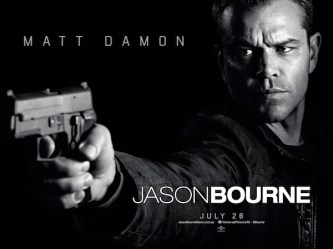 Much like the Bond films to which they’re so often compared, the Bourne movies have their devotees while only fitfully pleasing the critical establishment. This fifth movie — which is notable for marking the return of star Matt Damon and director Paul Greengrass after the semi-reboot of
 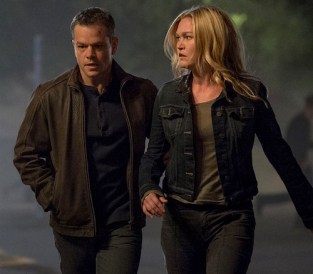 Action sequences ensue, shot with all the ShakyCam you’d expect from Greengrass. By now I imagine you have your own view on whether his style works or not. Personally, I think it’s considerably less bamboozling than when it made its debut in
  Frankly, Jason Bourne is at pains to mix in hyper-current iconography; the reasoning for Damon and Greengrass’ return now being that the world has changed and how does Bourne fit into that? So as well as social media and Greek riots we’ve got references to and riffs on hacking, Edward Snowden, government surveillance of its own citizens, the prevalence of Facebook/Twitter-esque tech companies, and so on. Sadly, I’m not sure the film’s actually got anything to say about any of these things. Greengrass and his co-writer, editor Christopher Rouse, have appropriated all these zeitgeisty concepts to make the film feel very Now, but that surface sheen is more or less where it ends. I mean, there’s a whole subplot starring Riz Ahmed as the Zuckerberg-like CEO of a social media company that I didn’t even mention in my plot summary because it’s kind of an aside. It’s kind of ironic, really, that it always seemed as if Greengrass’ more natural stomping ground was his documentary-ish real-world-exposé type movies, with his contributions to the Bourne series an unusual sideline; yet when he finally marries the two halves of his filmmaking career, it’s the action rather than current-affairs commentary that takes precedence.
 The end result is that Jason Bourne does thrill as an action movie, which seems to have been the primary goal of its makers, at the end of the day. As an action-thriller, however, the rinsed-and-repeated plot is a slightly faded imitation of former successes; a through-the-motions way to provide those impressively staged chases and punch-ups. It’s not the definitive Bourne movie one might’ve expected from the returning star/director combo (why else come back if not to perfect, or at least add to, the formula?), but instead means the film ends on an odd note: even though it wasn’t a wholly satisfying experience, and even though it doesn’t end with questions still blatantly hanging (as every Bourne movie bar Ultimatum has done), I want Damon and Greengrass to come back and do it all again, please. Only do it properly next time, yeah guys?
 Stoner comedies aren’t really my thing, but something about American Ultra — which is often pithily described as “
 really mean it’s funny (there are two or three laughs, tops), just that it has a less serious tone. Even if you want to claim the Bourne similarities are just one facet, the film as a whole feels generally reminiscent of any number of low/medium-budget action flicks. It’s not bad, it passes the time, but original or exceptional? No.

 Score:





 As Jason Bourne flits around London and New York making trouble for what’s left of Treadstone, a group of shady men go about safeguarding their own secretive activities. When Bourne exposes Treadstone, a series of convoluted join-the-dots links means it could bring them down too, so they set about destroying their risky initiatives, including killing a bunch of medically-enhanced operatives. What they didn’t count on was one surviving…
 For my money,
  Perhaps also, after four films, he’s too close. Clearly that has advantages for remembering the intricacies of the timeline and continuity, especially with the trilogy’s increasingly complex web of conspiracies and conspirators; but maybe Gilroy has become too deeply embroiled in that. After all, he thinks it’s OK to spend the first half hour of the film connecting up the dots between the previous story and his new plot — who really wants that? That’s for geeky fans to do later.
 At the end, the two films come together, adding a few seconds more story to what we saw at the end of IV, and ready to move on with unified purpose (well, sort of) in
  is wasted staring at monitors; Albert Finney is literally wasted, his one meaningful moment relegated to the Blu-ray’s deleted scenes section; Zeljko Ivanek gets a pivotal character but is underdeveloped and so his talents are wasted; and some actors from previous Bourne movies appear to be credited merely for use of their photos, until they turn up for ten-second cameos near the end that you’d rather weren’t there because it means someone is planning on a Bourne 5.
 100Films.co.uk