
James Gunn | 136 mins | cinema | 2.35:1 | USA / English | 12A / PG-13
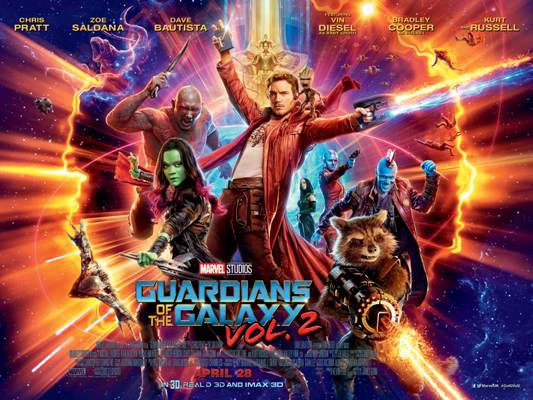
The franchise that some thought might kill the Marvel Cinematic Universe, but which actually turned out to be one of its most popular successes, is back for the difficult second album. And difficult it is, because Guardians 2 takes a lot of what made that first movie work and ramps it up to 11, consequently slipping over into bouts of self-indulgence.
The story picks up on a thread left conspicuously hanging at the end of the first movie: who is Peter’s father, and why did he have the Ravagers kidnap Peter from Earth? Vol. 2 digs into those answers pretty quickly, because it has somewhere else to go with them… but that would be spoiler territory. So while Peter (Chris Pratt), Gamora (Zoe Saldana), and the ever-hilarious Drax (Dave Bautista) toddle off to learn about daddy-o, the rest of the gang — Rocket (motion capture of Sean Gunn, voice of Bradley Cooper) and Baby Groot (still voiced by Vin Diesel, allegedly) — get caught up in a mutiny involving Yondu (Michael Rooker) and Nebula (Karen Gillan). All while the lot of them are being chased by a race of gold-skinned perfectionists led by the priestess Ayesha (Elizabeth Debicki) who the Guardians conned.
Returning writer-director James Gunn gets things off to a strong start, diving straight into answers, humour, an entertaining title sequence, a couple of action scenes, more humour, and more answers. But after this strong and pacy opening salvo, the film seems to flounder a little. Not fatally so, but it gradually becomes apparent that the middle is going on far too long. Your mileage will vary on how draggy this is — some people seem to have absolutely hated it; I thought much of it was amiable enough, but it goes nowhere fast and that eventually becomes wearing.
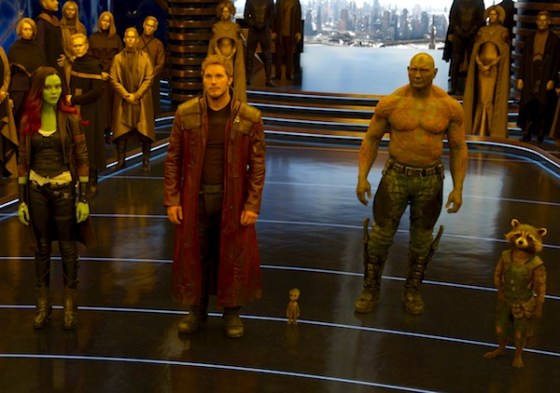
Part of the problem lies in splitting our heroes up into two groups with two stories. It may have been inspired by The Empire Strikes Back (or that may just have been a parallel some critics have spotted, I’m not sure), and it’s not a fundamentally flawed structural choice, but here it doesn’t really work. Part of the problem is that the gang works best when sparking off each other. Heck, the film even goes to pains to set up a joshing rivalry between Peter and Rocket, then splits them up! Story-wise, the issue is twofold: the A plot is a slow one that spins its wheels because it has too little story-fuel to drive the whole movie; but the B plot feels grafted on to give half the cast something to do, as well as provide a little action and humour while the other plot is tackling the emotional heft.
That said, uncommonly for a modern blockbuster, it’s the emotional side the film gets most right. While the plot dawdles, the action is adequate, and the comedy is hit and miss (more the former than the latter, to be fair, but there’s a definite case of “throw everything and see what sticks”), there are several characters who get strong, believable, rounded emotional arcs. The obvious one is Peter finding out about his parentage, but my favourite was where the film goes with Nebula and the relationship with her adopted sister, Gamora. There’s also a comparatively meaty subplot for Yondu, meaning it’s mostly the supporting characters who fare best with the material rather than the heroes — aside from Peter and (to a lesser extent) Gamora, the primary function of Drax, Rocket, and Baby Groot is to be humour generators. They are funny, though.

In the director’s chair, Gunn continues to dole out even more of what people praised about the first movie. You liked the retro-cool soundtrack? OK, how about a new track every time there’s a lull in the action! The use of the music feels sloppy, often just plonked there to cover a gap, with no discernible thematic relevance. It’s doubling down on something people latched onto the first time, but it feels slapdash. The one instance that almost works is Fleetwood Mac’s The Chain, which has a setup and a pay-off, but they’re not quite properly connected.
Also overdone is the slow motion walking. Remember that shot in the first film of the Guardians walking into battle in slow-mo looking badass, that was then humorously undercut when they started, like, yawning and stuff? James Gunn does, and he liked it so much that he uses it again several times here. Apart from he seems to have forgotten the second part of the scene that made it funny rather than cheesy. Cool people walking in slow motion seems to be one of those cinematic devices that doesn’t really date, especially when used sparingly, so I could let it go once, but here it reaches the point of “oh my God, another slow-mo walking shot?!”
This indulgence in everything people liked before extends right to the very end of the movie — literally. The end credits are a lively affair in and of themselves, but they’re further interrupted by a total of five additional scenes. Five. They’re mostly inconsequential (don’t go expecting any hints towards Infinity War), but they’re worth sticking around for because a couple are quite amusing.

Guardians of the Galaxy Vol. 2 is an uneven film, which manages to be entertaining as a whole thanks to its likeable and funny characters — even if the best gags have all been played in the trailers (and some of them played better in trailers, too), it’s trying so hard (so, so hard) to be a good time that much of it works. It’s strongest at the beginning and the end, which almost makes you overlook that it gets a bit thumb-twiddly in the middle, with one plot more of a short story than a movie and the other feeling a little like a waste of time. However, the surprising focus on and awareness of the characters’ psychological lives makes up for that somewhat — oddly, Marvel’s most comedy-driven and alien-starring movie may also feature their most effective understanding and representation of characters’ emotions.
But don’t worry, there are still jokes about poo and penises.

Guardians of the Galaxy Vol. 2 is in cinemas pretty much everywhere now. Except Japan. Sorry, Japan.
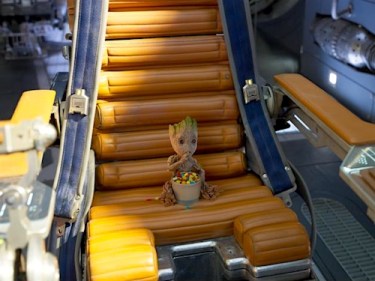


 Marvel Studios takes its boldest step yet, moving away from the present-day superhero milieu of its previous movies to a galaxy far, far away for a space opera epic. Its success, both critically and commercially, has cemented the Marvel Cinematic Universe as an infallible force in the current movie world. But, really, how good is it?
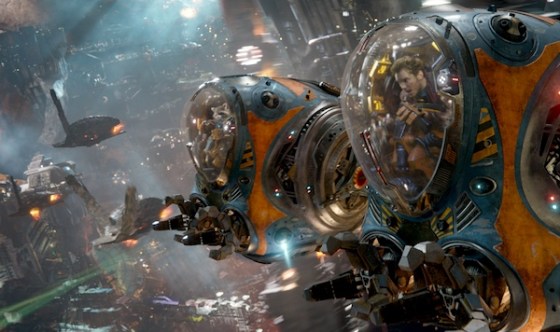
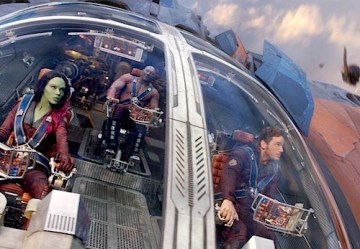
 The worst offender is the pod chase through Knowhere, a several-minutes-long sequence that registers as little more than a blur. There’s a shocking lack of clarity to its images, even by today’s standards. Maybe it’s better in 3D, when I guess the backgrounds would sink into the distance and important elements would be foregrounded; but in 2D, you can’t see what’s meant to be going on for all the fast-moving colour and split-second cuts. Almost as bad, though for different reasons, is the climax. It takes up an overlong chunk of the movie and at times feels repetitive of too many other Marvel climaxes — oh look, a giant spaceship crashing into a city! If anything, the film gets ‘worse’ as it goes on. Perhaps not in a very literal sense, but as the blustering action climax takes over, it moves further away from the stuff that makes it unique and interesting.
 It isn’t even called Nova City, but I don’t have the foggiest what it is called because the film didn’t make me feel I should be learning it. Some more effort making sure we knew why that place mattered, even if it was just a clearer depiction of all the planning for its defence, might have sold the entire climax better.
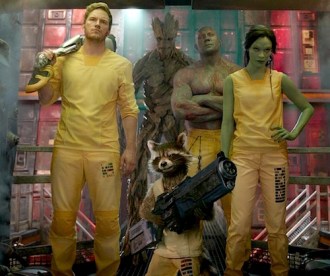 especially the overlong climax. Joss Whedon commented of his own Avengers film (as I quoted in
  If
If 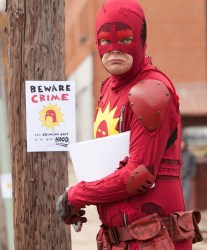 which moves fairly swiftly into the fantasy of being a successful superhero, Super stays quite grounded. The ending allows itself to be a little more triumphantly heroic, but not far beyond the bounds of realism (unlike Kick-Ass).
 really, they are deciding something is right and something else is wrong”. The psychology of superheroes has been a factor to one degree or another for decades now, not least the Batman films making the parallel between the hero and his villains, but the difference in Super is it’s not a parallel — it’s primarily the heroes who are messed up. The villains are criminals and quite nasty at times, but they’re mostly quite normal. They may deserve their comeuppance, but wisely — and interestingly — they’re not over-written or over-played to heighten them to the level of the psycho-hero. The Crimson Bolt is a sledgehammer to crack a nut, even more so than Batman in
 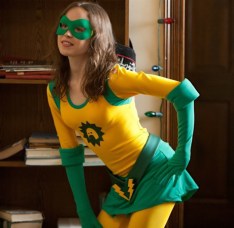 Super is about a troubled human being and his relationship with faith, morality and what he perceives as his calling… I think that is part of why we gave him Ellen Page as a sidekick — because her character, Boltie, actually is insane. The Crimson Bolt is not doing what he does because he enjoys hurting people but Boltie is and that is the difference between the two of them. It starts to become a concern when you enjoy the violence.”
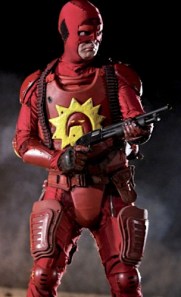 For all its grounded reality, Super lets loose in the final fifteen minutes, creating a punch-packing sequence that’s the rival of any comic book movie. It’s emotionally-charged action, all the more powerful for its semi-amateur-ness and realistic brutality. It climaxes in a face-to-face between our hero and the villain which is as good as any you’ll find in such a film. Is it revelling in the extremity of its violence? You might argue it is, but I don’t think it’s celebrating its gore so much as the triumph of its hero. And that’s followed by a neat epilogue, which I won’t reveal details of but is a kind of ending I’ve been wanting to see for a while.
 a decade-old track by Sweden’s 2007 Eurovision entry (they came 18th of 24. Don’t laugh — we were joint 22nd). And, despite the low budget, there’s great special effects. The tentacles are the rival of any big-budget movie; the blood and guts are all gruesomely realistic, not filmicly censored or reduced or cheaply fake; handdrawn-style Batman “kapow”s (etc) are very effective. The title sequence, in a similar style as the latter, but with a dance routine, is also a ton of fun.
 “I think that so many movies today try to be everything to all people and I’m a little sick of it. Super is not for everyone. It is for some people.” And for the people it’s for, I think it’s exceptional. If you were to compile a list of the greatest superhero movies, I believe Super’s unique style and perspective — plus its excellent climax — would earn itself a place right near the top.
 100Films.co.uk