
I have a backlog of 432 unreviewed feature films from my 2018 to 2021 viewing. This is where I give those films their day, five at a time, selected by a random number generator.
Today: singing vicars, grumpy gamers, very nice Kazakhs, and deleted actors.
This week’s Archive 5 are…
Going My Way
(1944)
Leo McCarey | 126 mins | digital (HD) | 1.33:1 | USA / English | U
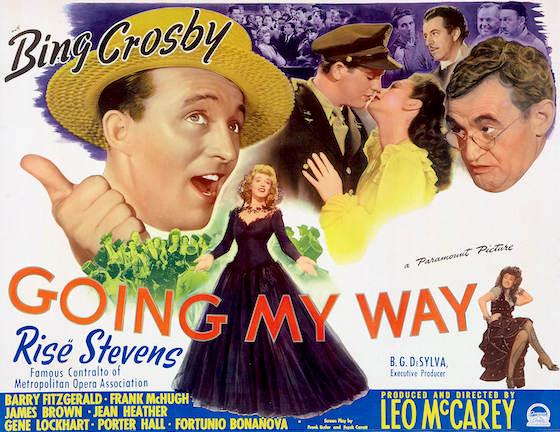
The Oscars, eh? Every year film fans pay them a load of attention, and every year we seem to be disappointed with the outcome. But this isn’t some new phenomenon: Going My Way hails from the 1940s, but is perhaps the definitive example of a film that managed to sweep the Oscars (it won seven awards from ten nominations) against a bunch of films that have endured to much greater acclaim (films it competed against included Double Indemnity, Laura, Lifeboat, Gaslight, and Meet Me in St. Louis. I think we can agree those are all better-remembered on the whole).
None of which is to say it’s a bad film. It’s a gently-paced series of vignettes, almost like a collection of short stories, springing from young priest Father O’Malley (Bing Crosby) arriving to take charge of a struggling New York City parish. His modern ways clash with the old-fashioned values of the incumbent Father Fitzgibbon (Barry Fitzgerald), but his worldly knowledge allows him to connect with some of the parish’s disaffected inhabitants. Despite the religious setting, it doesn’t lean too heavily on the wonders of Christianity (you know I’d be the first to rip into it if it did). Overall, it’s perfectly pleasant; an easy afternoon’s viewing.
Incidentally (and here’s a good bit of trivia that might come in handy for a quiz someday), it was the first Oscar Best Picture winner to have a sequel: The Bells of St. Mary’s, released the very next year… and also the very next review in this roundup…

Going My Way was #93 in my 100 Films in a Year Challenge 2021.
The Bells of St. Mary’s
(1945)
Leo McCary | 126 mins | TV (SD) | 4:3 | USA / English | U
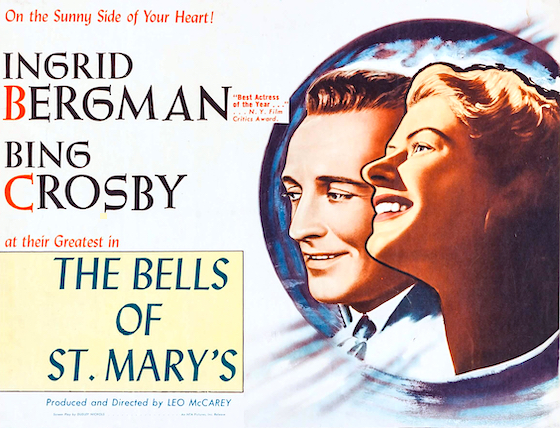
This followup to Going My Way was not only the first sequel to an Oscar Best Picture winner, but was also the first sequel to be nominated for the Best Picture Oscar.
Bing Crosby returns as Father O’Malley, sent to a new locale, ready to solve another series of subplots at a struggling religious institution, this time butting heads (sort of — it’s never as dramatic as that makes it sound) with Ingrid Bergman’s head nun. Like the first one, it’s really a bundle of subplots for Bing to ‘solve’. The low-stakes problems and amiable tone between the two leads, even when they’re disagreeing, makes for a gentle and relaxing kind of film. I’d give it the edge over its Oscar-winning predecessor, thanks primarily to Bergman’s performance, but neither film is likely to set anyone’s world alight.
As well as their Oscar success, the films were the highest grossing at the US box office for 1945 and ’46, respectively, another first for a film ‘series’. And yet, with six decades distance, they’re little more than also-rans; nicely obscure trivia answers to “films that won/were nominated for Best Picture”. Maybe there’s a lesson in that for anyone obsessed with the current cultural zeitgeist.
The Bells of St. Mary’s was #187 in my 100 Films in a Year Challenge 2021.
Zero Charisma
(2013)
Katie Graham & Andrew Matthews | 88 mins | digital (HD) | 16:9 | USA / English

I’d nickname this Portrait of a Manbaby on Fire. The manbaby in question is Scott (Sam Eidson), a stereotypical alpha-nerd: he has a neckbeard; he wears black T-shirts that feature elaborate depictions of grim reapers and the like; he lives with his grandma; he paints miniature fantasy figurines; he’s the Game Master of a role-playing group, which he rules with an iron fist. But when into-geeky-stuff hipster Miles (Garrett Graham) joins the group and everyone really likes him, Scott finds his position threatened, and he’s not happy about it.
As much as geek/nerd culture has transitioned into the mainstream over the past couple of decades, there’s still stuff that remains the preserve of the hardcore; the truly nerdy. That culture clash is part of what Zero Charisma is about, of course, with Scott’s true old-fashioned kind of nerdishness clashing with Miles’s new-school cool. But it’s also a character study of the former. Scott may seem a stereotype — like The Simpsons’ Comic Book Guy rendered in live-action — but I’d wager anyone who’s moved in nerdish circles has known someone at least a bit like him. Stereotypes are stereotypes for a reason. The film exposes and examines those to often amusing effect. Some have said it exaggerates these things, but I don’t think it’s particularly guilty of that. Maybe it generalises them, and lumps all the worst characteristics of the extremely nerdy together into one character, but that doesn’t make it inaccurate, just broad.
My only real problem was the ending. There’s a scene where everything comes to a head — a climax, if you will — but, in the wake of that, I felt it lacked adequate resolution. Has Scott learnt anything from this experience? Is he a changed man? Maybe a little, but not completely. To be fair, that’s a realistic character arc, because whose personality changes overnight after a single revelation? And yet it also doesn’t feel like the filmmakers quite know how they want to leave things. If they’d been going for a “change takes time and is incremental, but Scott’s started on that road” kinda message, I would have approved. Instead, the film tries to have its cake and eat it by showing Scott as better on the surface, but then secretly GMing a game where he still behaves like an asshole. Maybe it’s trying to say we can never truly change, however much our flaws are highlighted to us, which would be a pretty glum way to end an otherwise likeable comedy.
Zero Charisma was #109 in my 100 Films in a Year Challenge 2020.
Borat
(2006)
aka Borat: Cultural Learnings of America for Make Benefit Glorious Nation of Kazakhstan
Larry Charles | 84 mins | digital (HD) | 16:9 | USA & UK / English | 15 / R
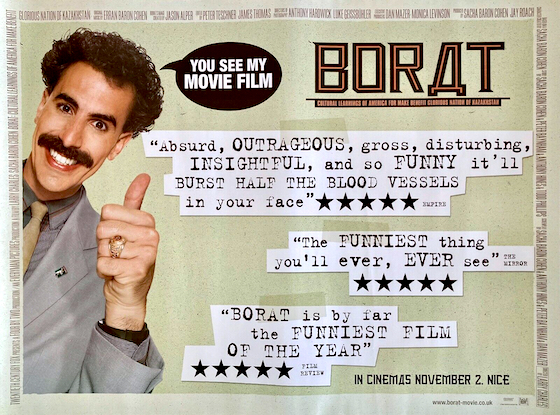
Ali G’s Sacha Baron Cohen adopts the persona of a Kazakh journalist to ostensibly interview Americans about their culture, but, unbeknownst to them, he’s of course really looking to expose their ludicrous views (you just know that, ten years later, a lot of these people voted for Trump) and take the piss out of them for our entertainment.
As with most sketch-based comedy, the end result is a mixed bag. Sometimes it’s very funny; other times, it’s just being gross for the sake of it, like in a naked fight between Borat and his portly producer. A few bits don’t quite land — sometimes you can feel Baron Cohen’s not getting the response he wanted out of his target — and, even though he’s taking the piss out of people who deserve it, it sometimes gets a bit uncomfortable (though that might just be my English reserve/politeness kicking in and making me cringe). Most of the sketches are quite short, which is nice — they generally don’t outstay their welcome, and, if one isn’t working, you can be assured another will be along shortly.
Borat was #220 in my 100 Films in a Year Challenge 2020.
The Thin Red Line
(1998)
Terrence Malick | 171 mins | Blu-ray | 2.35:1 | USA / English | 15 / R

An extensive cast of famous actors and recognisable faces star as a battalion of soldiers who spend 2 hours and 51 minutes taking one (1) hill in Terrence Malick’s very Terrence-Malick-y World War 2 movie. I mean, this is a movie about a battle in which the first shots aren’t fired until past the 45 minute mark, but there are plenty of shots showing the minutiae of nature. And there’s a lot of discussion about how there isn’t enough water.
None of which is necessarily a problem — indeed, there are plenty of people who think this is a great movie, and I’m glad for them. But for everyone who loves it, there’s someone who’d call it “pretentious and self-indulgent, despite gun battles and lush cinematography.” I find myself somewhat stuck in the middle. I mean, if you were expecting a normal combat movie from Terrence Malick, more fool you. And it’s unquestionably beautifully shot — so many gorgeous visuals, but also effective camerawork and editing to convey, say, the chaos of battle. But I also found it to be bitty and episodic. Well, calling them “episodes” might be kind — they’re scenes; sometimes less than scenes; just moments, or even shots. It’s like a really long deleted scenes package pretending to be a movie.
Of course, the behind-the-scenes stories sort of support that reading. The first cut clocked in at five hours. It took two editors and thirteen months of post-production to get it to a manageable size. Hans Zimmer composed over four hours of music, but only for a few bits of his work made it into the final cut. Billy Bob Thornton recorded narration for the entire film; the released cut has eight different narrators, but none of Thornton’s work is in there. Many actors thought they had significant roles, but found their performances reduced to little more than cameos. Most famously, Adrien Brody thought he was playing the lead role, only to discover at the premiere that he’s in just a couple of shots, and doesn’t even speak until over halfway through (and then it’s just a brief voiceover). And then there are the actors whose work was left on the cutting room floor: Bill Pullman, Gary Oldman, Lukas Haas, Viggo Mortensen, Martin Sheen, Jason Patric, Mickey Rourke… This movie has more great actors whose performances were deleted entirely than most movies have in their entire cast!
All of which suggests a movie that should be universally recognised as a disaster. That it isn’t — quite the opposite — is testament to something. Maybe someday I’ll rewatch it and find out what.
The Thin Red Line was #77 in my 100 Films in a Year Challenge 2020. It was viewed as an additional film for Blindspot 2020 after I failed to watch it for WDYMYHS 2019.


 Score:



 Murder on the Orient Express is arguably Agatha Christie’s most famous novel, perhaps because of its widely-known twist ending, or perhaps because it’s inspired in part by a high-profile true story, or perhaps because of this multi-Oscar-nominated all-star adaptation.
 100Films.co.uk