High and Low (1963)

aka Tengoku to jigoku

Akira Kurosawa | 144 mins | Blu-ray | 2.35:1 | Japan / Japanese | 12
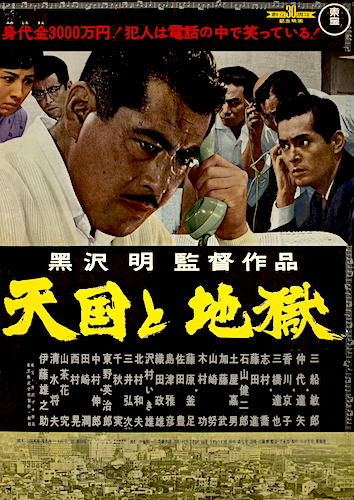
High and Low

Akira Kurosawa has a good many classic films to his name, but, according to users of both IMDb and Letterboxd, this is the second best of them all — and, on the latter’s list, the 12th greatest film ever made, to boot. No pressure.

Adapted from the American crime novel King’s Ransom by Ed McBain, the film stars Toshiro Mifune as a business executive who we first meet being wooed to join a potential coup of the company. (The film rattles through a few twists early on to set up its initial dilemma, which I’m now going to spoil, so if you want to go in completely cold, jump to the next paragraph.) In fact, Mifune is plotting his own takeover, paid for by leveraging everything he has. But then, his young son is abducted, with the kidnappers demanding a huge ransom — if he pays, his carefully-laid plans will be impossible to execute; but it’s his son! But then, it turns out it isn’t his son — the crooks took the wrong boy, instead kidnapping the son of Mifune’s lowly chauffeur. But they don’t know that, and there’s no way in hell the poor chauffeur could pay a ransom. What’s a man to do?

Some might power a whole film on that storyline and dilemma, but it’s only the beginning of High and Low. Its original Japanese title (天国と地獄) literally translates as Heaven and Hell, and, as both monikers indicate, this is a film of two halves; of opposing forces; of extreme choices. Without wishing to spoil any more of what goes down, I’ll say that almost the first hour of the film takes place almost entirely in a single room. It feels like the whole thing might unfurl there, a la Hitchcock’s Rope — almost a formal exercise in telling a story from a single setting. But then it moves to an immediately more dynamic locale — a train — for a properly thrilling sequence, around which the story and structure pivots. The rest of the film goes ultra-procedural. A lengthy scene early in this half depicts a police debriefing in a manner that feels almost documentarian, as if we’re witnessing a genuine meeting filmed and presented in real-time, as various detective duos update senior officers and their colleagues on the specific aspect of the case they’ve been working.

Hanging on the telephone

This eye for detail, presented with a degree of mundanity, makes the film feel extra realistic. That extends to the final details. No spoilers, but, although you may call this a Thriller due to the type of story being told, it doesn’t climax with a big twist or revelation; no reveal of some super-clever grand plan that, with implausible foresight, anticipated and accounted for everything that’s happened. Rather, the film seems to proceed methodically and logically through every thread of investigation and consequence for its primary characters, until it simply has no more left to tell.

It’s certainly a fine piece of work — although, on first watch, I’d say I’ve seen several better examples of the genre and several better films by Kurosawa. But that isn’t truly a criticism of the film, rather of its high placing on the lists mentioned at the start. Awareness of such accolades has a tendency to overshadow any first viewing of a film that warrants them (just witness how many people are underwhelmed by Citizen Kane), so I look forward to returning to High and Low sometime under less pressure.

5 out of 5

High and Low is the 30th film in my 100 Films in a Year Challenge 2022. It was viewed as part of Blindspot 2022. It placed 6th on my list of The Best Films I Saw in 2022.

That’s the Second Biggest Monthly Review of April 2022 I’ve Ever Seen!

If you’re unfamiliar with the work of the once-formidable computer game developer LucasArts, you might think the title of this month’s review is setting up an almost-but-not-quite record-breaking affair. Not so, dear reader.

As those au fait with the aforementioned studio’s venerable output are doubtless already aware, this month’s title is, rather, referencing a running gag from the Monkey Island games. That was prompted by the recent announcement that 2022 will see the release of a sixth game in the series. The Monkey Island games have been a big part of my life, ever since I played the original on our family’s first PC when I was about six years old, so I’m thrilled that we’re getting another. I’ve already begun replaying the preceding games in anticipation.

None of which has anything to do with films, of course (except for the trivia that Steven Spielberg and ILM did nearly make a Monkey Island film once), other than that it’s taken away some of my film-viewing time. Consequently, the following has occurred…


This month’s viewing towards my yearly challenge

#26 Death on the Nile (2022) — New Film #4
#27 Munich: The Edge of War (2021) — Wildcard #1
#28 Encanto (2021) — Series Progression #2
#29 The Father (2020) — Rewatch #4
#30 High and Low (1963) — Blindspot #4


  • I watched 11 feature films I’d never seen before in April.
  • Just four of them counted towards my 100 Films in a Year Challenge, along with one rewatch.
  • That means I’ve fallen behind schedule for the first time this year — I should’ve reached #33 to be on track to hit #100 in December at a steady pace.
  • I’m not too worried, though. This month, for example, I watched seven films that didn’t count towards the challenge, so there’s plenty of leeway to watch more challenge-compliant films in the future.
  • Nonetheless, I deployed my first ‘wildcard’ in April, counting Munich: The Edge of War as a second 2022-released film watched this month. It’s a nice category to be able to use a wildcard in… but now that I’ve done it once, I can’t do it again. Them’s the rules.
  • In case you weren’t sure, the series Encanto progresses is the Disney Animated Canon (or Animated Classics, or whatever else you want to call it — the official name has varied over time). It’s not the ‘next’ entry I need to see in that series, but that’s okay, because it’s one of the few I’m making my way through in any old order.
  • This month’s Blindspot film saw the great Akira Kurosawa in a Hitchcockian mode for kidnap thriller cum social drama High and Low.
  • This month’s WDYMYHS film didn’t happen in the end, leaving me with one to catchup — next month, hopefully.
  • From last month’s “failures” I watched Death on the Nile and Fast & Furious 9.


The 83rd Monthly Arbitrary Awards

Favourite Film of the Month
Aside from the films listed above, my viewing this month included such acclaimed and/or popular recent releases as Spider-Man: No Way Home and Best Picture Oscar winner CODA. But, while they were good isn their own ways, probably the best film I saw was a classic: Akira Kurosawa’s High and Low.

Least Favourite Film of the Month
Nothing truly terrible this month, but Fast & Furious 9 finally burst that franchise’s bubble, for me. Those films have been ridiculous but fun for about half the series’ run now, but I thought F9 tipped the balance too far — it was more ridiculous than ever, but it was no longer fun.

Most Unfortunate Casting That Didn’t Happen of the Month
Withnail & I is one of those films I’ve been meaning to watch forever but never quite cared enough to make the effort to get round to, until this month. Then, entirely by coincidence, I later happened to see on Twitter this bit of trivia: apparently, early in the development of Sherlock, creator(s) Steven Moffat and/or Mark Gatiss mentioned to Paul McGann that they were considering casting him as Watson with Richard E. Grant as Holmes. Now, obviously they’re Withnail & I personas wouldn’t be right for those roles, but they’re both much more versatile actors than that. As great as I think Benedict Cumberbatch and Martin Freeman were, a film/series with Richard E. Grant as Sherlock Holmes and Paul McGann as Dr Watson is something I now feel we’ve been robbed of.

Most Pointless Extra-Textual Question of the Month
When the trailer for Death in the Nile came out, one line from it went semi-viral: “we have enough champagne to fill the Nile!” Of course, the character is being metaphorical: no one thinks they actually have that much champagne; she just means they have a lot. But, as I said, the line went viral, and therefor you can find multiple articles that tried to answer the question, how much champagne would it take to fill the Nile? The answer? It’s complicated. And, really, for such a fundamentally pointless question (no one’s going to try to do it for real), does any answer closer than that matter?

The Audience Award for Most-Viewed New Post of the Month
Just three posts compete for this honour, once again (hopefully May will be when I finally get back on top of that), and the winner is the one with actual reviews to read: 2022 Weeks 9–11.


Every review posted this month, including new titles and the Archive 5


I’m going to try to get both my challenge viewing and my general reviewing back on track. We’ll see how that goes…