

One to take her…
one to love her…
and one to kill her.
Original Title: C’era una volta il West

Country: Italy, USA, Spain & Mexico
Language: English and/or Italian
Runtime: 166 minutes (international) | 145 minutes (US theatrical) | 175 minutes (Italy)
BBFC: A (cut, 1969) | 15 (1989) | 12 (2011)
MPAA: PG (1969) | PG-13 (2003)
Original Release: 21st December 1968 (Italy)
UK Release: 14th August 1969
First Seen: DVD, c.2003
Stars
Claudia Cardinale (8½, Fitzcarraldo)
Henry Fonda (My Darling Clementine, 12 Angry Men)
Jason Robards (Hour of the Gun, Tora! Tora! Tora!)
Charles Bronson (The Magnificent Seven, Death Wish)
Director
Sergio Leone (A Fistful of Dollars, Once Upon a Time in America)
Screenwriters
Sergio Donati (Face to Face, A Fistful of Dynamite)
Sergio Leone (The Good, the Bad and the Ugly, A Fistful of Dynamite)
Story by
Dario Argento (Deep Red, Suspiria)
Bernardo Bertolucci (The Conformist, The Last Emperor)
Sergio Leone (The Last Days of Pompeii, For a Few Dollars More)
The Story
The mysterious Harmonica arrives in the town of Flagstone, out for revenge against Frank. Frank, working for a railroad baron, is busy murdering Brett McBain for his land and blaming the crime on the bandit Cheyenne. Cheyenne teams up with Harmonica to help McBain’s newly-arrived widow, and therefore owner of his land, Jill. Jill finds herself caught in the crossfire between the three men pursuing their own interests…
Our Heroes
Jill McBain, a former prostitute who’s still subject to the will and whims of men. Harmonica, a formidable gunslinger known only by the instrument he plays. Even Cheyenne, a bandit leader, is a good buy when they’re all arranged against…
Our Villain
Frank, the meanest sonuvabitch in the West. What did he do to Harmonica in the past? What will he do to Jill to get his way? Nothing good…
Best Supporting Character
Crippled railroad tycoon Morton only wants to intimidate the McBains to relinquish their land, which I guess makes him a nice guy when compared to his murderous handyman, Frank, who he clearly can’t control.
Memorable Quote
Harmonica: “Did you bring a horse for me?”
Snaky: “Well, looks like we’re… looks like we’re shy one horse.”
Harmonica: “You brought two too many.”
Memorable Scene
In one of the most iconic opening sequences in cinema history, three gunmen arrive at a train station and… wait for a train. For ten minutes. Ten real-time minutes, accompanied only by sounds like a squeaky windmill, a dripping water tower, and distant bird cries. Then the train arrives… and then the train leaves… and then a harmonica plays. And the action… threatens to start. Ah, Leone.
Memorable Music
It’s a Sergio Leone film, of course there’s an Ennio Morricone score — and it’s one of his best. It was composed before shooting began so Leone could play it on set, so it fits like a glove. The best bits include the striking leitmotifs: a haunting one for Jill, with wordless vocals by Edda Dell’Orso, and a dramatic one for Harmonica, threatening guitar combined with a melody played on a… well, you know.
Technical Wizardry
The entire picture looks fantastic thanks to the work of cinematographer Tonino Delli Colli. It displays all the framing and composition Leone is famous for, but also evokes an oppressive hot, sweaty feeling, and the light and texture of the image have pure cinematic quality. They don’t make ’em like this anymore.
Letting the Side Down
Leone’s original plan was for the three gunmen in the opening scene to be cameos for the stars of The Good, the Bad and the Ugly — Clint Eastwood, Lee Van Cleef and Eli Wallach — but Eastwood (who’d already turned down the role of Harmonica) was unavailable. Shame.
Next time…
Considered by some to be the first part of a thematic “Once Upon a Time” trilogy, which continues with A Fistful of Dynamite (released in some regions as Once Upon a Time… the Revolution) and Once Upon a Time in America.
What the Critics Said
“The world of a Leone Western is just as enchanted as it was in the films the director saw as a child, but the values have become confused. Heroes as well as villains are apt to be motivated by greed and revenge, and the environments in which they operate are desolate and godless, though very beautiful. The Leone Westerns are twice removed from reality, being based on myths that were originally conceived in Hollywood studios in the nineteen-thirties. […] Once Upon the Time in the West thus is a movie either for the undiscriminating patron or for the buff. If you fall somewhere in between those categories, you had better stay home” — Vincent Canby, The New York Times (Just so we’re clear, I think this is a terrible review.)
 Score:
 98%
98%What the Public Say
“The clue’s in the title: Once Upon a Time in the West is a fairy story, a mythologised version of the American West, peopled with immediately recognisable archetypes. It’s also a commentary on the Western genre itself, and a celebration in the form of a kind of “greatest hits”, full of references to other films and filmmakers: John Ford, George Stevens, Anthony Mann, Shane, The Searchers, High Noon, and so on. […] So the game isn’t originality, but Everything More Iconic Than Everyone Else. Westerns – even great Westerns – would follow, directed by the likes of Sam Peckinpah, Walter Hill, and Eastwood himself, but [this] still feels like the genre’s final word.” — Owen Williams

America didn’t ‘get’ Once Upon a Time in the West when it first came out (hence the retrospectively laughable reviews, like the one above). The French did, though: it played for literally years in Paris cinemas, even inspiring fashion trends (the long duster coats). I confess, my initial reaction was a little more akin to the Americans’ — OUaTitW can be quite a slow film, and the plot is deceptively obscured until quite late on. But it certainly rewards repeat viewings, because it’s a film of rich content and, perhaps even more importantly, supreme style and technical achievement. The French were right (but don’t tell them that).

#68 will be… completed while you shop.
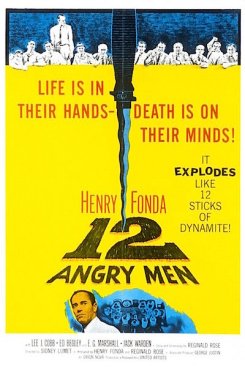 Twelve people sit around in two rooms and talk for an hour and a half in more or less real time — sounds like a recipe for dull pretension, and yet 12 Angry Men is anything but. In fact, it’s probably one of the most gripping thrillers ever made.
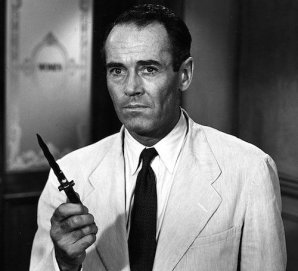 Slowly, steadily, surely, Fonda’s juror leads a recap of the evidence, analysing it, picking it apart, challenging presumptions and suppositions. Gradually, other jury members begin to be won over. This could be trite — of course our hero has to start convincing the others — but this is where the writing and cast shine again, because even men who seemed unswayable have their minds changed in a plausible fashion. Even then, the outcome rarely seems certain, each victory hard won, so that the film holds you rapt, desperate for sense and reason to prevail. There are moments of tension which may literally push you to the edge of your seat; moments of exultant success which may elicit an exclamation of approval similar to a point scored in a sports match.
 For all that 12 Angry Men seems to show justice being served in the face of adversity, what it actually shows is justice being served thanks to blind luck: if Juror Eight had been a weaker-willed man, or another who was just as prejudiced as his eleven compatriots, then the debate would never have occurred, the teenager condemned to death in the blink of an eye. What are the odds on every jury room containing a Henry Fonda? I don’t fancy them myself.
 100Films.co.uk