
Guillermo del Toro | 123 mins | Blu-ray | 1.85:1 | USA / English, American Sign Language & Russian | 15 / R

 2018 Academy Awards
13 nominations — 4 wins
Nominated: Best Actress (Sally Hawkins), Best Supporting Actor (Richard Jenkins), Best Supporting Actress (Octavia Spencer), Best Original Screenplay, Best Cinematography, Best Editing, Best Costume Design, Best Sound Mixing, Best Sound Editing.
I still can’t quite believe a creature-feature fantasy romance won Best Picture. It remains surreal to see a genre movie conquer the Oscars like that. Even The Lord of the Rings, for all its so-Fantasy-it-defined-the-genre-ness, has a lot of the “historical war epic” in its form (not to mention the genre-transcending cultural impact that film trilogy had), and so its win seems less striking than this out-and-out monster movie. Naturally, The Shape of Water doesn’t actually conform to the commonly-understood connotations of what a “monster movie” is, and therein lies what makes it something fresh, and therefore Best Picture material.
In fact, even “Fantasy” isn’t quite the right term for The Shape of Water — “fairy tale” is nearer the mark. It begins with voiceover narration talking about a princess as the camera glides underwater into a room where everything is afloat, including a sleeping woman… until everything gradually settles to the floor, an alarm goes off, and she wakes up — and now it’s just a real room. Except, even then, it’s not really real — it’s storybook-real; movie-real. Almost literally, in the sense that her apartment is above an old-fashioned movie palace. It’s a gorgeously designed set, but it doesn’t feel like somewhere someone would actually live — but it’s only just out of kilter, which is part of why it’s so fantastic. In case you missed it up top, the film also won an Oscar for production design, and that was certainly deserved.

Anyway, the woman in question is Elisa (Sally Hawkins), whose reality could hardly be more distant from that of a fairytale princess: she’s working nights as a cleaner at a government facility, wiping up the splattered piss of “clever men”. She’s also mute, communicating via sign language to her friends, coworker Zelda (Octavia Spencer) and down-on-his-luck neighbour Giles (Richard Jenkins). Things change when a mysterious new project arrives at the facility. Well, it’s no surprise to say that turns out to be a… kind of… merman… human/fish… being… It’s accompanied by head of security Strickland (Michael Shannon), who hates its guts and desires nothing more than to inflict pain, and scientist Dr. Hoffstetler (Michael Stuhlbarg), who is more sympathetic, for his own reasons. But it’s Elisa who, almost accidentally, comes to bond and communicate with the creature, in secret; but as their connection grows, she realises something must be done about its predicament.
I’ve read some reviews that berate Shape of Water for its straightforward storyline — I’ve described a fair chunk of the plot just getting to that point of conflict, and you can probably infer much of the rest. But I think such criticisms miss the point. For one thing, it is not fiction’s only goal to shock us with plot twists. There’s more to storytelling than just surprises, and Shape of Water certainly has more to it. For another, it is quite clearly a fairy tale — albeit an adult-minded one — and those go more-or-less one way. And even then, the events that I thought would form the film’s climax happen at the halfway point, so this viewer was at least somewhat surprised.

So what is there instead? Characters, for one. We don’t get too much backstory on any of them — which is interesting, because apparently del Toro wrote lengthy summaries for the main characters, some running to 40 pages, which were provided to the actors to read and use if they wanted. Whether they embraced them or not, they are all well-judged performances. Hawkins, Spencer, and Jenkins got the nomination nods, but it would’ve been equally at home in the hands of Shannon or Stuhlbarg. And that’s not to mention Doug Jones, who conveys the creature’s emotions with physicality and movement alone — aided by superb prosthetic and CGI technicians, of course. But while the film’s primary focus is on the interspecies love tale he features in, each supporting character has their own subplot to help sketch their personality, and provide meaning and resonance to the main story.
That’s where theme comes into it — intricately linked to the characters, because this is all about outsiders and otherness. The fish-man is the most obvious “other”, with Elisa positioned second (as alluded to earlier, she seems to only have two or three friends and acquaintances she can actually communicate with); but there’s also Zelda, a black woman, and Giles, a gay man — and this is ’60s America, making those statuses even ‘lower’. Plus there’s Dr. Hoffstetler, but that would be a spoiler. Suffice to say, his unique predicament is given a more nuanced portrayal than you’d normally find in American media. All of this exists in counterpoint to Strickland, who’s basically the physical embodiment of toxic masculinity. For a film set in the ’60s, with a lot of Cold War overtones — and in a Fantasy environment, with a supernatural romance at its core — The Shape of Water certainly has a lot of timely relevance.

But, while you can hold it up as a mirror to the here and now, it also has a timelessness — like all the great fairy tales, of course. It transcends its ’60s setting and its 2010s production to really be about values of humanity — of acceptance —that are always pertinent. By tucking these messages into a fantasy that is most assuredly aimed at adults (it practically contains a laundry list of “things not suitable for children”), del Toro has given depth and meaning to an outlandish movie that, yeah, fundamentally, as the jokes all go, is about a woman fucking a fish.

The Shape of Water is available on Sky Cinema from today.
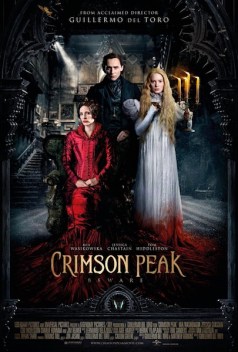 Mia Wasikowska stars opposite a British thesp best known for playing a comic book villain and a red-headed repeat-Oscar-nominee, in a Gothic drama-thriller from an acclaimed non-Anglo director? That’s a description of
  The story actually concerns Edith Cushing (Wasikowska), a well-to-do businessman’s daughter in upstate New York who is occasionally haunted by ghosts. She falls for visiting English gent Sir Thomas Sharpe (Hiddleston) and, long story short, moves with him and his haughty sister Lucille (Chastain) back to their crumbling — literally — pile in the English countryside. The house hides many secrets, and ghosts, too. Having said it’s not a horror movie, it would be unfair to class Crimson Peak as simply a tame drama — as you’d expect from writer-director Guillermo del Toro, those ghosts can be bleedin’ scary, and there are certainly a smattering of good old fashioned jumps to boot.
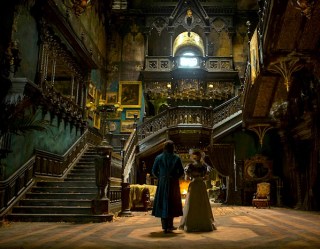 Whatever one’s thoughts on the story and tone of the film, it can’t be denied that its technical merits are extraordinary. Every inch of the design work is gloriously imagined, and the cinematography — the lighting in particular — is spectacular. And that gigantic house set…! And the climactic ‘limbo’ set, too — incredible work. (That’s not a spoiler, incidentally: it was the set’s nickname, not its literal location.) The ghost effects are excellent too — original, creepy, and executed in a way that blurs the lines between make-up, animatronics, and CGI. It’s a shame the film as a whole wasn’t better received, because I imagine that’s all that held it back from numerous awards-season nods.
 The names writers choose for their characters can sometimes tell you a lot about a movie. Pacific Rim is the kind of film that has characters called Raleigh Becket, Stacker Pentecost, and Hannibal Chau.
 — it was the 3D that added depth and height, and without that (or, as I said, an adjustment of focus to compensate) it’s all a bit… not flat, but not big either. That aside, it is beautifully shot, with excellent lighting.
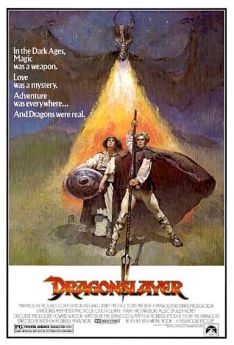 Back when he was still directing
 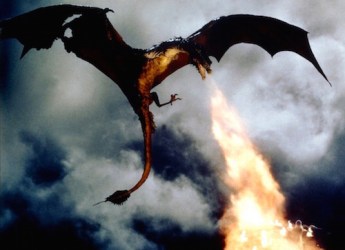 Vermithrax Pejorative is a long time coming, however, wisely kept off screen by director Matthew Robbins. It’s not that the monster shouldn’t be revealed, just that, like
 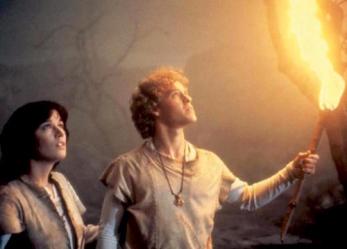 and giant monster than character development. Similarly, an interesting subplot about the move from The Old Ways of magic and superstition to The New Ways of Christianity feels like a good idea that hasn’t been fully integrated, made up of little more than a couple of passing nods and a negatively-inclined inclusion in the coda.
 100Films.co.uk