
Last month, I said this month would hopefully feature Stranger Things 3, Veronica Mars season 4, and The Boys season 1. It doesn’t. Not any of them. But I’m not short of other things to write about…

Years and Years
 The writer most popularly known for reviving Doctor Who, Russell T Davies, returns to science fiction for the first time in almost a decade with this acclaimed miniseries. This is a very different kind of sci-fi, though — no space invaders or malicious AI or mad scientists here. No, this story begins in 2019 as we know it and then moves across the next 15 years to explore just where we’re headed, in a realistic and grounded way. It focuses on a normal family from Manchester — four siblings, their grandmother, and assorted spouses and children — and how the changes in society and technology affect them. It’s a story of the ordinary people; the folks who don’t shape history, history happens around and to them.
Cannily, it dodges the Brexit bullet — there are implications it went ahead, but it doesn’t have any bearing on the story: these big changes are happening everywhere anyway, whether Britain leaves the EU or not. What it is aware of is how much society and technology are now intertwined. In the first episode, a teenager comes out to her parents as trans — not trans gender, but transhuman. She wants to ditch the limitations of flesh and live forever as data. Some people will scoff at that, but the way it’s presented and plays out over the next five episodes is highly plausible. RTD tackles a whole host of societal issues in a similar way — immigration, the gig economy, nationalism, etc — all mixed together in a way that reflects real life. After all, we’re never just dealing with or worried about one thing at a time, especially nowadays.
As someone who grew up in the ’90s and ’00s, learning about the Cold War as an historical event, I sometimes wondered how people lived their day-to-day lives with the constant threat of nuclear annihilation. Except that’s not what it was actually like, was it? It may’ve been there, in the background, ebbing and spiking depending on the political factors of the day, but people just got on with their everyday lives while that played out on the news. It’s the same nowadays, isn’t it? There’s so much crap going on in the world, and most of it we just see on the news — unless it happens to butt into our own lives for whatever reason. And Years and Years is that same thing, but projected into future events; and not fantastical things, like a mission to Mars or an AI breakthrough, but a very plausible extrapolation of where we’re headed.
Personally, I thought it was a work of borderline genius. RTD has always had a way with characters — of quickly shading in believable individuals, their families and lives; of writing scenes that sing with dialogue and interactions that seem plucked straight from real life — and here that’s married with an imaginative vision of the near future, the two working in harmony to create a drama that’s also a warning about what we’re getting ourselves into… although it’s also an admonishment, showing us what we’ve got ourselves into and wondering if it’s too late to stop it. But there’s a dash of hope in there, too; just a sliver of “maybe it’ll be mostly OK in the end.” Fingers crossed.
Peaky Blinders Series 4
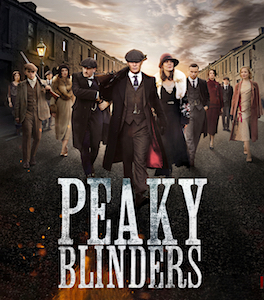 Birmingham’s premier gangsters return with a storyline that forces them to reckon with their past actions. So it’s unfortunate that this is a show that can’t be doing with recaps at the start of episodes. I spent most of the first instalment trying to remember the events of previous series and how they’d led to where things were, which is an unwelcome distraction that could be easily solved with a simple “previously on” at the opening. I don’t know why Netflix hate them so much (well, I do — it’s the assumption you’ll just binge-watch everything, and if you don’t then they want you to feel you have to; and we’re all just buying into what we’re told to do, which is half the problem (funnily enough, that’s a lot of what Years & Years was all about…)
Anyway, once things get up and running, and you can get your head around what’s going on enough to be going on with, this is another thrilling story of ’20s criminality. Adrien Brody pops in as a series-long guest star, a Mafia enforcer from New York who has a vendetta against the Blinders because they killed his dad, and now he’s brought his American muscle to wipe them out. With bigger forces out to gobble them up, the Blinders must rely once again on a mix of their wits and straightforward firepower. The show itself is the same, blending together tricksy plotting (Tommy Shelby may always have a plan, but we’re not always privy to it until after the fact) and impressively staged action scenes (there’s an extended shoot-out at the start of episode five that must’ve eaten up a lot of the budget; and if it didn’t, they’ve done a good job making it look like it did). In fact, the series as a whole looks stunning — style drips off the screen, whether it be the slow-mo hero walks or the pulsating rock soundtrack.
For my money, the plot was a little smaller-scale than previous seasons, despite involving ever-bigger outside forces, which made it feel almost like an extended movie rather than a dense season of television. But don’t take that criticism too much to heart — previous seasons may’ve been even better in my personal estimation, but this is still top-drawer drama.
Unforgotten Series 3
 Where the other shows reviewed this month are big, brassy productions told on a mythic scale, Unforgotten is almost the opposite, and yet it tackles themes no less grand. But it’s a quiet, understated drama, as London detectives Nicola Walker and Sanjeev Bhaskar (along with their team) investigate a cold-case murder, in the process having to tackle the fallout that time has wrought on the victims left behind.
This time, the skeleton of a teenage girl is found under a motorway, and it turns out to be a girl who disappeared on December 31st, 1999, and was a huge story at the time, which naturally leaves our little team under intense media scrutiny. (It’s somewhat amusing seeing this ITV-produced show get to use real ITV News presenters and graphics while the hero characters are slagging off the attitudes and methods of the media.) Unforgotten has the usual murder mystery array of suspects for us to theorise about, but what it also does well is portray the terrible sadness of such crimes. Reveals in the final episode push the storyline in a slightly different direction which allow it to pull focus in a different direction, too, although I’m not sure it really has the time or space to dig into that aspect.
Like Peaky Blinders, I don’t think this was the very best series of the programme (series two was harder hitting and even more emotionally complex), but it’s still more or less on form. It wears its heart on its sleeve, trying to treat these victims and suspects not just as pawns in an elaborate guessing game, but as real people whose lives have been torn apart. That makes it one of the better cop shows on TV, I think.
Things to Catch Up On
 This month, I have mostly been missing Wu Assassins on Netflix, starring Iko “The Raid” Uwais. The trailers look perhaps a bit cheesy, but also promise regular doses of Uwais’ incredible combat skills, so that’ll do me. Elsewhere, Preacher has embarked on its fourth and final season. Considering I’ve not seen most of season two and none of season three, that’s a bigger catchup project. And talking of stuff I’ve not seen, I never got round to Mindhunter season one, even though David Fincher directed some of it, and now there’s a second season, which he’s also partly directed. Considering it’s been five years since his last movie, I do kinda need that Fincher fix…
Next month… take your pick for what I’ll’ve watched and what I’ll’ve missed out of Peaky Blinders season 5 (starts tonight), Dad’s Army: The Lost Episodes (starts tonight), Sanditon (starts tonight), The Great British Bake Off (starts on Tuesday), Carnival Row (out on Friday), and The Dark Crystal: Age of Resistance (out on Friday). Bear in mind: I’ve only just finished one season of Peaky Blinders, and I didn’t much like The Dark Crystal. (Why do I feel like that means it’ll be the only one of these I end up actually watching…)
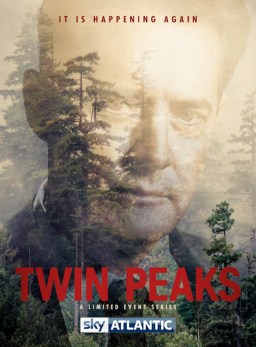 When the return of Twin Peaks was announced with the tagline “it is happening again”, I think everyone assumed it was, at worst, just an echo of one of the series’ famous lines which happened to work well for a revival; or, at best, an indicator to the plot — that the strange, sometimes otherworldly events of the original series were about to reoccur. As it’s turned out, perhaps what the tagline is most applicable to is the series’ effect: 27 years ago, Twin Peaks pushed new boundaries for what could be done on television, and the medium as a whole spent a couple of decades catching up. Now, rather than merely return to what he did all those years ago, as most revivals do, co-writer/director David Lynch is once again pushing at the boundaries of what’s possible or acceptable on mainstream(-ish) television. If “it” is “David Lynch being way beyond everybody else”, then it is indeed happening again. If you were after a comforting pile of references, callbacks, reflections, and imitations of the original series, you’re going to be disappointed — as one or two critics have been. If you were after something new in the weird world of Twin Peaks, well, step on up.
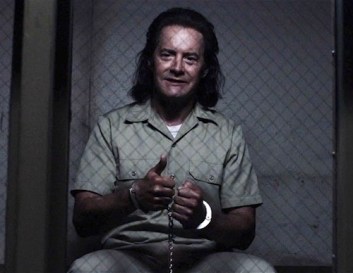 It’s also been widely reported that Lynch and co-creator Mark Frost wrote a single 400- or 500-page screenplay, shot it all, then chopped it up into 18 episodes in the edit. This I can very much believe. Individual episodes are almost shapeless as hours of television, and plot threads disappear for several episodes at a time, only to crop back up as if we’d never been away. While many series these days boast they are “actually an X-hour movie”, they still often function as individual episodes — they may not be completely standalone, but the shape of each hour, the way they’re paced and build to a cliffhanger, and so on, is episodic. Twin Peaks, however, feels like it means it — no doubt the legacy of Lynch’s production methodology.
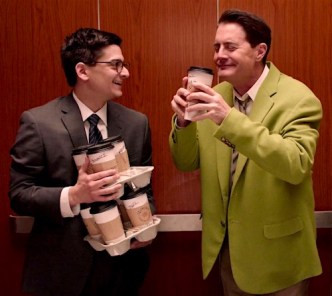 Some five-and-a-half hours into this 18-hour movie, Dougie hands his boss a stack of files. The boss slowly looks through them one by one, baffled by the seemingly senseless doodles Dougie has scrawled all over the pages. But after a while he begins to see a pattern, and comes to understand something. In the end he thanks Dougie. Dougie, as ever, looks blank, before doing a failed imitation of being a normal human being. Is Lynch deliberately setting out to say that he is Dougie and we are Dougie’s boss? That all of us are taking a long, slow look at Lynch’s indecipherable doodlings until we eventually discern some meaning. Or is it just a scene in Lynch’s world that we can coincidentally project that interpretation on to? As ever with David Lynch, I’m not quite sure.
 Well, I suppose it was too much to hope it would last. The most consistently great season of Doctor Who in over half a decade threw it all away with a frustratingly variable trilogy of stories (note: not a three-parter — this pedantic old-school Who fan insists we observe the difference). It all began with Extremis, which starts strong with a decent mystery (there’s a book in the Vatican library that causes anyone who reads it to commit suicide) and some good humour (Bill’s interrupted date), but increasingly becomes a lot of running around to delay the reveal. It’s a non-story pretending to be a story, basically. I don’t even care that it basically has an “and it was all a dream” ending. In fact, writer Steven Moffat found a way to make “and it was all a dream” work, which is a rare and miraculous thing. But the episode that leads to that ending doesn’t do enough heavy lifting to support it. A waste.
 In a remote small logging town where everybody knows everybody else, a teenage girl, who’s secretly into drugs and partying and is the daughter of a prominent local man, goes missing under mysterious circumstances in the creepy woods, which have a history of possibly-supernatural strangeness… Yes, this is the Australian answer to Twin Peaks — a comparison I have perhaps unfairly amped up with that description. It’s more about Anna Macy (
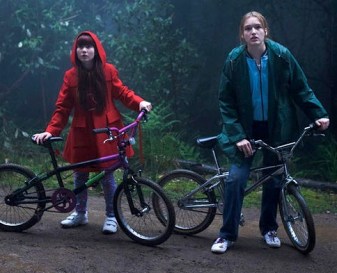 Personally, I want to know what the hell is meant to be going on, but the finale felt a lot like weak sci-fi to me and I’m not sure the answers will be worth it. I have that same hot/cold feel about the series as a whole: whenever it’s actually in front of my eyes I become engrossed, invested, and enamoured; but within hours of it finishing I feel a kind of indifference creep in. I can’t really explain why. It’s probably not a fair reaction.
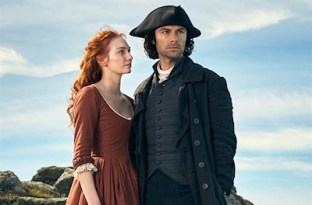 This month, I have mostly been missing the start of the third series of Poldark. Well, I’ve not even watched series two yet. I also
  The controversial Steven Moffat era of nuWho is headed towards its end, but before his final full series next year there’s this penultimate Christmas special. There have been 12 of them now and they’re always divisive: some people think they’re too Christmassy, some that they’re not Christmassy enough; some like that they’re standalone adventures suited to a broader audience, but other times they’re not standalone enough… Each year presents a different mix of these elements, pleasing some and alienating others.
 “Proper Bake Off” came to an end with what felt a little like a joyous celebration of the series’ unique charms, as well as its highs and lows. Considering the two festive episodes were shot before the controversial move to Channel 4 took place, that’s almost impressive. It’s hard to imagine GBBO without the alchemical mix of Mel, Sue, Paul and Mary, and these episodes showed the format on fine form. And then the BBC went and snuck in that
  The problem with Christmas specials of on-going shows is you’re sometimes left with on-going plots that must be acknowledged, and Grantchester has a particularly major one with its hero’s life-long love leaving her husband while pregnant. If you don’t watch, it’s set in the ’50s, so this kind of behaviour is the greatest scandal known to man. The special leaps into this without even the by-your-leave of a “previously on”, so I pity any non-regular viewers made to sit down in front of it on Christmas Eve. But it’s an immensely popular show with big ratings, apparently, so who can blame ITV for wanting it in their always-underpowered Christmas schedule? I imagine it fared better than Maigret did the next night…
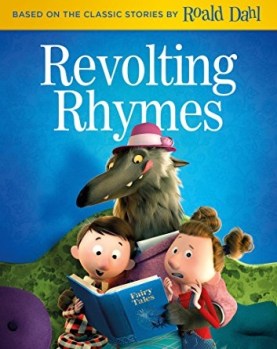 The team behind previous Christmas specials
  I thought And Then There Were None was one of the highlights of last year’s Christmas schedule, turning Agatha Christie’s most popular novel into a dark, slasher-movie-esque thriller, the first English-language adaptation to remain faithful to the original’s glum ending. I don’t know if this year’s Christie is faithful to her original short story, but it isn’t to the play adaptation (at least as I know it from
 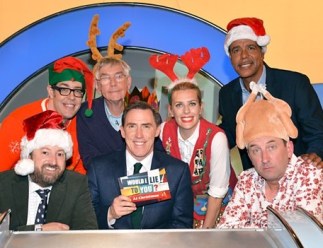 There’s always a lot of special episodes of comedy shows on over Christmas, with varying degrees of success. I thought this year’s Live at the Apollo was woeful, with Romesh Ranganathan the only truly bright spot in 45 minutes of flat observations and unfunny daftness. Conversely, Would I Lie To You? proved to be as good value as it always is, thanks to the quick wit of the regulars plus Tom Courtenay’s affected (I presume) dodderiness. Mock the Week’s clip show format was perhaps improved by the fact I didn’t watch the most recent series, while the imperfect Insert Name Here makes a nonetheless welcome return. In the comedy gameshow sub-genre, Alan Carr’s 12 Stars of Christmas was the kind of trash I’d never watch at any other time of year yet stuck with for all five hours and kind of enjoyed (helped by watching on catch-up and fast-forwarding the really repetitious bits), while the David Walliams-fronted Blankety Blank revival provided as much charm as the format ever has. And normally it wouldn’t count as comedy, but this year’s run of Celebrity Mastermind began with CBBC puppet Hacker T. Dog as a contestant. At least he didn’t win.
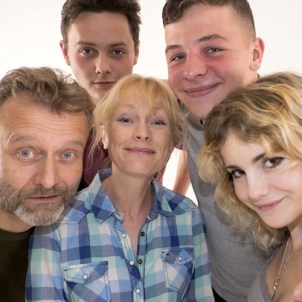 My list of Christmas TV to get round to remains pretty extensive. There are all those regular series that insert a seasonal episode — The Grand Tour (that’d be the episode with Richard Hammond’s ice cream comments that you might’ve heard about), Paul O’Grady: For the Love of Dogs, Yonderland (not that I’ve watched any of the latest series), QI, Inside No.9 (which I’ve never watched before, but the special sounds good)… And there are series coming back for one-offs too, like Outnumbered and Jonathan Creek (which I loved during its original run but have been surprisingly lax about watching in the last few years). I’ve also not yet caught a couple of this year’s animated adaptations, Michael Rosen’s We’re Going on a Bear Hunt and Raymond Briggs’ Ethel & Ernest (which I figure will count as a film). Documentaries like Lego’s Big Christmas and West Side Stories also sit on my list, likely to get forgotten. There’s Sky1’s big Christmas Day drama, The Last Dragonslayer (which I wager I’ll also count as a film); Eric Idle’s comedy musical science thing, The Entire Universe; and Charlie Brooker’s 2016 Wipe, which apparently manages to make 2016 funny (I’ll believe it when I see it). Finally, I always save Channel 4’s The Big Fat Quiz of the Year for either New Year’s Eve or New Year’s Day, because that just seems more appropriate.
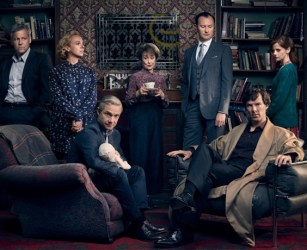 Things are beginning to wind down now… but as far as TV schedulers are concerned “Christmas” lasts until at least January 1st, so there are a couple of big hitters left. The biggest of all is a new, potentially final, run of Sherlock. No idea what the quality will be like, but expect lots of handwringing on social media and huge ratings either way. On New Year’s Eve there’s stage adaptation Peter Pan Goes Wrong, which I’ve heard such good stuff about it’s probably going to be a disappointment, and a Winnie-the-Pooh documentary that I’m going to watch even though it’s presented by Alan Titchmarsh. Next week (which you could argue is still part of Christmas if you have very forgiving holiday leave) sees lots of police shows kicking off, if that’s your thing: Death in Paradise, Endeavour, Midsomer Murders, No Offence, Silent Witness, Unforgotten… even Brooklyn Nine-Nine. And in the sphere of movies on TV, tonight you can choose between the network premiere of
  100Films.co.uk