

Country: USA
Language: English
Runtime: 81 minutes
BBFC: 15
MPAA: R

Original Release: 4th April 2003 (USA)
UK Release: 18th April 2003
First Seen: cinema, 2003
Stars
Colin Farrell (The Recruit, Total Recall)
Kiefer Sutherland (Flatliners, Dark City)
Forest Whitaker (Ghost Dog: The Way of the Samurai, The Last King of Scotland)
Radha Mitchell (Pitch Black, Silent Hill)
Katie Holmes (Wonder Boys, Batman Begins)
Director
Joel Schumacher (The Lost Boys, Batman & Robin)
Screenwriter
Larry Cohen (Maniac Cop, Cellular)
The Story
Slick, smarmy Stu uses the last remaining phone booth in New York City to call the young woman he’s trying to cheat on his wife with. Then the phone rings: there’s a sniper rifle trained on him, and if Stu doesn’t follow the caller’s instructions, he’ll die.
Our Hero
Stuart “Stu” Shepard, a slimy publicist who’s trying to cheat on his wife, strings along a kid with hopes of getting in the game, wears Italian clothes to make himself look better than he is, and is generally a dick to everyone. So not a very nice guy, really… but does he deserve to be shot by a sniper, hm?
Our Villain
A mysterious voice on the other end of the phone, The Caller has some kind of moral code, has demands of Stu to fit that code, and also has a high-powered sniper rifle that he’s not afraid to use on just about anybody. Surprisingly witty, too.
Best Supporting Character
Captain Ramey, the cop in charge of the situation once the police get involved, who is at least bright enough to realise there’s more going on than meets the eye.
Memorable Quote
(After cocking his gun) “Now doesn’t that just torque your jaws? I love that. You know like in the movies just as the good guy is about to kill the bad guy, he cocks his gun. Now why didn’t he have it cocked? Because that sound is scary. It’s cool, isn’t it?” — The Caller
Memorable Scene
With both his wife and mistress on the scene, and surrounded by police and news cameras, Stu finally makes his confession. A heartfelt monologue that is definitely a showpiece for Farrell.
Making of
The whole film was shot in just 12 days: ten days inside the phone booth and two to shoot the surroundings. To do this the crew worked “French hours”, which involves not shutting down the entire production for lunch (which just sounds logical to me), and was aided further by Farrell nailing some big scenes in one take.
Awards
1 MTV Movie Awards Mexico nomination (Best Colin Farrell in a Movie — see also: Daredevil)
What the Critics Said
“The triumph of director Joel Schumacher and screenwriter Larry Cohen in Phone Booth is not just that they pull off the central gimmick but also that they fashion from it a creditable thriller. The result is a movie that combines a seriousness of purpose with a delight in craft in a way Hitchcock would have appreciated.” — Mick LaSalle, San Francisco Chronicle
 Score:
 71%
71%What the Public Say
“It’s the kind of pulpy potboiler that is often wrecked by unnecessary padding, but the brisk no-nonsense approach here combines with its short length to make quite an entertaining off-beat thriller. Kiefer Sutherland’s vengeful psychopath who is only represented by a voice-over and a red dot for the majority of the film is the stand-out performance, but everyone involved acquits themselves admirably.” — Gary Anthony Cross, Film Noird

Regular readers will know of my fondness for the single-location thriller, and this is one of the films that helped define that love. And events occur in real-time, which is just a bonus. Colin Farrell and Kiefer Sutherland are both on excellent form as the hostage who maybe has it coming and the hostage taker who maybe has a point. Larry Cohen’s screenplay takes a simple setup and follows it through, keeping it engrossing but still relatively plausible (something other such films struggle with in order to extend their concept), with some killer dialogue to boot. It all adds up to an immensely effective thriller.

Next time… yo-ho, yo-ho, a pirate’s life for #70.
 When it comes to hitman movies, I’d’ve said there’s
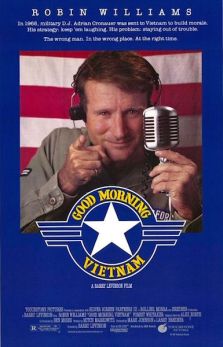 Inspired by the true story of a US Army DJ in Vietnam during the war, the resulting film is a showcase for star Robin Williams — reportedly, his antics aren’t even close to what really happened.
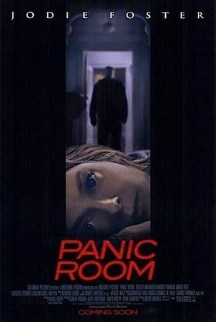 Panic Room stands out as (arguably) Fincher’s most atypical film. Whereas his others are all epic, in one way or another, this is the exact opposite. It’s very contained, virtually the entire running time spent on one night in one house, alleviated only by brief outside bookends and a guided tour of the house at the start. Fortunately, it’s still an outstanding little thriller.
 all the way squeezing the camera through banisters, coffee pots, and other assorted obstacles. There are several such shots, the majority early on (though not exclusively — witness the Hitchcockian transparent floor, for instance). This is presumably to help enliven the relatively slow build-up; later, the story’s inherent tension largely takes over.
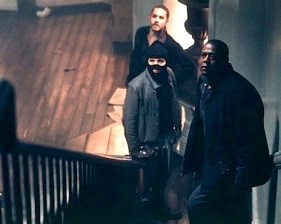 perfectly well staged and suitably tense or exciting as required, but Foster’s slow-mo dash for her mobile, and back into the panic room as the three burglars come pounding up the stairs, is one of those sequences that transcends the film it’s in to become a stand-out example of the form. Any skilled action director could have produced a good sequence at full-speed from that setup, but by switching to slow-motion Fincher stretches out the tension like an elastic band ready to snap, putting us on the edge of our collective seat as we urge Foster on through air that seems as thick as treacle.
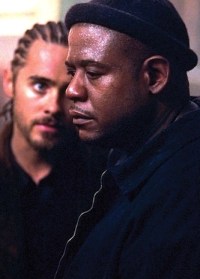 One other particularly interesting element is how we feel about Forest Whitaker’s character. This isn’t
 100Films.co.uk