
Peter Jackson | 95 mins | TV (HD) | 1.85:1 | UK & New Zealand / English | 15

Commissioned by 14-18 NOW (the UK’s arts programme for the First World War centenary) and the Imperial War Museum to see what he could do to make their old World War One footage more engaging for a modern audience, director Peter “Lord of the Rings” Jackson’s initial tests at restoring the footage were so successful that the project was eventually worked up into this feature-length documentary. It tells the story of the Western Front from the point of view of ordinary Tommies living and fighting on the frontline, using only footage from the period (plus photos, posters, artwork, maps, and so on) and narration taken from interviews with men who were really there — no historians to provide context or analysis here.
This presents two distinct things to consider when looking at the film: not only its success as a documentary, but also the methods Jackson and co have undertaken to produce it. In terms of the latter, what Jackson and his computer wizards have done goes far beyond the normal realms of “restoration”. For starters, the original footage has been cleaned up (removing scratches and dirt, stabilising the image, etc) — so far, so normal. But that original footage was shot on hand-cranked cameras, giving it a frame rate of anywhere from 10 to 18fps (sometimes varying within one piece of film). So, computers have created additional frames to bring all the footage up to a standard, smoother 24fps. Then the footage has been painstakingly colourised, and also converted into 3D (if you see it at a 3D cinema screening, anyway. Maybe there’ll be a Blu-ray). The goal of all this is to make it seem more immediate and real; to try to connect modern viewers to these men in a more direct fashion, without the distancing effect of watching juddery, indistinct black & white film.
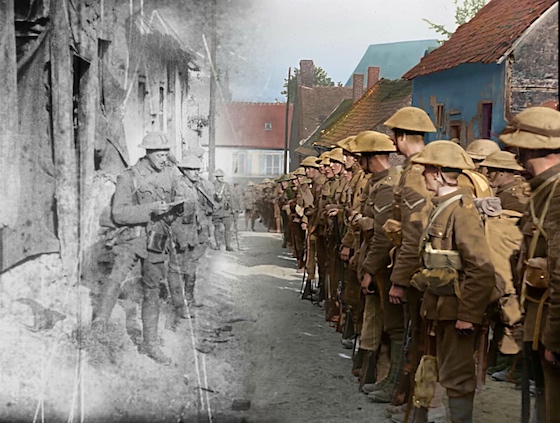
Calling the work Jackson and co did to old footage “restoration” has been controversial in some circles, because it goes beyond mere “restoration” and into the realm of revisionism, like the colourisation of old movies that came to prominence in the ’80s and was widely criticised (though it still occasionally rears its head today — try buying a Blu-ray of It’s a Wonderful Life without both black & white and colour copies of the film). Jackson has a different and specific aim with his work here, however. He’s not saying this is a better way to view old film footage fullstop, but rather is looking for a way to bring these past events to life for a modern viewer; to try to erase the past 100 years and put us in their shoes, to make us see how much these people, though separated by so much time, were really very similar to us. The effectiveness of the end result in achieving this goal — of bringing that long-gone war vividly to life — is undeniable.
Indeed, anecdotally, a lot of people do find the addition of colour to be revelatory — after the film’s screening on BBC Two last night, I saw many tweets talking about the “extraordinary”, “breathtaking”, “jaw dropping”, “spine tingling”, “astounding” moment when colour faded in. Personally, however, it rarely seemed like more than a special-effects veneer painted over the original footage. Well, that’s exactly what it is, in fact. It’s not necessarily a criticism, either — it may be for the best, even, because this isn’t a kind of ‘restoration’ we want to see applied across the board to old films. Either way, I do agree that it added a new perspective to see the war presented in this way; but the idea that it’s a perfect, genuinely lifelike ‘restoration’ didn’t quite wash with me. In fact, I thought one of the film’s most striking, identifiable moments came early on, before it had made the transition to colour: as the narrators talk about how young they were when they signed up, we’re shown closeups of soldiers’ faces, and you can really see how young they were — many of them literally just boys. I think it’s pretty common knowledge that, although the age to sign up was 19, lads as young as 14 lied to get in, but seeing it so clearly is another matter.
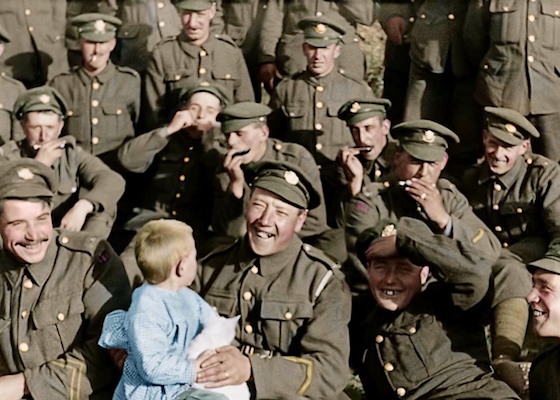
Moments like that prove that They Shall Not Grow Old’s success as a documentary doesn’t just lie with its “restored” footage. The film’s worth lies as much in the way the story is told — the voiceover narration taken from genuine soldiers’ testimonies, recorded by the BBC and IWM in the ’60s and ’70s; the editing of certain sequences — as it does in the “modernising” of old footage. The added colour and clarity do bring some bits to life and make them feel closer to today, as per Jackson’s stated goal, but a lot of the time the smeary, blurry quality of the colourisation makes it feel as much like a painting come to life as it does real footage. Nonetheless, the truthfulness of what we’re being told burns through that, and it’s the combination of visuals and audio that aids our understanding of what life was like for those men in that place at that time.
It’s quite a dense film too, packed with information, constantly surging forward with the images, an imagined soundtrack to match them, and almost non-stop narration. At times it becomes like a tone collage, where you almost absorb it more than process it, getting an impression of life on the front more than specific experiences. In this interview, Jackson says the film uses about 120 narrators, edited together to sound almost like they’re telling one story — the “common story” of the experience of a soldier on the Western Front, with extreme or uncommon anecdotes having been edited out. It means a lot of the war isn’t touched on (other fronts, other experiences, like the Navy or Air Force), but there were budgetary reasons for that as much as anything (they originally offered Jackson enough money for a film about 30 minutes long).

While those other stories are undoubtedly worth telling too, I think it was wise of Jackson to retain a degree of focus here. Rather than attempt to cram a wide-ranging account of a complex conflict into the brief running time of a single film, he’s instead painted a picture of what it was like to be an ordinary Tommy in the trenches of Europe. This is not the story of commanders and generals, of presidents and kings, but of ordinary blokes on the ground — the people most of us would’ve been, had we lived 100 years ago — and Jackson’s methods help make that story as real and relatable as it’s ever been.

They Shall Not Grow Old is available on iPlayer until Sunday 18th November. A documentary about the making of the film airs on BBC Four tonight at 7:30pm.
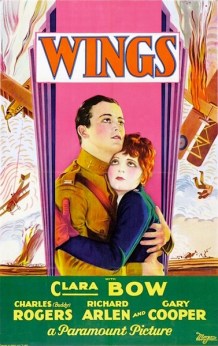 Students of the Oscars well know that, technically speaking, there wasn’t a single “Best Picture” award at the inaugural Academy Awards ceremony in 1929. Instead, there were two awards that covered that ground, seen (at the time) as being of equal significance. One was for “Unique and Artistic Production” — which I’d argue is more or less what most people think Best Picture represents today. That was given to F.W. Murnau’s
  he learnt to fly just for the film), and, mid-flight, had to film their own close-ups by switching on battery-operated cameras mounted in front of them. You wouldn’t know it from watching the film itself, though: even today, the action sequences carry a palpable air of excitement, aided (perhaps even created) by the knowledge that it was all done for real — including the crashes.
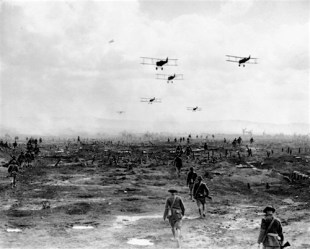 bomb-pockmarked battlefield. Those bomb craters were, in fact, genuine: the military spent a few days before filming using the location for target practice. The climactic battle that occurred on this site was filmed with up to 19 cameras at once, including some mounted on four towers, the highest of which reached 100ft. I know this is a review, not a catalogue of production numbers, but it’s quite incredible.
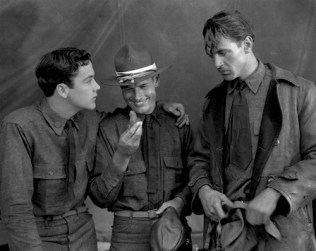 How much these factors affect the film’s quality seems to be very much a personal matter. Wings set the stall for many a Best Picture winner to follow by being not that well regarded by critics; indeed, more time and praise is given to its top-award compatriot, Sunrise. For the most part, I found the personal dramas passable enough, with a few outstanding scenes — David’s farewell to his stoical parents; Cooper’s scene; the bubbles (at first). However, the combat sequences, and in particular the aerial photography, are stunning; so impressive as to easily offset whatever doubts the other elements may engender.
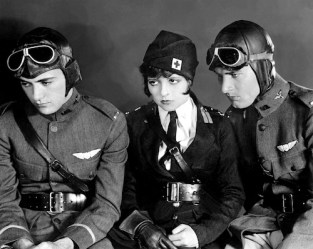 But I digress. Wings is a film that deserves to be remembered as more than a mere footnote. It’s not just a trivia answer to “what was the first Best Picture?”, but a worthy winner of that prize; a movie that, almost 90 years after it was produced, still has the power to elicit excitement and awe. Wellman’s picture may not have been deemed unique or artistic, even though it’s definitely the former and possibly the latter, but it was deemed outstanding, and it’s definitely that.
 Arguably the most famous clash of the First World War, the Battle of the Somme lasted four-and-a-half months from July to November 1916 and, with over a million men wounded or killed, is “
 The British press certainly believed they were seeing “the real thing at last” (the Manchester Guardian), feeling it showed “war, grim, red war; the real thing” (the Daily Sketch). The British public agreed, flocking to see the movie en masse: twenty million admissions were sold in the first six weeks of release. At the time, the battle still raged (the film debuted on 10th August 1916) — as Smithers notes, “to its original audience, the film was not history but a despatch from the front”. It is such an historical document now, but at the time it wasn’t even recent-history — it was produced as newsreel, a record of current events, designed to make people at home feel connected to the everyday lives of their family, friends and countrymen serving on the frontline.
 Equally striking is the scale of the operation. You know it was a monumental effort, but actually seeing so many men… You never see that scope in dramas because they don’t have the budget for all those extras, I guess, but here the crowds of soldiers just waiting around are remarkably large. And crikey, the heavy artillery! Even though you know these were real weapons, today they look more like some fantastical steampunk creation, so covered are they in rivets, and so damn huge.
 Speaking of the music, the Imperial War Museum DVD release offers up a choice of two scores: a newly-commissioned (in 2008) one by film composer Laura Rossi, and a recreation of the kind of music that would have accompanied the film in 1916. The film’s producer and distributor, William F. Jury, was also the editor of trade paper The Bioscope, and had columnist J Morton Hutcheson draw up a list of suitable pieces to be performed alongside screenings, which was published days before the film’s release. To quote Dr Toby Haggith (the Imperial War Museum’s film programmer), again in the DVD booklet
 Haggith summarises many of Hutcheson’s choices as “motivated wholly by the needs of propaganda… jaunty, martial and unashamedly heroic. Given the nature of the scenes recorded and the bloody history of this phase of the battle, the selection of such upbeat music seems deeply inappropriate.” However, other selections “reflect Hutcheson’s personal response to scenes that he found distressing on a universal level, and which led him to warn musicians that ‘they must realise the seriousness and awfulness of the scenes’… These contradictions suggest that Hutcheson had difficulty selecting music for the film because he was torn by the contrasting images and messages it conveyed. In this way the medley highlights the tension at the heart of the film.” Musician Stephen Horne, who leads the 1916 medley recreation, agrees that the film is torn “between a sense of propagandist duty and a desire to honour the reality that had not evaded the camera’s gaze.” It’s true that, however positive the final movie wants to be, it can’t completely escape reality. At one point it cuts abruptly from a jauntily-scored scene of men happily receiving post to “German dead on the field of battle”. A deliberate juxtaposition of happiness with the fate that awaits them with near inevitability? Seems a bit radical for a propaganda piece…
 But it can’t avoid drawing parallels: the film ends almost as it began, with artillery being moved up for the next assault and men marching to the front, waving merrily as they go. History repeats — probably not the lesson a propaganda film wants to impart, but one it can’t quite escape. And one that, even a hundred years later, we can’t quite learn.
 “The paths of glory lead but to the grave,” wrote Thomas Gray, and Stanley Kubrick — adapting from the novel by Humphrey Cobb — sets about proving him right.
 100Films.co.uk