Where the Sidewalk Ends (1950)

2009 #70
Otto Preminger | 91 mins | TV | 12
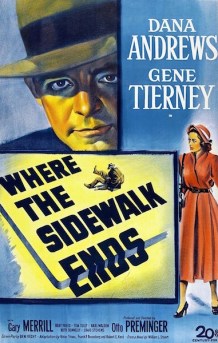
Where the Sidewalk EndsOtto Preminger’s film noir — scripted by Ben Hecht, adapted from William L. Stuart’s novel by Robert E. Kent, Frank P. Rosenberg and Victor Trivas, and quite what the difference between “adapting” and “writing” are I’m not sure — offers complex characters in a multi-layered plot. The ending particularly underlines this: the filmmakers could’ve killed anti-hero Dixon, could’ve had him choose to not open the letter, etc; but the decision he takes and the reactions of others are all relatively complex. Earlier, the sequences following Paine’s death are well constructed to produce the maximum amount of tension; their plotting clever, allowing for multiple (albeit similar) interpretations of events. Things happen which seem irrelevant, but are of course none-more-relevant later. Few films today are so brave as to not explain such things immediately.

There are lots of great scenes like these — look at the single scene featuring Klein and his wife, for example. It doesn’t have to be there — Klein could’ve just given his partner the cash — but for the sake of one short scene we get two proper characters. Yes, they’re quickly and sketchily drawn, but believable with it. The same goes for the old woman listening to the radio — does it matter that her husband’s dead, that she sits there for company, which she only gets because Paine always waves to her? Not particularly — but that it is there really adds to the film. Even the crooks get similar treatment, tiny elements (such as one character’s parole) progressing and returning, almost insignificant subplots that all have a place and function in the greater story.

Dana Andrews is an effective lead, believable as Dixon the thuggish cop. We support him, but only just — he doesn’t quite have the instant likeability of Bogie’s Marlowe, for example, but he’s enough on the side of right that we can get behind him. Gary Merrill’s Scalise is an appropriate villain. He’s not in it much — a little at the beginning, a little at the end — but he permeates the film to a degree, the uncatchable boss just out of reach, who Dixon wants to pin everything on.

All the other performances are good too, but perhaps most memorable is Karl Malden as newly-promoted Lt. Thomas. He’s both good at his job and bungling — for example, he creates a completely plausible theory of how Jiggs did the crime, convincing all around him; but the viewer knows how incorrect and circumstantial it all is, which makes Thomas look slightly bumbling even when he’s apparently on to a winner. Malden doesn’t make him too silly or bungling — he could be like Nigel Bruce’s Watson, for example — but nor does it go too far the other way, making him so hardline that he becomes a villainous figure. It’s a fine line that Malden negotiates with skill.

I really enjoyed Where the Sidewalk Ends, perhaps more than I expected to, and I should say it narrowly missed out on my 2009 Top Ten.

5 out of 5

Fatal Instinct (1993)

2009 #86
Carl Reiner | 90 mins | download | 15 / PG-13

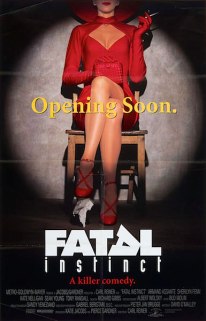
Fatal InstinctHaving just recently laid into High Anxiety, a spoof in a broadly similar style that also took on thrillers, it seems a little hypocritical to praise this, which flopped so badly in the US it went straight to video over here. Unfortunately, life isn’t that simple, and where Mel Brooks’ effort failed to amuse me this succeeded.

The plot, such as it is, doesn’t bear much discussion, being a loose amalgamation of half a dozen other films in the name of spoofery. So too the performances — no one distinguishes themselves as a comedic genius, but none let the side down. Reiner’s direction is equally fine, setting up and paying off the visual, verbal and aural jokes perfectly well. He drops the ball in a couple of instances however, allowing several jokes to run on well past their natural conclusion, and indulging in a few well-worn staples of the genre — the on-screen-musicians-playing-the-score turn up, for example, although at least there’s a nice variation at one point involving a tape player.

It’s a little difficult to understand exactly why it flopped so badly in the US as it followed in the wake of the similarly-styled Hot Shots!, which was successful enough to spawn a sequel. But then perhaps exactly that hindered it — Fatal Instinct’s release came just a few months after Hot Shots! Part Deux.

Or perhaps its targets were just too broad to attract a mass audience. While it ostensibly tackles then-recent thrillers like Basic Instinct, Cape Fear and Fatal Attraction (though the latter was already six years old at this point), it also has a lot of time devoted to the tropes of film noir, in particular Double Indemnity. Relying so heavily on a 50-year-old film isn’t likely to earn you much favour among the masses.

I’ve not seen any of those ’80s/’90s thrillers it targets, but Fatal Instinct seems to stick to the most famous bits, making the references easy to appreciate even for those with just a passing knowledge. Conversely, it seemed to me that having seen Double Indemnity would be a major advantage. But then again, perhaps that’s simply because I spotted the references to it and missed references to the films I hadn’t seen without, er, missing them, and anyone who hadn’t seen Double Indemnity would survive in much the same way. At the very least I’m sure it’s easier to follow than this paragraph…

Fatal Instinct may not be terribly original in and of itself — though, obviously, the films it chooses to spoof set it apart from its kin — and some of the gags are very much old hat (a roving camera bumps into something and breaks the lens, for instance), while others go on too long — as does the film itself, actually — but anyone who enjoyed all the films mentioned in this review may find it’s capable of raising a few smiles.

3 out of 5

Brute Force (1947)

2009 #73
Jules Dassin | 94 mins | TV | 12

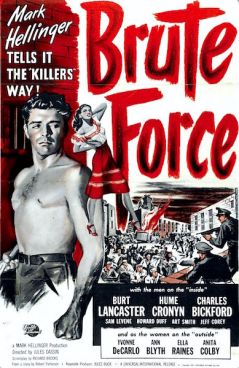
Brute ForceJules Dassin’s prison-set noir concerns a group of inmates trying to escape from the cruel regime of a vicious warden, allowed free reign by an ineffectual governor and target-driven bureaucrats (nothing changes, eh?)
Tonally, it’s varied. Early on it’s quite humourous, with a weak warden, jaunty calypso-singing inmate (who occasionally threatens to tip the whole thing over into a musical) and amusingly drunk doctor. Then there are the flashbacks to the outside world, laden with undercooked romance and awkward dialogue. In the final act it turns decidedly grim: warden Munsey lives up to his lowly reputation, goading one prisoner to suicide and beating another close to death, while the other wardens listen on from outside; one of the good guys betrays his mates, ultimately leading to wholesale slaughter as the escape plan goes awry. A balanced, varied tone is not necessarily a problem, but the flashbacks are almost uniformly unwelcome asides and, by separating the distinctly comical from the resolutely grim by placing them firmly at either end of the film, they don’t quite gel as a whole.

Still, the climactic prison break — including the build-up — is a brilliant extended sequence. Tense, epic and exciting, it concludes with a fantastic action sequence. It also delivers a powerful moral message, underlined by its direct delivery from a prison staff member rather than an inmate. It goes some way to make up for the earlier flaws, like the dialogue that’s occasionally typical of the period’s worst — “I’m just a guy who… explained his entire backstory in one slightly long and unwieldy sentence to someone who already knew it”.

What gets forgotten in all this, perhaps most depressingly, is the fate of those on the outside. We’re told early on that Collins’ love is refusing treatment for her cancer until she sees him again. This seems ready-made to provide justification for a prisoner to escape; indeed, the whole film is skewed this way, as we never discover many of the inmates’ crimes, and those we do hear are either done for good reason or not that bad. But it toes the more obvious moral line by having no one escape, and while the cancer isn’t mentioned again after the slaughter, it leaves what might otherwise seem a morally justifiable cheat (the prisoners are the good guys here — we expect and want them to triumph — but that they don’t is ‘correct’) with a bitter taste.

3 out of 5

Stranger on the Third Floor (1940)

2009 #55
Boris Ingster | 64 mins | TV

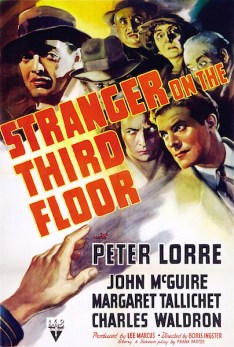
Stranger on the Third FloorDespite being “released the same month as Raoul Walsh’s They Drive By Night, and four months after Alfred Hitchcock’s Gothic Noir Rebecca,” says Paul Duncan in The Pocket Essential Film Noir, “this is often listed as the first Film Noir”. Not often enough to earn the treatment you’d expect such an accolade to afford, it would seem, as I hear it’s rarely screened and only available on DVD in Spain. That’s a shame, because it’s an entertaining — if brief — example of the genre.

The story is a morality tale of sorts. A journalist is the key witness to convict a man of murder, albeit on fairly circumstantial evidence; the journalist’s fiancee disagrees with what he did, though he tries to persuade her round to his way of thinking; but then the journalist finds himself in virtually the same situation, and it’s up to the fiancee to prove his innocence. And that’s most of the plot I’m afraid, though to be frank it’s fairly ancillary anyway.

The screenplay is a little slight and stretches its credibility — would a man really be convicted on such circumstantial evidence, for example? It plays structural tricks too: at one point the lead character is arrested off screen and the focus switches to his fiancee for the remainder of the film. Perhaps they didn’t have the money left for a cell set. Such leaps suggest an underdeveloped story, but on the bright side it certainly keeps things moving.

Despite these faults, many individual scenes are rather good. The journalist spends half the film pacing his room, for example, contemplating whether his irritating neighbour is dead or not, but it remains gripping. When he sleeps he has a nightmare, a showcase not only for the expressionist-influenced cinematography, but also the writing: the opening trial scene features a humourously inattentive judge and sleepy jury, but the exact same elements return to haunt our hero when he dreams he’s in the dock.

The climax is virtually the only scene to feature top-billed Peter Lorre to any significant degree, here fulfilling a couple of days left on his RKO contract with a small role. Nonetheless, in this one scene he out-acts the rest of the cast put together, using just a few lines of backstory to really flesh out his underwritten character. The sequence where the fiancee tries to escape him is suitably sinister. Still, the scene is over quickly and without the fullest logic in its execution — much like the film as a whole.

Stranger on the Third Floor is so imbued with the recognisable calling cards of noir in its cinematography, characters and plot points that it feels more like an entry in a well-established genre than a formative inclusion. At only just over an hour it is, on the one hand, too brief to dig into its characters or complicate its story, but on the other, it rattles past quickly enough that the good bits impress, the weak bits are only briefly registered, and it’s over long before anyone might even consider considering it a waste of time.

4 out of 5

The Lady from Shanghai (1947)

2009 #37
Orson Welles | 84 mins | TV | PG

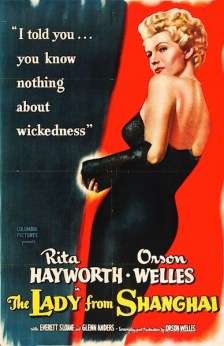
The Lady from ShanghaiThe Lady from Shanghai is an Orson Welles film… which means his original 155-minute cut was forcibly cut down by over an hour, the studio insisted he include more beauty shots of Rita Hayworth, as well as a song for her to sing, and the temp score he provided to the composer was ignored in favour of something Welles hated. Yet for all that — not to mention Welles’ distractingly atrocious Irish accent — it’s still a highly enjoyable film.
The plot is thoroughly noirish and offers up its fair share of twists along the way, while the performances are able if largely not particularly memorable. The exception to this is Glenn Anders, giving a gloriously unhinged performance as Grisby, drawling his vowels with high-pitched lunacy. Though Welles was heavily criticised for cutting and dying Hayworth’s hair — to the extent that some blamed it for the film’s box office failure — it hardly matters (I thought she looked better anyway), and the enforced beauty shots actually work thematically toward the conclusion.

Even more attractive are the skills Welles brings directorially, on display throughout. Every key sequence provides something genuinely worth looking at while still relating the intricate plot, though the cruise offers many of the best bits — the hot, sweaty foreign climes are conveyed brilliantly, aided by sumptuous location photography, and these sunny scenes contrast nicely with the noir plot. Mention must also be made of the the famous finale in the Hall of Mirrors, a precisely shot sequence that provides a fitting close. Elsewhere, Welles’ sense of humour is pleasingly present, lending the trial scenes in particular a distinctive style that brings some ever-welcome variety.

Brisk (at under an hour-and-a-half) but engagingly complex, and rarely less than beautifully shot, The Lady from Shanghai may be a compromised version of Welles’ intentions, but his undeniable ability (at directing, not accents) means it remains a compelling film noir.

4 out of 5

The Lady from Shanghai is showing on BBC Four at 10pm on Saturday 22nd August as part of a Film Noir Weekend. See this post at From the Cheap Seats for more details.

The Naked City (1948)

2007 #112
Jules Dassin | 92 mins | DVD | PG

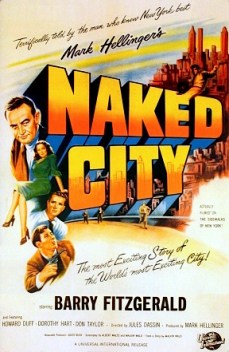
The Naked CityPolice procedural film noir, shot entirely on location in New York (unusual at the time).
The story is quite straightforward — girl is murdered, police investigate — but it exists mainly as a structure on which to hang perspectives of the city, its criminals and its law enforcement (though in an infinitely less pretentious way than that sounds). The odd, character-less voice-over narration is more puzzling than any mystery in the plot.

The acting is sometimes stilted and some of the direction is actually a little flat, but there are enough enjoyable elements to cover for it — particularly the chance to see so much footage of a real city at this time.

4 out of 5

Brick (2005)

2007 #72
Rian Johnson | 105 mins | TV | 15 / R

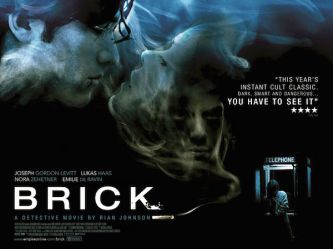
BrickThere’s a nagging sense that you’re watching a student short film for large chunks of Brick, especially at the start. This is accompanied by a niggling worry that it’s also been vastly overrated.

But it does, eventually, kick into gear — the incomprehensible plot becomes a bit clearer and the fantasy that these high school kids are in some film noir becomes less irritating and more quite fun.

It occasionally lapses back into its earlier problems but, all said, I’m glad I bothered to stick with it.

4 out of 5