
Patrick Tatopoulos | 92 mins | Blu-ray | 2.35:1 | New Zealand & USA / English | 18 / R
 It never seems to have been fashionable to admit to liking Underworld, the 2003 urban-Gothy-fantasy-actioner about vampires vs werewolves (here, Lycans) in the modern day, but I’ve always quite enjoyed it. It’s far from perfect, that’s for certain, but it has a kind of style-over-substance charm that I quite enjoy.
The 2006 sequel, Underworld: Evolution, is very much Part 2 of the story, but moves away from the urban settings to an array of more traditional Eastern European forests (albeit shot in Canada, I believe) and increasingly intricate myth-based storytelling. But still with guns. It’s also more full of creature makeup and gore (enough to bump the certificate to an 18 after the first film’s 15), and it’s not as good — Underworld may not be wholly groundbreaking (there’s a fair dose of The Matrix in there), but it felt less familiar than its sequel.
This third film is a whole different kettle of fish. With the first film’s dangling story pretty much wrapped up by the sequel (there’s room for more, but the main thrust is done with), this entry jumps back in time several hundred years for an origin of sorts, fleshing out flashbacks and backstory from the first two films. Unfortunately, we learnt pretty much all we needed to know in those flashbacks, and so in terms of both story and world-building Rise of the Lycans has little to add to the Underworld franchise. I suppose you could treat it in the style George Lucas wants us to take the Star Wars prequels and watch it before the first two films, but I don’t think it really fits there either — 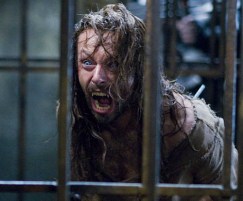 being set in medieval/dark ages times, this has a very different, more traditional feel than the urban original film… albeit with lashings of CGI.
In fact, it probably has most in common with the cycle of fantasy films we’ve received post-Lord of the Rings. There’s swooping shots of towering castles, werewolf armies storming the walls, over-designed armour, all that kind of stuff. It makes for passable fare, and I suppose if you watched it before the other two films you might be surprised with where the story ultimately goes. That said, the one twist aside — and it’s the kind of twist the studio would only have allowed a modern filmmaker to get away with because it was established in the backstory of another film — everything’s pretty standard and predictable, just with more (CG) blood and gore than you’d normally find (I’m surprised they didn’t push to bring it down to PG-13 territory).
The cast is led by two supporting actors from the preceding films, Bill Nighy and Michael Sheen. Nighy hams it up exquisitely, but placing him centre stage makes it a mite less fun than it was in the past. Sheen brings quality to any part and we get no less here. Rhona Mitra, being the franchise’s obligatory ass-kicking-girl (replacing Kate Beckinsale, whose character comes in to play much later in the fictional world’s timeline), is fine. I’ve seen an awful lot worse.
 In the director’s chair for the first (and, to date, last) time is special effects whizz Patrick Tatopoulos, who does a fine job of producing an action-fantasy film. There’s nothing remarkable about it but it largely works, though it’s a little bit on the dark side at times. I don’t know why so many films do this, incidentally — we’ve reached an era where people are mostly watching films in cinemas where the bulbs are under-lit to save money, or at home in probably less-than-ideal conditions, with various lights on and a screen left on factory settings. I wouldn’t mind if these dark movies looked fine once you were properly calibrated, but most of them are still ever so dark. Why do they think this is a good idea? Especially when you flick into 3D (which, fortunately, this film was just ahead of.)
But I digress. If you’re the kind of fantasy fan who was switched off by the urban antics of the first Underworld, this more traditional swords-and-monsters effort may appeal to your sensibilities. Otherwise, it’s really one for franchise devotees only, telling a tale you’ll know in a bit more detail. And for that, it’s not bad.

The fourth film in the series, Underworld: Awakening, which picks up the story twelve years after the end of the second film, is in cinemas in the UK and US from today.
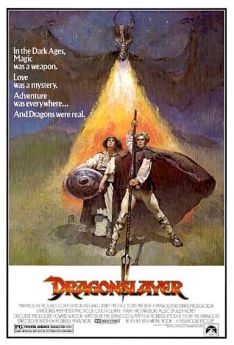 Back when he was still directing
 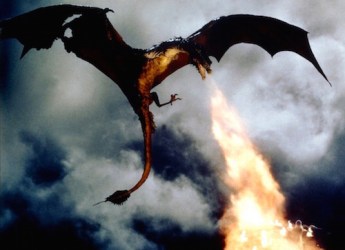 Vermithrax Pejorative is a long time coming, however, wisely kept off screen by director Matthew Robbins. It’s not that the monster shouldn’t be revealed, just that, like
 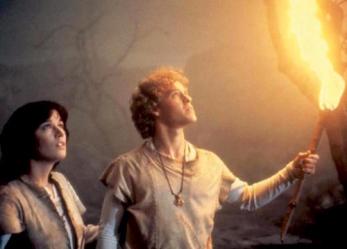 and giant monster than character development. Similarly, an interesting subplot about the move from The Old Ways of magic and superstition to The New Ways of Christianity feels like a good idea that hasn’t been fully integrated, made up of little more than a couple of passing nods and a negatively-inclined inclusion in the coda.
 100Films.co.uk