
In today’s roundup:
(1997)
Roger Nygard | 83 mins | streaming | 4:3 | USA / English & Klingon | PG / PG
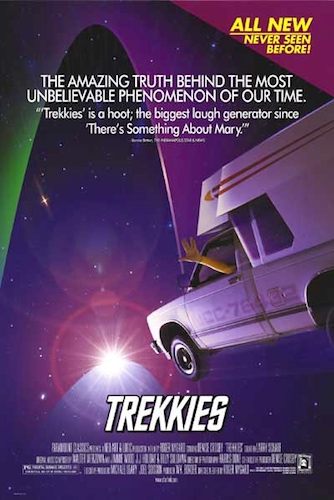
There are quite a few fan documentaries out there nowadays (a few years ago… wait, ten years ago? Bloody hell. Anyway, back then I reviewed the likes of Starwoids, Ringers: Lord of the Fans, and Done the Impossible: The Fans’ Tale of Firefly and Serenity). But before all of those, and I think the first of its subgenre, was Trekkies, which examined the phenomenon of Star Trek fandom — or, rather, the wild, weird extremities of it.
Trekkies begins with the proclamation that “Trekkies are the only fans listed by name in the Oxford English Dictionary.” That’s not true anymore (“Whovian”, at least, is in there), and that speaks to an interesting truth about this entire documentary. When it was released 21 years ago, Trekkies was exposing a niche thing to wider awareness, and these fans were seen as weirdos, fundamentally. Watching it today, though, you see that it’s mostly just cons and cosplay — stuff that’s been virtually mainstream for a few years at this point. It may’ve once seemed odd for these people to define their lives as “Star Trek fan”, but now, for many people (especially younger people), it’s perfectly routine to be defined by which fandom you’re in.
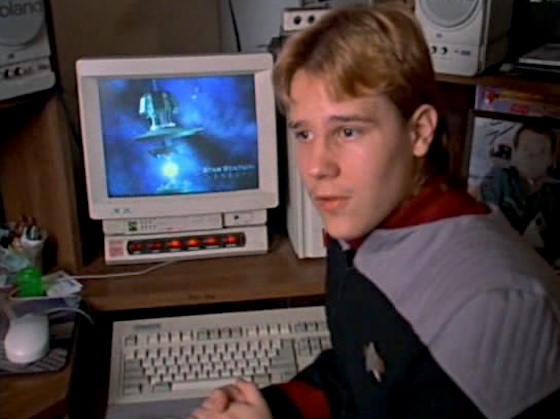
That said, Trekkies still managed to find some people who are pretty weird by any standard. At the time the filmmakers received some criticism for this — for creating a film that got laughs out of “look at the weirdos!” while ignoring the more normal side of fandom. That’s not a wholly baseless critique, but I didn’t think the film was cruel. As well as going “aren’t these people nuts!”, I think it does try to dig into why they do it, what they get out of it. I’m not sure how well it reveals the former (I mean, how did any of them go from liking a TV show to… this? It must be some personality thing), but it does a decent job of showing what benefits it brings them. And there are some incredible stories (mainly from interviewed cast members) about how Trek has changed, or even saved, people’s lives.
Trekkies may’ve lost the uniqueness it once had, with elements of the lifestyle it depicts coming to increasing prominence, but it still remains an interesting look at that kind of world, with some very memorable characters. And if you think it might’ve aged into irrelevance after all this time, there’s a bit about the importance of Captain Janeway as a role model for female leadership and what women can do — we’re still having debates and arguments about that sort of thing over twenty years later, which is, frankly, depressing.

(2004)
Roger Nygard | 93 mins | download | 4:3 | USA / English, German, Italian, Portuguese, French & Serbian | PG / PG
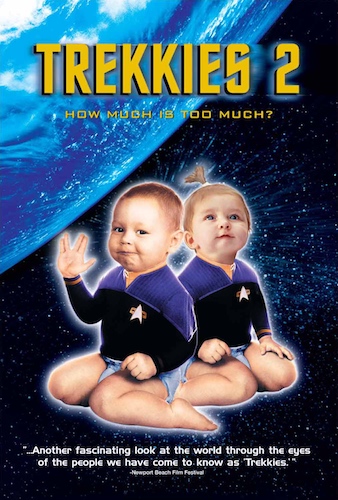
Such is the strangeness of Time that, just 24 hours after I watched Trekkies, I jumped forward seven years to catch up with some of that film’s featured fans in this lesser-seen follow-up. It’s not just repeat visits to old friends, though — if you thought America had a monopoly on crazies, well, Trekkies 2’s got news for you!
This time out director Roger Nygard and host Denise Crosby take us to Germany (visiting the set of a fan film); the UK (with a guy who turned his flat into a starship, which he’s listed on eBay for $2 million (a couple of years later it sold for c.$840,000, which was still 16 times what he paid for it)); Italy (where fandom is apparently centred around food); Brazil (where a collector has a rare playset from the ’60s… which Crosby accidentally knocks over); Australia (where the fans mainly seem to be female and obsessed with the sexy male cast members); France (which is really just “more international fans”, to be honest); and Serbia (where the series and its values has brought a lot of hope to people in a tumultuous region).
We also meet more US fans, as the sequel tries to rectify some of the first film’s shortcomings. For example, there’s a much greater section on filk music (which is, basically, music tied to sci-fi/fantasy fandom), as well as some crazy-funny Star Trek punk tribute bands — there’s a whole scene of that kind of thing in Sacramento, randomly. Plus we’re shown the lighter side of fandom, like the theatre company staging a satirical Trek-ified version of Romeo & Juliet.

And, as I mentioned, we catch up with some old friends, including Barbara Adams, the lady who wore her Trek uniform while on jury duty (and who has a hilarious Trek vs Wars debate with a coworker that’s like something out of The Office), and the film’s break-out star, Gabriel Koerner. A super-geeky teen in the first movie, seven years later he has a wife and has turned his hobby into a career in visual effects. It just goes to show, there’s someone and something for everyone.
Indeed, overall it’s not quite as “look at the freaks!” as the first film. It takes time to explicitly discuss what’s going too far and what’s normal, and it also highlights how Trek fandom has been a force for good, like raising money for charity, or giving hope in war-torn regions. Consequently it’s not as funny as last time, but probably in a good way — this one’s a bit more thoughtful, a bit fairer to its subjects as people. Ultimately, I think the two films work quite well as a pair. There’s also been talk of a Trekkies 3, which I hope happens — as I mentioned about the first film, attitudes to this kind of fandom have changed massively in the past decade or so (for example, the rise of Comic-Con and its influence), so it would be very interesting to explore that.
For my money, the most insightful moment in either film comes from Pierluigi Piazzi, a Brazilian publisher of Star Trek books, when he says that “this is a wonderful way to be crazy. Everybody’s crazy, but it’s wonderful this way.”

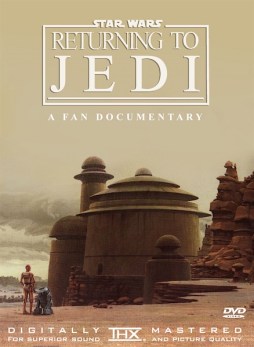 Returning to Jedi completes fan/editor Jamie Benning’s trilogy of documentaries about
  and Mark Hamill expected more darkness for Luke — but I guess they weren’t to be heard by an increasingly autocratic Lucas (reports of him essentially directing Jedi for Richard Marquand, or of his clash with the Directors’ Guild that prevented Steven Spielberg from directing the film, go unmentioned here).
 The first of Jamie Benning’s “filmumentaries” looks at the making of
  My personal highlight of the documentary comes in Cloud City, at the point Lando’s betrayal is revealed. Benning inserts a “deconstruction of an action scene” (Han shooting at Vader; Vader Force-stealing Han’s gun), using uncut footage and B-roll to quickly glimpse how such things are achieved — or were, before “with CGI” was the answer for everything. Here, Benning’s work transcends merely placing rare interviews or behind-the-scenes footage at the appropriate juncture, instead using that material to create something genuinely new and insightful.
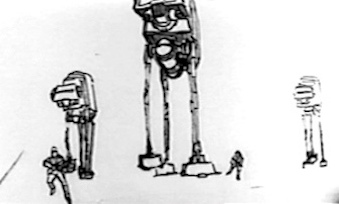 Niggles aside, I felt like I enjoyed Building Empire even more than its later predecessor (how very Lucas). I’m not saying it’s fundamentally better — just as with
 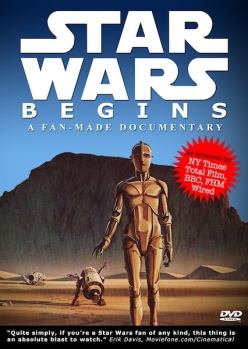 This year, I finally got round to watching the Star Wars Blu-rays I bought back whenever they came out, so I thought what better time to also finally watch Jamie Benning’s trilogy of “filmumentaries”. What’s a filmumentary, you ask? Well, here’s the opening text of the film itself:
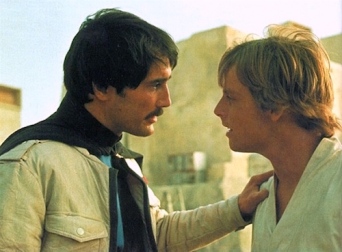 (i.e. before we even meet Luke in the finished film), the sequences were removed en masse due to execs’ fears they made the movie feel like “
 Star Wars Begins may not be the first port of call for anyone looking for an overview of the making of Star Wars, but it’s a goldmine of behind-the-scenes titbits and occasional candid revelations for anyone with a strong enough interest.
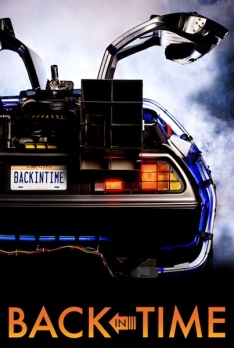 If you’re on social media (or even just frequent pop culture news sites), you can’t fail to have noticed that Wednesday just passed was “Back to the Future Day”, the exact date Marty McFly and Doc Brown (and Marty’s girlfriend) travel to in
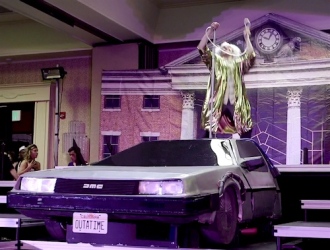
 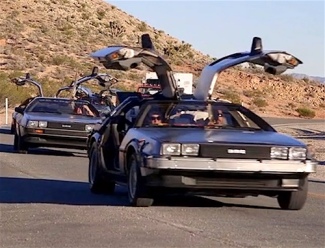 Then it moves on to the fans — what the film means to them, and what that’s led them to do. Those we meet include a couple who travel around the US in a DeLorean fundraising for Michael J. Fox’s charity; the team of aficionados who restored Universal Studios’ decrepit display DeLorean; the family of collectors who own the only film-used DeLorean that will ever be in private ownership; a guy who built a mini-golf course in his yard with a Back to the Future-themed hole that he’s used for charity events with some of the films’ cast; the people who have had some success developing a real-life hoverboard; and the guy who set up a fansite that was so good it became the official site, and is now regularly employed as an official consultant about the films, not least for the rafts of merchandise that comes out these days. We also get a look at the Secret Cinema event in London from a year or two ago that made headlines for all the wrong reasons. Naturally, none of that gets mentioned here (in fairness, because it has nothing to do with Back to the Future itself).
 That glaring error aside, Back in Time is not a bad film, provided you know what to expect. It’s a shade too long and the storytelling is occasionally a little jumbled, but there are some nice interviews and stories — hearing Michael J. Fox recount the Royal Premiere where he was sat next to Princess Diana pretty much makes the whole exercise worthwhile.
 100Films.co.uk