David Mackenzie | 89 mins | streaming | 2.35:1 | UK, Sweden, Denmark & Ireland / English | 15 / R

It’s funny, sometimes, the journeys we take to watch a movie. I distinctly remember Ewan McGregor appearing on a chat show to promote this back in 2011. I thought it sounded like a good setup for a story, so the film’s existence lodged itself somewhere in the back of my memory. Clearly the film itself didn’t have much impact, and so, with no one talking about it, and no releases or TV screenings or whatever that were high-profile enough for me to notice, it went on the back burner. Until last year, when I noticed it was available to rent on Amazon Video.*
Anyway, the aforementioned setup is a global epidemic that causes people to have an intense emotional outburst followed by losing one of their senses — for example, the first stage is an uncontrollable bout of crying followed by losing the ability to smell. Over a short period everyone experiences the same thing, then the world learns to adapt… until it happens again, losing another sense. While this is going on, we follow the relationship of Michael (McGregor), a chef, and Susan (Eva Green), a member of a team trying to find a cure for the disease. Obviously, this provides our human connection to events, with the grand world-changing stuff providing more of a backdrop.

It’s ironic, then — or at least counterintuitive — that there’s more emotional power in the montages about senses and what was being lost — the ideas-y stuff — than there is in the character- and relationship-based bits. Those are actually surprisingly clunky at first, with even McGregor and Green — both actors I like a good deal — struggling to make them work. Things do smooth out in that regard, but the romance plot proceeds to conform to a pretty standard shape. Was the sci-fi crisis meant to reflect the relationship, or is the relationship a down-to-earth framework on which to hang a big sci-fi story? I suspect the latter, because it’s the end-of-the-world theatrics that prove more interesting.
Those are kept grounded and plausible: despite the ever-worsening situation, people keep getting used to the new status quo and going on as normal — until the sensory deprivation goes too far to ignore, of course. There are lots of neatly observed and imagined little bits in how this unfolds, like how after taste is lost the rituals of going out to restaurants remains, with focus moved to the sounds and physical sensations of the environment and the food; and newspaper critics still review places for this, naturally. This “life goes on” thing feels very much like how we as a society genuinely react to big changes or threats.

So, it’s not a perfect film, but Jesus, the negative reviews I sampled (chosen at ‘random’, where “random” means “the top results on Google”) were shitty pieces of criticism. Their points include things like it’s preposterous (well, the plot is propelled by an unexplained virus — it’s less preposterous than, say, Spider-Man), or the characters fall in love while the world falls apart (because no one ever seeks comfort in others during times of stress or tragedy), or the screenwriter has kind of a funny name (seriously — a supposedly professional review dedicated some of its limited word count to basically going, “lol, foreigner’s got name that looks funny!”) It annoys me that some people get paid to write bollocks like that.
As I said at the start, no one ever really talks about Perfect Sense, even after its director has gone on to bigger things (Starred Up attracted a lot of praise and Hell or High Water earnt Oscar nominations), but it’s worth a look for anyone interested in broadly-plausible end-of-the-world dramas.

* Having rented it, I was surprised to see it begin with a BBC Films logo, because most BBC Films productions end up on BBC Two within a year or two. So I checked, and it turned out it had been on TV, just once, in November 2012. (You’d think they’d’ve shown it more than that in the five-and-a-half years since — I mean, they’ve shown The Ides of March six times in four years.) Worse than that, though, was when I checked my iPlayer downloads and found I had actually downloaded it, so paying for the rental was a waste of money. Well, at least it was only £1.99, and I paid with vouchers anyway. But the colour grading of the two was completely different, which was just odd. Anyway, back to the review: ^


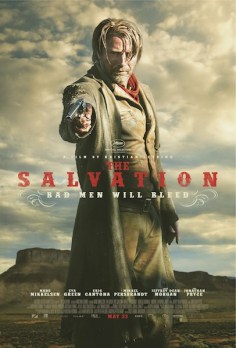 The spirit of the Spaghetti Western is kept alive in this Euro-minded South Africa-shot revenge Western.
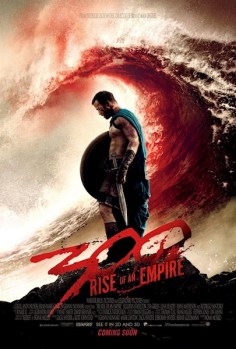 Taking place before, during, and after the events of Zack Snyder’s surprise-hit graphic novel adaptation
 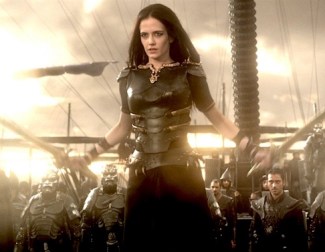 It’s also terribly obvious that it was shot for 3D. I’m not normally one to criticise a film for that — I think when some critics know a film is being released in 3D they see that in its shot choices, even if they’re perfectly valid choices for 2D. But Rise of an Empire screams that it was made for 3D from the start, with all manner of things thrust towards the camera, usually in slow motion, and the constant explosions of blood (to call them squirts or sprays implies a more liquid-like quality than they actually possess) which go nowhere else but camerawards. Presumably the only reason it’s not an 18 for violence is because it’s all so bloody silly.
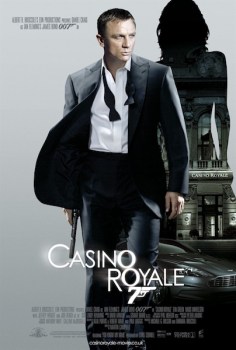

 Score:



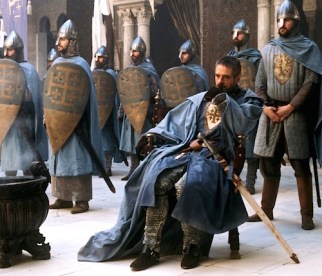
 Ridley Scott’s Crusades epic is probably best known as one of the foremost examples of the power of director’s cuts: after Scott was forced to make massive edits by a studio wanting a shorter runtime, the film’s summer theatrical release was so critically panned that an extended Director’s Cut appeared in LA cinemas before the end of the year, reaching the wider world with its DVD release the following May. The extended version adds 45 minutes to the film (and a further 4½ in music in the Roadshow Version), enough to completely rehabilitate its critical standing.
 A strong cast bolsters the human drama that sometimes gets lost in such grand stories. Bloom is a perfectly adequate if unexceptional lead, but around him we have the likes of Michael Sheen, David Thewlis, Alexander Siddig, Brendan Gleeson, and Edward Norton (well done if you can spot him…) There are even more names if you look to supporting roles. Most notable, however, are the co-leads: both Liam Neeson, as the knight who recruits Balian, and Jeremy Irons, as the wise advisor when he gets to Jerusalem, bring class to proceedings, while Eva Green provides mystery and heart as the love interest. Of everyone, she’s best served by the Director’s Cut, gaining a whole, vital subplot about her child that was entirely excised theatrically. It’s the kind of thing you can’t imagine not being there, and Scott agreed: it seems the chance to restore it was one of his main motivators for putting together a release of the longer version.
 (I’d wager
  Belated sequels can be a
 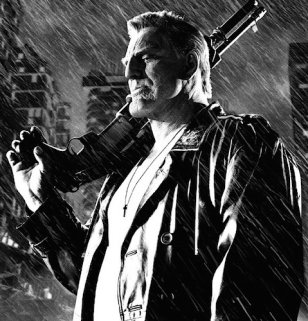 But the comic-book-ness of the first film — moments of almost metaphorical visual representation rather than literal reality, including physically-impossible action beats — has been ramped up. The value of the first film was never in its action, so the sequel’s lengthy punch-ups, crossbow-based guard-slaying, and all the rest, get boring fast. When it slips into this needless excess, A Dame to Kill For loses its way. When it sticks to what it does best — hard-boiled fatalistic crime tales with striking comic book-inspired cinematography — it does as well as the concept ever did.
 The intervening decade has lessened the impact of the first film’s sick ultra-violence, but there’s nothing even that extreme here, aside perhaps from one eyeball-related moment. On the other hand, nearly a decade of tech development means it looks better than the last one, both in terms of the CGI’s quality and the camerawork more generally — it’s less flatly shot; more filmic than the first one’s sometimes-webseries-y composition.
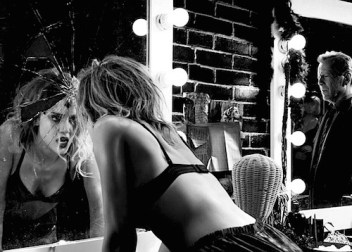 its predecessor, and that’s exactly what it delivers. I suspect the first benefits from nostalgia because, watching them virtually back to back, I found I liked Sin City less than I remembered, but enjoyed A Dame to Kill For just as much. It’s flawed in several aspects, but for honest-to-themselves fans of the first movie, I think it’s a “more of what you liked”-style success.
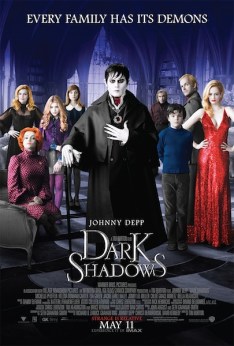 Director Tim Burton’s most recent live-action movie is an adaptation of a 1960s soap opera… albeit one featuring vampires, witches, ghosts and sundry other supernatural goings-on. You wouldn’t get that on
 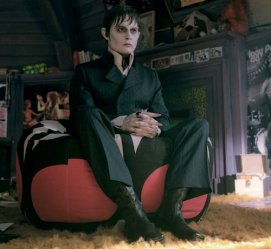 Early on, it works. The first 20 to 30 minutes offer a serviceable prologue and an engaging introduction to most of the characters. It’s funny, it’s occasionally spooky, there’s a good deal of promise for a marginally-more-serious
  It’s a tonal grab bag: at times it seems to be a knowing spoof of daytime soaps, at others pushing for drama almost with a straight face; it’s sometimes deliberately and successfully comedic, at others straining too hard for a desperate laugh; it has a strain of bizarre sexuality that may be aiming at comic but is frequently just uncomfortable. This scrappiness leads to the most cardinal sin of any entertainment: it ends up a bit boring; and, in its out-of-the-blue big-battle climax, crushingly derivative.
 100Films.co.uk