Rock n Roll Nerd (2008)

2009 #92
Rhian Skirving | 89 mins | DVD
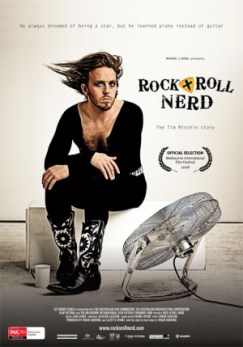
I don’t usually bother with plot summaries at the start of my reviews, working on the assumption most readers will know (or know of) the film and so don’t really need one. My assumption here is that most won’t have even heard of this film, though.

You may’ve heard of Tim Minchin, however, the Australian musician/stand-up who’s done a couple of tours, released a DVD or two, and popped up for guest spots on things like Never Mind the Buzzcocks and The Secret Policeman’s Ball. Back in 2005, no one knew who Minchin was — a struggling musician at the time, on the verge of quitting and finding himself a Real Job. He happened to live next door to aspiring filmmaker Rhian Skirving who, in more or less the same predicament, decided to film Minchin’s last ditch attempt at making it: trying his hand at comedy. They expected to film, at best, a small-scale suburban documentary about a wannabe failing to become a somebody, but what they wound up with was something rather different.

Almost as soon as filming began, Minchin was a hit at the Melbourne International Comedy Festival, where he was spotted by an Edinburgh producer and whisked off to the famous Fringe where (as the film’s own blurb describes it) he had “the most successful first season of any performer in the history of Edinburgh… walking away with the prestigious Perrier Newcomer Award, TV appearances, offers from Hollywood and the West End, the best management in the business and a gig at Albert Hall.” Not what either Minchin or Skirving had expected, that’s for certain!
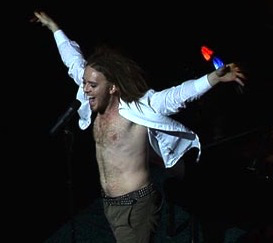
What this tale creates is an unusual rockumentary. It’s obviously not a concert film, nor a tour film, nor a retrospective on someone’s career; instead, it’s the chronicle of someone’s relatively meteoric rise to fame, from two unique perspectives: the camera is there as it happens, not belatedly once Minchin’s become more widely known; and the writer/director/cameraperson is a close friend, not just any old filmmaker hoping to cash in. One almost has to wonder if Skirving has psychic powers, so perfectly timed was her idea.

Minchin is pretty honest with the camera in tow. When he’s a success, we see him struggle with things like management: does he owe it to the person who discovered him to make sure she’s cut in on the deal? Is it right to just abandon her and move on? Does she just see him as a potential cash cow rather than genuinely wanting to support him? And so on. His honesty extends to the awards — his show is so hyped he winds up half-expecting the near-impossible, to win the biggest award in his first year. He’s not even nominated, having to ‘settle’ for a win as Best Newcomer. His confounded expectations aren’t boastful or immodest, the viewer privy to how his hopes were unrealistically raised in spite of himself.

Alongside this, Skirving and Minchin allow us to see the toll his professional breakthrough takes on Minchin’s personal life. His wife — newly pregnant — is left behind in Australia while he’s becoming the toast of Edinburgh. The timing of some events in his personal life also couldn’t be worse, and Skirving documents them without ever becoming ghoulish or intrusive. It is, in a way, brave of both Minchin and his wife to allow their inclusion, but good filmmaking on the part of Skirving to know where to draw the line.

Documentaries such as this often rely on the viewer having a pre-existing affection for either the performer or their work. Though it seems impossible to believe, I’m sure there must be some who dislike Minchin (his show did get one bad review, after all) and it may be they wouldn’t engage with this film because of it. However, some stories are capable of transcending one’s feelings about the subject covered, and Rock n Roll Nerd may just be one of those: even if you don’t enjoy Minchin’s songs, or indeed comedy music in general, the tale of his success — and what it’s like for an ordinary person to live through such a thing — is a story whose unique interest extends beyond fans-only territory.

4 out of 5

Rock n Roll Nerd: The Tim Minchin Story is currently only available on an Australian Region 0 DVD, available from the distributor, your favourite Australian DVD retailer (y’know, like EzyDVD), or importers on Amazon. The film’s official website can be found here — sadly no trailer, but there are comments from Minchin and Skirving.

Rock n Roll Nerd placed 6th on my list of The Ten Best Films I Saw For the First Time in 2009, which can be read in full here.
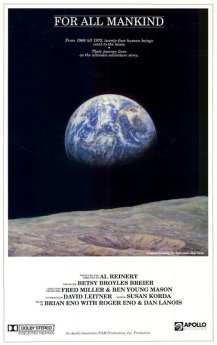
For All Mankind (1989)

2009 #42
Al Reinert | 77 mins | TV (HD)

For All MankindFor All Mankind tells the story of NASA’s Apollo missions to the Moon using only NASA’s own footage of the real missions.
It’s not a documentary in the sense that most people perceive the form — i.e. a highly realistic presentation of the facts — but instead something a little more interpretive, aiming to recreate the feeling and experience of travelling to the moon, not the hard facts of who went when and how it was done. As such it is both beautiful and artistic, featuring stunning photography that has been sensitively edited and scored.

In this regard, it makes In the Shadow of the Moon look like a Hollywood remake. While they follow the same tack — telling the tale of the Moon missions with just the testimony of the astronauts, treating it as one big mission rather than taking them all in strict chronological order — For All Mankind does it with a greater sense of artistry. Where Shadow feels like a typical documentary, with talking heads and onscreen identification of who’s speaking, Mankind just uses original footage and astronaut’s narration, never bothering to identify the speaker. Both styles have their place, and Shadow adds a great deal to the story with its retrospective comments by the astronauts, but the glorious footage and skilled editing of Mankind — and the added wonder of seeing it in HD, it must be said — leaves one with a sense of awe that isn’t as present in the more informative Shadow.

These two films make an excellent pair then, but For All Mankind’s beauty provides the superior experience.

5 out of 5

For All Mankind placed 5th on my list of The Ten Best Films I Saw For the First Time in 2009, which can be read in full here.

In the Shadow of the Moon (2007)

2009 #40
David Sington | 96 mins | TV | U / PG

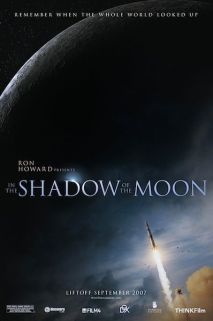
In the Shadow of the MoonIn the Shadow of the Moon tells the story of NASA’s Apollo missions using only contemporary footage and the words of the men who actually walked on the Moon.
The telling is dominated by the words of the actual astronauts, describing their personal experiences and feelings. Rather than following a mission-by-mission chronology it mixes all their stories together, thereby telling the tale of a journey to the Moon and exploring its surface only once. It’s a neat way of editing it, albeit essentially borrowed from For All Mankind, because it avoids repetition while also covering a variety of perspectives. The typically reticent Neil Armstrong is conspicuous by his unsurprising absence, but this allows the personalities of some of the others to come out more (Buzz Aldrin features relatively little too, for example), perhaps none more so than Mike Collins, the man ‘left behind’ while Armstrong and Aldrin stepped into the history books. He comes across as thoroughly likable and it’s a pleasure whenever he’s on screen.

Narration is limited to a couple of brief intertitles and that contained on archive footage, culled not only from NASA archives but also newsreels, adverts, speeches and so forth. In this it manages to avoid using some of the more obvious and over-played clips, such as Kennedy’s famous “not because it is easy, but because it is hard” speech, while unearthing some interesting bits of its own, like Armstrong’s parents on a game show the day he became an astronaut, being asked how they’d feel should he happen to be the first man on the Moon. Such found footage is often used to put the missions in the context of wider events at appropriate junctures, such as Vietnam and the Civil Rights movement during the time Apollo 8 led the first men to orbit the Moon, or showing the whole world watching the TV broadcast of Armstrong stepping on to the Moon for the first time.

Although this external perspective is welcome, while being kept to an appropriate minimum, it’s difficult not to note that this is exactly what the HBO dramatisation, From the Earth to the Moon, did at these points. Other points of emphasis feel similarly culled, such as the way Apollo 13 is almost glossed over, but there are only so many ways of telling the significant elements of the same story and any accusations of plagiarism, from either HBO’s series or For All Mankind, aren’t seriously justified.

A closing perspective treads the fine line that leads toward sentiment and preachiness, but errs on the right side of awe and significance. Some have criticised the end for having too much religion and spirituality and not presenting a conflicting, ‘accurate’ scientific perspective. As a staunch atheist, I found no such problem: beliefs are there to an extent, but they’re not overpowering and there’s no apparent religious agenda, as some critics might have you believe.

In the Shadow of the Moon may not offer the plain facts and figures of how we went to the Moon and who did it when, but it does present the reflections of the men who risked their lives to further the knowledge and reach of our species. Their thoughts on this are invaluable.

4 out of 5

Russian Ark (2002)

aka Russkiy Kovcheg

2008 #98
Alexander Sokurov | 96 mins | DVD | U

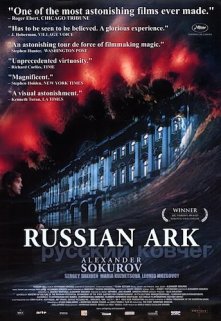
Russian ArkRussian Ark has received boundless praise from some quarters, and not just for being shot in a recording-smashing single take — to cite one review in particular, “anyone with an eye for beauty, a yearning for the past or a passion for pure cinema is going to be spellbound.”

Apparently some sort of artistic documentary on the history of Russia, told via a fantastical time-travelling-ish tour of a Russian museum, Russian Ark is certainly ‘artistic’. Unfortunately, it doesn’t teach you much and is at no point clear about what it’s covering. Perhaps a more detailed knowledge of Russian history would lend some meaning to the tableaus that are half-glimpsed as the Steadicam drifts by, though it spends as much time meandering down empty corridors in search of something to film as it does actually showing anything. When it does alight on something, the staging is occasionally spectacular, especially considering the self-imposed technical restrictions, but I gained little from this alone.

I freely admit this may say more about me than the film itself, but the most interesting parts were when the character whose point-of-view we inhabit and the French historian he encounters begin to discuss something that almost (almost) resembles a plot — how did they get there, how can the Frenchman speak Russian, can others see them, and so on. Sokurov merrily raises all these questions, in the process throwing a sci-fi dimension into his artistic-documentary-fantasy, but are there any answers offered? No, of course not — that’s not the point. Which does rather make you wonder why they’re vocalised at all…

Watching Russian Ark is a little like doing what the nominal lead characters do: wander aimlessly around an unfamiliar museum without any guide to what they see. Undoubtedly impressive, and worth seeing for the audacity of the single take, but I, unlike others, was far from spellbound.

2 out of 5

(Originally posted on 30th January 2009.)

The Aristocrats (2005)

2008 #87
Paul Provenza | 85 mins | TV | 18

The AristocratsIt’s not unusual for films showing on TV to be prefaced with content warnings about language, sex or violence, but I don’t think I’ve ever previously seen one that feels the need to place such a warning after every single ad break. But if there’s one film that needs that treatment — or, rather, one film they could actually show on TV that needs that treatment — it’s The Aristocrats.
The Aristocrats is, apparently, an incredibly famous joke, well known to all comedians — and, generally, only told to each other, not to audiences — that is flexible enough for anyone to tell in their own way and still have it work. It’s also incredibly vulgar; in fact, the point is often to make it as vulgar as humanly possible. To explain much more would ruin the point of the film, which aims to expose and explain this cultish joke to the masses. Personally I’ve never heard of the thing, and for all I know The Aristocrats could be an elaborate Blair Witch-esque hoax — “oh yeah, all comedians know it”. Note this: the only people you’ll see throughout are comedians, and they all seem to know each other too.

Subject matter aside, there’s not much of a structure to the material presented. Mostly compiled from dozens of interviews, the resultant piece is a jumbled mix of comedians telling their version of the joke, comedians explaining variations on it (those whose telling completely changes it are the ones who succeed), comedians explaining why it’s funny, comedians explaining how it works, comedians explaining how and why it varies, comedians musing on the differences between male and female tellings of the joke…

On the other hand, even though there is a degree of repetition, there’s also a surprising amount to say about it — even by the end, when yet another comedian launching into their version has you reaching for the remote, there’s often another little titbit around the corner. In other notes: for British viewers, the biggest and most widely known names — Billy Connolly, Eddie Izzard — barely feature; for everyone, it features one of the worst ventriloquists I’ve ever seen; and a mime artist who singlehandedly makes the entire thing worthwhile.

The biggest problem with The Aristocrats — the film, not the joke — is quite a simple one: it’s about a single joke. Even the most meandering comedians tell several of those in an hour and a half. To compound the issue, said joke can vary so much as to defy a lot of comedy-killing “why’s it funny?” analysis. What you’re left with is repetitive retellings of a joke that, to be blunt, is rarely funny whatever you shove in the middle. It’s an insider’s film about an insider’s joke; for the rest of us, it rather over eggs the point.

3 out of 5

Cathy Come Home (1966)

2008 #59
Ken Loach | 77 mins | DVD | PG

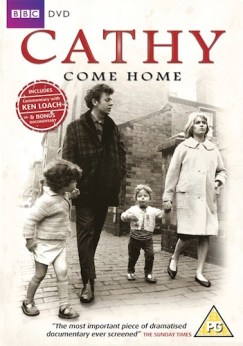
Cathy Come HomeTechnically a one-off TV drama from the BBC’s Wednesday Play strand, Cathy Come Home more than deserves consideration as a film in its own right, due to it being an early work of director Ken Loach, the fact that it’s shot largely on film using relatively experimental storytelling techniques, and also considering the huge social impact it had.

The piece tells the story of Cathy, a young woman who leaves behind a comfortable life for the excitement of the big city. There she falls in love with Reg, who she marries and has children with. But, through a series of incidents and accidents — most of them no fault of their own — Cathy, Reg and the children wind up without a house, and then gradually slide down the scale toward homelessness. In this respect the film can remind us of a facet of the ‘good old days’ that is often overlooked when our collective memory of the ’60s is made up of James Bond, the Beatles, and programmes like Mad Men. The drama also had a big impact at the time: 12 million watched, it boosted the newly-formed charity Shelter, led to debates in parliament, and, eventually, changes to the law.

Loach structures the film cleverly: Cathy and Reg’s slide into poverty is all too believable, while at the same time allowing the viewer to see a cross section of the homeless experience. He employs a documentary style throughout, so effectively that it still fools some into believing the whole piece is factual. In fact there’s a mix of interviews with those really suffering such situations, and performed scenes that are shot and cut disjointedly, as if they were observed rather than written. While some of the performances give the game away, they’re never poor enough to really detract. The downside of this style is that the storyline isn’t always clear. I’m still not sure if it was Cathy’s children that died in the caravan fire or someone else’s, just one among a few such examples. While ambiguity is no bad thing — the cruelly unresolved ending being a case in point — it sometimes just seems like a hole in the narrative. However, these moments are relatively minor, and certainly don’t dint the film’s impact.

Cathy Come Home is a powerful piece of work; an undoubted television classic that (bar a few technically-incongruous studio scenes shot on video) wouldn’t look out of place on a big screen. As an important and timely history lesson, a challenge to prejudices that some of us may hold, and a reminder of how close most of us are to such a fate — especially right now — it remains essential viewing. Sadly, I suspect it always will.

5 out of 5

Starwoids (2001)

2008 #17
Dennis Przywara | 79 mins | DVD | PG

StarwoidsAnother fan documentary (following yesterday’s review of Done the Impossible), Starwoids tells the tale of two groups of Star Wars fans who queued for six weeks to be the first to see The Phantom Menace. Alongside this, the film takes a couple of diversions into general Star Wars fandom.

The main story here is the more interesting element. You might think an hour of people standing in line is pretty dull, but, surprisingly, enough happens to hold the attention. The two groups make a structurally pleasing contrast: one is just a group of fans, who have a great time playing games and hanging out in line. Their biggest worries are the police moving them off the pavement, and where to go to the toilet. The other group was organised by fansite CountingDown.com, and turns from a bunch of people having fun into a 24-hour television studio and media event on a sidewalk, provoking arguments, governments and revolutions. Przywara uses no narration for the majority of the film, so these contrasts are left for the viewer and participants to draw out on their own. Generally it works, though leaps in time and the skipping of certain events occasionally make it hard to follow what’s going on, especially at the more argumentative camp.

The asides into broader fandom work fairly well. They break up the occasional monotony of people queuing, but are neither entirely related to the release of Episode I nor delve far into painting a picture of Star Wars fandom as whole. This dilutes the focus of the film a little: it’s neither a comprehensive overview of fans nor entirely centred on the anticipation of one film. It would be a lesser film if they were missing, however, as Star Wars: The Musical, the life of a toy collector, and the woman whose car is painted like an X-Wing are among the highlights. A trip to find filming locations in Death Valley is a misguided inclusion though, as the lack of comparative clips or stills from the film itself renders it fairly pointless.

Eventually the hundreds of queuing fans get to see Episode I. First reaction: they love it. Przywara returns four days later, and then a year later — amusingly, no one is asked for a retrospective opinion on the (generally reviled) film. Personally, I’d much rather watch Starwoids again: while the fans’ aggressive nature makes it a somewhat more depressing experience than Done the Impossible, the insight into what it’s like to be completely obsessed (and to queue for a month and a half) are both interesting and entertaining.

4 out of 5

Done the Impossible: The Fans’ Tale of Firefly and Serenity (2006)

2008 #16
Jeremy Neish, Brian Wiser, Jared Nelson, Tony Hadlock and Jason Heppler | 79 mins | DVD

Done the ImpossibleOne of the more recent entries in the “fan documentary” sub-genre (which also includes the likes of Starwoids and Ringers: Lord of the Fans), Done the Impossible investigates the cult sparked by the prematurely-cancelled TV series Firefly and its continuation movie, Serenity — a movie that only exists thanks to the fans’ dedication.

The activism, and success, of Firefly’s fans (known as Browncoats) makes for a key difference from other fan docs: these aren’t just people who queue for obscene amounts of time to see something they like; these are people who helped turn a cancelled TV show into a DVD hit, and then a successful movie too. As such, as well as touching on the basics of fandom (forums, conventions, fanfic, and so on), this documentary is the tale of the rise and fall of the TV show and the making of the movie, but from the perspective of the fans rather than the filmmakers. That said, a noteworthy number of those involved in the film are interviewed, discussing their love for both the show and its fans, and often confessing to be fans themselves. These include six of the lead cast (one of whom hosts the documentary, and another narrates the DVD’s extras), writers and directors, and creator/writer/director (and God to fans) Joss Whedon.

As a film, Done the Impossible has a nicely loose structure, on the whole following the thread of the production story through to around the time of Serenity’s premiere, but taking time for diversions into personal recollections and general areas of Browncoatism. Actually having a story to tell gives the film an advantage over other fan docs (Ringers rather lacked one, for example) — even though there are diversions, there’s always a narrative to keep things moving forward. It certainly stops things from seeming too slow or repetitive.

Whatever you may think of them, Firefly and Serenity broke the rules, and in the process helped pave the way for other cancelled properties being revived by fan support. With its emphasis on personal recollections alongside the minutiae of fandom, Done the Impossible is undoubtedly of primary interest to fellow Browncoats, and perhaps anthropologists. But there should be broader interest in the story of a dedicated and unfailingly hopeful mass of people who came together, refused to give up, and, against all the odds, actually won.

4 out of 5

Easy Riders, Raging Bulls (2003)

2008 #3
Kenneth Bowser | 113 mins | DVD | 15

Easy Riders, Raging BullsDocumentary, based on the best-selling acclaimed book by Peter Biskind, about the decade in Hollywood between the death and effective re-birth of the studio system.

It’s a broad story, with many threads, which means this film has a tendency to sprawl all over the place as it attempts to take an overview of it in chronological order. Consequently it’s short on great insight, but does provide an overview of what went on in this period — that is, the story of how Hollywood made the transition from the old studio system to the era of the blockbuster (a method which still more or less exists), via a brief period where directors truly had auteur-level control.

There are numerous interesting interviewees to help the story along, all of them people who were actually there, who lived through it and helped create it. This makes for a refreshing change, as most documentaries of this ilk seem to be full of film historians and journalists. Of course, there are many big names notable by their absence, so when the film makes its rambling way onto the likes of Scorsese and Spielberg that familiar sense of historic detachment does begin to creep in.

All told, it gives a good overview of the shape of what happened in this period, and how Hollywood became what we know today. Anyone after deeper explorations (of the period, the people, or the films themselves) will want to look elsewhere. I suspect the book may be a good place to start.

3 out of 5

À propos de Nice (1930)

2007 #108a
Jean Vigo | 23 mins | download | U

Short film about the French city of Nice, mixing documentary-style footage of people with shots of the architecture, as well as clearly staged scenes (a man getting sunburnt, for example).

There’s a certain playful edge to it all, not just with content such as a garish parade and crazy dancing, but with amusing tricks (again, the sunburning), camera tomfoolery (for example, moving it to follow the loops of arches at speed; or using slow motion and sped-up shots), and picking out shots of pedestrians apparently for their annoyance at being filmed.

It’s an interesting amalgamation, then: part art, part documentary, part sketch show.

3 out of 5