
Steven Spielberg | 155 mins | streaming (HD) | 16:9 | USA / English, Mende & Spanish | 15 / R
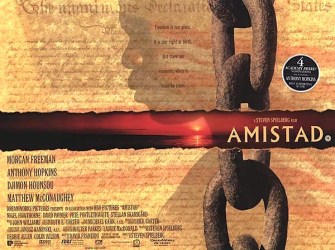 Feeling in need of more intellectual fare after helming The Lost World, Spielberg turned to a project already in development at Dreamworks: an adaptation of a non-fiction book about the 1839 mutiny on the slave ship La Amistad, and the ensuing legal battle. Although not poorly received by critics, there’s a sense that the consensus view dubbed it “black Schindler’s List”, the implication being that by aping the earlier film it was inevitably inferior. I don’t think that’s a watertight chain of logic, but, nonetheless, Amistad is clearly a ‘minor Spielberg’.
Despite being “a slavery drama”, most of the film functions as a legal drama: though it begins with the slave uprising, and later has an extended flashback showing their kidnap and transportation, the thrust of the film lies in the courtroom arguments about who owns the ship’s ‘cargo’ and consequently what should be done with them. This is a period when capturing Africans into slavery, and by extension their subsequent transportation, was illegal by international agreement, but actually owning slaves was not yet banned (at least in the US). It’s before the American Civil War too, so there’s a political dimension: if these ‘slaves’ are freed, what tension might that spark between the north and south?
 Though Spielberg is certainly not immune to the Africans’ plight — the depiction of life on a slave ship is appropriately harrowing — it’s clear from early on which side he expects us to identify with, in terms of cultural background if not shared morality: as survivors of the mutiny talk the next day, the slavers’ Spanish dialogue is subtitled but the slaves’ African dialect is not. It’s a simple but effective technique to align us with one side — as I say, not morally (in no regard is Spielberg trying to apologise for the slavers), but socially. Unfortunately, it’s not sustainable: later, when we need to understand the Africans to follow a scene’s point, their dialogue is suddenly subtitled, and from then it’s sporadically translated as needed. I can see why that choice was made, but it makes the unsubtitled bits feel like a cheat.
In most other regards, it’s kind of an old-fashioned movie. In a few ways that works: it’s got classical cinematography, both the use of film (obviously, this being well before mainstream adoption of digital) and the framing, the pace, the editing. In other respects… well, it feels very late ’90s now, the overall style of the screenplay and the treatment of the story reminding you that it’s not actually a moderately-recent film (which I guess I’d personally filed it away as, being the most recent of Spielberg’s pre-2010s films that I’d not seen), but is now nearly 20 years old. And, though I may be damned for criticising him twice in as many weeks, John Williams’ score is a little heavy-handed.
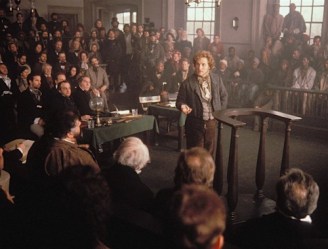 This can be said of Spielberg’s approach to the drama, too. Some of the courtroom stuff is suitably mired in legal technicalities and argument, but by film’s end it gets a little bit too… what’s the word? Not “preachy”. Not “sentimental”, exactly, though it’s born of that old criticism of Spielberg. “Melodramatic” may be on the money, though. It doesn’t help that everything reaches a climax — not only narratively, but also in the way it’s written, shot, acted, and scored — only for it to be revealed that it’s just the end of act two. Okay, that’s the truth of what happened (or near enough, for the purposes of this dramatisation), and by adapting it in that way it emulates the emotions the characters experienced; but from the audience’s perspective, you feel like you’ve reached the end… only to be served up another half-hour of movie. And it’s a long film too, so you feel that. It gets by because it’s fundamentally a good film, with strong performances and technical merits, but it’s a little bumpy for a bit.
There also seem to be a startling array of factual inaccuracies to level at the film. As ever with fictional adaptations of real life, it’s a difficult line. No fact-based fiction is 100% like reality, especially when you factor in unavoidable variances in people’s memories and opinions. However, the more serious or famous the events being depicted, or the more they’re being used to indicate some wider point about their setting, the greater the responsibility to present something that is at least passably accurate. I think some would contend that Amistad is not that. I’m no expert, but this section on Wikipedia, which is bolstered by multiple citations to suggest its accuracy, indicates the extent of the issue.
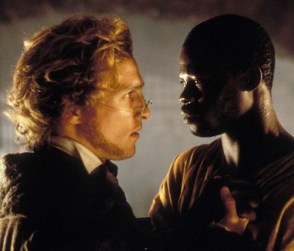 It’s easy to criticise Amistad, because Spielberg makes the production of very good movies look effortless, so the missteps stand out all the more. The story of La Amistad and its ‘cargo’ is a powerful one, and Spielberg has — naturally — turned it into a good film; but by remixing history to over-egg the message, it loses a little something. A valiant effort, but a film like 12 Years a Slave makes many of the same points in a less grandiose manner.

 Four years ago, DreamWorks’
  Tonally, DeBlois has been productively inspired by
  If there’s a flaw, it’s in some of the new characters. The primary villain is underused, introduced too late in the game to become a palpable threat. More time spent building him up, seeing his evil on screen rather than just being told about it, would’ve been appreciated. So too for the mysterious vigilante dragon-rider, who turns out to have a very significant role. The deleted scenes include a prologue that would have introduced the character at the start, which would have better established the mystery and import of their role. It’s clear why it was deleted (to focus on Berk and keep the initial tone light), but I still think it would’ve worked better in the film. In the final cut, the vigilante is mentioned all of once, then turns up and is unmasked about two minutes later. Really, though, these are niggles — even for them, the cumulative consistency is certainly better than, say, its Oscar conquerer
  Marvel Studios takes its boldest step yet, moving away from the present-day superhero milieu of its previous movies to a galaxy far, far away for a space opera epic. Its success, both critically and commercially, has cemented the Marvel Cinematic Universe as an infallible force in the current movie world. But, really, how good is it?
 The worst offender is the pod chase through Knowhere, a several-minutes-long sequence that registers as little more than a blur. There’s a shocking lack of clarity to its images, even by today’s standards. Maybe it’s better in 3D, when I guess the backgrounds would sink into the distance and important elements would be foregrounded; but in 2D, you can’t see what’s meant to be going on for all the fast-moving colour and split-second cuts. Almost as bad, though for different reasons, is the climax. It takes up an overlong chunk of the movie and at times feels repetitive of too many other Marvel climaxes — oh look, a giant spaceship crashing into a city! If anything, the film gets ‘worse’ as it goes on. Perhaps not in a very literal sense, but as the blustering action climax takes over, it moves further away from the stuff that makes it unique and interesting.
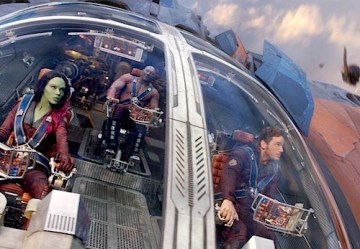 It isn’t even called Nova City, but I don’t have the foggiest what it is called because the film didn’t make me feel I should be learning it. Some more effort making sure we knew why that place mattered, even if it was just a clearer depiction of all the planning for its defence, might have sold the entire climax better.
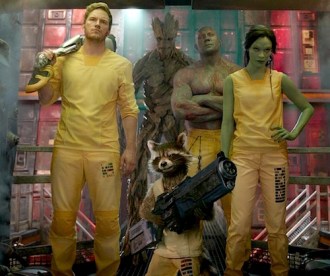 especially the overlong climax. Joss Whedon commented of his own Avengers film (as I quoted in
  100Films.co.uk