
Andrew Stanton | 132 mins | Blu-ray | 2.40:1 | USA / English | 12 / PG-13
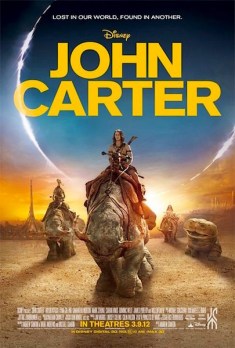 A box office flop (it made a once-astonishing $284 million worldwide, but that was off a $250 million production budget and a ginormous bungled marketing campaign), John Carter has gained something of a following among those who did enjoy it or caught it later — see this post by ghostof82, for instance. I approached it hopefully, then, buoyed by such positive after-reaction — many a good film has been ignored by the general audience. Disappointingly, I didn’t find John Carter to be one of them.
Adapted from a classic, influential science-fantasy novel by Edgar Rice Burroughs (that being A Princess of Mars, deemed too girly a title for a PG-13 SF/F blockbuster nowadays), the story sees American Civil War veteran John Carter (Taylor Kitsch) transported to Mars, which he finds populated by human-esque aliens, the two factions of which are at war, and giant four-armed green-skinned aliens, who are trying to stay out of it. Of particular interest is the half-dressed princess Dejah (Lynn Collins), promised in marriage to villain Sab Than (Dominic West) in order to end the conflict. Cue simplistic politicking and CGI-driven action sequences.
There have been many reasons cited why John Carter flopped, a good many of them centred around the marketing campaign (reportedly director Andrew Stanton, given power by his directorial success at Pixar (Finding Nemo, WALL-E), demanded a level of control Disney felt forced to give, and his belief that Carter was as renowned a character as (say) Sherlock Holmes or James Bond led to a misaligned campaign, one which the professional marketing people who knew what they were doing weren’t allowed to salvage). Also, the sheer importance of Burroughs’ novel was actually a hindrance —  not because it’s so famous (among Normal People, I don’t think it is), but because its influence means its imagery and concepts have already been plundered (Star Wars and its sequels being the most notable example). A sense of “seen it all before” is not a good thing ever, but doubly so for a movie that is, at least in part, based on spectacle.
That’s why it failed to connect with the general public, at any rate, but none are particularly good reasons to criticise the film for the more discerning viewer. Sadly, I think there are a good few others. The storytelling, for one, a confusing mess of alien names and words that are thrown around with reckless abandon. This may again by the fault of Stanton’s familiarity with the material, a lack of awareness that newcomers (aka the vast majority of the audience) wouldn’t have the foggiest what was going on. Such things are not necessarily a problem — look at the success of Game of Thrones or Avatar, both of which introduce silly names and/or thoroughly alien worlds. The difference there is the new information is either doled out slowly or doesn’t sound too far beyond what we already know — monikers like Joffrey or Tyrion are pretty close to real-life names, for instance. Everything in John Carter has a high fantasy name, however, and dozens of them are hurled at you virtually non-stop for the first half hour or more, making it almost impossible to keep up.
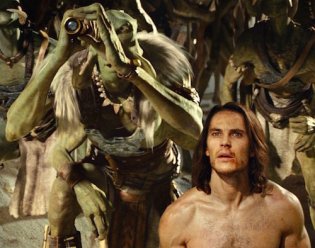 It doesn’t help that the film is structurally muddled at the offset. It begins on Mars, a voiceover detailing the conflict — an instant bombardment of names and concepts. I don’t mind things that challenge you to keep up, but it still feels a bit much. Then we jump to New York in the 1880s, where Carter is running away from someone in the streets. Then to his house, where his nephew has just turned up to be told he’s dead. You what? We just saw him in the telegraph office! And then we jump back to the 1860s, where he’s searching for gold and getting arrested (or something) by Bryan Cranston in a wig as some form of army officer. Then it gets a bit more straightforward. If being transported to Mars and meeting four-armed CG aliens who speak in subtitles is what you call “straightforward”, anyway.
This is mostly preamble, and it takes a long time to get through. I presume it’s faithful to the original story, because Cranston and co add virtually nothing to what goes on on Mars. That said, apparently Burroughs’ original book sticks to Carter exclusively, whereas the film keeps darting off to show us what’s going on elsewhere. I presume the idea was to give things a bit of momentum — while Carter’s being dragged around the Martian desert by his captors, we get to see the beginnings of the arranged marriage, etc. To me it just felt jumbled, and undermines Carter’s sense of confusion and discovery. We know far more of what’s going on than he does (if you can decipher it, anyway), leaving us waiting for our identification-figure to catch up.
 It feels a bit facile to criticise the quality of CGI these days, but that doesn’t stop John Carter from being over-ambitious in this regard. In fact, it’s not really the sometimes-half-assed green screen or occasional plastic-ness that’s the problem, but the design: those four-armed aliens are just a little too cartoony. Perhaps it’s a hangover from Stanton’s Pixar days, perhaps something just went a little awry during the process, but their design doesn’t look quite ‘real’ enough; a little like someone’s taken a real-life creature and then lightly caricatured it. I think it’s the eyes, which are perhaps a little too big and round and ‘cute’, but there’s something else indefinable there, or not there. These aliens aren’t just set dressing but proper motion-captured characters, played by the likes of Samantha Morton, Willem Dafoe, Thomas Haden Church and Polly Walker, so the lack of connection is regrettable.
The live-action cast don’t fare much better. You may remember Kitsch and Collins as co-stars of the poorly-received first Wolverine movie, where quite frankly they were two of the worst things in it (Kitsch was woefully miscast, for one). Doesn’t bode well for them being the leads, does it? Neither are as bad here, but neither quite click either. They’re surrounded by a gaggle of British thesps (West, Mark Strong, Ciaran Hinds, James Purefoy) who feel like they’re slumming it in roles that are beneath them.
Some of John Carter’s fans have accused audiences and critics of ‘bandwagonism’ — that is, hearing/assuming it’s bad and so treating it as such. I can assure you, that’s not the case here:  I was expecting, or perhaps hoping, to like it; to find a misunderstood old-style adventure full of entertainment value. It may be an old-style adventure, but that’s beside the point, because whatever it is, I just felt it wasn’t particularly well made: poorly constructed, weakly performed, lazily (and wrongly) assumptive of the audience’s familiarity with the material. Disappointing.

The UK TV premiere of John Carter is on BBC Two tonight at 6pm.
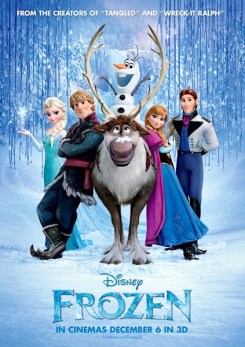 Frozen is a grim single-location thriller about three college kids trapped on a ski-lift overnight, battling hypothermia and worse over a hundred-foot drop. Or at least it was until last year, when Disney went and released its all-consuming mega-musical.
  Unlike the best Disneys, however, I think its appeal resides firmly with little girls — you don’t actually have to go very far on the internet to find people baffled by its success. Plenty of people think the music is bland, the characters underdeveloped, the moral and emotional arcs not fully thought-through, the visual style a rip-off from
 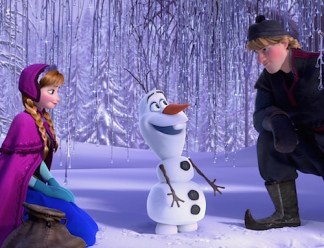 The lack of villain’s song is attributable to the fact that, for nearly the entire film, there are no nasty characters. A villain emerges right at the end to give us a climax, but for once that works — a genuine twist! It’s almost a shame it has to resort to that, but how else do you end a Hollywood movie other than a big dramatic confrontation? Plus, aforementioned snowman Olaf confounded my expectations, pulling off the quite remarkable feat of not being the most irritating CGI character since Jar Jar Binks. (I don’t know who is the most irritating CGI character since Jar Jar Binks, but Olaf is alright.)
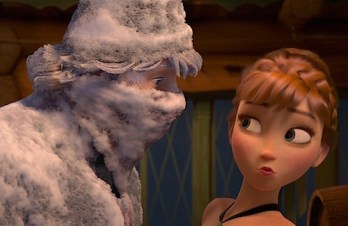 It’s not bad — it’s adequately cartoony — and actually the ice and snow effects are very, very good. It’s the character animation that I felt let it down, especially some of the more minor roles — there were points where their style and movement looked little better than you’d find in a video game cut scene.
 Frozen is by no means a bad Disney movie, and it does have a lot of favourable aspects. Whether the internet’s right and it’s not as good as Tangled, I wouldn’t care to say (I enjoyed Tangled, but at this point have largely forgotten it); conversely, the sometimes-rabid fan base are perhaps being a little over-enthusiastic. There’s nothing wrong with a kids’ movie being beloved by kids, though; and with all the dreadful things the media churns out for little girls to obsess over and centre their life values around, this is undoubtedly one of the most positive.
 Tom Hanks is Walt Disney and Emma Thompson is author P.L. Travers in “The Making of Mary Poppins: The Movie”. Disney has been desperate to turn Travers’ fictional nanny into a movie for years after he made a promise to his daughter; Travers has resisted, but now needs the money. She’s brought to LA to consult on the script, and proceeds to make life miserable for screenwriter Don DaGradi (Bradley Whitford) and songsmiths Robert and Richard Sherman (B.J. Novak and Jason Schwartzman). At the same time, we see the story of a family in Australia from the eyes of a little girl Ginty (Annie Rose Buckley), as they struggle with the whims of her father (Colin Farrell), a bank manager who’s a little too fond of the bottle. Guess what the connection is!
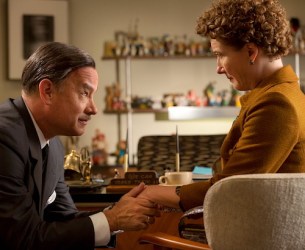 Similarly, Hanks’ part seems to be little more than a cameo at first, but he steadily appears often enough to make it a supporting role. Reportedly he has perfectly captured many of Disney’s real traits and idiosyncrasies, and who are we to doubt the word of people who knew the man? His performance is not just a shallow, simple impersonation, but there’s not that much meat to Disney’s character arc either.
 Some will find the story lacking in dirt, particularly when it comes to the portrayal of Disney. But it’s not whitewashed either, and do you really think the Disney Corporation would have allowed a movie to go ahead that depicts their founding father in a negative light? For that, I don’t think it’s as twee as it could have been — there’s definite conflict over what’s being done with Poppins, and, even with the film having turned out to be a solid-gold classic, we often find ourselves sympathising with Travers.
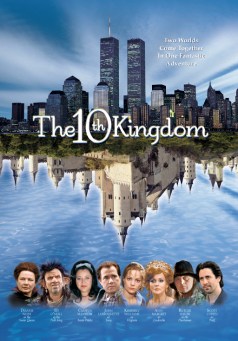 Created by British screenwriter Simon Moore (writer of
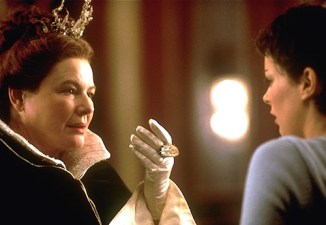
 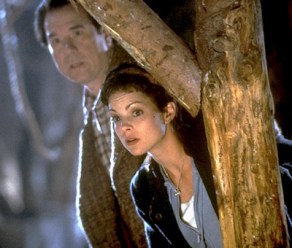 Anyway, the Nine Kingdoms is the place all our fairytales come from — the part of the narrative set there takes place “almost 200 years” after the “Golden Age”, when the events we know from stories actually happened. We’re led into this world by Virginia (Kimberly Williams) and her dad, Tony (John Larroquette), after indolent monarch-to-be Prince Wendell (Daniel Lapaine) flees to our world while escaping the Evil Queen (Dianne Wiest) and winds up taking the two New Yorkers back to his world. Along with Wolf (Scott Cohen), a chap with animalistic tendencies, the quartet try to stop the Evil Queen’s evil machinations.
 It also means the way it’s been edited into one long movie on DVD feels quite natural: it’s one long story with arbitrary breaks, not a series of finite episodes. (If you’re thinking, “of course it’s one story, it’s a miniseries”, plenty of single-narrative series and miniseries still function as discrete episodes that build to a whole.)
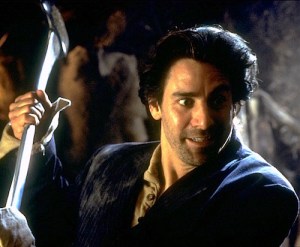 This gives the whole thing a heightened comedy tone, emphasised by many of the performances. A gaggle of troll siblings are irritatingly over-played, but Cohen’s meat-obsessed Wolf is a hammy delight (pun very much intended). The entertainment value means we quickly warm to the characters, so that when more perilous aspects of their quest do come into play later on, we care what happens. Plus, like most of the original fairytales (as opposed to Disney-style sanitised re-tellings), there’s the odd darker undercurrent. For instance, you may think the story of Snow White ends with a kiss and “happily ever after”, but here we’re told how the stepmother who poisoned Snow White was made to wear fire-heated iron shoes and ‘dance’ at the wedding until her feet were burnt raw, before being thrown out into the snow. Very dark and grim (and possibly from the original tale, for all I know).
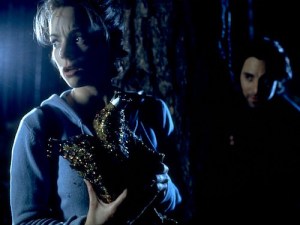 Little details in this vein abound: an apple tree has grown by Snow White’s cottage (don’t eat those apples!); the site of her glass coffin is now a tourist attraction; if you break a mirror, you genuinely get seven years’ bad luck… There’s also a pair of golden shoes that can turn you invisible, but the more you wear them the more you desire to use them all the time — what a precious idea (wink wink nudge nudge). These subversions also manifest in a strain of pleasant practicality; for instance, the abundant magic mirrors aren’t “just there”, but instead have been manufactured by dwarves. It lends the feel of a fully-conceived and rule-bound world, rather than an “anything can happen”, “just because” environment.
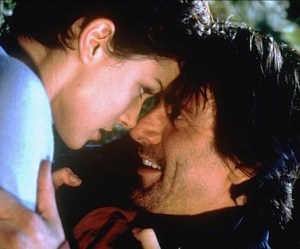 a world away from being locked in a castle until you change your mind. If this sounds like criticism, it isn’t. I’m not arguing the love story element of the series is unsuccessful — I’m sure it engages plenty of fans as the series’ primary attraction, even — but, on reflection, I’m not sure reading it as a Beauty and the Beast variation is actually that illuminating.
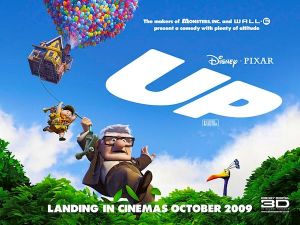 You know Up: it’s the Pixar movie where everyone talks about how amazing the first 10 minutes are, and never seems to have anything to say about the rest of the film.
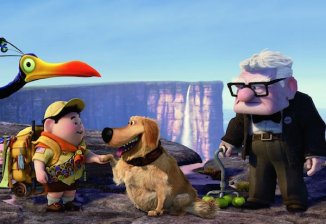 the best bits were shown off in advance. The special features reveal the extent the animators went to when researching real-world locations to influence the film’s strange, alien landscape; sadly, the fact the bizarre rock formations are actually a real thing somewhere in the world is more interesting than how they’re used in the film.
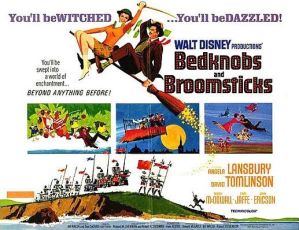 Disney attempted to replicate the success of
 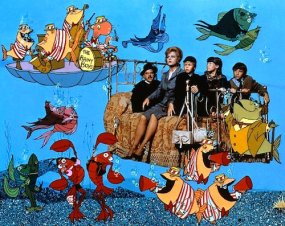 and one that’s mostly animated with our live-action heroes integrated; plus a climax where the good guys defeat one of the world’s great evils, with Poppins’ bankers here switched for the almost-as-bad Nazis. The magical special effects in that final sequence won an Oscar — and well deserved it was too. They look great, definitely holding up today, and it’s actually hard to be sure how they were all achieved.
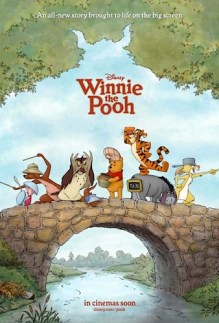 Winnie the Pooh, as many reviews on its release were keen to point out, is for small children. It doesn’t have the attempts to placate adults with their own jokes that elevate/plague most American animation; it’s only an attention-span-friendly hour long; and it has a lovely, genial, friendly tone, with brightly coloured characters, plinky-plonky songs and heartwarming moral messages.
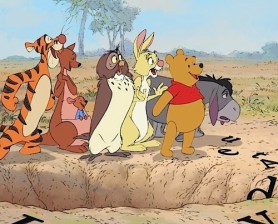 The majority of the film’s other elements click into place nicely too. The traditional animation is gorgeously executed, the voices are the ones we surely all know from growing up alongside Disney’s Pooh output, particularly Jim Cummings pulling double time as both Pooh and Tigger, as he has for decades. The exception I’d make is Bud Luckey’s Eeyore. I don’t know if he’s always sounded like that and I’d forgotten, but his voice didn’t work for me. It’s not the only problem: the songs can be a bit insipid; equally, a couple transcend that to work beautifully; and there’s no denying that it is a bit short; but then it doesn’t outstay its welcome, and hey,
 Disney’s 50th animated feature is Rapunzel in all but name, for no particularly good reason. It seemed to be met with universal praise on its release last year, critics hailing it as a return to Disney’s previous quality after a run of lacklustre releases, in particular the underwhelming return to 2D in the year before’s
  a number I usually particularly enjoy. It has one, I suppose, but it’s one of the weakest examples I’ve ever heard.
 Bolt is the 48th film in Disney’s animated canon (whatever the official name for that is these days), from their CG-only era that filled most of the ’00s. It’s a period already remembered as When Disney Lost Its Way, after the second (or is it third? I forget) ‘golden era’ of the early ’90s; the time that produced flops like
 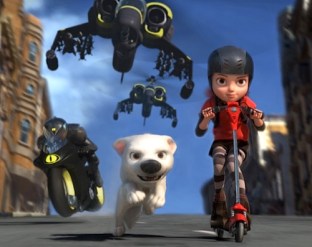 Also noteworthy are the action sequences. Far from being perfunctory attempts at liveliness, these are properly exciting, making full use of 3D CGI to create exciting and dynamic sequences. I’m not just talking about the couple we get from the TV-series-within-the-film either, but also the ‘real world’ ones as Bolt, Mittens and Rhino jump onto trains, out of moving vans, escape from a pound, etc. Of course, the TV-series-within-the-film is completely implausible — like you could film a TV show with massive action sequences in such a way that you only ever do a single take, never mind achieve all those effects on a TV budget. But then this is a film where a talking dog, cat and hamster work together to travel from New York to Hollywood entirely of their own volition — I think it’s safe to say no one’s aiming for documentary levels of realism.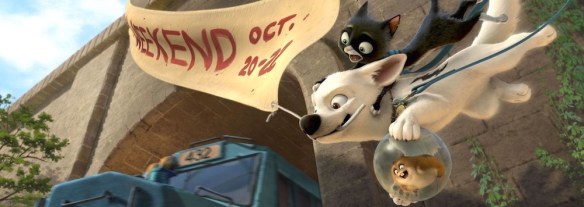
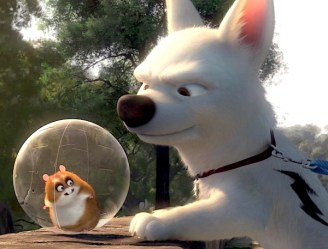 It would be easy to dismiss Bolt as part of Disney’s CG folly, especially as it stars Miley Cyrus and is immediately followed by their return to 2D animation, but I think that would be a mistake. It’s a fast-paced and fun adventure, with accurately-captured animals meaning it’s especially likely to appeal to dog lovers. Disney’s next golden era just might begin here.
 Do you need me to tell you how great Beauty and the Beast is? I imagine not. If you’ve seen it, you’ll know. If you haven’t, you really should, and then you’ll know.
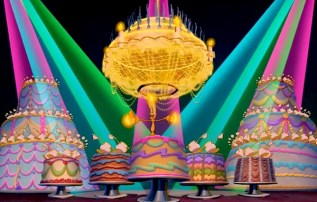 It’s not a bad song — not at all — but it’s a notch below the others. (There are a few more changes to the film than just adding the song, listed
  100Films.co.uk