
David Ayer | 117 mins | streaming (UHD) | 2.35:1 | USA / English & Spanish | 15
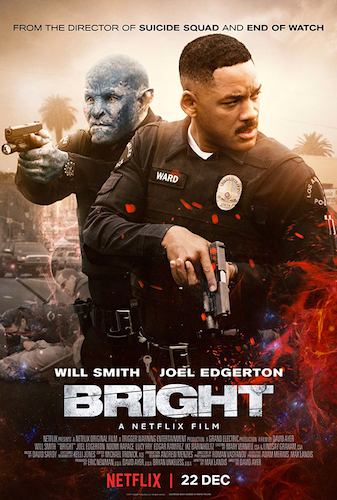
The director of L.A.-set crime thrillers Harsh Times, Street Kings, and End of Watch returns with another L.A.-set crime thriller, only this time with orcs. Yes, orcs. Also fairies and elves and dragons and all that.
But you knew that because you surely can’t’ve missed hearing about Bright these past few weeks. It’s Netflix’s first attempt at making a big-budget summer-tentpole-style blockbuster and they’ve been pushing it hard, but it was savaged by critics, only to then have proven immensely popular with viewers (it’s Netflix’s most-watched original production ever) and had a sequel speedily commissioned.
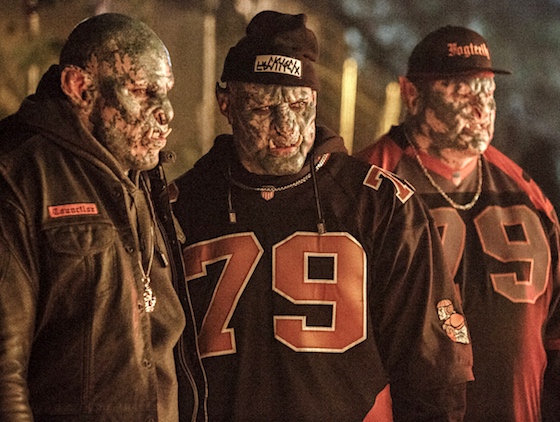
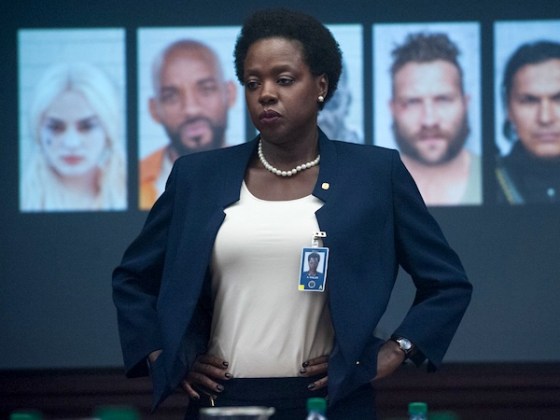
It’s set in an alternate present day where magic and the aforementioned fantastical creatures all exist. In L.A., humans are your regular run-of-the-mill people, elves are the well-off upper class living in a segregated oasis, and orcs are the poor underclass — a couple of thousand years ago there was a Lord of the Rings-style war to vanquish the Dark Lord, in which orcs picked the wrong side and still pay the price. Nonetheless, the LAPD has recently inducted the first orc cop (Joel Edgerton). When he and his partner (Will Smith) happen across a magic wand, a rare and immensely powerful device, they find themselves hunted by an evil elf (Noomi Rapace) who intends to resurrect the Dark Lord.
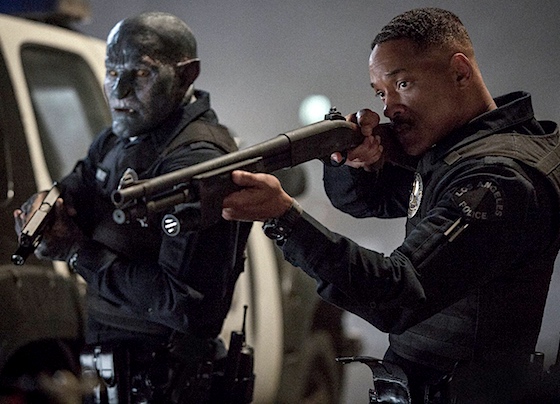
Bright is, straightforwardly, a mash-up of crime thriller and fantasy blockbuster. Visually and tonally it could be a sequel to End of Watch, were it not for the fantastical creatures. With them in the mix, the plot, creatures, terminology, etc, feels broadly familiar from other fantasy adventures. The unique point, obviously, is in combining these two disparate genres into a homogenous whole. In this regard, Max Landis’ screenplay is a mixed bag: I like the basic concept, and a lot of the ideas within it are decent too, but the execution leaves something to be desired.
For example, the alternate present-day L.A. is imagined just by switching out one real-life race for a fantasy one. So black people become orcs in a simple one-for-one switch. These race analogies are thuddingly heavy-handed, to the point where you wish they hadn’t bothered because then at least they might’ve done it by accident and it would’ve been subtle. Exposition is equally as on the nose, with characters spelling out world history and terminology to each other purely for the viewer’s benefit. It’s a challenge to convey this kind of information to the audience in a fantasy movie, but that’s not an excuse for doing it badly.
Ayer seems an apt choice for director — of course he is, because he made End of Watch and Bright really is very similar to that movie. He doesn’t seem to have a complete handle on the material, though. The pace feels all wrong — not terrible, just slower than it should be, like scenes need tightening up, maybe a few more deletions here and there. It feels like it’s been mis-paced in the same way as many a Netflix original series, which makes you wonder if this is a problem with someone who oversees stuff at Netflix rather than individual film/programme-makers. Conversely, it could be because most regular people just won’t notice it — these productions aren’t slow in the way an arthouse movie is slow, they’re just not moving through situations and dialogue at the rate they should; killing time by letting scenes roll on that bit longer than they have any purpose to, that kind of thing.
As the film goes on, it trades this early wheel-spinning for other problems: choppy editing; disjointed storytelling; ill-defined characters and motives. Noomi Rapace is severely underused as the villain — she has so little to do that the role could’ve been played by anyone. Edgar Ramirez isn’t quite so poorly served as an FBI-type elf also on the trail of the wand, but one wonders if someone was already thinking about sequels when shaping these supporting roles. At least Smith and Edgerton make for decent leads, even as they battle against the script’s character inconsistencies and dead-end subplots (for instance, a chunk of time spent on Smith’s home life at the start has barely any baring on later events).

Bright is hampered not by its potential-filled genre mash-up premise, but instead by the filmmakers chosen to execute that idea. They fitfully realise that potential, but it’s diluted by a rash of clichéd or plain undercooked filmmaking. The final result is a long way from perfect, but it’s also pretty far from being the disaster of epic proportions that critical and social media reaction seems suspiciously keen to paint it as (the Cannes-like “Netflix make TV not movies” sentiment is strong in some quarters). It’s a middle-of-the-road blockbuster movie, with some very solid plus points that are let down by some irritating negatives.

Bright is available on Netflix now and forever.
P.S. Random pointless thing of the week: there are British and American variations of the Bright poster. Spot the difference.
 2017 Academy Awards


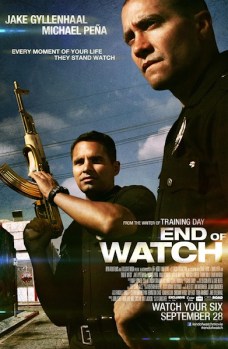 I don’t think anyone paid writer-turned-writer/director David Ayer much heed when he was one of a pack of people penning historically-inaccurate submarine thriller
  it would wash as a stylistic choice; because he attempts a diegetic explanation for why it’s shot this way, but then breaks the rules of that explanation instantly (and continues to do so, with increasing frequency), it turns a valid stylistic choice into an irritating, ill-thought-out distraction. Plus: you want to be innovative and shoot an L.A. cop movie on digital video? Too late! Michael Mann already got there… in 2006.
 Although there are things to commend End of Watch — in particular the performances, and even a couple of tense sequences when the filming style actually pays off — I can’t get on board with it being a best-of-year-type movie. Even if it could’ve been more — and, in spite of that varied CV, isn’t the best thing Ayer’s done (I very much liked his next movie, Brad Pitt WW2 tank movie
 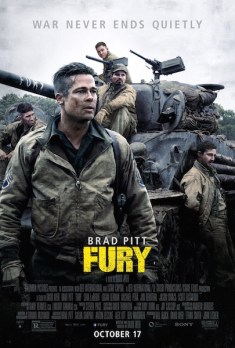 I don’t believe there are very many movies about tanks — there’s
 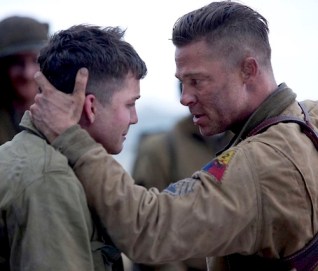 Most of the characters exist in a moral grey area, something which some reviewers seem to struggle with. From the off, our ostensible heroes are not shown in a particularly pleasant light, committing or encouraging acts we would view as unconscionable. As the film goes on, it seems like we’re being invited to bond with them, to respect or admire them. I’m not sure that’s a wholly accurate reading of it, though. I think we’re being shown different sides to them — much as Norman is, in fact. At first you see the depths they have reached; then, as you get to know them, you see a little more of their true (or at least their pre-corrupted-by-war) characters. Does this redeem them or excuse their actions? Well, that’s your decision. I don’t think the film is predicated on you coming round to their way of thinking. Without meaning to spoil anything, it’s not as if the meta/karmic world of plot construction lets them off scot-free by the end. Of course, whether we need our focus characters to be clean-cut heroes or whether complex morally-grey/black characters are preferable is another debate.
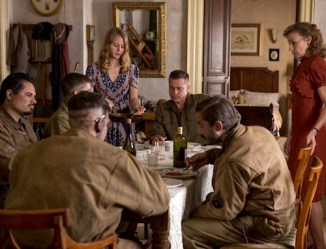 This is a scene most reviews seem to single out, I’ve since realised, but that’s for good reason: even watching it cold, the powerful writing, direction and performances mark it out as a sequence that transcends the movie it’s in. Again, it’s the unpredictability of what these men might do; the grey area of the guys we’re meant to think are the heroes not always being heroic.
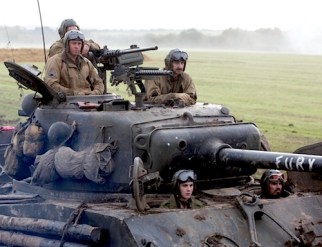 I think Fury is a rather rewarding movie for those that can, though. The fact it provokes debate is no bad thing — I think it’s a misinterpretation to read the film, as some online commenters clearly have, as “these guys do horrible things, but they’re the main characters and the not-Nazis, so I must be meant to like them, so the film is bad”. Well, I suppose it’s not news that some people struggle with cognitive dissonance. On the flipside, I don’t think you’re meant to outright hate them — there’s an element of “the Allies did bad things too, y’know” about the film, but that’s not its sole aim. I think it’s more complicated than that, and, naturally, all the better for it. Even on a more surface level, though, there’s adrenaline-pumping excitement to be had from the well-realised action scenes. It’s a combination that worked very well indeed for me, and if my score errs on the side of generosity then, well, consider it redressing the balance.
 100Films.co.uk