
You’ve probably heard that three short films have been released as part of the promotion for forthcoming sci-fi sequel Blade Runner 2049. More than just trailers, these shorts go some way to bridging the 30-year gap between 2049 and the original Blade Runner. They were released out of sequence over the past couple of months, but here they’re reviewed in chronological order.

(2017)
Shinichirô Watanabe | 16 mins | streaming (HD) | 1.78:1 | USA / English

The first short is an anime directed by Shinichirô Watanabe, best known for Cowboy Bebop and, I guess, helming two of the Animatrix shorts. Set a couple of years after Blade Runner, it tells the story of some Replicant rights activists and their successful attack on LA, which will lead to a ban on Replicant production.
As a story it is, of course, background detail — presumably not essential enough to be included in 2049 proper, but filling in the backstory for fans. It’s the kind of thing you could read about in just a line but is more exciting dramatised. That said, with such a short running time there’s no space to grow attached to characters, so the ultimate effect on the viewer isn’t so different to just reading about the events depicted.
As a short animation, however, it’s a quality production. Animation allows it to do things a live-action short couldn’t — you’d need a blockbuster CGI budget to pull this off for real. It’s a good marriage of form and intent: in the context of a prequel short, it’d be pointless to do an anime of people sat in a room talking. It has a bit of needlessly fiddly story structure at the start (including one of my pet peeves: “two weeks earlier”), but mostly it puts its short running time to decent use. There are a couple of striking, effective images, alongside various nods to the original film — visually, a lot of tributes are paid. Plus, look for cameos by Edward James Olmos’ Gaff and Dave Bautista’s character from 2049.
It may be worth noting that it’s nothing like Cowboy Bebop, either. No surprise — Bebop‘s tone hardly fits the grim world of Blade Runner. If you wanted an anime comparison, it’s more like a Ghost in the Shell short — again, not so surprising given the source similarities.
Despite my complaints about its structure and ultimate purpose, this is probably the best of the three shorts.

Watch Blade Runner: Black Out 2022 on YouTube here.
(2017)
Luke Scott | 7 mins | streaming (HD) | 2.40:1 | USA / English

2049 director Denis Villeneuve introduces each of the three shorts, explaining how he tapped filmmakers he respected to create these little tales. This one is by, to use Villeneuve’s word, his friend Luke Scott — director of Morgan and (most pertinently of all, I suspect) Ridley Scott’s son. We’re in live-action now, as entrepreneur Niander Wallace (Jared Leto) meets with some committee to convince them to re-legalise Replicant production.
It might seem odd, given their very different production styles, but this works well as a pair with 2022. It’s all in the story: the anime is about the final straw that banned Replicants; Nexus Dawn is about how they were brought back. Despite their short form, these films aren’t telling side stories, but revealing major points in Blade Runner‘s future history. There are also several direct references to the black out which further ties the shorts together. It might not be wholly clear in the anime itself, but that event was clearly world-changing. Perhaps that’s why 2022 was initially released last, to pay off the teasing references which feature in both live-action shorts.
For those seeking a tease for 2049, we get an indication of what Jared Leto’s performance will be like. I imagine those who find him inherently annoying will see nothing to challenge their preconception. For the rest of us, he’s okay. He suits the possibly-mad genius role, and thankfully keeps it understated. There’s also a supporting cast of names bigger you’d expect from just a prequel short (Doctor Strange‘s Benedict Wong, Peaky Blinders‘ Ned Dennehy), which I’m not sure adds a huge amount but perhaps indicates the esteem of the Blade Runner name.
Technically, the short itself is well shot — in both content and form, it could conceivably be a deleted scene from the main film. That’s both a blessing and a curse, I guess.

Watch 2036: Nexus Dawn on YouTube here.
(2017)
Luke Scott | 6 mins | streaming (HD) | 2.40:1 | USA / English

The final short, again helmed by Scott the Younger, is set just the year before the new film. It introduces us to Dave Bautista’s character, a kindly but down-on-his-luck kinda guy who one day finds himself in a violent altercation that will clearly change his life.
Even more than Nexus Dawn, this feels like a deleted scene — I won’t be at all surprised if this leads directly into the events of 2049. As it’s not dramatising a turning point in history, it feels the most trailer-like of the three shorts. It’s still a little background narrative that’s (presumably) not to he found in the film proper, but it seems to be teasing where 2049 will begin rather than filling in important backstory blanks. Plus, an opening montage of clips from 2049 includes another reference to the black out, again suggesting that the anime is actually the most significant and worthwhile of the three shorts.
Bautista continues to be a surprisingly charismatic actor — even with very little to do here, and keeping it low-key, you warm to him. Perhaps that’s the point of this short: for us to like Sapper, and understand what he’s capable of and why, before his appearance in 2049. Perhaps it’ll even be deserving of a higher rating after seeing Villeneuve’s film. As a film, the side-street setting is probably not that much more logistically complex than Nexus Dawn‘s single room (aside from all the extras involved), but Scott makes it feel more expansive.
At first blush Nowhere to Run feels like the least essential of the three prequels, but we’ll see if that changes with hindsight after viewing 2049.
Watch 2048: Nowhere to Run on YouTube here.
As a final thought, I’ll note that on Letterboxd I rated all three shorts 3.5 out of 5, and on IMDb gave them the equivalent 7 out of 10. Obviously I’ve separated them slightly here, with the anime getting 4 and the other two getting 3s, which would suggest an even finer gradation of marking (that I then rounded up/down). I don’t know if that’s really the case, but I think the reason why I settled on these differing scores is that the two live-action shorts feel like deleted scenes, while the anime feels like it’s expanding on something that would otherwise just be backstory. In other words, it depicts the most significant event in its own right.
Anyway, perhaps these scores will change after seeing 2049. Whether they do or don’t, all three shorts are essential viewing for fans, but probably inessential for the casual viewer — after all, if they really mattered, they’d be in the film.
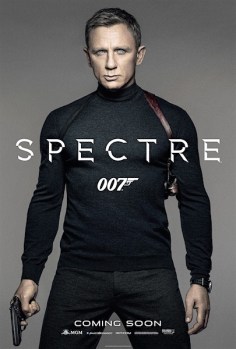 It’s been quite the year for spies on the big screen: mega-success for
 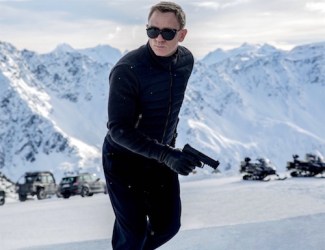 or, “they’ve merely brought back the classic Bond formula, albeit in the Craig-era style — what a regression”. You only have to look at the
  Craig’s films have stuck to the older formula of casting a respected/famous European: Dane Mads Mikkelsen, Frenchman Mathieu Amalric, Spaniard Javier Bardem, and now German “European actor du jour” Christoph Waltz. The double Oscar winner is on fine form at times, but there aren’t quite enough of those times. Again, without aiming to spoil anything, I’d say he’s not so much underused as misused.
 Well, I did too. Now I want a cake. And if you’d like to watch someone eat a Madeleine, check out
  Marvel Studios takes its boldest step yet, moving away from the present-day superhero milieu of its previous movies to a galaxy far, far away for a space opera epic. Its success, both critically and commercially, has cemented the Marvel Cinematic Universe as an infallible force in the current movie world. But, really, how good is it?
 The worst offender is the pod chase through Knowhere, a several-minutes-long sequence that registers as little more than a blur. There’s a shocking lack of clarity to its images, even by today’s standards. Maybe it’s better in 3D, when I guess the backgrounds would sink into the distance and important elements would be foregrounded; but in 2D, you can’t see what’s meant to be going on for all the fast-moving colour and split-second cuts. Almost as bad, though for different reasons, is the climax. It takes up an overlong chunk of the movie and at times feels repetitive of too many other Marvel climaxes — oh look, a giant spaceship crashing into a city! If anything, the film gets ‘worse’ as it goes on. Perhaps not in a very literal sense, but as the blustering action climax takes over, it moves further away from the stuff that makes it unique and interesting.
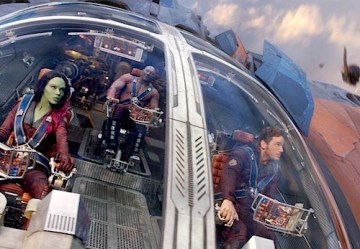 It isn’t even called Nova City, but I don’t have the foggiest what it is called because the film didn’t make me feel I should be learning it. Some more effort making sure we knew why that place mattered, even if it was just a clearer depiction of all the planning for its defence, might have sold the entire climax better.
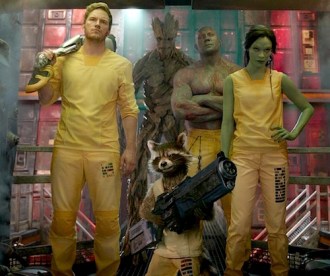 especially the overlong climax. Joss Whedon commented of his own Avengers film (as I quoted in
  100Films.co.uk