
Jon Favreau | 118 mins | cinema | 1.85:1 | USA / English | PG / PG
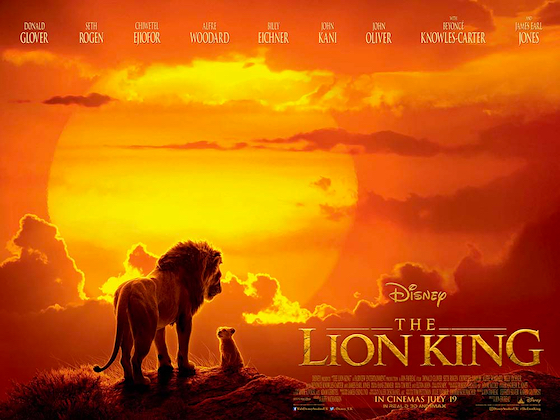
The Lion King might be the best Disney film. It’s that or Beauty and the Beast. (I’m sure many classicists would plump for something older, but sorry, I’m a ’90s kid.) (Also, by “Disney film” I mean their animated output. Obviously Disney release tonnes of other stuff, and have for a long time, but by “Disney film” we really mean the animations, don’t we? Not “any film that happens to be released by Disney”. I do, anyway. Especially in this context.)
Sorry, let me start again: The Lion King might be the best Disney film. So when they started down this road of live-action remakes of their beloved classics, it was inevitable their attention would turn to it. Of course, you can’t really do a live-action version of a film whose characters are all lions and hyenas and warthogs and stuff — not without going down the puppetry/costumes route of the stage version, anyhow, which apparently is gangbusters in the flesh (I’ve never seen it; that’s changing in August, Coronavirus permitting) but I can’t envisage working for the mass moviegoing audience. So instead they did the obvious thing and went for photo-real CGI. Heck, most “live-action” blockbusters nowadays are 50%+ CGI anyway, especially Disney ones (they didn’t even design the Avengers’ costumes for Endgame until post-production, ffs). But, at the end of the day, “photo-real CGI” is just another kind of animation. So what Disney have done is remake the animated Lion King in the totally different form of… animation.
Yeah, you probably knew all that already, and maybe had similar rants in your own mind / reviews / Twitter feeds / in Wendy’s / shouted at tea, Sue (delete as culturally appropriate). But it remains a relevant perspective on this film, because it indicates the essential question one keeps coming back to when watching it:
Why does this exist?

Obviously, the simple and true answer is “to make money”. These Disney live-action remakes have been financial successes, otherwise they wouldn’t keep doing them. The more popular the original animated movie, the more successful the remake. The Lion King is one of the most popular of them all, ergo it was a safe bet to be a big hit. The biggest risk was that “why bother?” question — audiences might’ve felt it was pointless and stayed away — but that didn’t happen: it made $1.656 billion worldwide, making it the 7th highest-grossing film of all time. The original film is down at a lowly 47th. If you were the kind of person who thought box office numbers were the be-all and end-all, you might conclude that this film is even better than the already-classic original. It is not. That it did well at the box office is no surprise — I think there’s a massive curiosity factor involved in these remakes (how faithful will they be; what will they have added or taken away; how will this familiar tale look and feel in a new medium) — but that would only get it so far, and most of it would come from opening weekend. Something obviously worked for audiences, because they must’ve kept coming back.
Well, I can’t explain that one for you. On my first viewing, I didn’t think it was a particularly good film. I rewatched it last night, this time in 3D, and enjoyed it a little more second time round. In part that was because it has really good 3D. Indeed, the praise I’d read for that version was the only reason I was tempted to give the film a second look, and it didn’t disappoint in that department. Whatever you make of the rest of the movie, the photo-real CGI is undeniably a phenomenal technical achievement, and it’s only improved by the life-like dimensionality brought by 3D. With a screen-filling 1.78:1 aspect ratio, it really is like looking through a window. Beyond that, though, I liked the film itself a little more. That’s probably down to expectations — not that I was expecting great things on my first viewing, but knowing exactly what was coming, being fully aware of all the disappointments in store, mitigated them somewhat, and so I was able to enjoy the bits it did well.
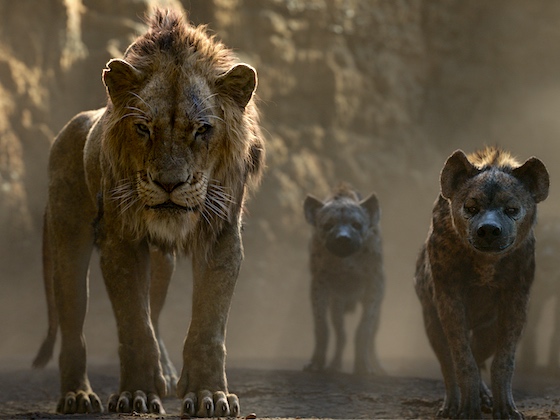
Nonetheless, I think the best way to sum up the experience is to say it’s like a cover song from a TV talent show: a reasonable approximation of the original, although clearly not as good, with unnecessarily added riffs and tricks as the cover artist struggles in vain to “make it their own” while not fundamentally deviating from what made the original so beloved. The trailers made it look like a shot-for-shot remake (possibly deliberately), but director Jon Favreau insisted it wasn’t. He’s right, but it might be better if he had been slavishly faithful, because when he strikes out in a different direction it undermines some of the best bits of the original. At least two songs are rendered as damp squibs by less-imaginative staging, while Can You Feel the Love Tonight is for some reason staged in the afternoon. But even more poorly handled is Be Prepared. It’s perhaps the greatest villain’s song in the Disney canon. You might’ve thought it was impossible to ruin a song so inherently fantastic. I certainly did. Sadly, Favreau has proven us wrong.
The voice cast are uniformly adequate, with a couple of standouts. The major one is Chiwetel Ejiofor, who gives a suitably menacing and conniving performance as the treacherous Scar. It’s at least the equal of the original, which considering that was performed by villain par excellence Jeremy Irons is saying something. (Be Prepared is obviously a black mark against this interpretation, but it’s not Ejiofor’s fault he was lumbered with an underpowered rewrite.) James Earl Jones reprises his commanding performance as Mufasa from the original movie. Actually, I don’t know whether he performed it anew or they just recycled his original recordings. You assume the former, but the film is so faithful that the latter may have sufficed. Elsewise, it’s the comedy parts that are given room to shine, with a nice double act from Billy Eichner and Seth Rogen as Timon and Pumbaa, and John Oliver nabbing the lion’s share of the best lines as Zazu (pun very much intended).

This remake has enough residual quality leftover from the original film to tip the scales into the “didn’t hate it” category. More critical viewers may not be so kind — indeed, they haven’t been. Conversely, those who are less demanding may find the result reasonably likeable (I first saw it with my mum, who thought it was a pleasant couple of hours at the cinema). Still, even with all the technical prowess on show, it can’t replicate either the magic or the majesty of the original animation.

The not-live-action live-action Lion King is on Sky Cinema from today.
 The latest from Marvel (or Marvel Studios, as they’re now branded, presumably in a bid to differentiate themselves from the properties owned by other studios that have been only too keen to use the Marvel logo and blur the line for the casual moviegoer) opens the door on a new facet of their shared cinematic universe, though does so in a movie whose plot follows the familiar “superhero origin story” rulebook. On the bright side, Doctor Strange has several other qualities to recommend it.
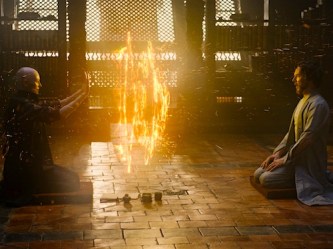 where the incredible effects are half the point — seemed dead in an era where every movie has CGI and every blockbuster has its share of once-impossible visuals. Strange demonstrates the form can be alive and well. The way the effects are created — with green screen and pixels — is the same as any other movie, but the designs and the visual imagination are exciting.
 Then there’s the cast. Obviously keen to avoid being typecast after playing an arrogant British genius in both
 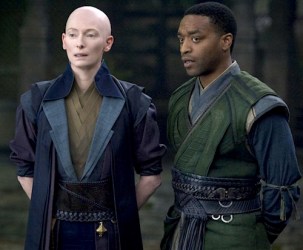 Besides, one of the film’s best characters is of Asian ethnicity, so it kinda balances out. That’s Benedict Wong as the sorcerers’ librarian, who’s likely to emerge as the film’s most popular character. It helps that viewers aren’t likely to expect much of him. Conversely, Chiwetel Ejiofor and Rachel McAdams are seriously underserved, perhaps hoping for more meat in the no-doubt-intended sequel(s).
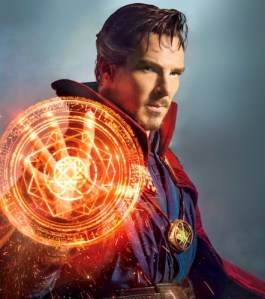 a teaser for another Marvel film, the other relates to the plot of the movie we’ve just seen. The former is first (and about 10% of my screening walked out before it came on) and the latter is, obviously, second (by which time about 90% had left). Those percentages ‘matter’ because, a) how do people not know Marvel’s rep for these scenes by this point?, and b) I think the scene related to the film you’ve just watched is the one that should be more attached to it, with the ‘teaser trailer’ being a fun bonus for those dedicated to stick around to the bitter end. But maybe that’s just me.


 Score:



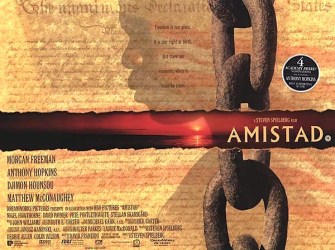 Feeling in need of more intellectual fare after helming
  Though Spielberg is certainly not immune to the Africans’ plight — the depiction of life on a slave ship is appropriately harrowing — it’s clear from early on which side he expects us to identify with, in terms of cultural background if not shared morality: as survivors of the mutiny talk the next day, the slavers’ Spanish dialogue is subtitled but the slaves’ African dialect is not. It’s a simple but effective technique to align us with one side — as I say, not morally (in no regard is Spielberg trying to apologise for the slavers), but socially. Unfortunately, it’s not sustainable: later, when we need to understand the Africans to follow a scene’s point, their dialogue is suddenly subtitled, and from then it’s sporadically translated as needed. I can see why that choice was made, but it makes the unsubtitled bits feel like a cheat.
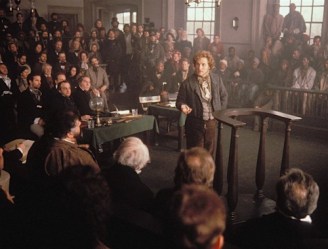 This can be said of Spielberg’s approach to the drama, too. Some of the courtroom stuff is suitably mired in legal technicalities and argument, but by film’s end it gets a little bit too… what’s the word? Not “preachy”. Not “sentimental”, exactly, though it’s born of that old criticism of Spielberg. “Melodramatic” may be on the money, though. It doesn’t help that everything reaches a climax — not only narratively, but also in the way it’s written, shot, acted, and scored — only for it to be revealed that it’s just the end of act two. Okay, that’s the truth of what happened (or near enough, for the purposes of this dramatisation), and by adapting it in that way it emulates the emotions the characters experienced; but from the audience’s perspective, you feel like you’ve reached the end… only to be served up another half-hour of movie. And it’s a long film too, so you feel that. It gets by because it’s fundamentally a good film, with strong performances and technical merits, but it’s a little bumpy for a bit.
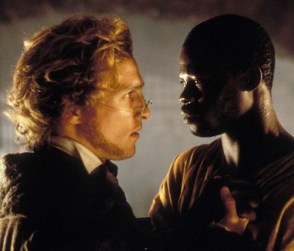 It’s easy to criticise Amistad, because Spielberg makes the production of very good movies look effortless, so the missteps stand out all the more. The story of La Amistad and its ‘cargo’ is a powerful one, and Spielberg has — naturally — turned it into a good film; but by remixing history to over-egg the message, it loses a little something. A valiant effort, but a film like
  2014 Academy Awards
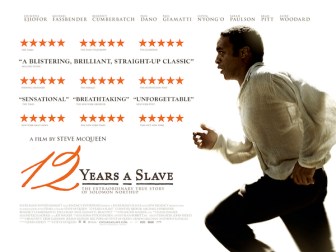 As we know, the Oscars are racist and always have been, especially recently. Like two years ago, when they didn’t give a load of nominations and several awards to a film about slavery from a black director and black screenwriter.
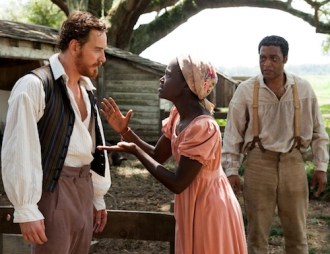 who will break your heart, and Michael Fassbender, who is overdue the gong for his many varied and accomplished performances. (I doubt his forthcoming triple of
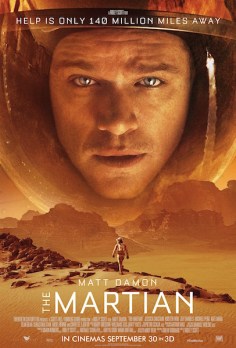 Ridley Scott’s latest arrives on Blu-ray in the UK today, with a disappointing dearth of special features (disliked
  Whether that’s appropriate or not is another matter. A well-argued
 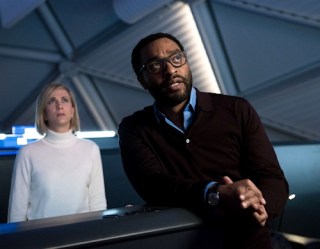 While Damon is stuck on Mars by himself, a starry supporting cast actually get to interact with each other. This is a quality ensemble and, short of writing an epic essay of a review where I just praise them all one by one, there’s little to do but list their names. That said, Jessica Chastain gets the most brazenly emotional beats as the commander who chose to leave Watney behind and has to face the consequences of her decision; Jeff Daniels treads a line between being an evil bureaucrat and just a regular bureaucrat (apparently consideration was given to turning him into a full-blown villain; thank goodness they swerved that bullet); Chiwetel Ejiofor brings easy gravitas to NASA’s director of Mars missions; Michael Peña provides some additional comic relief, if not as strikingly as he did in
  I’ve read at least one review that described The Martian as “an instant sci-fi classic”, and at least one other that described it as “no sci-fi classic”. I’m going to sit on the fence of that debate for the time being. What I will say is that it is undoubtedly an accomplished piece of entertainment. For a film that primarily concerns itself with a man applying scientific principles to tasks like “growing potatoes”, that’s surely some kind of achievement. In our current climate (both in society in general and in the “more explosions less talking, please” state of blockbuster cinema), to make space travel — and science in general — seem fun and appealing to the masses is no bad thing whatsoever.
 #1
#1  #7 Super 8 (2011)




















 Favourite Film of the Month
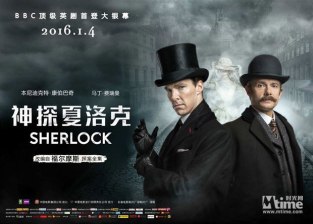 I know I’m meant to choose these awards, rather than let the Chinese public do it for me, but surely it’s worthy of note that the cinema release of Sherlock: The Abominable Bride saw it top the box office in China, as well as post strong figures in South Korea and other countries.

 100Films.co.uk