Archive 5, Vol.4

I have a backlog of 432 unreviewed feature films from my 2018 to 2021 viewing. This is where I give those films their day, five at a time, selected by a random number generator.

Today: singing vicars, grumpy gamers, very nice Kazakhs, and deleted actors.

This week’s Archive 5 are…

  • Going My Way (1944)
  • The Bells of St. Mary’s (1945)
  • Zero Charisma (2013)
  • Borat (2006)
  • The Thin Red Line (1998)


    Going My Way

    (1944)

    Leo McCarey | 126 mins | digital (HD) | 1.33:1 | USA / English | U
    Going My Way

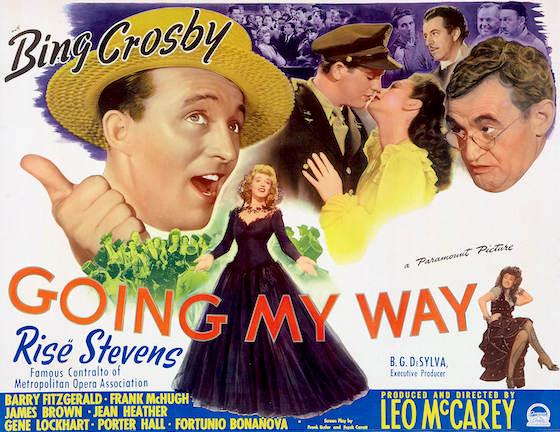
    The Oscars, eh? Every year film fans pay them a load of attention, and every year we seem to be disappointed with the outcome. But this isn’t some new phenomenon: Going My Way hails from the 1940s, but is perhaps the definitive example of a film that managed to sweep the Oscars (it won seven awards from ten nominations) against a bunch of films that have endured to much greater acclaim (films it competed against included Double Indemnity, Laura, Lifeboat, Gaslight, and Meet Me in St. Louis. I think we can agree those are all better-remembered on the whole).

    None of which is to say it’s a bad film. It’s a gently-paced series of vignettes, almost like a collection of short stories, springing from young priest Father O’Malley (Bing Crosby) arriving to take charge of a struggling New York City parish. His modern ways clash with the old-fashioned values of the incumbent Father Fitzgibbon (Barry Fitzgerald), but his worldly knowledge allows him to connect with some of the parish’s disaffected inhabitants. Despite the religious setting, it doesn’t lean too heavily on the wonders of Christianity (you know I’d be the first to rip into it if it did). Overall, it’s perfectly pleasant; an easy afternoon’s viewing.

    Incidentally (and here’s a good bit of trivia that might come in handy for a quiz someday), it was the first Oscar Best Picture winner to have a sequel: The Bells of St. Mary’s, released the very next year… and also the very next review in this roundup…

    3 out of 5

    Going My Way was #93 in my 100 Films in a Year Challenge 2021.


    The Bells of St. Mary’s

    (1945)

    Leo McCary | 126 mins | TV (SD) | 4:3 | USA / English | U
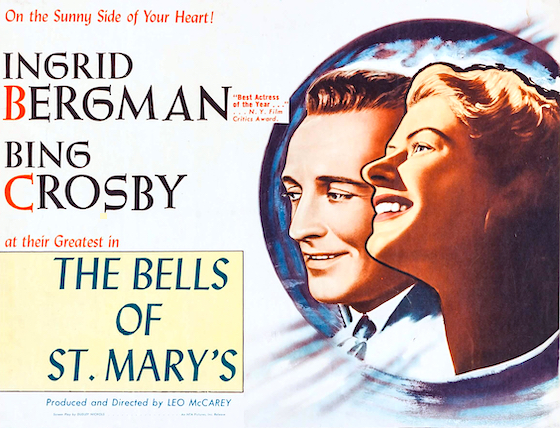
    The Bells of St. Mary's

    This followup to Going My Way was not only the first sequel to an Oscar Best Picture winner, but was also the first sequel to be nominated for the Best Picture Oscar.

    Bing Crosby returns as Father O’Malley, sent to a new locale, ready to solve another series of subplots at a struggling religious institution, this time butting heads (sort of — it’s never as dramatic as that makes it sound) with Ingrid Bergman’s head nun. Like the first one, it’s really a bundle of subplots for Bing to ‘solve’. The low-stakes problems and amiable tone between the two leads, even when they’re disagreeing, makes for a gentle and relaxing kind of film. I’d give it the edge over its Oscar-winning predecessor, thanks primarily to Bergman’s performance, but neither film is likely to set anyone’s world alight.

    As well as their Oscar success, the films were the highest grossing at the US box office for 1945 and ’46, respectively, another first for a film ‘series’. And yet, with six decades distance, they’re little more than also-rans; nicely obscure trivia answers to “films that won/were nominated for Best Picture”. Maybe there’s a lesson in that for anyone obsessed with the current cultural zeitgeist.

    3 out of 5

    The Bells of St. Mary’s was #187 in my 100 Films in a Year Challenge 2021.


    Zero Charisma

    (2013)

    Katie Graham & Andrew Matthews | 88 mins | digital (HD) | 16:9 | USA / English

    Zero Charisma

    I’d nickname this Portrait of a Manbaby on Fire. The manbaby in question is Scott (Sam Eidson), a stereotypical alpha-nerd: he has a neckbeard; he wears black T-shirts that feature elaborate depictions of grim reapers and the like; he lives with his grandma; he paints miniature fantasy figurines; he’s the Game Master of a role-playing group, which he rules with an iron fist. But when into-geeky-stuff hipster Miles (Garrett Graham) joins the group and everyone really likes him, Scott finds his position threatened, and he’s not happy about it.

    As much as geek/nerd culture has transitioned into the mainstream over the past couple of decades, there’s still stuff that remains the preserve of the hardcore; the truly nerdy. That culture clash is part of what Zero Charisma is about, of course, with Scott’s true old-fashioned kind of nerdishness clashing with Miles’s new-school cool. But it’s also a character study of the former. Scott may seem a stereotype — like The Simpsons’ Comic Book Guy rendered in live-action — but I’d wager anyone who’s moved in nerdish circles has known someone at least a bit like him. Stereotypes are stereotypes for a reason. The film exposes and examines those to often amusing effect. Some have said it exaggerates these things, but I don’t think it’s particularly guilty of that. Maybe it generalises them, and lumps all the worst characteristics of the extremely nerdy together into one character, but that doesn’t make it inaccurate, just broad.

    My only real problem was the ending. There’s a scene where everything comes to a head — a climax, if you will — but, in the wake of that, I felt it lacked adequate resolution. Has Scott learnt anything from this experience? Is he a changed man? Maybe a little, but not completely. To be fair, that’s a realistic character arc, because whose personality changes overnight after a single revelation? And yet it also doesn’t feel like the filmmakers quite know how they want to leave things. If they’d been going for a “change takes time and is incremental, but Scott’s started on that road” kinda message, I would have approved. Instead, the film tries to have its cake and eat it by showing Scott as better on the surface, but then secretly GMing a game where he still behaves like an asshole. Maybe it’s trying to say we can never truly change, however much our flaws are highlighted to us, which would be a pretty glum way to end an otherwise likeable comedy.

    3 out of 5

    Zero Charisma was #109 in my 100 Films in a Year Challenge 2020.


    Borat

    (2006)

    aka Borat: Cultural Learnings of America for Make Benefit Glorious Nation of Kazakhstan

    Larry Charles | 84 mins | digital (HD) | 16:9 | USA & UK / English | 15 / R
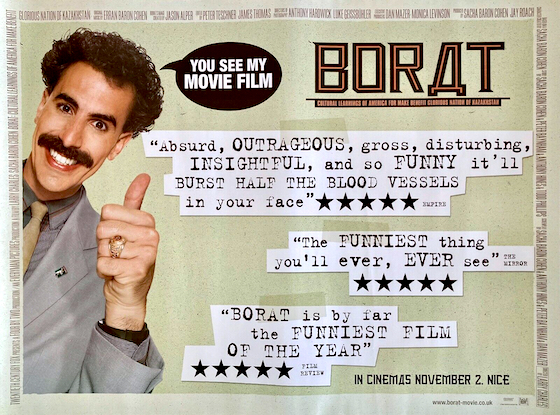
    Borat

    Ali G’s Sacha Baron Cohen adopts the persona of a Kazakh journalist to ostensibly interview Americans about their culture, but, unbeknownst to them, he’s of course really looking to expose their ludicrous views (you just know that, ten years later, a lot of these people voted for Trump) and take the piss out of them for our entertainment.

    As with most sketch-based comedy, the end result is a mixed bag. Sometimes it’s very funny; other times, it’s just being gross for the sake of it, like in a naked fight between Borat and his portly producer. A few bits don’t quite land — sometimes you can feel Baron Cohen’s not getting the response he wanted out of his target — and, even though he’s taking the piss out of people who deserve it, it sometimes gets a bit uncomfortable (though that might just be my English reserve/politeness kicking in and making me cringe). Most of the sketches are quite short, which is nice — they generally don’t outstay their welcome, and, if one isn’t working, you can be assured another will be along shortly.

    3 out of 5

    Borat was #220 in my 100 Films in a Year Challenge 2020.


    The Thin Red Line

    (1998)

    Terrence Malick | 171 mins | Blu-ray | 2.35:1 | USA / English | 15 / R

    The Thin Red Line

    An extensive cast of famous actors and recognisable faces star as a battalion of soldiers who spend 2 hours and 51 minutes taking one (1) hill in Terrence Malick’s very Terrence-Malick-y World War 2 movie. I mean, this is a movie about a battle in which the first shots aren’t fired until past the 45 minute mark, but there are plenty of shots showing the minutiae of nature. And there’s a lot of discussion about how there isn’t enough water.

    None of which is necessarily a problem — indeed, there are plenty of people who think this is a great movie, and I’m glad for them. But for everyone who loves it, there’s someone who’d call it “pretentious and self-indulgent, despite gun battles and lush cinematography.” I find myself somewhat stuck in the middle. I mean, if you were expecting a normal combat movie from Terrence Malick, more fool you. And it’s unquestionably beautifully shot — so many gorgeous visuals, but also effective camerawork and editing to convey, say, the chaos of battle. But I also found it to be bitty and episodic. Well, calling them “episodes” might be kind — they’re scenes; sometimes less than scenes; just moments, or even shots. It’s like a really long deleted scenes package pretending to be a movie.

    Of course, the behind-the-scenes stories sort of support that reading. The first cut clocked in at five hours. It took two editors and thirteen months of post-production to get it to a manageable size. Hans Zimmer composed over four hours of music, but only for a few bits of his work made it into the final cut. Billy Bob Thornton recorded narration for the entire film; the released cut has eight different narrators, but none of Thornton’s work is in there. Many actors thought they had significant roles, but found their performances reduced to little more than cameos. Most famously, Adrien Brody thought he was playing the lead role, only to discover at the premiere that he’s in just a couple of shots, and doesn’t even speak until over halfway through (and then it’s just a brief voiceover). And then there are the actors whose work was left on the cutting room floor: Bill Pullman, Gary Oldman, Lukas Haas, Viggo Mortensen, Martin Sheen, Jason Patric, Mickey Rourke… This movie has more great actors whose performances were deleted entirely than most movies have in their entire cast!

    All of which suggests a movie that should be universally recognised as a disaster. That it isn’t — quite the opposite — is testament to something. Maybe someday I’ll rewatch it and find out what.

    3 out of 5

    The Thin Red Line was #77 in my 100 Films in a Year Challenge 2020. It was viewed as an additional film for Blindspot 2020 after I failed to watch it for WDYMYHS 2019.
  • Archive 5, Vol.2

    I have a backlog of 442 unreviewed feature films from my 2018 to 2021 viewing. This is where I give those films their day, five at a time, selected by a random number generator.

    Today: musical comedies from ’41 and ’51; murder mysteries from ’33 and ’73; and an animated film that changed the Oscars.

    This week’s Archive 5 are…

  • Royal Wedding (1951)
  • A Study in Scarlet (1933)
  • Chicken Run (2000)
  • The Last of Sheila (1973)
  • Road to Zanzibar (1941)


    Royal Wedding

    (1951)

    aka Wedding Bells

    Stanley Donen | 93 mins | digital (SD) | 4:3 | USA / English | U

    Royal Wedding

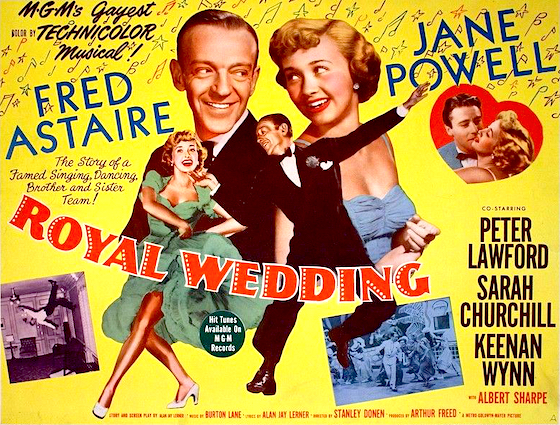
    Cynically, I assumed this US production was designed as a cash-in to a news event, most likely the wedding of Princess Elizabeth (i.e. the Queen) and Philip. Although those are indeed the eponymous nuptials, they actually took place several years earlier, in 1947; and in the UK, for its initial release the film was retitled Wedding Bells so audiences wouldn’t think it was a documentary about the real event. So much for my modern cynicism.

    The actual plot is semi-biographical, inspired by the real-life dance partnership of the film’s star, Fred Astaire, and his sister Adele, and who she went on to marry. Here the sister is played by Jane Powell (almost 30 years Astaire’s younger) as the duo take their successful Broadway show across the ocean to London in time for the royal wedding. Such window dressing aside, the plot that unfurls is run-of-the-mill, with both siblings finding themselves in romantic entanglements, and the songs are unmemorable too. The object of Astaire’s affection is played by Sarah Churchill, daughter of Winston Churchill, which adds a bit of fun trivia, at least.

    There is one noteworthy highlight: a set piece in which Astaire dances up the walls and across the ceiling of his hotel room, an effect that’s achieved seamlessly — there’s no wobble or what have you to give away the trickery, and Astaire’s choreography helps hide the behind-the-scenes technique too. There are one or two other neat bits if you’re a fan of dance-y musicals, but, on the whole, this is a thoroughly middle-of-the-road Astaire musical — not bad, just no more than adequate.

    3 out of 5

    Royal Wedding was #180 in my 100 Films in a Year Challenge 2021.


    A Study in Scarlet

    (1933)

    Edwin L. Marin | 72 mins | Blu-ray | 1.33:1 | USA / English | U

    A Study in Scarlet

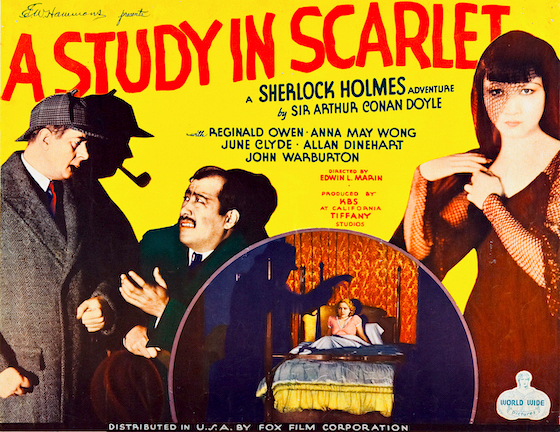
    For some reason, cinema has a long history of taking the titles of original Sherlock Holmes stories but then producing an entirely new plot underneath. A Study in Scarlet — the very first of Sir Arthur Conan Doyle’s Holmes works — seems to be a particularly afflicted tale. It features the first meeting of Holmes and his roommate / sidekick / chronicler, Dr Watson, but I think there are two adaptations that actually show this — and, ironically, neither of them are actually called A Study in Scarlet (one is the debut episode of Sherlock, A Study in Pink, and the other is the first episode of the Russian series The Adventures of Sherlock Holmes and Dr. Watson, which is called Acquaintance). According to IMDb, “the Conan Doyle estate quoted the producers a price for the rights to the title and a considerably higher price to use the original story” — perhaps they did that all the time, hence my observed phenomena.

    Obviously, this ‘poverty row’ effort is one such example of title/story mismatch: this so-called adaptation stars Sherlock Holmes and Dr Watson… and that’s where similarities to the novel end. The pair don’t even live at 221b Baker Street — for no apparent reason, it’s been changed to 221a. Did the filmmakers just misremember one of the most famous addresses in literature? Having only paid for the rights to the title, the producers hired director Robert Florey (the Marx Brothers’ The Cocoanuts; Murders in the Rue Morgue) to write a new story, and actor Reginald Owen — who stars as Holmes — wrote the dialogue. Owen hoped this would be the first in a series of Holmes films starring himself. It wasn’t.

    Physically, Owen isn’t anyone’s ideal image of Holmes, but his actual performance is adequate. Much the same can be said of the whole film: it’s an entertaining-enough 70-minute crime romp, with enough incident to create a brisk pace, and a use of the rhyme Ten Little Indians that makes you wonder if Agatha Christie saw this movie before she published And Then There Were None six years later (or is it just a coincidence? The audio commentators spend a good deal of time chewing it over). Given second billing behind Owen is bona fide Chinese-American movie star Anna May Wong, even though she has relatively little screen time. She makes her mark, though, with a role that doesn’t simply conform to racial stereotypes (possibly an unintended side effect of her late casting rather than genuine progressivism by the filmmakers, but sometimes you gotta take what you can get).

    This particular Study in Scarlet is a long way from being a definitive Sherlock Holmes movie, but for fans of ’30s detective flicks, it’s nonetheless a likeable little adventure.

    3 out of 5

    A Study in Scarlet was #206 in my 100 Films in a Year Challenge 2021.


    Chicken Run

    (2000)

    Peter Lord & Nick Park | 84 mins | digital (HD) | 16:9 | UK, USA & France / English | U / G

    Chicken Run

    I’ve always enjoyed Aardman’s work. I grew up watching the Wallace & Gromit shorts on TV, and have seen all of their feature output — except their first. I’m not sure why it’s taken me 20 years to get round to Chicken Run. I guess when it was originally released I had grown out of “kid’s movies” but not yet grown back into them; but since then, to be honest, something about it never particularly appealed to me. It certainly has its fans: it’s still the highest grossing stop motion film ever; there was a push to get it an Oscar Best Picture nomination, the failure of which led to the creation of a category it could’ve won, Best Animated Feature (trust the Academy to shut the door after the horse had bolted); and when Netflix recently announced a sequel, there was much pleasure on social media.

    So, finally getting round to it, would I discover what I’d been missing all along? Unfortunately, no. I thought it was fine. In no way did I dislike it, but nor did it charm me in the way of my favourite Aardman productions. It’s rather dark for U-rated film — it doesn’t mince its words or imagery about the fact the chickens are being killed — and that contributes to some particularly effective sequences, like when our heroes end up inside the pie machine, or a suitably exciting climactic action sequence. There are some reliably decent gags along the way, too.

    I’m sure I’ll watch the sequel. Maybe I’ll like it more. But, I confess, the fact they’ve now announced a new Wallace & Gromit movie for the year after does have me even more excited.

    3 out of 5

    Chicken Run was #148 in my 100 Films in a Year Challenge 2020.


    The Last of Sheila

    (1973)

    Herbert Ross | 120 mins | digital (SD) | 1.85:1 | USA / English | 15* / PG

    The Last of Sheila

    I’d never even heard of this before Rian Johnson mentioned it as an inspiration for Knives Out 2. Co-written by Anthony Perkins (yes, Norman Bates from Psycho) and Stephen Sondheim (yes, the famous musical composer), The Last of Sheila is a murder mystery firmly in the Agatha Christie mould — despite the writers’ pedigree, there are no significant horror elements (even the deaths are, at worst, on the PG/12 borderline) and certainly no song-and-dance numbers (excepting a magnificently inappropriate song over the end credits, sung by Bette Midler). Apparently Perkins and Sondheim used to host elaborate scavenger hunts for their friends in the late ’60s and early ’70s, and they adapted them into a screenplay at the suggestion of a guest, Herbert Ross, who produced and directed the film (seems only fair).

    Further inspiration came from their professional lives and acquaintances, because the potential victims and suspects are all actresses, agents, and the like, gathered for a Mediterranean cruise aboard a producer’s yacht. He proposes they play a game about secrets and gossip — but clearly one of the secrets in play is too big, because someone winds up murdered. A well-constructed mystery is unfurled throughout the film, although its execution is a little variable: a fun, very Christie-esque first half gives way to long talky scenes in the second, as characters stand around and explain the plot to each other. But when that plot is as good as this — with some nice surprises, plus motives dark enough to give it a little edge — it feels churlish to object too strongly.

    4 out of 5

    The Last of Sheila was #186 in my 100 Films in a Year Challenge 2021.

    * IMDb says it was given a 15 on video, but the BBFC say it hasn’t been rated since 1973, when it got an AA. The BBFC site is crap nowadays; IMDb will accept any old junk users submit. You decide. ^


    Road to Zanzibar

    (1941)

    Victor Schertzinger | 87 mins | DVD | 1.33:1 | USA / English | PG

    Road to Zanzibar

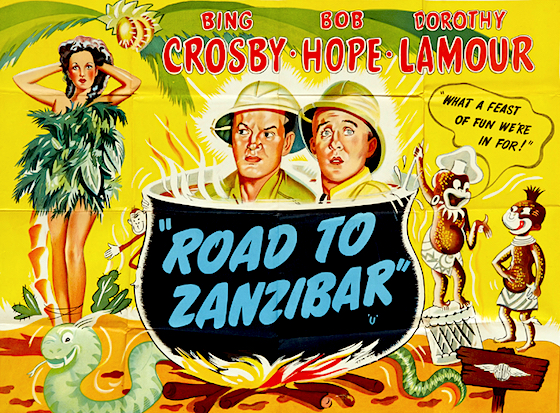
    The second in what became the Road To… series — though it was never intended as such. What ended up becoming Road to Zanzibar was initially an original feature, first offered to Fred MacMurray (this before his roles in the likes of Double Indemnity and The Apartment) and George Burns (an actor I’m not particularly familiar with). After they rejected it, apparently someone at Paramount remembered Road to Singapore had done relatively well, and that Bob Hope and Bing Crosby seemed like a good pairing, and so they were offered it.

    As I wrote in my last review of a Road To film (which was over 11 years ago?! Jesus…), if you’ve seen one Road To film then you’ve a fair idea what to expect from any other — essentially, a suitably daft bit of fluff and fun. This one’s a bit thin — on plot, on gags, on everything — but it skates by on the charm of Bob and Bing, joined, as ever, by Dorothy Lamour. The only serious problem is the same as Singapore: dated depictions of African stereotypes. It kind of gets away with it by being a spoof of “African adventure”-type movies, but maybe that’s me being kind with hindsight. Either way, the bit where the tribe’s African dialogue is subtitled with contemporary American vernacular is one of the film’s more amusing gags.

    3 out of 5

    Road to Zanzibar was #110 in my 100 Films in a Year Challenge 2019.


  • Road to Rio (1947)

    2010 #101
    Norman Z. McLeod | 97 mins | TV | U

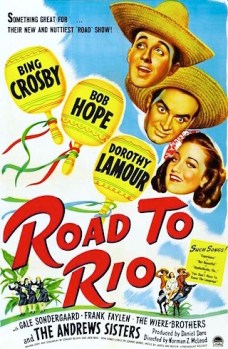
    Bing Crosby, Bob Hope and Dorothy Lamour return for the fifth film in the Road to… series.
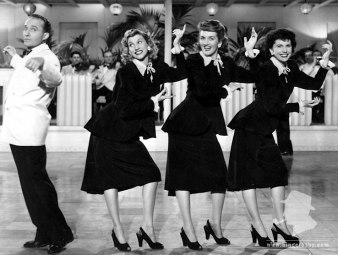
    If you’ve seen one Road to film then you’ve a fair idea what to expect from any other: lots of comedy, a few songs, a bit of romance, as well as some general hijinks. The differences, in all of these aspects, lie in the specifics: which songs, which gags, and so on. Even the plot’s largely the same, though transplanted to different settings. Not that the story really matters — it’s a post on which to hang jokes, slapstick routines, musical numbers, and whatever else the stars and filmmakers felt like throwing into the pot. One might say it’s a variety show with a framing device, though there is a little more to the narrative than that.

    In this particular entry, my personal preferences largely extend to the comedy scenes, though the musical side is noteworthy as the only film Bing Crosby and the Andrews Sisters appeared in together. But my preferred trio here is the Wiere Brothers, as three Brazilian musicians who enable a couple of good comedy routines. It’s awkward to list specific favourites when it comes to such sequences — there’s a danger of either ruining the joke or not conveying why it’s worth mentioning — but Rio has its share, I promise.

    To relate it to the other Road to movies I’ve seen (and reviewed), in terms of quality Rio falls ahead of Singapore but behind Morocco. The three stars I’ve awarded to each belies how much I enjoyed them, with Morocco in particular worth a fourth. But I think it’s also fair to say these films are a rather dated style of entertainment. That’s not necessarily a bad thing — as noted, I still think they’re fun, and I’m sure many others do and would too — but plenty of modern viewers would find them (to be polite) too quaint.

    3 out of 5

    High Society (1956)

    2009 #54
    Charles Walters | 107 mins | DVD | U

    High SocietyCole Porter-scored musical remake of The Philadelphia Story, which is probably most famous for featuring Who Wants to Be a Millionaire? and being star Grace Kelly’s final film before becoming a princess.

    Despite rarely singing, Kelly is by far the film’s standout element — it’s easy to believe three different men would be vying for her affection, but she also gets the chance to show the greatest range of any cast member. Admittedly it’s shades of comedy rather than a full awards-worthy display of ability, but she carries the film beautifully. It’s no wonder her husband-to-be, Prince Rainier of Monaco, objected to her appearing in movies when she played roles such as this: a divorcee who at one point allegedly sleeps with another man on the eve of her wedding to a third is surely no role for a princess. (Turns out she didn’t sleep with him, mind.)

    Bing Crosby and Frank Sinatra are more-or-less themselves as the male leads, though the sole song they perform together, Well, Did You Evah!, is one of the film’s best — despite being a late addition from a previous Cole Porter musical after it was realised Crosby and Sinatra didn’t have a number together. Louis Armstrong also plays himself, literally, and brightens up the screen whenever he appears. His band’s duet with Crosby, Now You Has Jazz, is another of the film’s highlights.

    Despite being adapted from an acclaimed play and film, the plot feels like a relatively slight contrivance to link together a couple of songs — alternately of the Romantic and Comedic variety — and some farcical humour with a romance-based thread. That the right people end up together is no surprise — so little surprise, in fact, that the story doesn’t even bother with such trivial things as making the final entanglements come together believably.

    No matter. It’s the journey to the inevitable conclusion, through a few comical scenes and a few decent tunes, that makes High Society a perfectly pleasant dose of entertainment.

    4 out of 5

    High Society is on TCM UK today, Saturday 4th April 2015, at 4:15pm, and on Sunday at 9:35am.

    White Christmas (1954)

    2008 #97
    Michael Curtiz | 115 mins | DVD | U

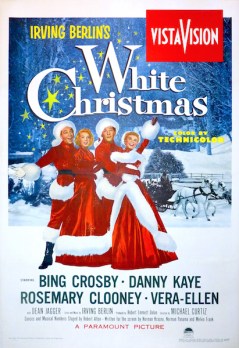
    White ChristmasWhite Christmas is surprisingly un-Christmassy. Yes, it’s set at the right time of year, and the plot concerns itself with do-gooding and charity and other such vaguely seasonal themes; but, crucially, there’s a distinct absence of snow (until the very end) and little else actually inspires much Christmas feeling.
    The plot winds its way to a moving finale, but, baring a few memorable numbers — Sisters, for example; and, particularly, a rendition of it by the male leads — most of the path there is quite average. One wonders how much of its renown is actually based on the titular song.

    3 out of 5

    White Christmas is on Film4 today, Monday 24th November 2014, at 12:50pm.

    Road to Singapore (1940)

    2008 #61
    Victor Schertzinger | 85 mins | VHS | U

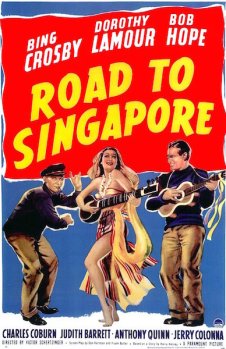
    Road to SingaporeBob Hope and Bing Crosby star as a pair of young(ish) playboy sailors who run away from responsibility and family expectations in this comedy that launched the perennially popular Road to… series, which would spawn six sequels over the next 22 years.
    Rather than a “comedy”, Road to Singapore might best be described as a “variety film” — it offers a mix of comedy, excitement, romance and song, a selection of entertainment that is more often provided by a few hours of TV these days. While it’s predominately light-hearted, the overall air is still more serious than that of the one other Road to… film I’ve seen, Road to Morocco: the plot seems to have been the film’s starting point, rather than an afterthought to connect the appropriate set pieces, and a couple of fight scenes are not wholly comedic in their choreography.

    Unfortunately, in spite of this, there’s nothing here that’s as memorable as in Morocco. Bob and Bing are a great double act, undoubtedly carrying the film, but while it starts well enough it loses it as it goes on — even at a brief 85 minutes, it begins to drag early in the second half. It’s also worth noting that much of it is incredibly dated now, peppered with things like blacked-up natives (and our heroes blacking up to fit in) and the “good little housewife” routine. This is more an observation than a criticism — it’s very much a film of its time.

    It might also be worth noting that, while I found Singapore reasonably entertaining, the friend I was watching with — who has enjoyed several other entries in the series, but had yet to see this — found it lacking. The score, however, is solely my own.

    3 out of 5

    Road to Morocco (1942)

    2007 #56
    David Butler | 78 mins | VHS | U

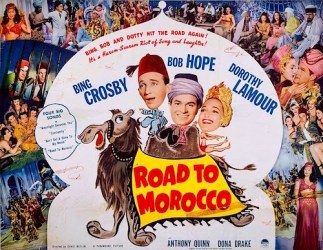
    Road to MoroccoGentle, silly humour abound in this comedy, the third in the Road to… series. If you remember those plays that Morecambe & Wise used to do you’ll have a fair idea what this feels like, although with a couple of added musical numbers (and pretty good ones at that). It’s not ‘great cinema’ and it won’t be to everyone’s taste, but it makes for a light, fun way to spend not much more than an hour.

    3 out of 5