
Paul Verhoeven | 108 mins | TV (HD) | 18 / R
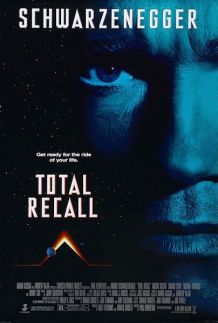 Post Inception, it feels like we should be seeing a revival of interest in all things Total Recall, concerned as it is with dreams, fake memories, and what’s real and what isn’t. On the other hand, aside from an ambiguity about whether the lead character is dreaming or not — which adds texture but, arguably, is unimportant to the film’s primary thrills — there’s not that much to read into it.
For me, the joy of Total Recall is in discovering another ’80s blockbuster (ignore the fact it was released in 1990), the kind of thing I grew up watching on rented videos and BBC One Bank Holiday schedules; films like the Indiana Joneses, Back to the Future, Ghostbusters, Burton’s Batman, and all the rest (I feel I’ve used these examples before; I must have some others), whose practical effects and general style and tone — not a conscious effort by these filmmakers, I’m sure, but instead just How Hollywood Films Were Then — vividly recalls that era for me; films that at the time were, to my young eyes and understanding, enduring classics of cinema that had always existed… despite the fact most were just a few years old.
I suspect it’s for this reason that my top note on Total Recall is “fantastic effects”. But, still, they are; from the wide shots of a Martian landscape and its complex of buildings, to the mutants, disguises, and blood ‘n’ gore. That it all becomes slightly cartoony — albeit the nastiest, gruesomest cartoon (apart from, y’know, some of That Japanese Stuff) — just adds to the charm. Similarly, a lot of the ‘science’ is utterly implausible or impossible — which,  depending on your point of view, either supports the “it was all a dream” reading or is just a case of artistic licence, hardly uncommon in SF cinema.
Also very much ‘of the era’ is the star, Arnold Schwarzenegger (as if you needed telling). He really isn’t cut out for any role more demanding than the Terminator, though his laboured delivery and awkward presence injects a certain amateurish, humorous charm to any scene he’s in — ergo, much of the film. Conversely, Michael Ironside makes an excellent villain. Though his death is suitably dramatic, it’s a shame he’s not The Big Bad Guy — the film follows the blockbuster rule of dispatching villains in order of importance well enough, but Ronny Cox doesn’t come close to the commanding presence required to create a memorable villain in such little screen time. It leaves the viewer longing for Ironside to be featured during the final climax instead of Cox’s limp boss.
I suppose Total Recall endures in that way successful films do, because they provide a point of shared cultural awareness. I feel its influence has diminished with time — this is entirely subjective, but it doesn’t seem to come up as much as it used to — and presumably will continue to do so, as its not-unjustified absence from Best Of lists means fewer new viewers come to it and so its cultural cachet diminishes. 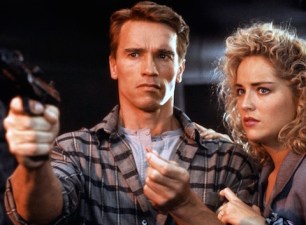 Perhaps it’s ultimately destined for an afterlife as a film representative of its era; the kind of thing that comes up as a footnote or personal favourite in texts & documentaries specifically discussing things like The Sci-fi Cinema of the ’90s. Or perhaps I’m doing it a disservice. We shouldn’t really try to predict these things too much, it’ll only lead to embarrassment when the opposite happens.
So, Total Recall. Good fun. Quite funny. Bit gory. I liked the effects.

Total Recall is on Syfy (UK) tonight, Monday 10th November 2014, at 9pm.
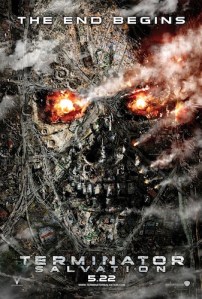 Terminator Salvation begins with a title sequence that displays the film’s title twice. I know you shouldn’t judge a book by its cover and all that, but somehow it just doesn’t bode well.
 sequences that could benefit from a wider perspective, for example Connor’s helicopter crash. That said (again), I’m a little torn what to think of that example: keeping the camera on Connor produces an unusual spin on a potentially familiar sequence, but it’s also a bit disorientating and, as I say, compounds this sense of watching someone else play a game.
 And even if you hadn’t seen it on the box or heard about it in all the film’s publicity, it’s obvious pretty early on that Marcus Wright will turn out to be a Terminator. To McG’s credit, he plays the ultimate reveal quite well — for those who know, it just about functions as a scene in its own right; for those who still hadn’t guessed, it works as a reveal — but if any filmmaker genuinely thought they’d kept it covered up they were sorely mistaken, and the first half could’ve done with a more knowing rewrite to compensate. Or just delete the prologue.
 He’s fine as ever, though his accent seems to waver between American and his native Australian. The same can’t be said of Helena Bonham Carter’s brief turn — her voice hits a constant fake American. Meanwhile, Arnie’s digitised cameo is just that. On the one hand it’s a nice touch, on the other it’s ultimately pointless — Connor doesn’t even react to the familiar face.
 More interesting than these slight tweaks is the behind-the-scenes story of a very different film, which I alluded to earlier. I don’t want to discuss it at length, but
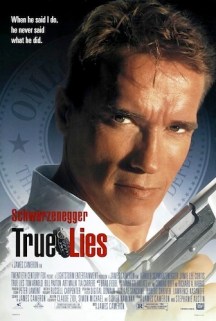 Quite how I’ve not got round to seeing True Lies until now is a little beyond me. Perhaps — no, definitely — if they’d re-released a better edition on DVD I’d’ve bought it and seen it then; but they never did, and so it’s taken ’til now to reach the top of my rental queue (not that my rental service works that way) and ‘force my hand’, as it were (because it’s certainly been on TV enough over the years).
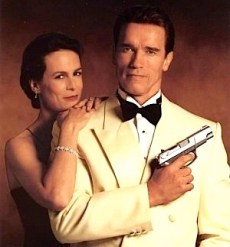 audacious things that might get laughed out in a straight actioner. The demise of the villain, for instance, is a great idea and great fun, but would be a step too far normally; but here that’s OK, because it’s allowed to be funny as well as cool.
 to do everything themselves (and even if they don’t their face gets CG’d on).
 100Films.co.uk