
As I mentioned in my August review, this TV column was meant to go up last month, but I didn’t get round to it and now there’s tonnes to cover. So, let’s get cracking…

Lucifer Season 5 Episodes 1–8
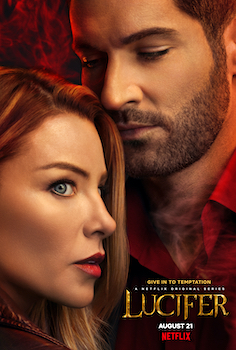 The
The Fox Netflix comic book adaptation reimagining returns for its final penultimate season. For most of its production cycle, season 5 was indeed intended to be the end of Lucifer. Apparently it was only when they came to writing the finale that they realised it contained a whole season’s worth of material, and so a sixth season was brought into being. And for this first half of season 5 — or season 5A, if you prefer — it does feel like things are headed towards an ending, mainly because of the reveal/cliffhanger on the midseason finale (no spoilers here!)
Before that, we get to see Tom Ellis exercise his acting chops by playing Lucifer’s scheming, American-accented twin brother, Michael, and a fun episode where all the cast get to play at being in a black-and-white ’40s film noir. That episode, It Never Ends Well for the Chicken, is an absolute delight, one of the series’ best ever, and is also by far the lowest-rated on IMDb. Some people don’t deserve nice things… Anyway, the season as a whole continues in the same vein as ever, albeit leaning a little more into its fantastical arc plots (as it also did last season, to be fair). It’ll be interesting to see how all that plays out, bearing in mind everyone thought they were making an ending until very late in the day.
The Crown Season 2
 When I last watched The Crown, Peter Capaldi was still the Doctor, the Netflix MCU was still expanding, and there was still a month left of the glorious days before “is Twin Peaks season 3 a movie?” debates. I enjoyed that first season, so quite why it’s taken me this long to get round to the second, I don’t know. Anyway, season two is in some ways the second half of season one — in my first season review I noted that the storyline about Philip’s position relative to Elizabeth was left open-ended, and the second run does indeed follow up on that, providing the focus of the first few episodes and a throughline that’s only really resolved in the finale (whether they’ll pick back up on it with the new, older cast in future seasons, I guess I’ll find out later). Whether its historical accuracy is strictly, well, accurate is still debatable, but any modifications or embellishment to fact are to the aid of making a compelling drama, which this undoubtedly is. Some people will never get on board with caring about the rarefied family and political problems of a royal family, but I think it’s remarkable how human and relatable those often are; and, when they’re not, they’re usually at least of some historical significance.
Archer Season 7
 After being less ambivalent about Archer’s fifth season experiment, Archer Vice, I was delighted to see it return to its original espionage trappings for season 6. I guess the writing team disagreed, because once again they’ve relocated the cast to a new setting: as a private detective agency in LA. For me, this played much like Vice did: I enjoyed it enough while it was on, but overall it can’t seem to equal the quality of the spy-based seasons. The storylines often aren’t as engaging; the humour isn’t as effective.
Next up is a period of the show where they pushed the setting even further from the original format each season, which doesn’t fill me with excitement, for obvious reasons. Though first up is “a 1947 noir-esque Los Angeles setting”, which does sound up my street. Fingers crossed.
Jonathan Creek Series 3–4 + Specials
 This particular batch of Creek episodes begins with Christmas special Black Canary, which aired between series 2 and 3. It’s one of the series’ very best episodes (indeed, it’s the top-rated on IMDb), a great mystery with an atmospheric snowbound Christmastime setting. Unfortunately, things then go off the boil a bit in series 3. Every single episode is written by David Renwick, and you wonder if he was beginning to run out of fresh, clever ideas. Nonetheless, there are some highlights here: a missing alien corpse; a mystery where a missing apostrophe may be a vital clue; and creepy one where a man apparently crawled up some steps after being shot in the head.
But the next Christmas special, Satan’s Chimney, is a definite return to form — the kind of Gothic mystery one associates with Creek but actually only gets from time to time. It’s the second best-ever episode according to IMDb voters. It’s also the first after costar Caroline Quentin departed the show. Julia Sawalha makes a solid replacement, depending on personal preference (I think Maddy is the better character; my partner disliked her intensely was glad to see her replaced). Unfortunately, the ensuing series 4, in which she also costars, seems to struggle for ideas even more than series 3, including some particularly dark and unpleasant mysteries.
And then, following a five-year gap (enough for Renwick to recharge, I guess), we get another feature-length special, The Grinning Man, which once again leans into the Gothic, and, once again, finds it works out for the best — it’s the fourth best-ever episode per IMDb voters. I’m seeing a pattern emerge. It also introduces another new sidekick in the form of Sheridan Smith, who adds a bit of sparky youth, even in spite of Renwick’s slightly “old man trying to write young person” characterisation of her. Unfortunately, this may be where the “good stuff” ends, at least if we’re to believe IMDb: no future episode even cracks the top 20, with five of the remaining seven right at the bottom of the chart. Oh dear.
The Twilight Zone ‘Best Of’
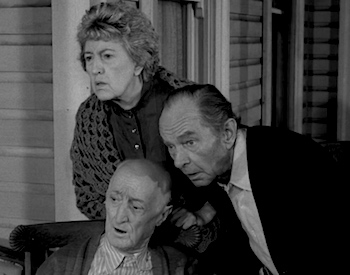 This month’s penultimate selection of the original Twilight Zone‘s best episodes begins with one that was remade by Steven Spielberg for the film revival, Kick the Can. It’s mostly a very grounded episode, set in an old people’s home where one ‘troublemaker’ tries to incite the others to have some fun. He has a crazy “fountain of youth”-type theory… which, of course, turns out to be true (this is The Twilight Zone, after all). It’s a very sweet episode, with a nice little message — essentially, you’re only as old as you feel; it’s about having an attitude that keeps you young. But trust TZ to not let it be entirely nice, adding a bit of glumness to even a happy ending by having one guy get left out. The movie version expanded on the ending, which was criticised by some, but those additions were actually the suggestion of the original episode’s writer.
Sticking with the big-screen theme, Mirror Image was reportedly the inspiration behind Jordan Peele’s Us, which doesn’t surprise me because Us came to mind while I was watching it. They’re not that similar to execution, just base concept — a woman waiting for a bus thinks she’s going mad when other people in the depot tell her she’s done things she doesn’t remember… but then she spots her doppelgänger in a mirror. It’s a creepy premise, and some moments provide suitable visualisations of that idea, but unfortunately it runs out of places to go with its setup, and the ending is inconclusive. Us does it better because it does go somewhere with it. Plus, Us‘s explanation for what’s actually going on is just as unsettling as when it was all unexplained, whereas Mirror Image undermines itself with some mumbo jumbo about parallel universes.
A Penny for Your Thoughts hasn’t inspired any cinematic do-overs (that I know of), but it’s easy to imagine it being reworked as a mid-’90s Jim Carrey comedy. It’s about a bank clerk who tosses a penny and it lands on its side, which grants him the ability to hear others’ thoughts (I’m sure that’s scientifically accurate). Unfortunately, it seems he’s not the brightest spark, because he keeps talking to people as if they’d just said their thoughts out loud. Okay, if this happened to you then you wouldn’t believe it and it might take you a moment to catch on… but even once this guy twigs, he keeps making the same mistake. Anyway, it builds up to a nice little twist (just because someone’s thinking about something doesn’t mean they’ll follow through) and, no spoilers, but it comes to a happy ending. A pleasant Twilight Zone episode?! A veritable rarity.
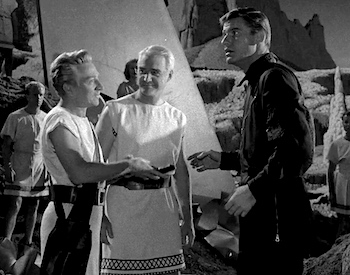 Conversely, there’s a typical Twilight Zone parable to be found in People Are Alike All Over. Unfortunately, it’s one of those episodes that only comes into its own at the final reveal — the journey there seems padded out to fill the requisite amount of screen time. Some of the pulp-SF stuff seems a bit dated now (the idea that Mars might be inhabited by an entire race of human-like beings is, obviously, daft), but it’s all in aid of an accurately cynical critique of mankind and our attitude to new discoveries.
The simply-titled season three opener is Two, named for its characters: two survivors from opposing sides of a devastating war, who bump into each other in a deserted town and proceed to eye each other up as they mooch around semi-aimlessly. It’s conceptually sound (about reconciliation between individuals when there’s no point fighting anymore), but dull in execution — so much of it is just them wandering around, not reconciling. Alternatively, it’s “an ethereal poem of an episode” (per Thrillist). I suppose that’s one way of looking at it.
The Last Flight might be my pick for the most underrated Twilight Zone episode. I know I’m including it in a review of ‘best’ episodes, but this is the ninth such selection, and I’d rate it much higher — in my opinion, it’s one of the series’ very best instalments. Written by the great Richard Matheson (arguably a more consistent writer than even Rod Serling; but then he only wrote 16 episodes vs Serling’s 92), it’s the story of a World War I pilot who lands at a present-day American airforce base. I won’t spoil what unfolds from there, because the episode is perfectly conceived and executed from beginning to end, a note of praise I wouldn’t apply to even some of the most well-regarded episodes. Part of why it’s so good is that it doesn’t just settle for its first idea — there’s a twist, and then there’s character development, and a final reveal/confirmation. Not every Twilight Zone episode bothers to add so much detail or so much character richness.
 Finally, Jack Klugman makes his fourth and final TZ appearance as the lead of In Praise of Pip. He plays a bookkeeper and failed father, now worried about his grown son who’s been injured in Vietnam (this is before the full-on Vietnam war, by-the-by — it’s speculated that this might be the first time the country was mentioned in a US drama). What plays out is the story of a man realising he’s wasted his chance to enjoy his kid’s childhood. It’s a good theme, and one fit to be given a fantastical Twilight Zone spin (it makes a change for a TZ episode to be about a man revisiting someone else’s childhood), but I wasn’t convinced by how it played out. In part, he makes a deal with God that thousands, millions, of other parents have tried to make, without success, because they don’t live in the Twilight Zone. I’m not sure how this would play with them… That aside, BuzzFeed describe the episode as “sweet. Harmless. Moving in a boring, safe sort of way,” and I’d tend to agree. On the bright side, it has one great scene in a hall of mirrors — a well-worn cinematic device but here justified with some clever compositions. Like the majority of Twilight Zone episodes, there’s always something to like.
Things to Catch Up On
 This month, I have mostly been missing the second season of The Umbrella Academy, which I’ve heard fantastic things about. I never got round to watching season one (although I meant to), so I really should catch up. And talking of “second seasons of superhero shows I never got round to the first season of”, Amazon just started The Boys season two. I want to catch up on that, too.
Back to Netflix, who also just released mission-to-Mars drama Away. It’s a concept that always entices me, even if the last one I tried, Mars, was so weak I only ever watched one episode. They’ve also recently launched Young Wallander, a reboot that sees the Swedish detective as a junior cop in the present day. Not sure how I feel about that — what makes it Wallander as opposed to Generic Swedish Cop? I’ll find out at some point, hopefully.
Next month… talking of stuff Netflix have recently added, they’ve got the first two seasons of YouTube’s Karate Kid sequel, Cobra Kai, ahead of their premiere of the third season next year. I’ll definitely be covering that next month, as well as… I dunno, whatever else turns up and/or I finally get round to watching.
Plus more Twilight Zone. There’s a lot of that to go yet.
 Adapted by James Graham from his own West End play and directed by Stephen Frears almost as if it were a movie (note how only the first episode has a proper title sequence), Quiz is the story of Major Charles Ingram, who in 2001 went on Who Wants to Be a Millionaire? and — allegedly — cheated his way to winning the million-pound jackpot with the help of his wife and someone in the audience coughing to indicate correct answers. But Quiz takes its remit wider than this, showing how Millionaire was born and spawned a nationwide community of quiz enthusiasts determined to game the system and make it onto the programme — and once on there, cheat in their own ways.
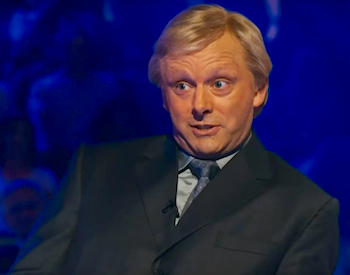 Indeed, even as there are serious events (watch out for the undeserved fate of the Ingrams’ pet dog), Quiz is consistently very funny. There’s a gag in the closing seconds of episode two (punctuated by a smash cut to black) that is golden. Michael Sheen’s uncannily spot-on impersonation of Chris Tarrant will also tickle anyone familiar with the man — i.e. UK viewers, but I guess it won’t translate internationally. Matthew Macfadyen is more understated but also excellent as Charles Ingram, while Helen McCrory burns up the screen as their barrister later on. Those are the obvious standout performances, but the whole cast are on form, in particular Mark Bonnar as one of Millionaire’s exec producers. He’s consistently superb in everything I’ve seen him in (if you haven’t, you should definitely watch
 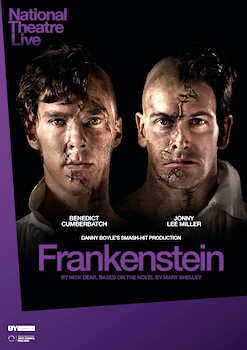 As theatre goes, this is a blockbuster: directed by Danny Boyle and starring Benedict Cumberbatch and Jonny Lee Miller, with the actors alternating who played Victor Frankenstein and his Creature for each performance. One of each was filmed for the National Theatre Live cinema screenings, and for the lockdown National Theatre at Home release they also made both available.
 The most recent missing story to be animated (see
 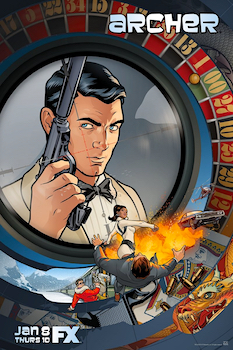 When I watched Archer’s fifth season (aka Archer Vice), I was picking it back up after years away and was set to continue it. That was
  In
In  In 153rd is The Whole Truth, which is about a car that’s been haunted since it came off the production line — although this one’s considerably less threatening than
  The lead actor is Pat Hingle, of Commissioner Gordon in
  This month, I have mostly been missing Killing Eve, the third season of which is currently airing between iPlayer and BBC One. For the first two seasons we had to wait until after it had finished in the US so they could put the whole lot up on iPlayer at once, which no one noticed during season one but drew a lot of criticism during season two (you can work out why, I’m sure). Consequently, I binged those first two seasons (indeed, I came to it late, so
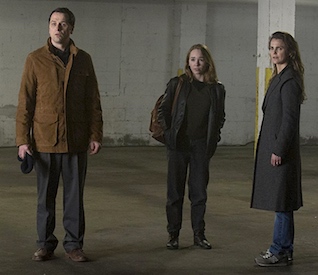
 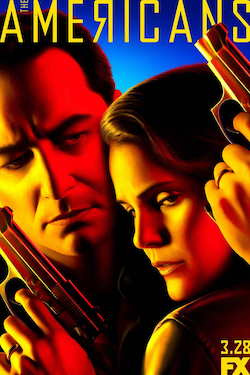 That song was released in 1987, the same year as the final season of The Americans is set. The show has typically avoided featuring well-known music in favour of cult favourites and obscurities, but R.E.M.’s classic would’ve been an appropriate number to hear during one of the series’ trademark music montages in the finale. (That said, it did contain both Dire Straits and U2, so they weren’t above using big hits.) Maybe it would’ve been a bit on the nose, but it certainly was applicable: it was the end of the world as the characters knew it, and so too for fans, as six incredible seasons came to a final end. But do we feel fine? That depends how you define “fine”. The show will be missed terribly, but goddamn if it didn’t stick the landing to cement itself as one of the greatest TV series ever made.
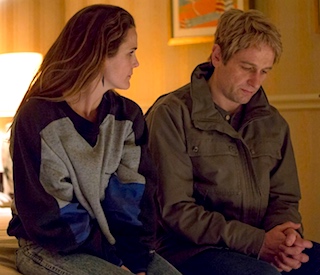 given texture or sometimes affected by the relationships, whereas by this point the relative importance and impact seems reversed. I guess you could still enjoy it as “just a spy show”, but I don’t think you’d want to — the stuff you’re invested in has shifted. That was always the programme’s genius, of course: it’s not about spies who happen to be married, it’s about marriage through the prism of people who are spies.
 As a commenter on
  I wrote
 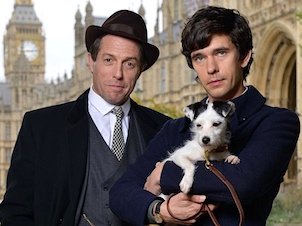 This month, I have mostly been missing A Very English Scandal, the Russell T Davies-penned drama about the real-life case of a ’60s politician and his secret homosexual lover. It seems to have gone down exceptionally well, and anything by RTD is always worth watching. Other than that, it feels like there’s a bunch of stuff on streaming I’ve been meaning to get round to and still haven’t. That list would keep us here all day, though.
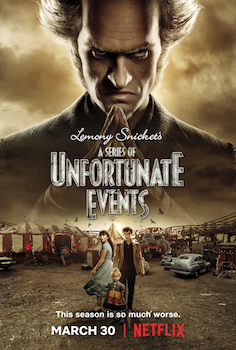 Abandon your vapid, facile distractions and set aside your very fine dramas, because it’s time to indulge in some vicarious fearsome disaster with the return of Netflix’s venerable family delight — a phrase which here means: A Series of Unfortunate Events is back.
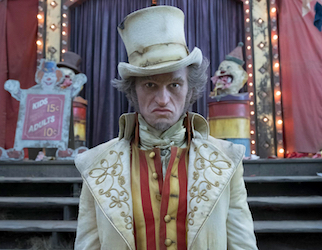 Neil Patrick Harris is having a whale of a time as Olaf and all his varied aliases, while the apparent earnestness of child actors Malina Weissman and Louis Hynes is clearly well measured for effect rather than poor work. There’s an array of memorable guest performances this season as well, from Kitana Turnbull, fantastically horrid as Carmelita, a little-goody-two-shoes teacher’s-pet bully the Baudelaires encounter in the opening two-parter; to Lucy Punch as an obsessive fashionista; to Sara Rue as a new inductee into the secret organisation trying to help the Baudelaires. Best of all is Nathan Fillion, born to play the fast-talking dashing hero who gets a ton of the best lines. If there’s a downside, it’s that we don’t see enough of some people. Unlike most kids’ fare (and, let’s be honest, some stuff made for adults), this isn’t a show where good is always rewarded and bad behaviour always punished, and that means some people may be shuffling out before we’ve had as much as we’d like. I guess the clue was in the title…
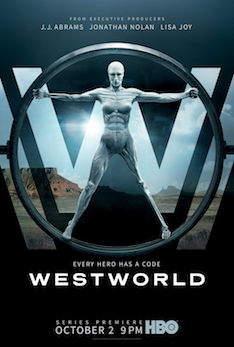 With season two imminent (it begins tomorrow, people!) I finally got my behind in gear (it’s only taken 18 months) and missioned my way through the first season of HBO’s reimagining of
  During its production Westworld hit the headlines because they shut down production for a while to retool the scripts and hone the story. Maybe this was why. If so, it paid off, because from the fifth episode things pick up considerably. Developments and twists really kick the mysteries into gear. Scenes between characters begin to carry more meaningful dialogue and affecting emotion. There’s even some action to give it a nice adrenaline kick at times. Rather than feeling like it’s ambling nowhere in particular, you feel like showrunners Jonathan Nolan and Lisa Joy have some very particular things in mind, but good luck guessing what they are because there are many surprises in store: however close you think you are to uncovering Westworld’s games, someone always has something else up their sleeve. It develops an almost
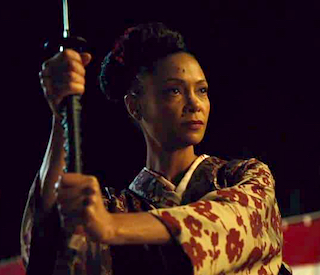
  The other most striking thing about the show are the performances. It’s like an acting masterclass: there are numerous fine performers here, and they’re all doing their best work. Ed Harris, Anthony Hopkins, Thandie Newton, Evan Rachel Wood, Jeffrey Wright… they’re all so magnificent that I don’t know who to single out without going on forever. And that’s not to undersell the rest of the cast either, many of whom would be said to excel in most other shows, but here there’s just so much raw talent on display.
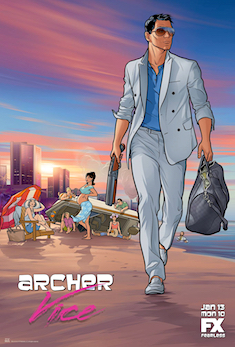 Here in the UK, animated spy-comedy Archer originally aired on Channel 5, until they started really titting about with the scheduling, which is what led me to drop off watching. It’s all on Netflix nowadays though, so I’m finally getting back into it.
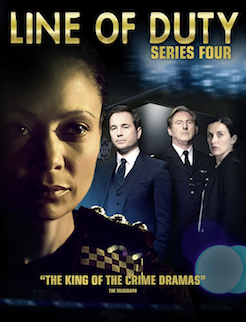 Another superb performance from Thandie Newton here, as the subject of AC-12’s latest internal affairs investigation. She’s convinced she’s arrested a notorious serial killer known as “Balaclava Man”; our faithful heroes reckon she’s cut corners, overlooking serious concerns about the evidence; the higher-ups who were exerting pressure on her to close the case would rather it all just went away. And as is the Line of Duty way, some shocking early developments send things spiralling in different directions. After the programme had become increasingly mired in its multi-season meta-arc
  While I very much enjoyed
 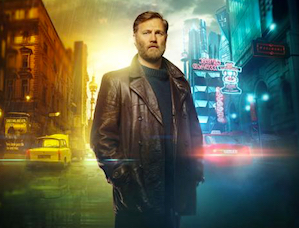 This month, I have mostly been missing the BBC’s miniseries adaptations of China Miéville’s The City and the City and Agatha Christie’s Ordeal by Innocence, both of which I’ve been saving up to watch in a more condensed fashion once they’re finished. The Christie ended on Sunday but the Miéville is only halfway through. Anyway, I imagine I’ll cover both next month. Also released this past month was Netflix’s big-budget reboot of Lost in Space, which I would’ve watched if I hadn’t been missioning my way through Westworld this past week. That might be here next month also. And finally, the last-ever season of The Best Show On TV™, The Americans, is underway in the US. Again, I’m saving it all up ’til it’s done, but I do intend to watch it promptly so as to avoid finale spoilers — my real hope is to time it just right so that I can watch the finale the day after it airs in the US, but we’ll see. Said finale isn’t until May 30th, so whatever happens I won’t be reviewing that until June.
 100Films.co.uk