2015 was, as I’m sure you’ve gathered, the largest ever year of 100 Films — or 200 Films in a Year, as it’s currently known. For 2015 only, I think, because I have no intention of trying to replicate that feat next year (see here for more on that topic).
How better to finally wrap up a year than with a look at the best and worst, right? As always, my picks are not culled from films freshly released in 2015, but from this list of my personal viewing. (For what it’s worth, that list includes 22 releases from 2015, as well as 37 from 2014, some of which others would count as 2015 titles… and some of them have indeed made my best-of list.)
You can also vote for your favourites from my pick, and find out which 50 most noteworthy new films I didn’t see. There might be a few surprise along the way, too.
So without further ado…
 The Five Worst Films I Saw For the First Time in 2015
In alphabetical order…
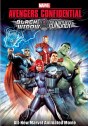 Avengers Confidential: Black Widow & Punisher
Marvel may dominate the live-action superhero arena right now, but DC has the edge in animation — and work like this is going to do nothing to change that. An uninteresting story that’s blandly told in every regard, this is a total waste of time.
 Blitz
Blitz
There are a lot of very, very good actors in this Jason Statham vehicle, but it’s a terrible film that’s even below standard for the star, let alone his supporting cast. So bad it feels like a spoof, there is no good reason for anyone to watch this movie.
 Jack the Giant Slayer
X-Men’s Bryan Singer is the latest filmmaker to take a fairytale and give it the Lord of the Rings treatment. That formula doesn’t work here, unfortunately. The result is a flat, cheap-looking, overlong bore. Another waste of good talent.
 Parabellum
Alfred Hitchcock once said that “movies are real life with the boring parts cut out.” I guess this isn’t a movie, then, because it’s not real life and it’s boring as can be. My least enjoyable viewing experience this year.
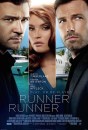 Runner Runner
Again, talented stars (Ben Affleck, Gemma Arterton) slum it in a poorly-constructed thriller with no thrills. That it’s from the director of The Lincoln Lawyer, an excellent thriller that made my top ten a couple of years ago, only makes matters worse.
 The
The Ten 20 Best Films I Saw For the First Time in 2015
Given the extraordinary personal achievement in my viewing this year — doubling my titular goal — I’ve decided to also double my year-end top ten. It seemed appropriate.
Obviously I haven’t done such a percentage-related increase (or reduction) of my list before now, but then no previous year has seen quite so remarkable a change in my viewing total. In other (smaller) years, these additional films may well have made the cut, so this is a way of giving them their due. (Besides which, my list is numbered, so you can ignore #20 to #11 if you want.)
Final point: although this list isn’t limited to 2015 releases, there are six included, so I’ve noted their ‘2015 rank’ too.
2015 #6 After all the behind-the-scenes kerfuffle, Ant-Man probably had the lowest audience expectations for any Marvel Studios movie since Iron Man. Perhaps that’s what allowed it to become the mostly purely entertaining Marvel movie since Iron Man, too.
The Mission series here reconfigures itself as the modern equivalent to classic Bond, washing down espionage thrills with gadgets and humour. The result is fantastically enjoyable, and only so low on this list because of a certain other film a bit higher up…
John Cusack and Minnie Driver have never been more likeable as a guy and the prom date he jilted, brought back together by their high school reunion. Oh, and he’s now a hitman, in town on a job. Consitently funny, this is first-rate action-comedy entertainment.
An idiosyncratic crime drama from writer-director Jim Jarmusch, Ghost Dog stands alongside the otherwise-peerless Léon as a hitman movie that may not deliver enough action thrills for some, but is seeped in distinctive qualities of its own.
Martin Scorsese’s best-regarded works may hew towards the mainstream-intellectual, but here he sets his sights on genre material — specifically, a psychological mystery thriller — and produces a corker. Heavily Gothic in tone, it’s the first of several such films on this list.
A British-made India-set ‘Western’, this beautifully shot Boy’s Own adventure is rollicking old-fashioned entertainment from start to finish. It’s buoyed further by a cast of top-drawer British character actors, topped off with Kenneth More and Lauren Bacall. Magnificent.
One of the most acclaimed films of all time — if we’re talking “the history of cinema”, it’s certainly more important than anything else on this list. Almost 90 years old, it remains surprisingly accessible to modern eyes. An exceptionally affecting experience.
2015 #5 In a year overloaded with spy thrillers, this Bond pastiche stood out by, a) getting in early (it was released last January in the UK), and b) being a helluva lot of fun. Thematically questionable it may be, but the filmmaking verve is a joy to behold.
2015 #4 2015’s highest grossing film, this sequel/reboot of the beloved franchise has proved somewhat divisive. It certainly has flaws in characters and plot, but director Colin Trevorrow has bottled genuine Spielbergian awe and wonder, and that counts for a lot.
If this were only a top ten, I’d’ve slipped this in higher up, as much to recommend it as anything. In many respects it’s a familiar mismatched-people-fall-in-love rom-com (hence why its position dropped), but the uncommon melancholic tone makes it feel unique.
I’d wager it’s impossible to describe a Wes Anderson film without recourse to words like “quirky” and “unique”, both wholly apt epithets for The Grand Budapest Hotel, naturally. Others include hilarious, clever, inventive, controlled, and delightful. The last may be the most appropriate of all: this is a film full of delights, from the performances, to the dialogue, to the locations, to the design, to the camerawork. Anderson is the kind of filmmaker who has a cult following, which can sometimes be a bad omen. Based on this evidence, his fandom might just have the right idea.
2015 #3 There has been an awakening — have you felt it? Well, of course you have. Everyone outside of China has. Half of them twice. The J.J. Abrams-led return to a galaxy far, far away may have received a mixed reception, due to it essentially being the cinematic equivalent of a greatest-hits cover album, dealing in nostalgia more than it does originality… but it’s clearly been made by fans with an eye to crafting something that’s both enjoyable and recognisably Star Wars-y — two balls the prequel trilogy less dropped, more hurled to the ground. It’s a thrilling adventure with likeable new characters and, in my opinion, interesting new villains. There’s scope for the makers of Episodes VIII and IX to produce something even better off the back of this, and that’s exciting.
Terry Gilliam’s 1984 for 1985 is set in a dystopian Britain almost as bad as our current one, where mindless, faceless bureaucracy rules the day. It’s the kind of film where a typo can lead to a man’s death; where Jonathan Pryce fantasises about being a sword-wielding angel fighting a giant silver samurai; and where Robert De Niro turns up as a terrorist plumber. You know, if Wes Anderson is “quirky” and “unique”, I don’t think we’ve yet invented words to describe Terry Gilliam…
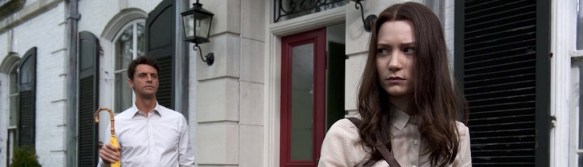
I promised you more Gothic and here it is. Director Chan-wook Park places 7th on my top ten for the second year in a row with this dark psychological thriller about a reclusive teenage girl who meets her uncle for the first time when he comes to stay following her father’s death. He’s charming, but mysterious — what are the secrets that everyone seems to know but her? Dripping with style and atmosphere, Stoker is a feast for the eyes and ears; a beguiling, sensuous, classically Gothic thriller.
2015 #2 Director George Miller returns to the Mad Max series after a 30-year hiatus for the stand-out action movie of… well, “the year” seems to undersell it. Once upon a time he was bold enough to make a chase the entire third act of a film; now, the chase is the entire movie. This is action filmmaking elevated to a genuine art form — literally, if the award season buzz is anything to go by. While the done-for-real stunts are busy boggling your mind, there slips by a story that’s surprisingly rich in theme and character. It gives added weight to a type of storytelling that could only be achieved on film — there’s a reason Miller started with a storyboard and only bothered to write a screenplay when the studio insisted.
A third dose of Gothic now, this time with a heavier dose of the “horror” element that’s so often attached to the term. Gemma Arterton and Saoirse Ronan are mother-and-daughter vampires on the run, hiding out in a seedy seaside town, where Ronan tries to lead some kind of normal life as a perma-teen while her mother’s busy doing what she’s always done: whoring. These vampires aren’t glamorous or sparkly, but damaged and discarded. Byzantium is not a very popular film, but its tarnished charms and fatalistic stylings, powered by two strong central performances and atmospheric direction, made me love it.
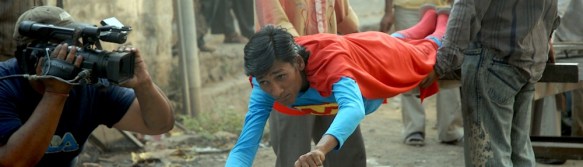
Selecting these 20 films was tough, then putting them in order was just as hard, but one thing was a lock from the start: these are my top four films I saw in 2015. The only question was the order they went in, which on another day may have been completely different — any one of them could’ve been #1. This little-seen documentary (Channel 4 premiered it in the middle of the night a few months ago, although it’s available on YouTube) takes us to a small, poor town in India where the locals make their own movies, and they’re a roaring success. It’s an inspirational film about living your dreams even when the world won’t let you, though undercurrents of reality stop it from becoming too tweely self-congratulatory. I’m not overstating it when I say I believe this is an absolute must-see for any lover of film, and probably a good many people besides.
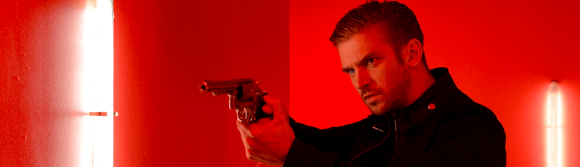
I feel like I’m being in some way Awkward with many of this year’s choices, because there’s a notable strand of films that aren’t particularly well regarded by viewers en masse (see: #11, #7, #5, now #3). Well, I’m not being awkward, dear reader: I loved all of them, and I loved this one most of all. Like several of those others, it crafts a unique mood with lashings of style, in this case inspired by ’80s movies and music. Dan Stevens is a mysterious ex-soldier who enters a family’s life and brings a load of trouble in his wake, but is he (anti-)hero or villain? Even by the end, you might not be sure. Witty, exciting, stylish, idiosyncratic, this is one guest I want to stay forever. (Sorry — it seems I can’t end any piece about this film without a terrible pun.)
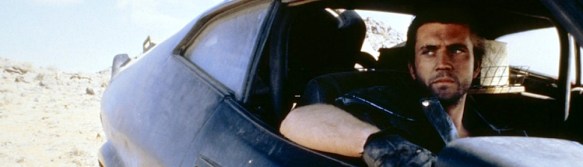
34 years before Fury Road, there was The Road Warrior. A post-apocalyptic Australian Western, it sees Mel Gibson’s titular drifter drafted into defending an oil-rich community from a violent gang of fetish-attired marauders. While the film has much to offer throughout, the real joy is the third act: a balls-to-the-wall multi-vehicle chase, as Max and co attempt to escape in a heavily-armoured oil tanker and the gang give chase in a fleet of vehicles. Maybe it’s not as slick or extravagant as Fury Road, but it was done without a lick of CGI (for all Fury Road’s “done for real” claims, there’s an awful lot of computer work across that movie) and that added tangibility gives it the edge for me. Not to mention that it did it first — without Mad Max 2, we wouldn’t even have Fury Road.
2015 #1 Not as life-affirming as Supermen of Malegaon. Not as stylish as The Guest. Not as groundbreaking as Mad Max 2. Certainly not as ‘significant’ as a host of films further down this list. But from the moment the familiar beats of the famous theme tune begin to pulse over the company idents at the top of the movie, Rogue Nation engages you in a perfectly-crafted entertainment. It delivers sequence after sequence of finely-tuned action-thriller excitement, both from Tom Cruise’s crazy stuntwork and writer-director Christopher McQuarrie’s Hitchcockian control of espionage scenes. The plot may only be solid rather than any great shakes, but it’s supported by likeable heroes, a menacing villain, and well-pitched humour. It’s all topped off with Rebecca Ferguson, who could hold her own in a stand-off with Daisy Ridley and Charlize Theron for 2015’s most kick-ass heroine. Mission perfected.

As ever, I welcome your opinion on my top ten — not just in the comments section, but also in the form of a lovely poll. Multiple selections are allowed, so feel free to pick several favourites.
And if you feel I’ve made an unforgivable omission, I welcome your scathing criticisms in the comments.
Despite doubling the size of my selection, this was still a really, really tough year for picking favourites. Competition was harder than ever, not just because I watched 200 films (47% more than even my next biggest year) but because I made a conscious effort to watch fewer time-killers and more things I’d really been intending to see. As a result, films that I enjoyed immensely or admired intensely fell by the wayside, leaving several big guns to duke it out for the limited slots.
As if doubling my top ten wasn’t enough, the tightly-fought race got stuck for a while at 30 titles. The closest to making it in was my 1,000th film, Mark Cousin’s epic 15-hour documentary The Story of Film: An Odyssey (so epic that my review draft is still in the form of 4,300 words of notes). It hurt to leave it out, but something had to go. The remainder of those 30 (which I guess would be #22 to #30, then) were, in alphabetical order, The Babadook, Gone Girl, High Noon, Looper, Paddington, Scanners, Spectre, Stranger by the Lake, and Wings. In most other years, any of those could’ve found themselves comfortably in my top ten.
I can’t end this without mentioning the 38 films that earned themselves 5-star ratings this year. 17 of them made it into the top 20 — I won’t list those again, so you can go find the three four-star imposters for yourself (clue: they’re right at the end… or start, in the order I’ve written it). The remaining 21 five-starers were Argo, The Babadook, Boyhood, Boyz n the Hood, Dreams of a Life, Filmed in Supermarionation, Fury, The General, The Girl with the Dragon Tattoo, Gone Girl, High Noon, Interstellar, Looper, The Philadelphia Story, sex, lies, and videotape, Shallow Grave, The Story of Film: An Odyssey, Stranger by the Lake, Whiplash, Wings, and The Wrestler. Reading through those again, there are several I feel should’ve been in my top 30… or 20… but what would I take out in their place? This year’s been too good, clearly.
Finally, on the same topic, there was one five-starer from each of my additional kinds of reviews (I love it when that happens — so neat). They were: non-list review 2001: A Space Odyssey, extended cut X-Men: Days of Future Past – The Rogue Cut, and short Feast.
Naturally, there were a considerable number of notable releases this year that I’ve yet to see. In my annual tradition, here’s an alphabetical list of 50 films — chosen for a variety of reasons, from box office success to critical acclaim via simple notoriety — that were released in 2015 and that I’ve not seen.
As is so often the case, it’s a funny old mix, because there were some films that seemed too ‘significant’ to leave out. This is why, despite recording my progress with these in my statistics every year, I’ll never, ever see 100% of them. For a current example, Minions is the 5th highest grossing film of 2015, so on the list it goes; but I didn’t really like Despicable Me and haven’t watched Despicable Me 2, so what are the chances I’ll ever decide to spend some of my time on Minions? Pretty darn slim, I reckon.
Anyway, the 50 I’ve chosen to highlight — some of which I do very much want to see — are…

Amy
Beasts of No Nation
The Big Short
Black Mass
Blackhat
Bridge of Spies
Brooklyn
Carol
Chappie
Cinderella


Creed
Crimson Peak
The Danish Girl
Everest
Ex Machina
Fantastic Four
Fifty Shades of Grey
Furious 7
The Good Dinosaur
The Hateful Eight


Home
Hotel Transylvania 2
The Hunger Games: Mockingjay – Part 2
In the Heart of the Sea
It Follows
Joy
Legend
Macbeth
The Man from U.N.C.L.E.
The Martian


Me and Earl and the Dying Girl
Minions
Pan
Pixels
The Revenant
Room
San Andreas
The Second Best Exotic Marigold Hotel
Sicario
Snoopy and Charlie Brown…

Spotlight
Spy
Steve Jobs
Straight Outta Compton
Suffragette
Taken 3
Ted 2
Testament of Youth
The Visit
The Walk
And so, after all that verbosity, the largest ever year of 100 Films comes to an end.
Apart from the 21 reviews I still have to post, of course. (In that respect, 2014 isn’t even finished yet.) But no matter, it will be done.
For now, all that remains is for me to thank you for reading, to wish you all the best with your own film-watching endeavours (having spent several days shut away in my own world of statistics and lists, I’ve a few people’s posts to catch up on!), and to say “see you soon” for 2016 — the 10th year of 100 Films! I have some stuff planned…

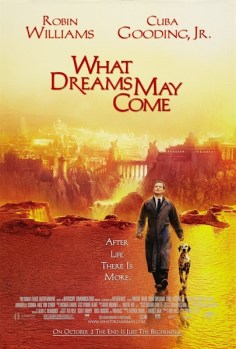 When What Dreams May Come first came out, the reviews seemed to conclude that it was rubbish, but at least visually splendid. Back in 1998, that put me off — “it’s not meant to be very good” was the takeaway thought there. As the years have gone on, for some reason those reviews (or possibly just one I extrapolated into a consensus, who knows?) stuck with me; and as my temperament as a film fan grew, that it was visually extraordinary (even if nothing else) began to seem reason enough to watch it. It lingered in the back of my mind, never quite becoming a “must see”, especially as the opportunity rarely (if ever) presented itself. So that’s more or less how I come to it now, 17 years since its release and those reviews — a long-awaited scratch of a long-lingering itch. (Perhaps this gives some insight into why/how it takes me so long to get round to watching recommendations/things I’m quite keen to see/etc.)
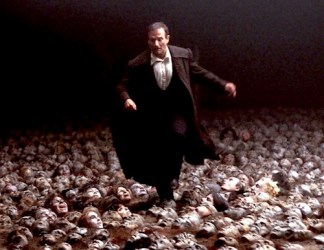 Hell, incidentally, also looks incredible, as do the various locales visited by Chris and his companions (played by Cuba Gooding Jr and Max von Sydow) on their way there. Director Vincent Ward and his team have created a rich, engrossing visual space here. It’s not just the Oscar-winning visual effects either, which create Chris’ initial realisation of Heaven as a kind of living painting, but also the locations, their decorations, and some fantastic sets. The design work is brilliant, and the vast majority of it still holds up today. Even the CGI doesn’t look glaringly like 17-year-old graphics, and in many cases what I presume is a mix of live action, models and some CGI is far more effective than the all-CG look it would likely have if made today.
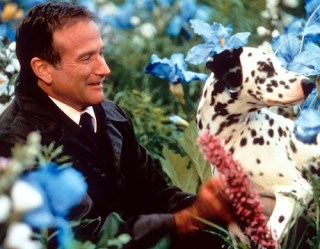 Nonetheless, some will identify with the sentimental “love transcends death”-type message more than others, and there’s a chance those who like (or don’t mind) their films to be at the soppier end of the spectrum will genuinely love it. For the rest of us — for anyone who likes visual splendour in their movies, anyway — it does indeed merit a look for the imagery alone.

 Score:













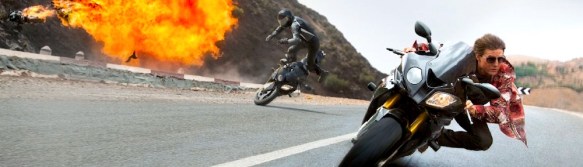



 Screened in UK cinemas simultaneously with its TV premiere (and coming to the big screen in various other countries over the next week or so, too), the latest episode of the BBC’s modern-day Sherlock Holmes series is actually a standalone adventure set in the character’s original Victorian time period.
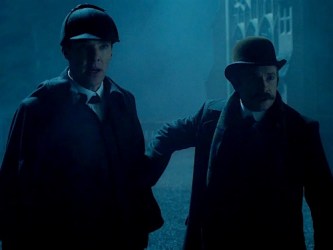 The case they find themselves embroiled in is a little more period than usual, however, with lashings of Gothic and some of the trappings of a Christmas ghost story. The episode is co-written by series creators Mark Gatiss and Steven Moffat, and anyone familiar with Gatiss’ wider work can clearly see his influence here. Moffat brings his trademark fast-paced intricately-tricksy plotting, for which individual viewers’ mileage varies greatly: some find it genius, some find it tedious. Is it clever, or does it just think it’s clever? Is it impossible to follow, or were you just not paying enough attention? As to the first question, I think it’s a bit of both; as to the second, I think the episode ultimately answers everything, but you might need to realise a few things for yourself.
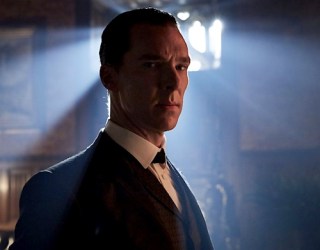 Until the last half-hour or so, anyway, when the modern version suddenly comes crashing in. At first it seems like a clever interlude; a little reminder of the true time period for this version of the characters, and a tease for season four. But it quickly transpires that, no, this episode isn’t actually a wholly standalone aside from the main series — Gatiss and Moffat have found a way to integrate it into continuity. For me, this is where the special begins to come apart at the seams; not because I inherently object to this integration, but because from that point on the episode begins to jump back and forth between the present, the imagined past, and various other dream-state asides. It’s almost entirely justified by the beautifully-shot Reichenbach Falls sequence, but a spot of cinematographic prettiness doesn’t really excuse the way the story goes a little haywire. The least successful part of all, for me, is that it calls into question the solution for the case we’ve just been presented with… but then doesn’t get round to offering another, meaning you kind of feel like the case hasn’t been solved, even though it presumably has been, with the first solution. I think.
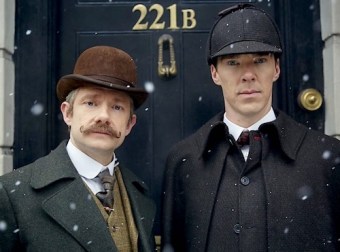 As someone who enjoys Sherlock Holmes in his proper era but is also a fan of this modern day version (I would say “a big fan”, but I’m not one of those people), I’d rather they’d played this a little more straightforward. Not a lot — it’s still under the umbrella of Sherlock after all, and the era-transposed stylistic flourishes in the first hour-ish worked very nicely in my opinion — but the mixed-up mishmash of the final act dilutes the effectiveness of the entire experience. There’s fun and thrills to be had along the way, but in another form it could perhaps have been a Sherlockian classic in its own right.
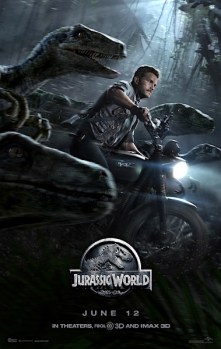 22 years ago,
  awe is front and centre once again. Even some of the film’s ‘problems’ aren’t, in my eyes. Does it spend too long wandering around the park before the big action starts? Not for me… which I guess is a viewpoint that comes with all the caveats of my opening paragraph. I rather suspect this is a movie that was very literally made by fans, for fans.
 but 2.35:1 can feel a little too wasteful of screen real estate (as a believer in presenting films in their original ratio (as we all should be) you tend not to question it, but looked at objectively, 2.35:1 on a 16:9 telly is kinda silly. (Not that I’m advocating those daft-looking 21:9 TVs they made a couple of years ago, mind.)) I’ve no idea if 2:1 is likely to catch on more widely (I bet
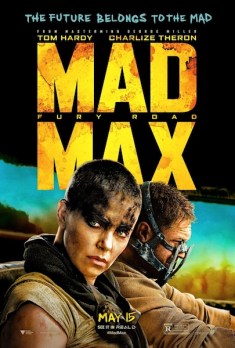 After a decades-long diversion into children’s movies like
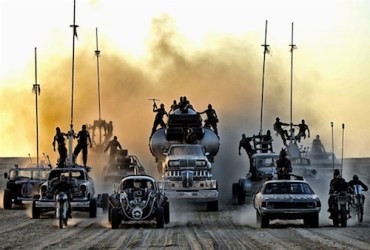
 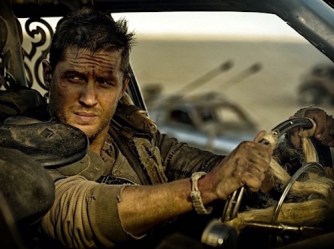 I say that, but the finished film is visually stunning on two levels: cinematography and editing. It was shot by John Seale, and Miller had him amp up the saturation. The point was to do the opposite of most post-apocalyptic blockbusters, which are normally desaturated to heck, and it indeed creates something strikingly different. Conversely, Miller has intimated the ideal version of the movie is in black and white with no dialogue, just the score — completely visually-focused storytelling. I have a feeling he’s right, or that it would at least work well. Some nuance would be lost, but all the major plot points and character arcs would be followable.
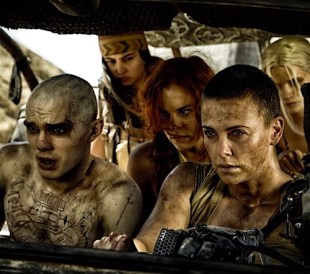 but all are deftly executed. That it doesn’t expound on these at length, or linger on their detail, means you have to pay attention to get the most out of that side of the film. I guess some would counter that with, “you have to look hard because you’re reading something that isn’t there,” but I refute that. That it doesn’t spell everything out at length, or hammer home its points and themes heavy-handedly, is a good thing.
 (Ooh, that turned a bit philosophical, didn’t it?)
 John Singleton became the first African-American Best Director Oscar nominee, as well as the youngest, for this debut. 23 years on, his story of the lives and troubles of young black men in L.A. remains sadly pertinent.
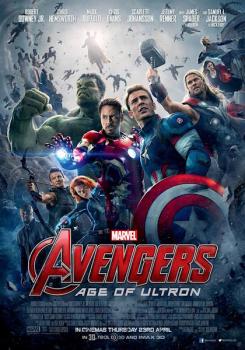 It feels kind of pointless reviewing Avengers: Age of Ultron, the written-and-directed-by Joss Whedon (and, infamously, reshaped-in-the-edit-by committee) follow-up to 2012’s “third most successful film of all time” mega-hit
 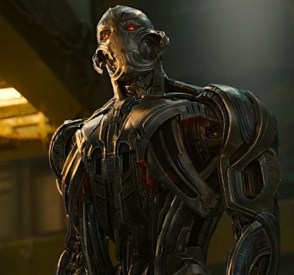 Even though the first half of that is still three years away, we’re still very much on the road to it. Heck, we have been practically since the MCU began, thanks to those frickin’ stones (if you don’t know already, don’t expect me to explain it to you), but now it’s overt as well as laid in fan-friendly easter eggs. The titular threat may rise and be put down within the confines of Age of Ultron’s near-two-and-a-half-hour running time, but no such kindness is afforded to the myriad subplots.
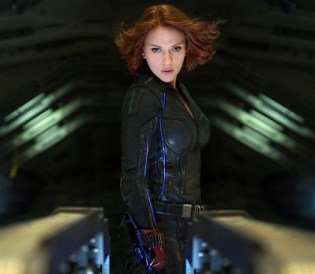 (not just obvious stuff like the Hulk, but digital set extensions, fake location work, even modifying Stark’s normal Audi on a normal road because it was a future model that wasn’t physically built when filming) that stuff they genuinely did for real looks computer generated too. All that time, all that effort, all that epic logistical nightmare stuff like shutting down a capital city’s major roads for several days… and everyone’s going to assume some tech guys did it in an office, because that’s what it looks like. If you’re going to go to so much trouble to do it for real, make sure it still looks real by the time you get to the final cut. I’ll give you one specific example: Black Widow weaving through traffic on a motorbike in Seoul. I thought it was one of the film’s less-polished effects shots. Nope — done for real, and at great difficulty because it’s tough to pull off a fast-moving bike speeding through fast-moving cars. What a waste of effort!
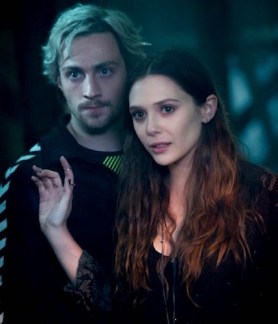 The really daft thing is, Whedon specifically added Scarlet Witch and Quicksilver… wait, are Marvel allowed to call them that? I forget. Anyway, Whedon added the Maximoff twins because, as he said himself, “their powers are very visually interesting. One of the problems I had on the first one was everybody basically had punchy powers.” I know Hawkeye’s power is more shoot-y than punchy, and we all know
  At the end of the day, what does it matter? Age of Ultron isn’t so remarkably good — nor did it go down so remarkably poorly — that it deserves a reevaluation someday. It just is what it is: an overstuffed superhero epic, which has too much to do to be able to compete with its comparatively-simple contributing films on quality grounds, but is entertaining enough as fast-food cinema. Blockbusterdom certainly has worse experiences to offer.
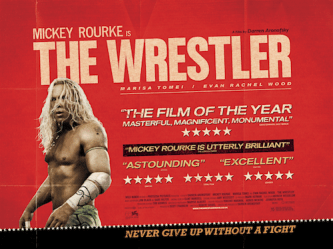 Mickey Rourke’s Oscar-robbed performance is the primary draw of this drama about a washed-up pro wrestler struggling to make ends meet. As ill health threatens his ability to continue performing on the miserable, brutal ex-pro circuit, he ties to connect with his estranged daughter (Evan Rachel Wood) and woo a kindly stripper with personal issues of her own (Marisa Tomei, in another Oscar-worthy turn).
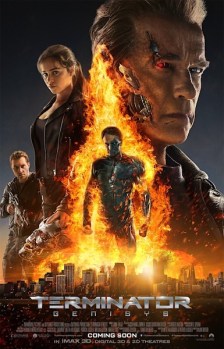 I liked
  Now, a good idea doesn’t guarantee a good execution, and here is where we begin to encounter Genisys’ problems. Time travel is a tricksy thing to engage with in fiction, and is highly prone to creating plot holes — something blockbusters regularly struggle with anyway. Genisys has at least one glaring one. Then there’s the general level of quality — the screenplay, acting, effects, and so on. In this regard, I suspect the reason so many people reacted so badly to it is that it follows, and riffs off of, two of the greatest sci-fi/action movies ever made. In and of itself, Genisys is no worse than any of the other half-dozen-or-so middle-of-the-road $150-million-plus-budgeted blockbusters we’re routinely served every year now. If you instead compare it to its iconic forebears, however, it comes up much shorter.
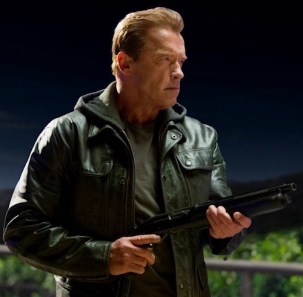 And yet the man who was responsible for those remarkable pictures, James Cameron, was impressed by it. He’s interviewed among the film’s special features, where he explains, “can I guarantee that you’ll enjoy it? No. I just know that I enjoyed the film, you know. But I strongly suspect that… you’re gonna love this movie.” Well, he was way wrong there! You almost feel a bit sorry for everyone in those special features, actually. They’re all so confident that Genisys is a great, well-made movie that everyone’s going to love, and they have big plans for a trilogy which they keep talking up. I would love to see their reactions after the reviews and box office figures came in…
 100Films.co.uk