
Quentin Tarantino | 168 mins | Blu-ray | 2.76:1 | USA / English & Spanish | 18 / R
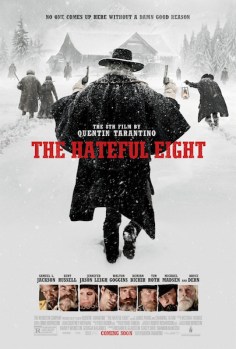 Quentin Tarantino hadn’t made a film in the same genre as his preceding movie for almost 20 years when The Hateful Eight came out — his second go-round with the Western genre, after the Spaghetti-ish thrills of Django Unchained three years earlier. Aside from the setting and its accoutrements, however, The Hateful Eight has more in common with Tarantino’s debut feature, Reservoir Dogs.
Wyoming, sometime after the Civil War: bounty hunter Major Marquis Warren (Samuel L. Jackson) flags down a stagecoach driven by O.B. (James Parks), looking for transport to Red Rock. Inside is fellow bounty hunter John Ruth (Kurt Russell) with his latest catch, Daisy Domergue (Jennifer Jason Leigh), who’s worth $10,000 — naturally, Ruth is suspicious of Warren’s motives. Later, they pick up Chris Mannix (Walter Goggins), who claims he’s to be sworn in as the new sheriff of Red Rock — also of great suspicion to Ruth. As a blizzard chases them, the quintet seek shelter at Minnie’s Haberdashery, a rest spot Major Warren has clearly visited many times before. However, Minnie isn’t home, and care of her establishment has been left in the hands of Bob (Demián Bichir). Inside, they find fellow travellers Oswaldo Mobray (Tim Roth), Joe Gage (Michael Madsen), and General Sandy Smithers (Bruce Dern). Ruth doesn’t trust a’one of them — and as they settle down to ride out the blizzard, it turns out he’s right about someone…
I’m not the first to observe that The Hateful Eight actually functions like a murder mystery, Agatha Christie style. It might be easy to miss because the film doesn’t begin with a murder or feature a detective, but then neither do all of Christie’s stories. Instead, there’s a long period setting up all the players and suggesting their motivations, and then eventually the proverbial does hit the metaphorical fan, after which deductions must be made. 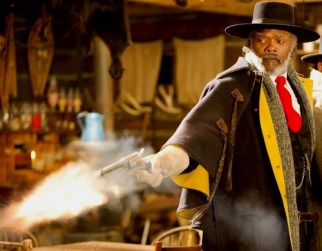 And it’s all in a remote, isolated location which has been cut off by weather, and every character is hiding some nefarious past — so far, so And Then There Were None. All of this comes dressed in QT’s famed dialogue, unfurled at the somewhat languorous pace he’s gradually been cultivating for a few movies now, and topped off with a few doses of the old ultra-violence.
One reason the “whodunnit” label doesn’t really stick is that Tarantino doesn’t sit it out until the end. Without spoilers: there’s certainly mystery about who is and isn’t involved, but you can’t invest in that too much because the answer is a little bit Murder on the Orient Express. Not completely Orient Express (I said no spoilers!), but a bit. One factor he does handle well is that (again like And Then There Were None) you can never be quite sure whose side you should be on; who might turn out to be a villain. Even at the end, when all has been revealed, the heroes are hardly heroic.
More talked about than the film’s content has been the way it was made. Despite the confined setting, Tarantino chose to shoot it on 65mm film, using the Ultra Panavision 70 process (only the 11th film to do so) and lenses that hadn’t seen light in nearly five decades, all of which have produced incredible images. QT’s regular DP since Kill Bill (excepting Death Proof), Robert Richardson, has once again done sterling work, with beautiful shots of scenery near the start and a fantastic definition of space once we’re locked up in Minnie’s.
 Ultra Panavision 70 produces an ultra-wide 2.76:1 frame (for those not in the know, your widescreen TV is only 1.78:1), which for such an intimate story has struck people as odd ever since it was announced. In fact, it pays off in (at least) two ways: firstly, all the scene-setting scenery looks magnificent; secondly, for a lot of the film there’s stuff going on in the background or at the edge of frame — it’s not just a series of close-ups or two-shots where the ancillary detail is either non-existent or doesn’t matter, but one where that ‘background’ detail is sometimes very instructive to what is going on. Tarantino also uses the full width a lot of the time, placing two figures at either edge of the image — this really isn’t a film you could crop (thank goodness it doesn’t exist in the pan & scan era!)
Richardson’s work was Oscar nominated but lost to The Revenant (which I’m now a little biased against, after it beat this, Fury Road, and handed Roger Deakins his 13th loss, but I’ll see what I think when it finally hits British home ent formats next month), but the film did triumph for Ennio Morricone’s score — and quite rightly so, too, because it’s incredibly atmospheric and effective. Tarantino has commented that it isn’t really a Western score (which you’d expect from Morricone, what with his famous ones), but more of a horror movie score, and that that’s appropriate for the film. And, y’know, that’s not pretentious director-speak — he’s right. Well, that the movie is a horror movie is debatable, but he is right that Morricone’s work sounds more like a horror score, and that that score is appropriate to this movie. It even recycles some of Morricone’s material from The Thing,  as if to bring the point home (and that’s far from the only thing about The Hateful Eight that’s indebted to The Thing, but I’ll leave that for someone else to dig into another time). Even though this is the first time he’s had a full score composed for one of his films, Tarantino still sources a couple of well-selected songs from elsewhere, including a very apt credits track by Roy Orbison.
The Hateful Eight may have a deceptively simple story, with straightforward characters and — once they’re finally all revealed — straightforward motivations; and despite that running time, it’s not as grand or as epic as either Inglourious Basterds or Django Unchained; but I say “deceptively simple” because I feel that it’s the kind of film that might reward repeat viewings, to reveal depths of character as well as hints toward the ultimate reveals. Or maybe I’m being generous — maybe it is just a long-winded, verbose way of telling a slight tale. But if it is, it’s still a mighty entertaining one.

The Hateful Eight is released on DVD and Blu-ray in the UK today.


 Score:



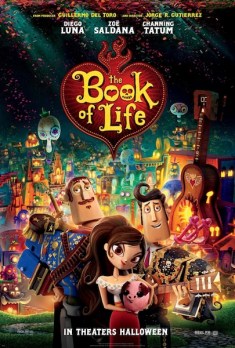 A myth-like animated musical adventure based around Mexico’s Day of the Dead, most notable for its unique art style that presents gorgeous visuals throughout.



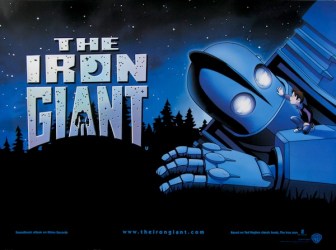 Adapted (loosely) from Ted Hughes’ children’s novel The Iron Man, the feature debut of director Brad Bird (
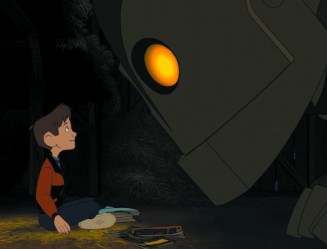 The story, as reconstructed by Bird and screenwriter Tim McCanlies, integrates influences from ’50s B-movies (very apt for a giant robot ‘monster’) and Cold War/Space Race paranoia for a potent storyline that has a different emphasis from the novel’s “world peace” finale, but nonetheless is promoting understanding of alien/foreign powers and, y’know, deep stuff like that. Alternatively — or, rather, concurrently — it’s an
  reputation it has gradually amassed — and which only continues to grow, I think. Last year saw the release of an extended Signature Edition, with a couple of short scenes added, which comes to US Blu-ray (alongside the original version) later this year. Just from reading about those new scenes, I’m not convinced they’ll improve the experience, but it’ll certainly be worth finding out.
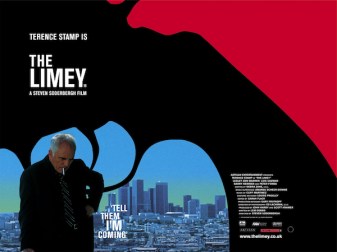 There’s an argument to be made that, from a cinematic perspective, mainstream US cinema these days is boring. Look at the kind of films American auteurs were producing in and around the studio system in the ’90s and early ’00s:
  This isn’t a conceit Soderbergh uses for one scene, or wheels out now and then, but an overall approach. Some sequences are more thick with it than others, but it’s always right around the corner. It creates a unique sensation. Not disconcerting, exactly, but mysterious and querying. It has you constantly question what you’re watching — is it a memory? A plan? A fantasy? A delusion? It draws connections back and forth across the timeline of the story, bringing out thematic angles. At its most key, it helps explain what happens at the end (too bluntly for some reviewers, I should add). This collage-like style — which unlike, say, Memento’s back-to-front narrative has no obvious in-story point — will certainly not be to everyone’s taste, but it presents an interesting challenge to our usual ideas of how a film should be constructed.
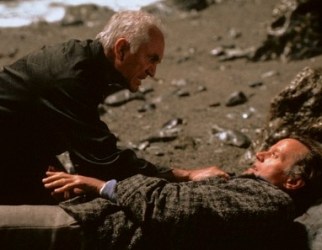 Despite the visual trickery, The Limey still works pretty well as a straightforward thriller. You have to be prepared to accept the slippery editing, because there’s no avoiding it, but the throughline of Stamp tracking down bad men and how he deals with them is still here. Personally, I’ve never much rated Stamp as an actor, but somehow he fits here. He’s a fish out of water, a man out of place — way out of place — and possibly out of time, too, seeming like a ’60s or ’70s British gangster transported to turn-of-the-millennium L.A. It’s no discredit to the supporting cast that they mainly exist to bob around in his wake.
 The third feature (but first you’re likely to have heard of) by writer-director Alexander Payne (


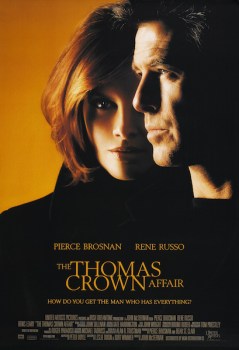 Once upon a time, John McTiernan was an action auteur, known for films that sat comfortably on the “mainstream modern classics” scale, like
 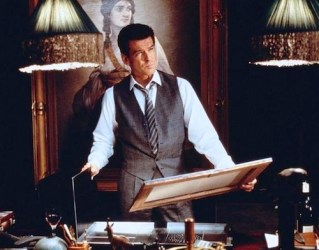 McTiernan’s action background comes to the fore in a pair of extended heist scenes at either end of the movie, which are surely the standout parts. The seductions and plot twists in between these bookends are certainly entertaining and may even keep you guessing, but it’s the heists that pack the most entertainment. They’re the kind of thing we don’t see so much nowadays, at least not in mainstream movies, because any sequence designed to provide excitement is a fight of some kind, and most of those are shot in the shaky-cam style. There’s none of that palaver here, just perfectly choreographed cutting between the various players in each heist, and some well-chosen music — as if being ably to do awesome stuff accompanied by the James Bond Theme wasn’t cool enough, here Brosnan gets to do the same to Nina Simone’s Sinnerman.
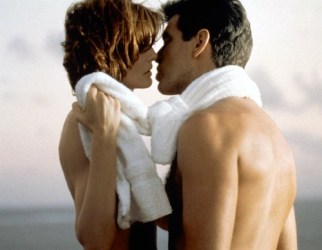 The Thomas Crown Affair may not be the best film on any of its principals’ CVs (well, except perhaps for Russo’s), but it’s a consistently enjoyable light thriller with a couple of particularly memorable sequences and a fun central dynamic. Apparently it’s better than the original, too. There’s long been talk of a sequel, but it seems to have gone the way of McTiernan’s career, which is a shame.
 100Films.co.uk