
Denis Villeneuve | 121 mins | Blu-ray | 2.40:1 | USA / English & Spanish | 15 / R
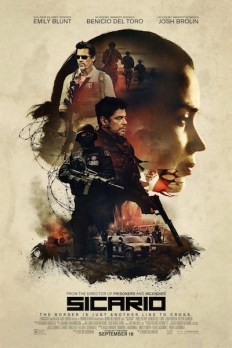 Fighting a losing war against Mexican drug cartels in Arizona, FBI agent Kate Macer (Emily Blunt) is keen to be enlisted to an interagency task force run by Department of Defense consultant Matt Graver (Josh Brolin). Taken along for the ride but kept in the dark, Macer becomes increasingly concerned that all is not as it seems — especially when it comes to Alejandro (Benicio Del Toro), a mysterious task force member whose motives seem to be a big secret…
Much like his previous film, Prisoners, director Denis Villeneuve here takes a storyline that could fuel a run-of-the-mill genre picture (a war-on-drugs action-thriller) and instead turns it into something altogether classier. In this regard, I’m tempted to invoke the work of directors like Hitchcock and Fincher. Sicario isn’t necessarily a film I could picture either of them making (maybe Fincher), but the way it takes a “genre movie” and elevates it artistically has a certain similarity. That said, like those directors at their best, Villeneuve here works primarily with tension and suspense — words I’m about to thoroughly overuse in this review, but they encapsulate the feeling of watching Sicario so well.
Any viewers seeking simple action thrills will not be satisfied with the sequences offered here, but the way the scenes rely on suspense rather than bullet choreography makes for a supremely tense movie; one that can grip you like a vice and only occasionally let up, letting you catch your breath before it doubles down. As viewers, we’re positioned alongside Macer, kept out of the loop and so unsure who to trust and what exactly is going on for much of the movie. In that respect the plot demands a certain level of attention, because it isn’t always spelled out in nice bitesize chunks of exposition.
 Arguably, the film loses its way a little when it does reach that point. Answers are forthcoming eventually, and the third act occasionally abandons the conflicted and complex world that came before it for more straightforward and satisfying turns of events. Fortunately, the film survives such wobbles thanks to the strengths it’s already established, and with an even deeper dive into moral greyness even while it seems to be offering a simplistically fulfilling climax.
Blunt is excellent as Macer, an outwardly tough-as-nails tactical specialist who is hiding a less assured core. If that sounds almost trite then it doesn’t play that way, afforded greater subtlety by Blunt and screenwriter Taylor Sheridan. Macer is a capable agent, but is she capable of operating in Graver’s world? The only other character and performance that really stands beside Blunt is Del Toro’s Alejandro. Around 90% of Alejandro’s dialogue was cut by Del Toro and Villeneuve before shooting began, and it works to everyone’s favour. He’s an unreadable presence in his silence, seeming both brooding and almost bored, like he’s fed up waiting for the task force’s duties to get him where he wants to be. His silence is threatening, even after his demonstrated skill-set is (to Macer, anyway) a kind of comfort. It’s only fitting that the final scene — the real climax of the movie, hitting hard on its emotional arcs even after the plot is done — is a two-hander between Blunt and Del Toro, loaded with as much tension and suspense as any other part of the movie.
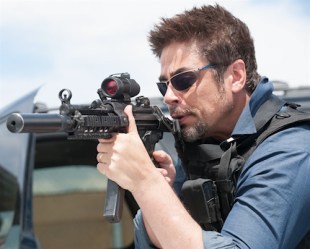 Brolin may be a headline lead alongside those two, but his character is given little to work with beyond being a son-of-a-bitch who keeps Macer onside with (deceitful) charm. He’s fine but unremarkable in that role. Perhaps the sequel will give him more to work with. More memorable is Daniel Kaluuya as Macer’s FBI partner, Reggie Wayne. More time spent with Macer and Wayne working together wouldn’t go amiss. Jon ‘the Punisher’ Bernthal also pops up in a small part, imbuing what could’ve been a sketchy plot-driver with more believability.
The film’s other real stars are behind-the-scenes. First, the Oscar-nominated cinematography by Roger Deakins. I must admit I was a little underwhelmed at first, as the film starts in the flatly-lit daytime world of the Southern US / Mexico region. Not that it’s poorly shot, just that very little of it struck me as particularly remarkable. As the film transitions to more nighttime settings, however, Deakins’ work comes vibrantly to life, starting with some majestic golden-hour shots of ominous cloud-darkened skies, which seem to visually overwhelm Macer as she begins to realise she’s out of her depth. Later, the task force descend into tunnels, and the film presents a mixture of ‘regular’ photography — so dark that only certain things can be glimpsed in the patches of light — and both thermal- and night-vision shots. I guess it’s a cliche to say the use of headcam-type footage puts the viewer there with the characters, but here it really does. Most extraordinary are the thermal shots: captured for real with a thermal vision camera, rather than a post-production special effect, they look like some heightened-reality video game, their eeriness only adding to the tension.
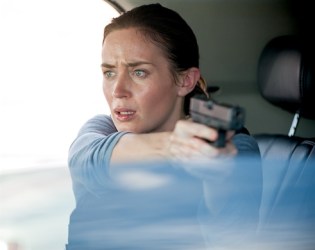 Tension is definitely the name of the game when it comes Jóhann Jóhannsson’s score, which was also Oscar nominated. Dominated by elongated, heavy strings and pacey, heartbeat-emulating percussion, it makes the threats lurking in every corner feel tangible; makes the sense that everything is doomed and liable to go south at any moment palpable. It’s a major contributor to the film’s mood.
It may have familiar genre building-blocks at heart, but between Sheridan’s focus on character, Blunt and Del Toro’s nuanced performances, Deakins’ fantastic imagery, Jóhannsson’s intense music, and Villeneuve’s skilful orchestration of every aspect, Sicario emerges as a film that exceeds the artistic and emotional effect you’d typically expect from a “genre movie” without sacrificing the thrills that should be inherent.

Sicario is available on Netflix UK as of yesterday.
It placed 1st on my list of The 20 Best Films I Saw For the First Time in 2016, which can be read in full here.

 Score:




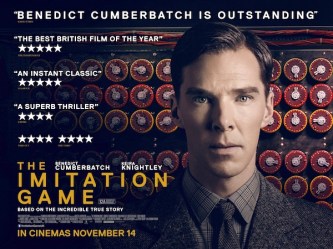 Alan Turing was a war hero: he led a team of cryptologists who managed to break the Germans’ Enigma encryption, thereby giving the Allies access to tonnes of vital information that (historians estimate) helped shorten the war by up to four years. This information was beyond top secret — so much so that they created a new designation for it, “ultra secret” — so when the war was over, Turing & co’s contribution went unrecognised for decades. Alan Turing was also a homosexual in an era when that was illegal. When he was caught, he was sentenced to chemical castration, which caused (or at least contributed) to him taking his own life. Fine way to treat a war hero, but that’s what you get with discriminatory attitudes.
 The screenplay by newcomer Graham Moore topped the Black List in 2011, so it’s probably of little surprise that it went on to win an Oscar, but I think it’s fair to say its quality, while good, isn’t that good. The use of three concurrently-told timelines seems to be too much for Moore and/or director Morten Tyldum to handle at times, occasionally flitting to a different era with little purpose beyond “it’s about time we told more of that storyline”. That’s not to say a wholly chronological telling would’ve been more effective — though perhaps it would’ve placated critical viewers who expected (and retrospectively demand) a cryptography-based wartime thriller — but the period juggling clouds the point as often as it illuminates it.
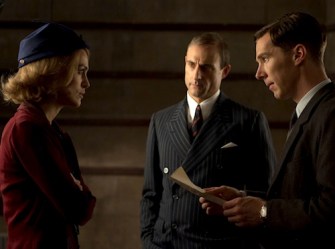 Also up for the golden man was Knightley, who does give one of her better turns as Turing’s sort-of-sidekick. The pair have a fairly complex relationship — both halves are key to conveying that, and they both do. At least as remarkable as either is young Alex Lawther, who arguably gets the film’s stand-out acting moment in his final scene, where a tumult of emotion is contained beneath a stiff-upper-lip surface in a tight close-up. On the strength of this, an actor to watch out for. The rest of the cast don’t get the same depth of material, but Charles Dance and Mark Strong provide exceptional value, as always, and Rory Kinnear does his best to bring some nuance and interest to a part he’s overqualified for.
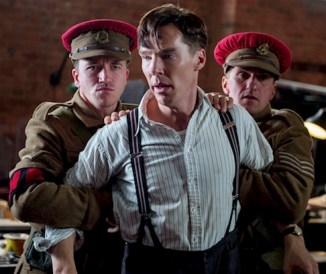 Perhaps that just stems from a frustration at some of the film’s other issues. It clearly has a flexible relationship with historical accuracy — well, what biopic doesn’t? Without wanting to spoil plot developments, some viewers feel the film suggesting Turing knew of the spy at Bletchley Park is insulting to his memory, because in real-life he didn’t even know the individual. Alternatively, is it not a way to integrate that part of the Enigma story into a film that otherwise wouldn’t have a satisfactory way to touch on it? Everyone’s mileage will vary on whether that should’ve been done or not.
 Without meaning to sound too judgemental (though when has that ever stopped me?), those factors making me think this is the kind of film “normal people” will probably love a lot more than “film fans” — which probably explains why it’s in the IMDb Top 250 but all the most-liked reviews on Letterboxd have exceptionally low scores. Personally, I’m going to side with the populous: not everything has to be a groundbreaking feat of Cinema to be a story worth telling and told well, and if it is indeed some kind of “historical revisionism” to say that there’s nothing wrong with being gay and the way Turing was treated post-war was horrendous, well, I’m OK with that revisionism.
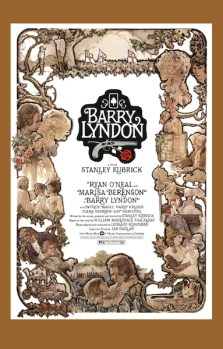 Stanley Kubrick made a good many exceptionally well-regarded films — indeed, with possibly the exception of his first semi-amateur feature,
 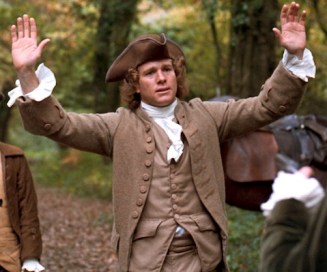 who often tells us less-than-favourable things about the lead character. Apparently this is an example of an unreliable narrator, and I suppose some of the things we’re told aren’t directly evidenced on screen, but I’m afraid I’m going to have to leave that seam to be mined by other writers, because (on a first viewing at least) I didn’t see where or to what effect the narrator was lying to the viewer.
 but a fictional biopic, that ranges across Europe and across time to… what effect? It’s a Kubrick film, so the ultimate goal of the tale, the message(s) it may be trying to impart, are debatable. You could see a story of the pitfalls of hubris. You could see an exploration of how a certain class lived in this time period. You could just see a man who led an adventurous life.
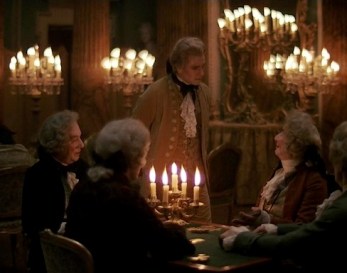 just that it remains the best among greats. (That said, having looked up images online for this review, it seems slightly less striking to me now. That may be the quality of the screengrabs; it may be that the painterly quality is so remarkable at first appearance (before becoming more familiar when the whole movie has that quality) that its memorableness is heightened.)
 The director of





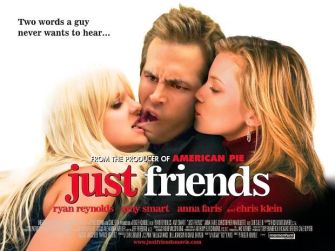 I was aware of the existence of Just Friends in the way you’re aware of any movie with name actors that came out during the period in which you were cognisant of films that were being released — that is to say, I knew it was a film and it was a comedy, and I had paid it no heed beyond that. Until a couple of months back, when
  For all kinds of reasons, Just Friends spends a long time feeling like a morally bankrupt movie. It’s unclear if it’s praising or condemning Chris’ frivolous lifestyle, if he needs saving by coming home, or if he deserves revenge on the people who mistreated him. We know what the standard Hollywood perspective on these things is, so kudos to some degree for dodging it (at least for a while), but it doesn’t commit to the other direction either. What the story really amounts to is wish fulfilment on an epic scale. Its message is essentially: you can go back to your past and make it better. Maybe I’m just a cynic, but that’s not something I believe.
 One lesson I took from watching Just Friends (as if I didn’t know this already) was that just because a bunch of people defend something they like in a comments thread on the internet, it doesn’t mean you’ll like that thing too, even if that comments thread is on the A.V. Club. Nonetheless, while Just Friends is not any kind of “must see” film, as a 90-minute diversion — with, at this temporal distance, a splash of mid-’00s nostalgia — it’s passably entertaining.

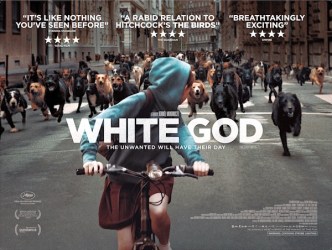 Thirteen-year-old Lili (Zsófia Psotta) and her dog Hagen are forced to temporarily live with her father, Dániel (Sándor Zsótér), because her mother is going on holiday with her new partner. Dániel doesn’t like Hagen anyway, but when the dog’s behaviour causes problems for him, he sets Hagen loose on the streets. Already angry with her father and his attitude, a devastated Lili sets out to find her beloved dog, who is busy discovering the darker side of mankind and our treatment of animals.
 For all the toughness of the journey, where it leads is triumphant; not entirely so, I must add, but enough. The film’s third act can pithily be described as Rise of the Planet of the Dogs: having seen the abuses of humans, an impounded Hagen leads a canine uprising that seeks to… well, they don’t speak (they’re dogs, remember, and this isn’t Disney), so who knows what their precise aims are? “Revenge” would be too cruel, but they definitely seeking some retribution. The film’s sadness doesn’t disappear (hence why not entirely triumphant), but some wrongs are righted.
 Some will find the middle of the film a slog, I suspect, both emotionally and with its occasionally lagging pace. However, the bookends seek to justify it. There’s catharsis in the finale, as described, but even better is the film’s opening. It has to be seen to be properly understood, but it’s operatically scored, shot, and edited, and involves hundreds (literally) of trained dogs en masse. It’s spectacular, unforgettable moviemaking; perhaps even one of the best openings to a film ever. And I don’t say that just as a “dog person”.
 100Films.co.uk