The Cabinet of Dr. Caligari (1920)

aka Das Cabinet des Dr. Caligari

2017 #163
Robert Wiene | 77 mins | Blu-ray | 1.33:1 | Germany / silent (German) | U
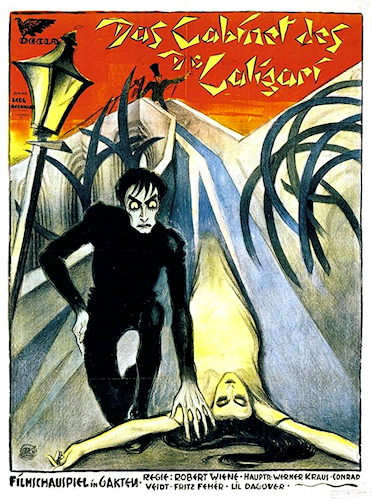
The Cabinet of Dr. Caligari

The poster child for German Expressionist cinema, as well as featuring “cinema’s first true mad doctor” and “cinema’s first unreliable narrator” (at least according to David Cairns on the Masters of Cinema Blu-ray — I haven’t verified those statements for myself), The Cabinet of Dr. Caligari certainly has a lot to unpack for a film that’s barely an hour-and-a-quarter long. Or does it? Because one has to wonder if there’s an element of style over substance here.

“A mystery story told in the Poe manner,” according to the original Variety review, the titular Dr Caligari (Werner Krauss) is the host of a fairground attraction, and his eponymous cabinet contains Cesare (Conrad Veidt), a somnambulist who Caligari controls — at the fair, to answer questions from the audience; and at night, to do his evil bidding, including murder. Caligari’s activities come to the attention of young Franzis (Friedrich Feher), who attempts to uncover the truth about the doctor and expose him.

But the most famous thing about Caligari by far is not the storyline or the characters, but the visual style. Painted backdrops evoke a landscape straight out of a nightmare: jagged lines and stark monochromatic shapes (this isn’t just a film that happens to be filmed without colour, it feels black and white), they give the impression of the winding streets of a town and its locales without actually being one. The implied structures tower over the characters, leaning in above, creating an oppressive and unnerving atmosphere, while their total lack of reality evoke theatre more than the literalism we’re now used to from film. The make-up and performances are the same: heightened; dreamlike — or nightmarish.

Impractical architecture

Which may be entirely appropriate given the film’s framing narrative, which (spoilers!) introduce an ending that’s a little bit “and it was all a dream”. Or was it? Well, that depends how you interpret what happens. The bookends were apparently added to help sell the film to the public, framing its fantastical narrative in something more grounded. The screenwriters weren’t happy — as Lotte H. Eisner writes (in the MoC booklet), “the result of these modifications was to falsify the action and ultimately to reduce it to the ravings of a madman. The film’s [screenwriters], Carl Mayer and Hans Janowitz, had had the very different intention of unmasking the absurdity of asocial authority, represented by Dr. Caligari.” Well, the tacked-on ending doesn’t necessarily negate such an interpretation, you just need to fill in the blanks to get there yourself.

For example, there’s what Cairns calls his “Mulholland Drive theory”: that what we witness is all true, until the point that Franzis sees the asylum director is Caligari; from there until the reveal that Franzis is an asylum patient is a fantasy. Evidence in favour of this: everything goes implausibly swimmingly for our hero in that section, from easily recruiting the asylum staff to finding (as Cairns puts it) “Caligari’s second cabinet, in which he keeps his entire backstory.” It’s a fun reading, even though it’s clearly a case of projecting an interpretation onto the film that wasn’t intended by the makers.

One that fits better, perhaps, is that Franzis’ flashbacks aren’t merely “the ravings of a madman”, but he’s telling the truth, and that somehow between the end of his flashbacks (which see Caligari locked up in his own asylum) and where we join the framing narrative (with Franzis locked in the asylum and Caligari in charge), the evil doctor has reasserted his authority and captured his accuser. Of course, that requires a leap — how does Caligari regain control? Why don’t we see it happen? Well, we don’t see it happen because that wasn’t what the makers intended.
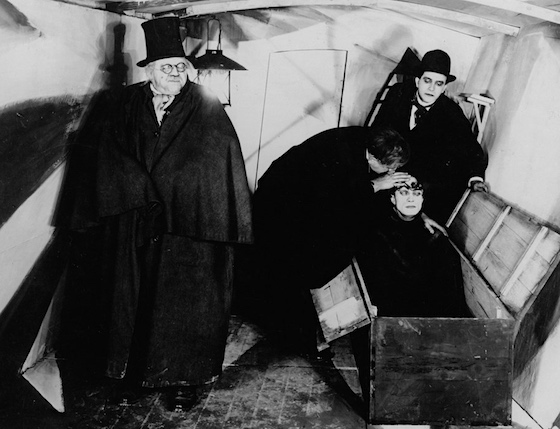
Suspicious activity

And so we come back to “it was all a dream”. Maybe that’s the best explanation — the writers may’ve hated it, but in some respects it saves them from themselves: Cairns’ visual essay highlights a bunch of plot holes, inconsistencies, and confusions, not to mention issues of character motivations and actions (“in a way it makes no sense to speak of character motivation in a mad man’s fantasy”), all of which you can hand-wave away if “it was all a dream”. This is why I wondered if it was style over substance. The sets, the make-up, the performances — all fantastically atmospheric. The story, the characters, their actions — not such great shakes.

But maybe that’s okay. After all, why not? Director Robert Wiene and his crew did a fantastic job of bringing a surreal nightmare to life, and nightmares seldom feature plausible storylines.

4 out of 5

The Cabinet of Dr. Caligari was viewed as part of my Blindspot 2017 project, which you can read more about here.

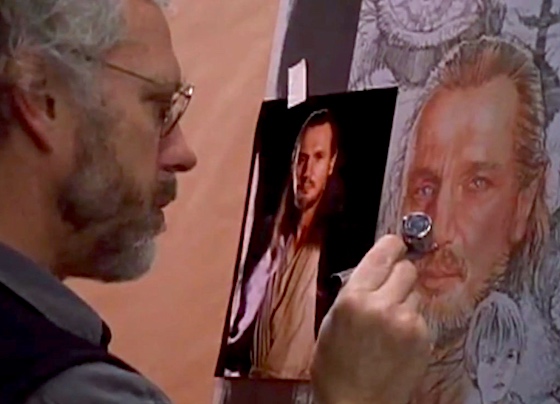
Drew: The Man Behind the Poster (2013)

2017 #127
Erik Sharkey | 97 mins | streaming (HD) | 16:9 | USA / English

Drew: The Man Behind the Poster

If you don’t know the name Drew Struzan, there’s a fair chance you know his work: he’s the poster artist behind the likes of the Back to the Future trilogy, almost everything Indiana Jones related, many iconic Star Wars posters (including the primary art for the prequel trilogy), and so many more. Even when not painted by Drew himself, his style has been a major influence on blockbuster posters across the board, even in today’s era of Photoshopped collages. Nonetheless, you may wonder if the topic can really support a feature-length documentary. How much is there to say? Turns out, plenty.

It starts out, as the title might suggest, in the form of a biography — rather than just looking at Struzan’s famous posters, it talks about his days as a struggling artist; literally starving, choosing to spend his limited money on paint rather than food. Once it reaches his move into film posters it goes more topically, covering a series at a time. He started on B-movies, which led to doing a poster for Star Wars’ 1978 re-release, which led to Indiana Jones, which was his big breakthrough: his poster for Temple of Doom established him as the Indy artist, and he went on to do video covers, book covers, and the rest.

Painting Menace

Despite the biographical start, the film is really an appreciation, if that were a genre, but a well-deserved one. There are stories about how the posters were commissioned, or designed, or painted, or whatever, but also about their impact, effect, and significance, and what it’s like for filmmakers to work with Struzan. In that regard the list of interviewees is impressive, including the likes of Steven Spielberg, George Lucas, Frank Darabont, Guillermo del Toro, and more. Their presence speaks not only to the awe-inspiring people Struzan has done posters for, but also how much they admire him. As Spielberg says, he was trying to make a movie that would live up to the art they’d later commission from Drew.

Movie posters are just advertisements, really; certainly in the minds of executives — I mean, why else are the Marvel ones overloaded with every possible character and location featured in the movie? But to the public they’re more than that. Michael J. Fox makes the point very well right at the start of this film: the poster is the first part of the story; it’s where the film begins for the audience. There’s definite truth to that — the ad creates an expectation, and the resultant film has to match it. With Struzan’s work, the bar was never set higher.

4 out of 5

My Cousin Rachel (2017)

2018 #33
Roger Michell | 106 mins | streaming (HD) | 2.35:1 | UK & USA / English | 12 / PG-13

My Cousin Rachel

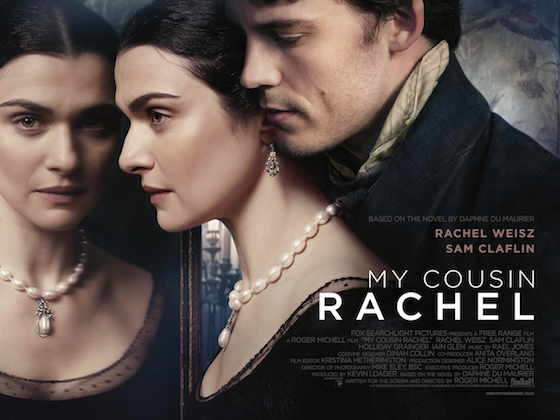
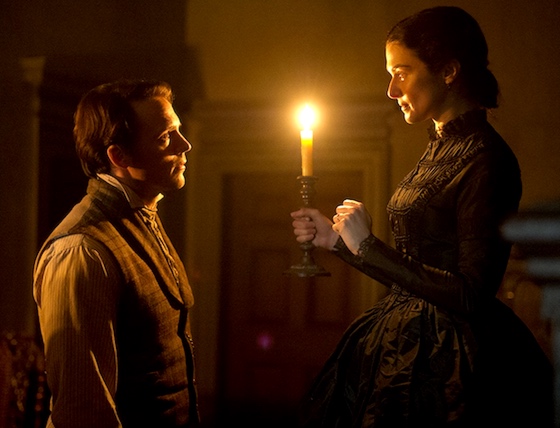
Adapted from a lesser-known Daphne Du Maurier novel (previously filmed in 1952 with Olivia de Havilland, and here relocated from Cornwall to Devon to avoid comparisons to Poldark (really)), My Cousin Rachel is the story of an orphaned young man, Philip (Sam Claflin), who’s raised by his older cousin Ambrose until the latter’s health forces him to leave for Florence. There Ambrose falls in love with their cousin Rachel (Rachel Weisz) and marries her, but shortly after dies. His final letter to Philip implies Rachel may’ve had a part in his demise. When she arrives at their estate in England, Philip is determined to confront her, but soon finds himself entranced by her, as does everyone. Is she a scheming murderess intent on using her wiles to acquire the family’s estate, or did Philip’s imagination get the better of him?

That mystery is really the heart of My Cousin Rachel, which unfurls as a classy, lightly Gothic melodrama. It’s a puzzle that’s not so much investigated as gradually hinted at, leaving the audience to make up their own mind. It certainly was successful in having me change my opinion on where it was headed multiple times. The pace is fairly leisurely, which some reviewers have found to be trying; but while it’s certainly a slow burner, for me that was part of why it worked. The passage of time and the opportunity it grants for overthinking sways Philip’s mind hither and thither, and so the film gives the viewer similar space to think, for their opinion to shift, back and forth. It makes you a part of his paranoia.

Who's playing who?

Rachel Weisz is typically excellent, delivering a finely balanced performance that is at once charming and suspicious — is Rachel simply quietly enigmatic, or she hiding a scheming and deadly nature? Sam Claflin is very effective as the hot-headed, easily-led young man at the centre of the story, exhibiting these characteristics which sell Philip’s flip-flopping opinions, which could otherwise have come across as inconsistent. You can believe their passion of each other — or, certainly, his for her — which leads to some earthy bits that might surprise anyone expecting a quaint Heritage melodrama. Thrusting among the flowers aside, the overall style does evoke those Sunday evening costume dramas (you can see why they were wary of a Poldark comparison), as does the pretty photography by DP Mike Eley — it’s not the most outright gorgeous film you’ve ever seen, but it’s a bit of a looker.

My Cousin Rachel’s unhurried storytelling may put off some viewers, but if you settle into its rhythm then it’s a paranoia-fuelled guessing game that will keep you rethinking the truth up until its closing moments.

4 out of 5

My Cousin Rachel is available on Sky Cinema from today.

ManHunt (2017)

2018 #94
John Woo | 109 mins | streaming (HD) | 2.35:1 | China & Hong Kong / Japanese, English & Mandarin | 15

ManHunt

John Woo’s latest movie is now “A Netflix Film” in the UK, US, and presumably some other territories too. After almost 15 years spent making period dramas, it’s a return to the contemporary action-thriller genre that made his name. Whether it represents a return to his previous quality… well…

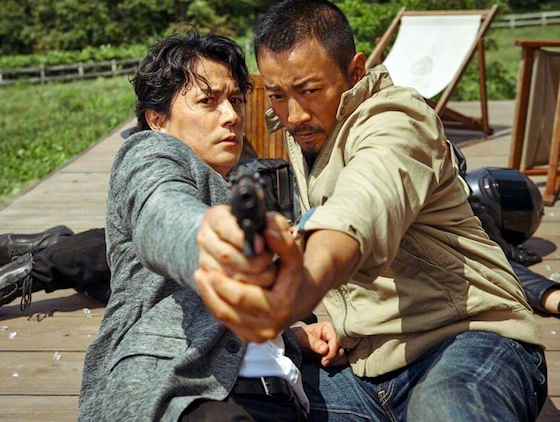
ManHunt introduces us to Du Qiu (Hanyu Zhang), a Chinese lawyer for a Japanese pharmaceutical firm, credited with saving the company when he won a court case three years ago. Now he’s leaving to head to America, but the company’s president tries to persuade him to stay by sending a sexy lady to wait at his house. Unfortunately for Du, when he wakes up the next morning she’s dead and he’s the prime suspect. Soon he’s on the run to clear his name, with hot-shot cop Yamura (Masaharu Fukuyama) on his tail, though he’s not convinced of his target’s guilt. That’s just the start of it — why would someone want to frame Du for murder? Well, it gets complicated…

For the first half of its running time, ManHunt is a baffling experience. Not so much because of the plot — though that sets so many wheels in motion that one must pay attention — but because of how it’s put together. One major problems is the way it casually mixes together multiple languages, leading to some flat translations (that’s being kind — maybe the screenplay, which comes courtesy of seven screenwriters, was unexciting to begin with) and clunky line delivery. But hey, this is an action movie, so we can forgive some iffy performances. A greater barrier to enjoyment comes in the form of Taro Iwashiro’s underpowered, plinky-plonky score. That might be fine during chatty scenes, but it continues into the early action sequences, robbing them of pace, dynamism, and excitement. It’s a thoroughly bizarre choice that undermines the film’s raison d’être.

Not chuffed to be cuffed

With its unoriginal innocent-man-on-the-run story and disengaging production quirks, it’s tempting to give up on ManHunt before the half-hour mark. However, director John Woo does begin to sneak in some of his trademark flair. One particularly good bit sees Yamura and his new partner visit the crime scene to go over what they think happened. Woo mixes together their reenactment with flashbacks in interesting, increasingly overlapping ways… until the sequence ends with the female officer getting hysterical, the old-fashioned-ness of which undercuts the sequence a little right at the end.

As the various plot strands kicked off at the start begin to come together, the film becomes increasingly worth watching. If you can make it through the first half, the second begins to revel in its own silliness. It stops mattering that everyone has to deliver dialogue in at least two languages but none of them can actually act in more than one. It stops mattering that the plot barely makes sense — in fact, it actually improves the crazier it gets. A framed man on the run? Yawn. A pharmaceutical company searching for a secret formula to perfect the currently-lethal super-soldier drug it’s testing on homeless people, which is in the possession of the widow of a former employee they killed for alleged corporate espionage, and using drug-enhanced hitwomen to do its dirty work while corrupt addict cops cover up the indiscretions of its president’s son? Awesome. And the action finally kicks into gear too, gradually shifting first into having some good moments, then into whole sequences that are worth your time. Is it all too little too late? Kinda. But at least it rewards those prepared to stick with it.

Sharing is caring

In many ways I should give ManHunt just 2 stars, but that would be to ignore the fact that I’m glad I watched it. But if a 3-star rating is any kind of recommendation, here it’s a very cautious one.

3 out of 5

ManHunt is available on Netflix now.

Review Roundup: 3 Long Films That I Didn’t Enjoy Directed by Martin Scorsese

The title’s pretty self-explanatory, isn’t it?

Those films were:

  • Silence (2016)
  • Casino (1995)
  • New York, New York (1977)


    Silence
    (2016)

    2017 #141
    Martin Scorsese | 161 mins | streaming (HD) | 2.35:1 | USA, Taiwan & Mexico / English, Japanese & Latin | 15 / R

    Silence

    A re-adaptation of Shūsaku Endō’s novel (previously filmed in 1971), Silence is gorgeously produced but torturously dull Christian propaganda. The plot is about two priests travelling to anti-Christian Japan to find their mentor, who’s rumoured to have renounced the Church, but really it’s about faith and the testing of it.

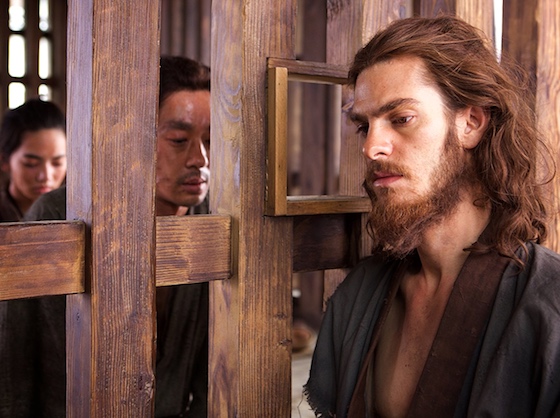
    The foremost of the two priests is Rodrigues (Andrew Garfield), the kind of Christian who lets others die for his faith even as he doubts it. Like many a preacher before him, Rodrigues’ sin is pride — too proud of his faith, his culture, his rightness, his superiority, to consider another point of view; to bend to help others. Conversely, his accusers and persecutors lack compassion or fairness, torturing and killing from exactly the same position as Rodrigues: that their beliefs are correct, all others be damned. Well, of such things are all religious wars made, I guess. At least the Horrible Japanese are better than the Christians’ own Inquisition was: if people renounce Christianity the Japanese sometimes set them free; the Inquisition just used it as another reason to murder them. God, religious people can be shits.

    There are no good people here. The Christians are colonialists with a monomaniacal belief in their own faith. The Japanese are so set against it that they’ll torture and murder their own people just to get back at the Christians. It’s a world full of hatred. So much for the love of God. All this intolerance is as pointless then as it ever was before or has been since. If we just let others go on how they want to go on — live and let live — then the world would be such a nicer place.

    Rodrigues in prison

    For all the violent torture depicted on screen, the hardest thing to take is the film’s slow, slow, slow pace. It does have some theological points to make, but they’re thin gruel for the time it takes to make them — or, rather, the time it wastes before it really starts to consider them. If the first hour was a lot shorter it would improve the whole film; indeed, it would’ve made me better disposed to the rest. It does improve, but by the time it improved I was already bored and annoyed with it. Its best qualities by far are visual: as well as stunning cinematography by Rodrigo Prieto, the whole production is beautifully mounted — the locations, sets, costumes, make-up, and so on, are all very well realised.

    To say Silence was not a box office success is an understatement: off a budget of $46 million, it took just $23.7 million worldwide, and only $7.1 million of that in America. I think it must’ve been promoted badly — I’m sure it’d appeal to the Bible Belt crowds who flock to that niche Christian shit that’s always turning up nowadays. And if you’re in any doubt that it’s meant to be a pro-Christian film: the premiere was held at the Vatican and it was screened early for 400 priests.

    2 out of 5

    Casino
    (1995)

    2018 #19
    Martin Scorsese | 178 mins | download (HD) | 2.35:1 | USA & France / English | 18 / R

    Casino

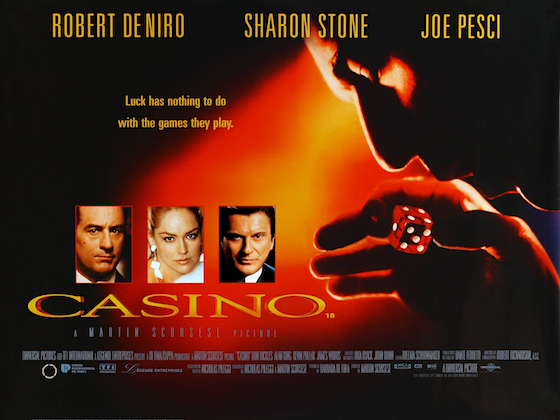
    “A fictional story with fictional characters adapted from a true story,” as the film’s own credits describe it, Casino tells of the rise of Sam ‘Ace’ Rothstein (Robert De Niro, of course) in Mob-controlled Las Vegas, whose life is made awkward by his loose-cannon Mob-enforcer best friend Nicky Santoro (Joe Pesci, of course) and his tumultuous marriage to hustler Ginger (Sharon Stone).

    “There’s no plot at all”, says Martin Scorsese in an interview included on Casino’s Blu-ray (per IMDb). “It’s three hours, no plot. […] There’s a lot of action, a lot of story, but no plot.” Well, er, he’s not wrong. Casino seems to skip around at random, devoid of a throughline to guide its narrative. It flies off on so many different tangents, it takes a while to get a handle on what it’s about — if it’s about anything. Or possibly it’s about too much. For example, there’s a lot of “how the casino business works” stuff early on, which is quite interesting in itself but only some of it has any relevance later on; and eventually the film gets sidetracked wholesale into De Niro and Stone’s marriage woes, which are at best a subplot earlier on. Whatever it was supposed to be, I was never hooked and never engaged.

    De Niro blows

    Part of this is the film’s storytelling style — I didn’t know Scorsese was in the business of making visuals to accompany audiobooks. Well, that’s what Casino felt like. Naturally there’s skill on display (they’re very, very good visuals to accompany an audiobook), but the voiceover-driven style really alienated me. It makes the characters feel at arm’s length: despite De Niro and Pesci constantly taking directly to us, I didn’t feel like I was getting to know or connect with them, I was just being told about them. The endless narration constantly skims through events too, making it feel like a summary rather than an actual story. You might think that would give it pace, but it does the opposite: the first hour drags and drags, and then drags some more, and eventually this three-hour film feels every minute of it.

    I read one review of Casino that concluded, “I don’t feel like watching it again, but it certainly made me want to watch Goodfellas again.” I know the feeling.

    3 out of 5

    Casino was viewed as part of my What Do You Mean You Haven’t Seen…? 2018 project.

    New York, New York
    (1977)

    2018 #88
    Martin Scorsese | 156 mins | DVD | 16:9 | USA / English | PG / PG

    New York, New York

    Once again, this is a lengthy Martin Scorsese movie that seemed terribly unfocused for so long that it lost me ages before it found what it wanted to be about. (Well, it predates the other two, but whichever order you put them in it’s looking like a definite pattern.)

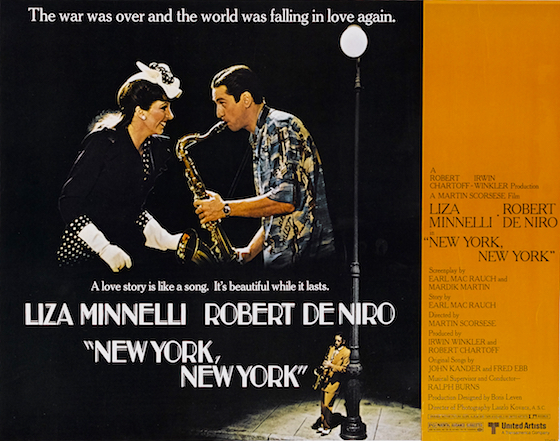
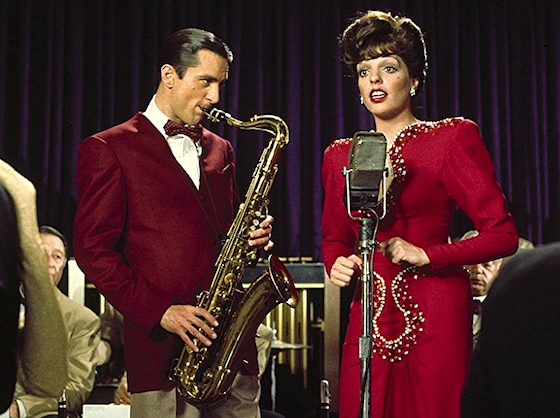
    Starting on VJ Day in New York, it stars Robert De Niro as a wannabe musician and Liza Minnelli as a wannabe singer who wind up in a romance and co-dependent career, until one outshines the other. De Niro is playing an angry young man who has talent but whose temperamental nature may well get in the way of success — yes, it’s Any Robert De Niro Movie. But, wow, his character is annoying, and I imagine his actions are only getting more distasteful with time — the way he badgers and cajoles Liza into going out with him (something she eventually agrees to) is the kind of behaviour that gets regularly criticised nowadays (rightly). Well, I don’t think he’s meant to be a nice guy — the film seems to be about their tempestuous relationship and how that helps and hinders their careers — but I wasn’t sure the film knew how unlikeable he was.

    I wasn’t sure the film knew much of anything, really. Apparently much of the dialogue was improvised, which in turn made it a nightmare to edit into a coherent narrative, which would explain the messiness — everything feels overlong, unfocused, and increasingly dull. Consequently there have been several cuts of the film, with this being the longest “director’s cut” released in 1981. It has some good bits, foremost being the extended Happy Endings musical interlude, which at one point was ditched to create one of the shorter versions. I like the idea of this film being less long, but don’t lose the only really good bit!

    So good they named it irrelevantly

    Just to wind me up further, the content has fundamentally nothing to do with the title. I mean, it begins in New York, and when the characters go on tour they’d like to get back there, and eventually they do and so some more of it’s set there, and occasionally they’re writing the titular song (which, I confess, I was unaware hailed from this film — I assumed the movie was named after the famous standard, not that it spawned it), and in the epilogue Liza performs said song (post-2016 observation: said epilogue is gosh-darn similar to La La Land’s!) Anyway, my point is: this film could’ve been set almost anywhere and not affected anything much, so why the title?

    2 out of 5

  • Jumanji: Welcome to the Jungle (2017)

    2018 #89
    Jake Kasdan | 119 mins | Blu-ray (3D) | 2.39:1 | USA / English | 12 / PG-13

    Jumanji: Welcome to the Jungle

    As Avengers: Infinity War breaks almost all opening weekend records, a surprise box office champ from last year makes it to UK DVD and Blu-ray. Well, it’s not all that surprising that Jumanji: Welcome to the Jungle did well at the box office — it’s the belated sequel to a successful film that has become a childhood favourite for many, and it stars one of the few current actors who’s more-or-less guaranteed to get a film good gross on his appearance alone, The Rock — but how well it did shocked many who commentate on such things. In the US, although it only opened at #2 (behind The Last Jedi in its second weekend), it climbed to #1 for its third weekend, then stayed there for four of the next five weeks. Eventually it overtook every Spider-Man movie to become Sony’s highest-grossing film ever domestically. Worldwide, it’s taken just shy of $957 million to be Sony’s second highest-grossing film of all time (behind Skyfall). That’s more than just some vague nostalgia for an old Robin Williams movie.

    Set 20 years later, a group of mismatched high school kids wind up in detention and are assigned to clear out an old classroom. There they find an old games console with a single game: Jumanji. They boot it up, select their characters… and are sucked into the console, finding themselves inhabiting their avatars inside the game’s jungle world. In order to escape they must complete the game, by battling against a gang of mercenaries to return a jewel to its rightful home.

    Search for the high school kid inside yourself

    It’s a very different setup to the original movie, which is refreshing — it could’ve just been a rehash with modern effects (while the Williams movie still has a lot going for it, the mid-’90s CGI is definitely not one of them). That said, it’s not as innovative or inventive as the first movie. The way that brought the board game’s environment to life in the real world was a unique concept, whereas this sequel merely offers an Indiana Jones-esque jungle adventure, albeit with self-aware characters. It doesn’t even use the fact it’s supposedly a video game that much, aside from a few jokes (our heroes have ridiculous only-in-a-game abilities and weaknesses; non-player characters sometimes have looping dialogue).

    Where it does work is the characters and the performances. The headline cast are excellent, playing at once their in-game characters and evoking the real world counterparts who’ve inhabited them. Much of the film’s fun comes from the juxtapositions: the most obvious is Jack Black as a self-obsessed teenage girl in the body of an overweight middle-aged man, but there’s also Dwayne Johnson as a scaredy nerd in the body of, well, The Rock; Kevin Hart as a bulky jock reduced to being a short-ass backpack carrier; and Karen Gillan as an under-confident academic girl now in the body of a sexy Lara Croft type. Well, frankly, I’m not sure how much Hart brings to the table, but Johnson and Gillan are really good (and — minor spoiler! — share what is perhaps one of the best kisses in screen history), and Black is clearly having a whale of a time. The quality of the characters quietly builds to a point where the epilogue back in the real world is surprisingly emotional.

    MVPs not NPCs

    Unfortunately, not everything works that well. The main thing that suffers is the villain. I suppose there has to be one, if only to provide an obstacle at the climax, but that’s also the only reason he’s there — an antagonist for the sake of it. He either needs more time investment, to make him a proper character, or, actually, less — make him even more of an uninteresting obstacle than he already is. Heck, they could’ve got some gags out of the weak plots of old video games. It’s a similar situation with world building. For example, the city they visit looks fantastic in the establishing shot, but there’s no time invested in it — it’s just a place for an action scene, clearly meant to provide visual variety from the other settings of jungle, jungle, and jungle. Maybe that’s ok, but you feel like there could be more to this world.

    These issues with plot construction extend to individual gags, some of which feel like setups in need of pay-offs. For example, Hart’s character has a weakness for cake. We learn that, then he accidentally eats some cake and loses a life, but… that’s it? The scene is mildly amusing thanks to the OTT way it causes him to die, but it feels like that’s a reminder — “weaknesses matter, and cake is his” — before a proper pay-off later. But there isn’t one. I mean, how about this: not only does cake kill him, but he can’t resist it (it’s like, you know, a weakness). So in the rhino scene, instead of just dropping him, they drop a trail of cake to lure him along; then, rather than the rhinos just being distracted by him running away, he eats the cake and explodes, which takes out the rhinos. (Hire me, Hollywood!)

    There is running. There is also jumping. Yep, definitely a video game.

    In some respects these are all nitpicks. They don’t detract from the main fun of the film, which is the mismatch between real-world kids and their in-game avatars, and putting those characters through an action-adventure. The result is amusing and exciting, and ultimately a lot of fun, even if a bit of polish could’ve made it better. Nonetheless, I probably enjoyed it more than the original.

    4 out of 5

    Jumanji: Welcome to the Jungle is released on DVD and Blu-ray in the UK today.

    Geostorm (2017)

    2018 #70
    Dean Devlin | 109 mins | download (HD+3D) | 2.40:1 | USA / English, Cantonese, Russian, Hindi & Spanish | 12 / PG-13

    Geostorm

    Geostorm met with widespread derision when it hit the big screen last year, but, despite the many negative reviews (it has just 12% on Rotten Tomatoes), I heard someone say it was actually an entertaining popcorn blockbuster. I forget who that was, sadly, because they were wrong. Very wrong.

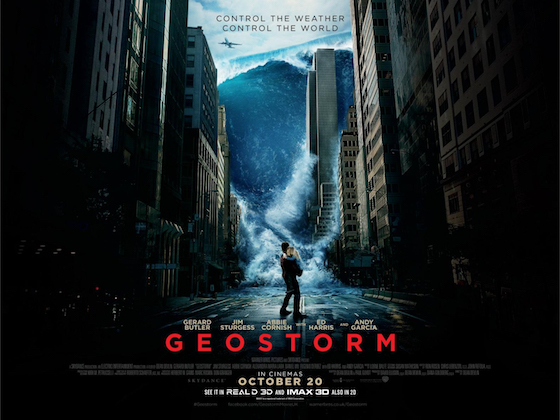
    Set in the near-ish future, it’s about a giant weather-control system installed in orbit around the Earth that begins to malfunction and cause disastrous freak weather events, which have the potential to build into a so-called “geostorm” — a devastating planet-wide weather fuck-up, basically. And there’s only one man who can stop it… despite the fact he’s not been involved with the system for about three years and during that time it’s been successfully run by a massive team of no-doubt-highly-skilled people.

    A lot of films of this type start out okay and get dumber as they go on. Geostorm hits the ground running with shit dialogue and nonsensical plot developments — I’d list some, but God, there are far too many for me to bother. That said, here’s my favourite: when someone advises the US President that they’ll need to send a whole team with various skills and abilities to fix the malfunctioning global satellite weather control system (because, you know, that must be a pretty complicated set of interrelated systems, and no one knows whether it’s software or hardware or whatever else), the President decides they’re only allowed to send… one person. And it isn’t even a specific person who he thinks is a whizz — his next instruction is “find me that person.” And everyone else in the room seems to think this is a reasonable course of action. I mean, there are no words for that kind of stupidity. Well, maybe “Trumpian”, but the film isn’t presenting it as satire. And, as I said before, there’s already a massive staff up there running operations — why would the President not assume the one person with the specific skill-set needed to diagnose and fix the problem is already up there? How do people get paid to write crap this stupid? How could any self-respecting writer generate this?!

    From their expressions, I presume they're reading the screenplay

    Well, quite frankly, I’m not sure Geostorm was even written by a writer. Exhibit A: About 56 minutes into the movie, one character says “it’s bigger than you and me”, and a supporting character corrects him: “you and I”. But “you and me” is grammatically correct in that situation. Any writer worth whatever you get paid for writing a $120 million movie should know that, ergo there can’t’ve been any writers involved. Or, yeah, the writers who were involved were really, really, really shit. They should be ashamed of themselves.

    The film is littered with faults, minor and major, that draw attention to themselves like this. Apparently the original cut received poor reactions from test audiences, leading to extensive reshoots, which I imagine explains some of the inconsistent crap that goes down during the film’s finale. (Spoilers follow, should you care.) One of the significant establishing traits of the film’s primary hero, Jake (Gerard Butler’s character), is he has a daughter who he loves very much — there’s an emotional scene when he leaves her to go off to the weather satellite, and so on. But later, when he has just minutes to live, he seems to have no pressing desire to want to talk to her. He just tells his brother to stay in her life — which the brother wanted to do anyway, but earlier Jake had been stopping him. Written like this that almost plays like character development — how he’s accepted his brother again — but that’s not how it plays out.

    Gerard Butler, thwarted by another door

    Oh, but it gets worse. (More spoilers!) So, the station’s commander departed ages ago with the rest of the crew, leaving Jake alone to fix the problem and then die when the station blows up anyway (don’t worry about the logistics of that, the film doesn’t). But then Jake gets stuck when he has to… open a door. And suddenly the commander’s there, and she knows what to do to… yes, open a door. So that means she’s been hiding out somewhere on the station, making sure Jake doesn’t see she’s still there, until that precise moment when he needs help… to open a door. Oh, and then, by total chance and plot implausibility, they actually survive the destruction of the station, and get in a satellite and use it to return to Earth. Not an escape pod, a satellite. Why does a satellite have enough empty space to carry two people? There’s no way you could answer this stuff.

    Some people, even including some filmmakers, seem to think critics and “pretentious” filmgoers slag off movies like Geostorm based solely on the genre or concept or some other fundamental characteristic. And, yeah, there must be some people who won’t give certain genres a fair shot; but that’s not widely the case, as the praise attracted by better blockbusters proves time and again. No, films like this get slagged off when they’re shittily made. Geostorm is shittily made.

    1 out of 5

    Geostorm featured on my list of The Five Worst Films I Saw For the First Time in 2018.

    The Dark Tower (2017)

    2018 #25
    Nikolaj Arcel | 95 mins | streaming (HD) | 2.39:1 | USA / English | 12 / PG-13

    The Dark Tower

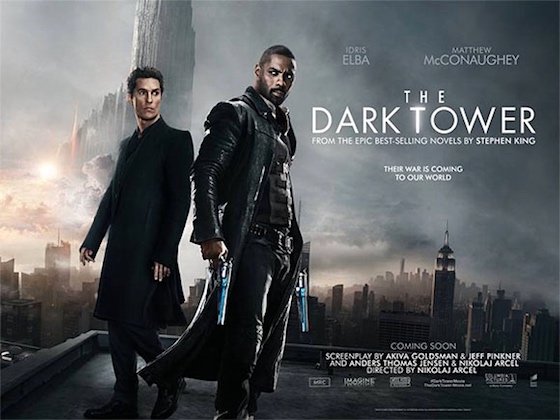
    The Dark Tower started life as a literary work that is, according to its author, Stephen King’s magnum opus: a series of eight novels, written over 30 years and spanning some 4,250 pages, that not only tell their own genre-mash-up story, but also reference or connect up many of King’s more widely-known works. Since 2007 there have been various efforts to try to wrangle such an epic work onto the screen, with perhaps the most high-profile being Ron Howard’s ambitious plan to spread it across both film and TV, alternating a trilogy of big-budget movies with seasons of TV on HBO in order to adapt the whole saga. This clearly proved to be too formidable a goal, but eventually paved the way for what was released: a single 90-minute film. From one extreme to the other, eh…

    It’s easy to imagine why fans of the books have found this film disappointing, then — I mean, there’s no way they’ve managed to accurately condense seven novels (and some of them very long novels at that) into an hour and a half. But, despite the series-encompassing title, it’s my understanding that it’s primarily an adaptation of the first novel, so surely fans would know they could expect the rest of the narrative if sequels were produced? The perceived problems must go deeper, therefore, and be more general: leaving aside fan reaction, the film has a Rotten Tomatoes score of just 16%.

    Strut

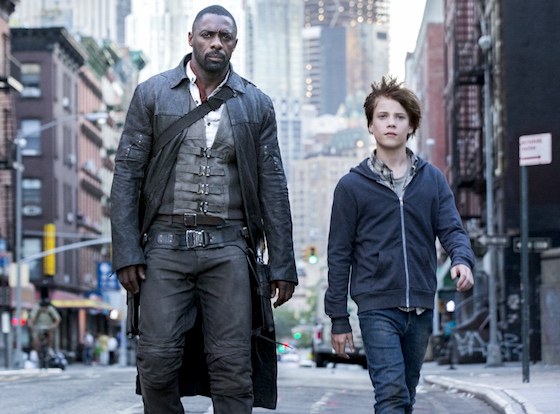
    Well, I don’t know what people were hating, because I thought it really wasn’t that bad. I can’t comment on its faithfulness or thoroughness as an adaptation, but as an action-fantasy movie in its own right I thought it held together pretty well. It only cost $60 million (a bargain for a blockbuster nowadays), but they got good value for money: it doesn’t look cheap, and it has a respectable lead cast as well. Idris Elba’s presence may’ve pissed off some people (his character has consistently been depicted as white in illustrations accompanying the books), but he seemed to fit the role. Matthew McConaughey makes for a decently unsetting bad guy. Our identification figure is a kid played by Doctor Foster’s Tom Taylor, who’s fine here but got to show more chops in that series.

    The relatively stringent budget probably explains why it’s a little light on things like epic action sequences, with those that are included feeling like the makers were probably doing their best on a limited expenditure — the action isn’t bad, but those scenes aren’t as awesome as the film thinks they are. Less readily excused is the plot, which is a bit slim — the story is very straightforward, despite the intricate fantasy gubbins dressing it up, moving directly from A to B to C with minimal complication. Similarly, familiar character arcs are efficiently executed. But if a film’s biggest crime is unoriginality, it’s no worse than the majority of Hollywood’s output for the past 20 or 30 (or more) years, is it?

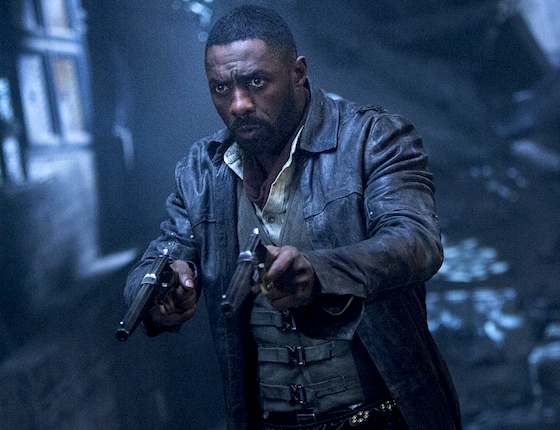
    Slinging guns

    Well, according to script editor (and fan of the books) Andrew Ellard in his discussion of the movie, that’s precisely the problem. He argues the film represents “the exact same competent mediocrity we’ve seen before from — say — I, Robot or I Am Legend. Not a bad film especially. Just kinda nothing. Or like Inkheart or Assassin’s Creed, fantasy you won’t remember tomorrow. But the books are fascinating. Full of ideas & imagery that haunt you. To pick the blandest, most generic stuff? Dumb.” This, I do suppose, is what fans were primarily upset about. If you don’t know the books then the film we’ve been given is fine as just a reasonable time-passer, but if you feel that it could — should — have been something truly special, how frustrating that must be.

    The Dark Tower grossed $113 million, which, at less than double its budget, probably isn’t enough to secure the mooted sequel (especially when it’s put in comparison to 2017’s other Stephen King adaptation, It, which surpassed $700 million). I guess someday it’ll get re-adapted, probably as a TV series, maybe by Netflix, or Amazon, especially if they still haven’t found the Game of Thrones-beater they’re currently looking for. Until then, this version stands as a reasonably enjoyable quickie — not as bad as you may’ve heard, but apparently not all it could’ve been either.

    3 out of 5

    The Dark Tower is available on Sky Cinema from today.

    Review Roundup: Comedy Documentaries About Music

    In today’s does-what-it-says-on-the-tin roundup:

  • Anvil: The Story of Anvil (2008)
  • Popstar: Never Stop Never Stopping (2016)


    Anvil:
    The Story of Anvil

    (2008)

    2017 #117
    Sacha Gervasi | 77 mins | streaming (HD) | 16:9 | Canada / English | 15

    Anvil: The Story of Anvil

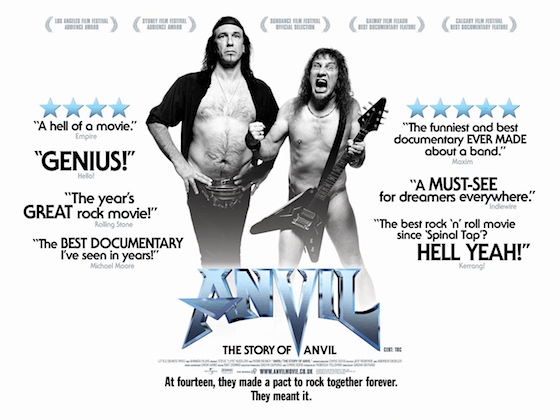
    This is the real Spinal Tap: a rockumentary about heavy metal group Anvil, who once headlined alongside Whitesnake and Bon Jovi, and are cited as an influence on groups like Megadeth and Metallica, but who haven’t enjoyed the same success as any of them. The film follows the group as they attempt to relaunch with a tour and new album.

    Truth is stranger than fiction, as they say, and, thanks to This is Spinal Tap, Anvil at first feels like fiction, with broad characters and a humorous tone. But it isn’t a blatant rip-off of Rob Reiner’s influential mockumentary, it’s a true story.

    That knowledge gives the whole thing a different air. It’s not so much tinged with sadness as endlessly sad — hopes and dreams that have come to nothing, even though they’re still pursued; how those continued pursuits falter and fail. And, perhaps worst of all, is the esteem other bands hold them in — the influence they admit to have taken from Anvil — and yet Anvil themselves languish in crummy jobs with no wide recognition, while the people who ripped them off (as one of them even admits) are famous and successful.

    A lot of comedy would actually be quite sad if it wasn’t fiction. Anvil proves that.

    4 out of 5

    Popstar:
    Never Stop Never Stopping

    (2016)

    2018 #41
    Akiva Schaffer & Jorma Taccone | 83 mins | streaming (HD) | 2.35:1 | USA / English | 15 / R

    Popstar: Never Stop Never Stopping

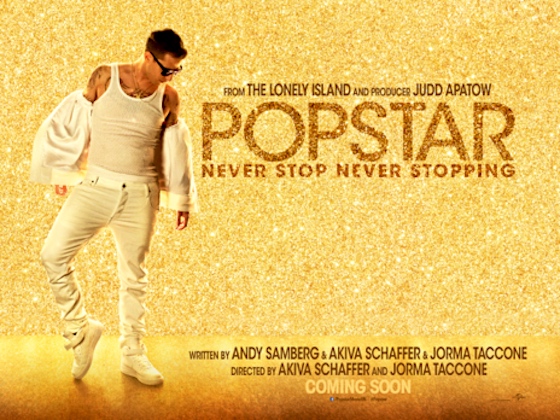
    This is Spinal Rap: comedy trio The Lonely Island star as the Style Boyz, a popular pop-rap boy band who disbanded after their frontman, Conner4Real (Brooklyn Nine-Nine’s Andy Samberg), decided to go solo. The mockumentary follows Conner as he goes on tour to launch his second album.

    Popstar is every inch a modern do-over of This is Spinal Tap. That’s not to say it’s a straight-up remake, but it’s certainly a spiritual sequel, with many similar building blocks: not very bright musicians; unsuccessful musical endeavours; and lots of fully-realised spoof songs. Where Spinal Tap satirised the metal scene of the ’80s, Popstar turns its sights on the world of present-day mainstream music. In both cases, the base funniness is enough that you don’t need much familiarity with reality to get the gags.

    It only bears so much comparison to its forebear (there’s nothing as iconic as “it goes up to 11” to be found here), but as a modern take on the same genre, it has merit. And, most importantly, I thought it was consistently very amusing.

    4 out of 5

  • Zatoichi’s Flashing Sword (1964)

    aka Zatôichi abare tako

    2018 #50
    Kazuo Ikehiro | 82 mins | Blu-ray | 2.35:1 | Japan / Japanese

    Zatoichi's Flashing Sword

    Zatoichi’s built up quite the reputation by the beginning of this seventh adventure: his previous escapades have left many gangs gunning for him — literally, as it turns out, because the story begins with Ichi getting shot by an opportunistic nobody. Fortunately for everyone’s favourite blind masseur-cum-swordsman, the guy’s clearly not a great shot, and a friendly passerby sees to it that Ichi gets the care he needs. Later Ichi sets about tracking down his mysterious benefactor, which puts him in the middle of a conflict between two gangs — what else is new? This time they’re arguing over a free fireworks display and the rights to provide a river crossing service. Sounds a bit less violently dramatic than normal, doesn’t it? But when gangsters don’t get what they want…

    Flashing Sword offers a more straightforward story than some other instalments of the Zatoichi series: the opposing sides and their differences are thoroughly established, and one gang are even clearly the good guys! Makes a change from Ichi having to pick between the lesser of two evils and/or trying to wipe out both sides. Some other reviewers seem to find the story simplistic or lightweight. Conversely, I appreciated the clarity of approach, and thought the film found different ways to add complexity beyond pure plot gymnastics.

    Did somebody mention gymnastics?

    Playing out as more of a drama than some of the other films, the events here have something of an emotional impact on our roving hero. As the two sides argue in low-key fashion, Ichi’s involvement in the conflict is limited, and so he settles into the home he’s been welcomed to as a guest, to the point where he almost seems ready to settle there. Well, we know he never will, but that’s dramatic irony for you. It’s the same with the pretty young lady that Ichi once again finds himself involved with (all the ladies love a blind man, it would seem) — we know they’ll never end up together, but the characters have to find that out for themselves. This time, Ichi is robbed of his possible dreams in particularly cruel fashion, as the bad guys scheme to force the good boss’ hand. Ichi finds out the truth, but by then it’s too late — all that’s left is for him to take revenge.

    And that brings us to one thing everyone can agree on: that the film’s climax is spectacular. First Ichi stalks around the enemy HQ, hidden in nighttime shadows, picking off the guards in small clumps. Then he faces the army of gangsters head-on, as the sound of fireworks explode outside; then he extinguishes the candles so that his adversaries must, like him, fight in the dark; and finally the combat moves outside, the fight unfolding in an elegant bird’s-eye tracking shot, lit by the multicoloured fireworks overhead. It’s another example of great direction by Kazuo Ikehiro, who also helmed the previous film. He seems to have been reined in here — the imagery isn’t quite as consistently striking this time — but there’s loads of great stuff nonetheless, and the finale is the best of it. Derek Hill of Images describes it as a “long, messy climax [that] rewards viewers’ patience with one of the most memorably over-the-top finales that the series has produced thus far.” Todd Doogan and Bill Hunt of The Digital Bits call it, simply, “a classic.”

    Colourful action

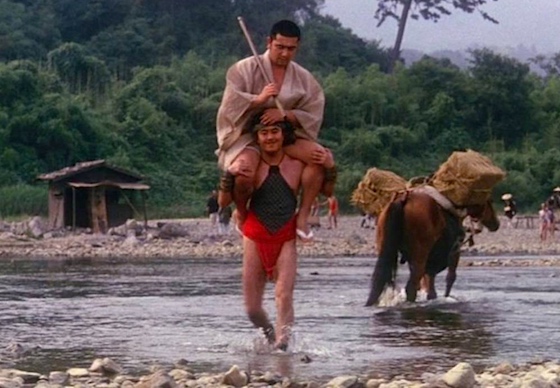
    The earlier parts of Flashing Sword put Ichi in a comedic role (extended skits include a bit about him being too heavy to carry comfortably across the river, and another where he’s served spoiled rice that he proceeds to smear all over the room), but during the climax he becomes something else entirely — Walter Biggins of Quiet Bubble describes him as “a demonic avatar”; Paghat the Ratgirl reckons he “captures something of a Dark God in his physical presence and prowess.” Never is this sense clearer than when he finally comes face-to-face with the enemy boss, Yasugoro. Portrayed by Tatsuo Endo, he’s a very good villain: preening with confidence when he’s winning, a cowering coward when losing, always blighted by a stutter. As with all good villains, they bring out the truth of our hero: even as Yasugoro smashes tiles on Ichi’s head, making him bleed (gasp!), the blindswordman stays true to his word and doesn’t draw his sword… until Yasugoro draws first, and Ichi abruptly cuts him down.

    As I mentioned earlier, a few of the other reviews I’ve read are a bit down on Zatoichi’s Flashing Sword, though Letterboxd users do rank it in the series’ top ten best instalments (just). I’m more aligned with the latter. Although it may seem more simplistic than some of the series’ other films so far, it puts that apparent plainness to meaningful use, and boasts arguably the series’ greatest action sequence to date as a capstone.

    4 out of 5