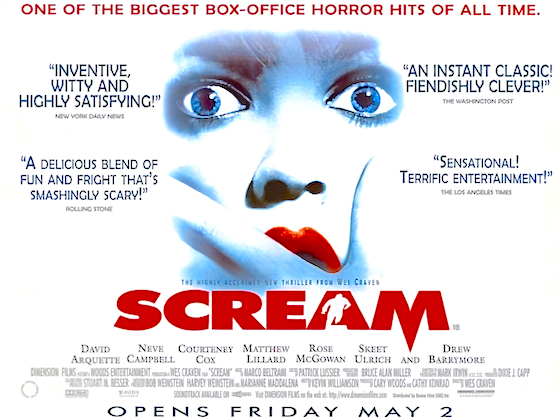
Scream (1996)

The 100 Films Guide to…

Scream

Someone has taken their love of
scary movies one step too far.

Country: USA
Language: English
Runtime: 111 minutes
BBFC: 18
MPAA: R

Original Release: 20th December 1996 (USA)
UK Release: 2nd May 1997
Budget: $14 million
Worldwide Gross: $173 million

Stars
Neve Campbell (The Craft, Wild Things)
David Arquette (Buffy the Vampire Slayer, Never Been Kissed)
Courtney Cox (Ace Ventura: Pet Detective, 3000 Miles to Graceland)
Drew Barrymore (Firestarter, 50 First Dates)

Director
Wes Craven (A Nightmare on Elm Street, Red Eye)

Screenwriter
Kevin Williamson (I Know What You Did Last Summer, The Faculty)


The Story
In the quiet town of Woodsboro, a mysterious man in a mask starts murdering teenagers, first taunting them with horror movie trivia questions.

Our Hero
Sidney Prescott is an ordinary high school girl… apart from the fact her mother was murdered a year ago, and it was her eyewitness testimony that saw a man sentenced to death. Now, a serial killer seems to be targeting her — could the events be connected?

Our Villain
A slasher movie has to have a distinctive-looking, nicknamed serial killer at its centre, and here it’s Ghostface — although he’s actually only called that once in the film itself. His costume is a generic Halloween outfit bought from any old store, and is technically called Father Death. Why didn’t that name stick instead? Probably because it’s a bit shit.

Best Supporting Character
The film has severable memorable supporting turns, but perhaps the key one is nerd and video store employee Randy (Jamie Kennedy). He knows all the rules of horror films, and when it turns out his friends don’t, he helpfully gives them an explainer — which also works for any audience members who maybe aren’t so au fait with the genre either.

Memorable Quote
“No, please don’t kill me, Mr. Ghostface, I wanna be in the sequel!” — Tatum

Memorable Scene
The opening scene: everyday teenage girl Casey (played by Movie Star™ Drew Barrymore) is preparing to watch a movie when she gets a phone call. It seems like a wrong number, but the man keeps calling back. At first their chat is a bit flirty, but then it begins to get a bit weird, and soon… well, if you haven’t seen it, I wouldn’t want to spoil it for you.

Making of
The movie’s climax takes place at a house party the kids are having to take their mind off the killings, or something. But you wouldn’t guess it was the climax to start with, because it begins a little over halfway through the film — the ‘scene’ altogether lasts 42 minutes. It was shot across a gruelling 21 days of night shoots. After it was finally done, the crew had T-shirts made saying “I Survived Scene 118”.

Next time…
Two direct sequels followed in 1997 and 2000. More recently, the franchise has been subjected to the usual rounds of revivals: it took on parodying the ‘legacy sequel’ with a continuation in 2011, then did the same again with another one in 2022. A sequel to that is on the way next year. In between, there was a spin-off TV series that lasted three seasons. Season 1 and 2 were a reboot, unconnected to the movies; then it rebooted itself for season 3, still with no connection to the movies.

Awards
1 MTV Movie Award (Movie)
1 MTV Movie Award nomination (Female Performance (Neve Campbell))
4 Fangoria Chainsaw Awards (Wide-Release Film, Actress (Neve Campbell), Supporting Actress (Drew Barrymore), Screenplay)
1 Fangoria Chainsaw Award nomination (Supporting Actor (Skeet Ulrich))
3 Saturn Awards (Horror Film, Actress (Neve Campbell), Writer)
3 Saturn nominations (Director, Supporting Actor (Skeet Ulrich), Supporting Actress (Drew Barrymore))

Verdict

By the mid-’90s the once-popular horror genre was languishing in a mire of endless sequels to the same old titles — but then Scream came along and gave it a much-needed kick up the rear end. Originally titled Scary Movie (in some ways, a more apt title), Scream is a horror movie that knows it’s a horror movie — a kind of self-awareness, often (arguably mistakenly) referred to as post-modernism, that was ever so popular in the ’90s. But it worked for a reason: it treated the audience with respect. It said, “you know the rules, so let’s not pretend.” And that facilitates two things: by acknowledging the rules, it can play with them to make you laugh; and it can break them to surprise you. Thus Scream is simultaneously a spoof of the slasher genre and a genuine entry in it. It’s potentially a tricky tightrope to walk (several major directors were rejected because they thought the film was just a comedy), but Wes Craven nails the tone so perfectly that he makes it look easy. So what might have been a last-hurrah commentary on what had already been instead turned out to be the beginning of a new wave; one which has helped fuel the genre for over 25 years since.

2022 | Weeks 27–28

Hello! Yes, it’s me — I am still here. I’ve just been finding my time filled up with other stuff: working on the 2022 iterations of both WOFFF and FilmBath Festival (in addition to the ol’ day job); dogsitting for the in-laws; throwing up from eating bad garlic…

Anyway, here are some reviews of films I watched all the way back in July. (Oh dear, I am behind. Well, let’s see if I can catch up…)

  • Johnny Gunman (1957)
  • A Better Tomorrow (1986), aka Ying hung boon sik
  • Mifune: The Last Samurai (2015)
  • The Lost Daughter (2021)


    Johnny Gunman

    (1957)

    Art Ford | 67 mins | digital (HD) | 4:3 | USA / English

    Johnny Gunman

    The history of cinema is littered with fascinating asides and dead ends, and this is one of them: an independent film from before independent films were really a thing; from the time when the studio system was beginning to falter, but the film school auteurs hadn’t yet arrived (Spielberg, Scorsese, Coppola, et al were still in their teens when this was made).

    As with the films that would later break similar new ground after the digital video revolution in the ’90s, there are cracks — it’s amateurish and undeniably low-budget in places — but also artistry — every once in a while it’ll whip out an exceptionally well-lit scene or interesting visual. Story-wise, it’s an odd mix: there’s the noir-ish gangster plot line, which is derivative and clichéd; but it takes over the film from what you feel like it almost wants to be, which is a Before Sunrise-style slice of life. Maybe, in a freer world, that’s what the filmmakers would’ve produced; but when you’re one of the first people trying to break in from the outside, hitting the familiar beats of a genre is no bad idea.

    Some of the highlights of the film come at the start, with documentary-like shots of New York street life when our heroine visits the Greenwich Festival. It’s a brief little window into the real 1950s NYC, before the rote gangster plot comes to dominate. Indeed, being shot on location, and with an inexperienced cast, lends the whole production a certain veracity that you don’t always get from soundstage-bound studio pictures of the era. On the other hand, that’s also what gives it the rough edges that will make it unpalatable to some viewers.

    However you cut it, this is hardly a forgotten gem, but it’s an interesting detour of movie history that I’m glad I stumbled across.

    3 out of 5

    Johnny Gunman is the 45th film in my 100 Films in a Year Challenge 2022.


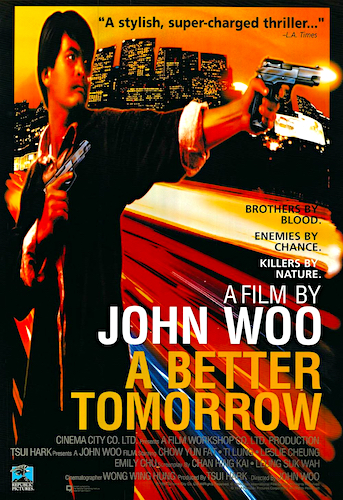
    A Better Tomorrow

    (1986)

    aka Ying hung boon sik

    John Woo | 96 mins | digital (HD) | 1.85:1 | Hong Kong / Cantonese, Mandarin & English | 18

    A Better Tomorrow

    A Better Tomorrow was the first in a run of modern-day gangster action movies that would make director John Woo’s name. Its original Chinese title translates as True Colours of a Hero, which is just as apt: it’s about a pair of mid-level crooks, one of whose brother is a cop, and the ways and whys in which they try and fail to escape the criminal life.

    Woo’s style was cutting edge back in the day, but that day is now pushing 40 years ago. Of course, his flamboyant style has never been to some people’s taste (witness the dismissive stance some still take towards M:i-2). Viewed now, this is cheesier and less stylistically polished than his later career-defining HK films like The Killer or Hard Boiled, but, on the couple of occasions it does explode into action, it’s suitably grandiose, and it has an engaging storyline and character dynamics.

    In regards to the latter, you can definitely see why Chow Yun-Fat was the breakout star. He’s actually got a supporting role, but his charisma shines off the screen, and there’s a plausibility to the way he handles the action. (Ironically, although it made Chow an action icon, he was cast because Woo didn’t think he looked like an action star.)

    Not Woo’s strongest film, then, but a definite sign of someone headed in the right direction — and, clearly, his later work paid off that promise.

    4 out of 5

    A Better Tomorrow is the 46th film in my 100 Films in a Year Challenge 2022. It was viewed as part of “What Do You Mean You Haven’t Seen…?” 2022.


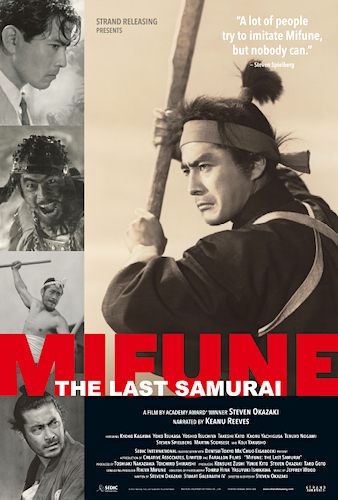
    Mifune: The Last Samurai

    (2015)

    Steven Okazaki | 77 mins | DVD | 16:9 | USA & Japan / English & Japanese | 12

    Mifune: The Last Samurai

    At just an hour and a quarter, this biography of the actor Toshiro Mifune feels more like a primer on his work and life (complete with newcomer-friendly contextual asides into the history of Japanese cinema, the career of Akira Kurosawa, etc) rather than the deep-dive exploration of the man and his legacy that some reviewers hoped for. I certainly learnt stuff, but such criticism has validity. For that reason, the less you know about Mifune (and Kurosawa), the more you’ll get out of the film. That said, it might pay to have already seen some of their films — it’s not that director Steven Okazaki doesn’t introduce and summarise them adequately; more that, if you’ve seen them, you know the full context.

    Nonetheless, a good range of interviewees ensure the documentary is not without insight, managing to explore both what made Mifune the man tick and what made him such a phenomenal screen presence. Plus, the fact that Okazaki is happy to explain contextual topics (like a history of chanbara films; or matters of social history, like what losing World War 2 was like for the Japanese people) is both education and useful, because I imagine most non-Japanese viewers don’t have much baseline knowledge about this stuff. The film is definitely a biography of Mifune (not, say, a history of 20th century Japan using the actor as a gateway), but there’s much to be gleaned here for the interested viewer.

    4 out of 5

    Mifune: The Last Samurai is the 47th film in my 100 Films in a Year Challenge 2022.


    The Lost Daughter

    (2021)

    Maggie Gyllenhaal | 122 mins | digital (HD) | 1.66:1 | USA, UK, Israel & Greece / English & Italian | 15 / R

    The Lost Daughter

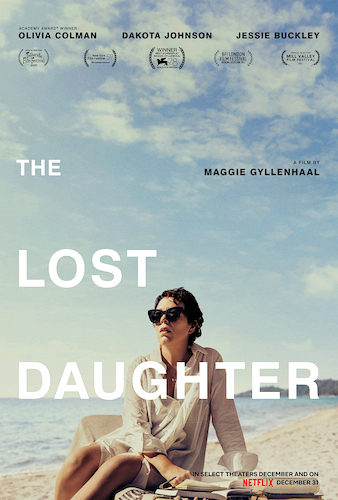
    Maggie Gyllenhaal’s directorial debut, based on a novel by Elena Ferrante, stars Olivia Colman as Leda, a woman on holiday alone in Greece, where she encounters a young mother (Dakota Johnson) whose daughter briefly goes missing, reminding Leda of her own younger days, when she was played by Jessie Buckley and had a husband and two daughters herself.

    It’s perhaps initially difficult to pin down exactly what The Lost Daughter is driving at — I suspect it’s the kind of film in which some people would say nothing happens. But it’s really a kind of mystery, where the mystery is the lead character’s psychology: why is she like this? There’s also the more obvious mystery of what exactly happened in her past, but that isn’t solved so much as gradually doled out in flashbacks. Obviously that kind of story relies a lot on its performances, and Colman is as strong as ever. So much of the importance of the film, which lies in her character and emotion, is conveyed without dialogue. That’s not do down the able support from Buckley and Johnson, mind.

    Gyllenhaal’s direction is interesting and effective, using lots of fairly extreme close-ups to give a kind of tactile sensation to the film. On the other hand, I would say it feels a little longer than necessary (especially after the ‘reveal’ scene, where the final piece of the puzzle clicks), and I’m not convinced it knows how to end (or perhaps it’s my fault for not really ‘getting’ the finale).

    Overall, though, it’s an impressive debut from Gyllanhaal, and a great alternative perspective on motherhood.

    4 out of 5


  • 2022 | Week 26

    I’m taking you back over two months here, to the end of June / start of July, for another eclectic batch of films I happened to watch in close proximity to each other…

  • The Flying Deuces (1939)
  • Apollo 10½: A Space Age Childhood (2022)
  • My Name Is Julia Ross (1945)
  • Ambulance (2022)
  • Easy A (2010)


    The Flying Deuces

    (1939)

    A. Edward Sutherland | 68 mins | DVD | 4:3 | USA / English | U

    The Flying Deuces

    I feel like I’m aware of Laurel & Hardy in a way I would say “everyone” is, but I guess that’s probably not true anymore (the kind of stuff I picked up or learnt about by osmosis in my ’80s/’90s childhood is surely very different to what kids got growing up in the ’00s/’10s). But I don’t think I’ve ever actively seen any of their work; certainly none of their feature-length films. The Flying Deuces is “probably their most famous film”, at least according to the blurb on my copy. Certainly, it’s the one you see bandied about the most; but then it’s in the public domain (one of only two Laurel & Hardy films where that’s the case), so it’s inevitably subject to endless cheapo releases. Leaving the quality of the print aside (it was poor; but at least it wasn’t cut, which apparently many are), I can’t say I was too impressed by the quality of the content, either.

    Here’s the rub: it’s a comedy, but it barely made me laugh. The humour operates at a basic level, with gags that are either well-worn or repetitious. “How anyone could be so stupid as to stand there and continually bump their head is beyond me,” one of them says at one point. And yet the other does exactly that, because that’s the level most of the film’s humour operates at. Some might say this is the downside of the duo being popular and their work being old — i.e. it’s been imitated and copied for decades, and we’ve moved on. But I don’t find that to be the case with silent comedians —who were equally, if not even more, popular, and whose work is even older — nor with things like the Road to films — which are far from the height of sophisticated comedy, but tickle my fancy more often.

    Well, there’s your answer, I guess: it’s all a matter of taste. And it seems Laurel and Hardy aren’t to mine.

    2 out of 5

    The Flying Deuces is the 41st film in my 100 Films in a Year Challenge 2022.


    Apollo 10½:
    A Space Age Childhood

    (2022)

    Richard Linklater | 97 mins | digital (HD) | 16:9 | USA / English | 12 / PG-13

    Apollo 10½: A Space Age Childhood

    I guess one of the advantages of being a filmmaker with some degree of clout is you can take your regular-ass childhood and turn it into a movie as if it was somehow special. That’s what the Before trilogy and Boyhood mastermind Richard Linklater has done here, fictionalising his autobiography as the story of ten-year-old Stanley, who lives in Huston, Texas, in the era of the first moon landing. Except, in this version, Stanley is secretly recruited by NASA to secretly train to be a secret astronaut to secretly be the first person on the Moon, in secret. If that sounds like an unusual spin on a traditional nostalgia-driven biopic, don’t get excited: that subplot is moved away from as quickly as it’s introduced, and only pops back up two or three more times, each brief. The film is much more concerned with real memories than imagined ones, and is much less fun for it.

    Often, at Christmas or other such get-togethers, members of my family will end up reminiscing about various childhood recollections. I’m sure many other families do a similar thing. What’s shared on these occasions are the kind of mundane memories that mean the world to us but, if you stopped to think about it, you know no outsider would find of much value. Well, seems Richard Linklater hasn’t stopped to think about it. And I really do mean “mundane”: there’s a sequence about which sibling did which chores and how they made their school lunches. As a commenter on iCM put it, Linklater “name checks every TV show and movie he saw, every game he played, everything in his diary […] for long stretches, it just feels like an itemized list of childhood memories.”

    One part that’s actually rather good is Jack Black’s voiceover narration as the adult Stanley. There’s probably too much of it (again underlining the fact these are nostalgic anecdotes rather than a true narrative), but the actual quality he brings is very nice. It feels calm and understated, neither giving in to Black’s usual mania nor substituting it for the hardcore tweeness you might expect from such a rose-tinted autobiography.

    Maybe Apollo 10½ will be more interesting to young people or future generations, whose technology- and safety-obsessed childhood experiences will be so far removed from what we see here. To them, it’s an historical documentary. I can’t say my childhood was much like this one (especially as it occurred almost 30 years later), but I guess I’ve picked up enough of this kind of nostalgia from other American films and TV series down the years that what Linklater has to share doesn’t feel remarkable enough to be worth sharing.

    3 out of 5

    Apollo 10½: A Space Age Childhood is the 42nd film in my 100 Films in a Year Challenge 2022.


    My Name Is Julia Ross

    (1945)

    Joseph H. Lewis | 65 mins | Blu-ray | 1.37:1 | USA / English | PG

    My Name Is Julia Ross

    Here we have one of those films that commonly gets called a film noir, but isn’t really (or, at least, doesn’t fit well with the standard conception of what noir entails). The blurb for Arrow’s Blu-ray release describes it as a “Gothic-tinged Hitchcockian breakout hit” (apparently it was produced as a B-movie but became so popular they promoted it to “A-feature status”), which struck me as accurate — it’s less standard noir, more a Rebecca-influenced psychological thriller. While it’s clearly no Hitchcock, it’s a very entertaining substitute.

    Nina Foch stars as the eponymous Julia Ross, who takes a job as a live-in secretary for a wealthy widow. But the job is a front: Julia is kidnapped, waking up a prisoner in a Cornish mansion, where the widow (Dame May Whitty) and her son (George Macready) try to convince her she’s actually Marion Hughes, the son’s wife, and she’s having a bit of an episode.

    From the way Arrow described the film, I assumed it was going to play to some degree with the idea that maybe she is actually mad. It would be a neat twist, right? That she is Marion Hughes, and the stuff we saw at the start was part of her delusion. But no, the film doesn’t even vaguely gesture at that route: right after Julia meets her prospective employer, we see that she’s plotting something nefarious — and the film isn’t even seven minutes in. Then, even before we really know that something’s up, Julia’s fancy-man is looking into her disappearance. It’s like the film’s playing all the right notes but in the wrong order.

    But it doesn’t really matter, because the whole thing is suitably entertaining. Rather than relying on the mystery of what’s happening, it’s more about how Julia can get out of the situation. Will she be able to escape her confinement? Can she somehow get out a message for help? Or will the villains succeed in their scheme? Plus, at just 65 minutes, it moves at a whipcrack pace, so you can sit back and enjoy the absurd plot rather than worrying about, well, how absurd it is.

    4 out of 5

    My Name Is Julia Ross is the 43rd film in my 100 Films in a Year Challenge 2022.


    Ambulance

    (2022)

    Michael Bay | 136 mins | Blu-ray (UHD) | 2.35:1 | USA & Japan / English | 15 / R

    Ambulance

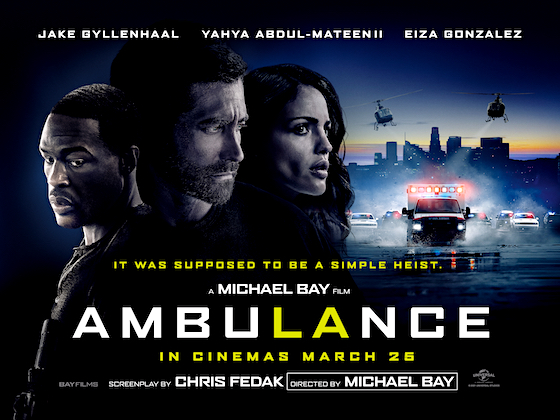
    When their bank heist goes sideways, two brothers (Jake Gyllenhaal and Yahya Abdul-Mateen II) make their getaway in a stolen ambulance — with a policeman they shot and the paramedic working on him (Eiza González) in the back. With the cops immediately on their tail, thus begins an epic car ambulance chase around the streets of LA.

    The setup feels like it should signal the low-/mid-budget debut of a new director showcasing their talents with a 90-minute stripped-back thrill-ride that’s mostly contained to the eponymous setting. But it’s not directed by some newbie — it’s Michael frickin’ Bay, back on the form that gave us action classics like The Rock. And so the 90-minute character-focused thriller is in there (honest it is), but augmented with 40 minutes of big-budget Bayhem.

    Compared to Bay’s other work in the past 15 or so years, Ambulance feels restrained. Compared to almost any other filmmaker, it’s anything but. When I say “restrained”, part of what I mean is the editing. Not that it takes a leisurely approach by any means, but it doesn’t have that “impressionistic jumble of B-roll” style Bay has tended towards on and off ever since Armageddon, and that became his only mode during a couple of the Transformers sequels. Also, I didn’t notice this until I read it on IMDb, but the film contains a literal Chekhov’s gun — that is, a gun that is a “Chekhov’s gun”. That’s so Michael Bay.

    Giving this film 5 stars would be a bit silly… but it was really good. It’s the kind of movie you’d never rate higher than 4, but you love for what it is: magnificent Bayhem.

    4 out of 5

    Ambulance is the 44th film in my 100 Films in a Year Challenge 2022. It placed 9th on my list of The Best Films I Saw in 2022.


    Easy A

    (2010)

    Will Gluck | 92 mins | digital (HD) | 16:9 | USA / English | 15 / PG-13

    Easy A

    When an overheard white lie about losing her virginity makes barely-noticed Olive (Emma Stone) the centre of her high school rumour mill, she decides to manipulate her newfound notoriety for her own amusement.

    As “raunchy teen comedy” plots go, it hits a sweet spot of being neither too prudish nor too lecherous. The dialogue elevates it further in a sharp and witty script by Bert V. Royal (who, it seems, has since only worked on TV shows I’ve never heard of. Shame). In her first lead role, Emma Stone gives a perfectly-pitched, surprisingly nuanced performance. The story really allows her to show off her versatility, believable as both the ‘quiet girl’ and ‘confident slut’. Obviously there’s lots of comedy, but she sells the moments of sincerity too. It’s no wonder she quickly got snapped up for more awards-type work. Plus, there’s Stanley Tucci being what I imagine Stanley Tucci is actually like as a dad, which is perfection.

    The only major downside (and it’s a bit of a spoiler, but also so predictable that it barely counts as a spoiler) is that it would’ve been nice if the guy she eventually ends up with wasn’t so stereotypically hot. We’re meant to buy him as a kinda-goofy sports mascot rather than someone who’d actually be playing The Sport? Yeah right.

    I’m not always a fan of high school movies or teen comedies, but there are definite exceptions, and this is the latest addition to that rarefied list.

    4 out of 5


  • 2022 | Weeks 24–25

    Similar to Week 21 last time, Week 23 only included rewatches, so gets skipped in the title. As for the other two, that brings us fundamentally to the end of June (the 26th, to be precise), and so almost to the halfway point of the year. But I’ll leave such discussion to my monthly reviews.

    Instead, here are the remaining four reviews of films I watched that fortnight…

  • The Ghost Writer (2010)
  • Escape in the Fog (1945)
  • Pretty in Pink (1986)
  • House of Gucci (2021)


    The Ghost Writer

    (2010)

    aka The Ghost

    Roman Polanski | 128 mins | digital (HD) | 2.35:1 | France, Germany & UK / English | 15 / PG-13

    The Ghost

    Originally released as The Ghost in the UK (the same title as the Robert Harris novel on which it’s based), but now on Netflix under its US title, The Ghost Writer, whatever you call this film, it’s an effective thriller about a subject that might not sound thrilling: writing an autobiography. The key is that the person being biographied is a former British Prime Minister (Pierce Brosnan) who was involved in some shady business during his time in office, which is beginning to resurface in the news; plus the fact that his first ghost writer was recently found dead, washed up on a beach on the island the ex-PM is currently calling home. It’s into this maelstrom that our hero, the new ghost writer (Ewan McGregor), is dropped, and soon finds himself more involved than he’d like.

    So, despite the unique setup, it’s a fairly straight-up thriller plot of political intrigue and buried secrets. That’s not a criticism — this is very much my kind of thing. What elevates it is the film’s style and atmosphere. There’s something odd about it all, which makes the viewer feel as unsettled and out-of-place as McGregor’s character quickly becomes. Some contributing factors to this sensation are likely unintentional — the result of things like half the cast having to labour under different accents, or the excessive green screen used to fill in the views of Cape Cod (the film wasn’t shot in the US, but in Germany and Denmark, for “the director’s a criminal wanted in the US” reasons) — but neither of these elements felt glaringly bad to me, just… off.

    As I say, I think such an atmosphere is actually very fitting for a political thriller full of questions about who can be trusted, life-or-death mysteries, and a couple of solid twists. Yes, very much my kind of thing.

    4 out of 5

    The Ghost Writer placed 8th on my list of The Best Films I Saw in 2022.


    Escape in the Fog

    (1945)

    Oscar Boetticher Jr. | 63 mins | Blu-ray | 1.37:1 | USA / English | PG

    Escape in the Fog

    With the fifth (and, it would seem, final) of Indicator’s Columbia Noir box sets then-imminent, and a new series of Universal Noir soon to begin, I thought it was about time I actually started watching them. So here’s the first, both for me and the series (i.e. it’s the oldest film in box set #1). It’s a quickie from director Budd Boetticher (before he started being credited under that name) about a San Fransisco nurse who has an ultra-specific dream about a murder, then meets the victim-to-be in real life. It turns out he’s a spy about to be sent on a top-secret mission, but his only hope of making it alive is her using the details from her dream to prevent his death.

    It’s unfortunate that this 30-film ‘series’ (they’re only connected by the studio that made them and Indicator happening to bundle them together, of course) begins with such a travesty of a film. For starters, it’s barely even a noir, more a melodramatic mildly-fantastical spy thriller. Well, I can enjoy that kind of thing too — goodness knows the number of spy movies I’ve given high scores to, and there’s something to be said for a spot of ridiculous hokum — and Escape in the Fog might have been another such fun example, except it’s been made with a total absence of passion. It’s about as thrilling as a lukewarm cup of milky tea at a cafe that only has outside seating on a drizzly winter afternoon. It’s only redeeming quality is that it’s so daft (though only in places, because it ends up forgetting its own ridiculous conceits) that you can’t help but have a bit of a laugh at it.

    Filler in every sense of the word.

    2 out of 5

    Escape in the Fog is the 38th film in my 100 Films in a Year Challenge 2022.


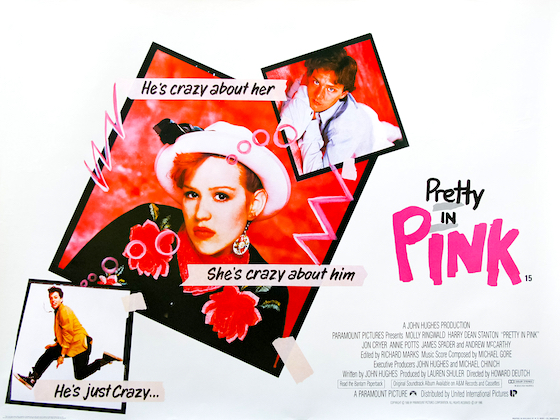
    Pretty in Pink

    (1986)

    Howard Deutch | 97 mins | digital (HD) | 16:9 | USA / English | 15 / PG-13

    Pretty in Pink

    Another John Hughes-penned ’80s teen movie that had passed me by (it’s only in the past few years that I’ve watched The Breakfast Club and Ferris Bueller’s Day Off, and I’ve still not seen Sixteen Candles or Weird Science). This one stars Molly Ringwald as Andie, a non-popular high school girl caught between the affections of her childhood friend (Jon Cryer) and a rich kid who’s suddenly showing an interest in her (Andrew McCarthy).

    No bones about it, plot-wise it’s a pretty standard love triangle romcom; but the devil is in the details, and Pretty in Pink has a lot of likeable ones. For starters, it’s so ’80s. Like, aggressively. Like, if you made a movie set in the ’80s, you wouldn’t make it this much ’80s because people would criticise you for overdoing it. Then there’s the supporting performances. Harry Dean Stanton makes a great ‘movie dad’ — you know, the kind of comforting, supportive father figure you kinda wish were your own. I don’t think I’ve ever seen him in a role like this before. The relationship between him and Ringwald comes across as really sweet and effective without tipping over into saccharine or implausible. Then there’s Annie Potts as Andie’s older best friend, proving she should be known for more than just being screechy and kooky in Ghostbusters. Plus, James Spader makes for a superb villain. It’s only a small role in the grand scheme of the film, but he does smarmy glibness so well.

    Poor Molly Ringwald — she’s fine in the lead, but everyone else is so good they kinda overshadow her in her own movie. Or maybe that’s unfair: Andie is a pretty likeable lead, with a commendable amount of independence and self-worth. Okay, she lets that slip a bit for A Boy, but what teenager hasn’t let such heady new emotions get the better of them? She comes out for the best in the end.

    The only major downside is the rushed third act, which makes the ending feel unearned — a feat that’s almost impressive when the ending is so predictable. It’s actually due to a post-test-screening rewrite and reshoot: in the original version (spoilers!) Andie ends up with Duckie, not Blane. Personally, I don’t think either is right: she should’ve chosen neither of them. As I see it, the film doesn’t really set up her getting back with Blane (presumably because it was a last-minute change), so I don’t buy that; but nor does it do enough to suggest she’d suddenly find Duckie a romantic proposition. They should have settled for being BFFs, and Blane should’ve fucked off. But I guess a romcom where the girl ends up single wasn’t done back then. You’d probably still find it a hard sell today, to be honest.
    4 out of 5

    Pretty in Pink is the 39th film in my 100 Films in a Year Challenge 2022. It was viewed as part of “What Do You Mean You Haven’t Seen…?” 2022.


    House of Gucci

    (2021)

    Ridley Scott | 158 mins | digital (HD) | 2.39:1 | USA & Canada / English, Italian & Arabic | 15 / R

    House of Gucci

    Director Ridley Scott tells the true (ish) story of the behind-the-scenes dramas at Italian fashion house Gucci in the mid 20th century. If you think that sounds like some kind of dull boardroom drama, oh boy, is it not. With the amount of scheming and backstabbing that goes on, it’s more like a variation on The Godfather than a staid piece about people arguing in suits in offices. Oh, those crazy Italians, eh?

    Of course, none of the main cast are Italian. But they are all doing Italian accents. Or what passes for Italian accents in the mind of us anglophones — they sound about as authentic as a Dolmio advert. Or a Mario game. “It’s a-me, Lady Gaga!” Although, once you get over the humour value of that, Gaga is genuinely very good in her Lady Macbeth-esque role as a woman who marries into the family and goads her husband into dominating the business. And then there’s Jared Leto, buried under prosthetics as well as the dodgy accent. Does he know he’s getting laughs with almost every line, or does he think he’s giving a serious dramatic performance? Who knows. Who cares. No one in the rest of the cast is as memorable — even when we’re talking about actors of the calibre of Adam Driver, Salma Hayek, Jeremy Irons, and Al Pacino — but then, I’m not sure there’d be room for that many Big performances. Scott brings his usual pizzazz too, with the well-shot gorgeous locales looking beautiful and elegant. Parts of Italy are just fundamentally beautiful, and you think it would probably be hard to mess up filming them.

    There are plenty of criticisms of the film to be found in pro reviews and viewer comments across the usual sources. Reading them, I don’t necessarily disagree on any particular point. For one thing, it’s definitely too long, and still leaves a load of information to be dumped in the inevitable “what happens next” text at the end. It could also be clearer about what’s going on at times, especially legal stuff, like when they’re suddenly being investigated for financial crimes. That said, it has an energy that often keeps it barrelling along. It’s probably an advantage to not know the real-life events, because it allows the story to unfold without preconceptions about where it’s going, so you’re not waiting for it to get to the bits you know.

    Flaws and all, I had a ball watching it. It may really be a 3-star film in some senses, but I got a 4-star level of enjoyment out of it.

    4 out of 5


  • Paris, Texas (1984)

    Wim Wenders | 146 mins | digital (HD) | 1.66:1 | Germany & France / English | 12 / R

    Paris, Texas

    This was my first experience of a Wim Wenders film, so I wasn’t quite sure what to expect, other than knowing it’s an acclaimed classic that features on many “great movies” lists (albeit usually a bit further down than many of the most famous “great movies” on such lists).

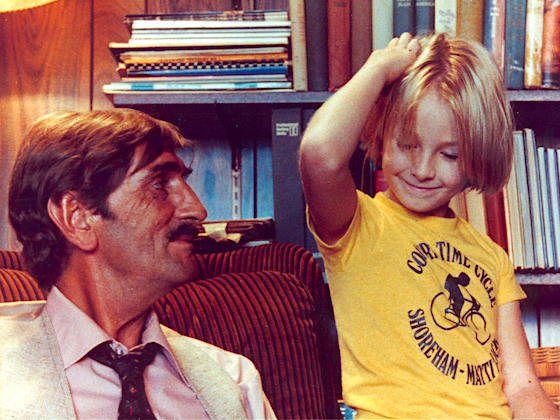
    It starts out almost Lynchian, with a man, Travis (Harry Dean Stanton), wandering out of the desert. Where’s he been? How long’s he been there? No one knows. He ends up in the care of a quirky doctor in the back of beyond — it’s not even your typical American “small town”, but a trailer and a shack in the middle of nowhere. Then his brother (Dean Stockwell) comes to get him, and it becomes a bit Rain Man (a film released four years later, so certainly not an influence) as two estranged and mismatched adult brothers embark on a cross-America road trip because one of them objects to flying. Then they get home, and it becomes a domestic comedy-drama about an absent father trying to reengage with his preteen son, Hunter (Hunter Carson). And then they go off in search of the boy’s mother, Jane (Nastassja Kinski), and it becomes something else again… It almost circles back round to Lynchian, in fact, with a couple of extended sequences in a surreal, almost otherworldly place of work.

    But to keep calling it “Lynchian” is to do Wenders’ work a disservice, because it’s not a copy — indeed, in 1984 Lynch was releasing his Dune, and had yet to embark on most of the films that define “Lynchian” for us. An alternate comparison might be the Coen brothers, at least for the opening section: it’s of a piece with their heightened worlds (the weirdo doctor living in the middle of nowhere) and semi-outlandish stories (Travis reappearing from nowhere). But this was released the same year as the Coens’ debut, Blood Simple, so, again, it’s not exactly a fair comparison. Or if it is fair, it’s backwards: if anyone influenced anyone, it would be Lynch and the Coens drawing on Wenders.

    Father and son

    Setting simple (and kinda inaccurate) comparisons aside, in parts this is a magnificent film. The scene where Travis and Hunter walk home after school ‘together’ borders on magical; a truly superb sequence of father-son bonding. The bit where we first enter Jane’s place of work feels like descending into some previously-unknown alternate world that exists adjacent to our own (as I say: Lynchian). Then the ‘conversations’ with Jane through the oneway glass, especially the first one, are subtly powerful in how they’re shot and performed. When it works, this is a striking, memory-searing movie.

    But then, overall, I found it kinda… not slow, exactly — and I couldn’t necessarily point at which bits I’d cut — but I did wonder if it might benefit from being tighter. Especially the first hour or so, which is mainly about Travis and his brother in a way that doesn’t ultimately feel too relevant to what the film really wants to dig into, which is Travis’s relationships with his son and ex-wife. Of course, his relationship to his brother is adjacent to that, but it’s not as vital. That portion of the film does serve to build up mystery and delay certain revelations, but I wonder if the film wouldn’t be just as effective if that section were pared back somewhat. Apparently filming started without a completed screenplay, the intention being to film in story order and write the ending when screenwriter Sam Shepard had an understanding of how the actors were portraying the characters. That methodology might explain why the narrative shifts and changes so much, I think.

    Through all of this, the film really rests on the shoulders of Harry Dean Stanton. Even when he’s initially taciturn, it’s clear he’s the man to watch; the enigma we must solve. And when we finally learn his history — which is completely at odds to the calm, composed, quiet man we’ve followed throughout the film — it’s… well, I’m not sure what it is. Not necessarily what I was expecting; and yet, what was I expecting? Part of the point of the whole thing, surely, is how much he’s changed, and how that facilitates his final choices. But then, his choices seem based in the man he was, not the man he’s become, so is he right? Maybe; maybe not. I suppose there’s stuff to debate and talk about here, which is often a signifier of a Great Movie.

    An adjacent world?

    As to that, I won’t be adding it to my personal favourites pile right now. But it’s a fascinating, at times incredible, film. I can understand its appeals to a certain kind of cinephile.

    4 out of 5

    Paris, Texas was re-released in UK cinemas at the end of July by Curzon, with the UK debut of a 4K restoration (which is the version I watched. It looks good). There are still some screenings going on, and it’s available to stream on Curzon Home Cinema for £3.99. If you prefer your films free, it’s also on All 4 until the middle of September, but I don’t know if that’s the new restoration or not.

    I do know it was the 40th film in my 100 Films in a Year Challenge 2022, and was viewed as part of Blindspot 2022.

    Prey (2022)

    Dan Trachtenberg | 99 mins | digital (UHD) | 2.39:1 | USA / English | NR* / R

    Prey

    In the seemingly-endless cycle of “trying to reboot popular ’70s/’80s sci-fi franchises”, it is once again the turn of Predator, following in the wake of 2018’s disappointingly messy The Predator and 2010’s apparently-disliked Predators (I enjoyed it, but everyone seems to write it off nowadays). Where both of those tried to go bigger — either with more or larger versions of the eponymous aliens — Prey strips things back to basics, as per the one entry in the series everyone can agree is good, the first.

    Set around 300 years ago, when indigenous people still lived freely on the plains of North America, the film introduces us to a member of the Comanche tribe, Naru (Amber Midthunder, who genre fans might recognise from X-Men-adjacent TV series Legion), a young woman who wants to prove herself as a hunter like the tribe’s menfolk, including her exalted brother (Dakota Beavers). Long story short, she’s about to get her chance when an alien Predator rocks up.

    Plot-wise, Prey is pretty straightforward. And therein lies a big part of its success, because what more do we want from a Predator movie than “a hero has to fight a technologically-superior Predator”? If you do want more than that, I think you’ve come to the wrong franchise. Of course, simply rehashing what’s gone before is just another path to failure, and so what Prey does is take those basic bones and dress them up with fresh settings, ideas, and perspectives. In this case, that’s the period setting and Native American heroes. How do you defeat a Predator using weapons no more technologically advanced than bows and arrows? With intelligence, of course, and the film does a nice job of showing Naru gather information and formulate plans without ever needing to spell them out for us.

    The prey becomes the predator

    That it can pull that off is also to the credit of star Amber Midthunder, who conveys so much of Naru’s thought processes through only looks and expressions. All round she makes for an appealing heroine: she’s capable and brave, but not foolishly so, sometimes hanging back to assess the situation, or even running away when the odds aren’t in her favour, rather than diving in mindlessly. As action heroes go, I think that counts as nuance. I saw one critic tweet that she’s so good she needs to be given a Marvel superhero role ASAP, which is more a depressing indication of the state of cinema (appealing action lead? The highest honour would be a Marvel role!) than an indication of Midthunder’s ability (please, Hollywood, don’t just waste her on Marvel filler).

    This may be a straight-up humans vs aliens action movie, but it still treats its audience with a degree of respect. It knows we’re capable of joining dots ourselves, especially when we can see characters doing the same. Naturally, Prey has some developments and moments derived from previous Predator movies — it wouldn’t really be part of the same franchise if it wiped the slate wholly clean — but they feel recontextualised or come into play naturally, rather than the filmmakers over-eagerly forcing them on us as a plea to nostalgia.

    Quite aside from the plot and action, this is a beautifully made film. The first half-hour almost evokes the work of Terence Malick, with its relatively slow pace and photography that showcases nature and gorgeous scenery. This would’ve been a stunner on the big screen. Most big-budget theatrically-released films don’t look this much like A Movie nowadays, never mind streaming churn. I say it only “almost evokes Malick” because it’s not actually Malick-speed slow, but what it’s doing is quite deliberate: establishing the characters, the environment they live in, the things they know and the tools they have access to, and so on — as well as building up the looming threat of the alien hunter — so that we understand the world and the stakes when things kick off later.

    They're going on a bear hunt (no, really, at this point they think it's a bear)

    One thing I sort of want to pull the filmmakers up on is the language(s) used for dialogue. During promotion, they’ve talked about how some of the film is actually in the Comanche language, a selling point because of diversity and inclusion. Well, not much of the dialogue is Comanche — the primary language is unquestionably English — and it’s not subtitled, which means the vast majority of viewers can’t understand it, so they could be saying anything. I don’t think a film is ‘in’ a language if you can’t understand it (it’s why I’ve not listed Comanche as a language at the top of this review, nor the European languages spoken by the settlers who come into the plot, which also aren’t subtitled). That said, there is the option to watch the entire film dubbed in Comanche — a first, apparently. That would be more historically authentic, but it’s also a dub, i.e. not how the film was ‘intended’. Nonetheless, I’ve already seen some argue it’s a better version, so it may well be worth a look.

    That minor point aside (it’s not something I’m holding against the film, just the filmmakers’ boastfulness), Prey is a resounding success at what it sets out to be: an action movie in which humans and Predators have a fight. It’s the Predator film fans have long been waiting for. And it hopefully indicates to the studio bigwigs what the future of this franchise should be: pick a different era, with different technology and/or attitudes to combat, drop a Predator into it, and see how the humans get on against it. Honestly, with the right creatives, you could milk that simple premise for another half-dozen or more enjoyable movies, I reckon.

    4 out of 5

    Prey was the 49th film in my 100 Films in a Year Challenge 2022. It placed 10th on my list of The Best Films I Saw in 2022.

    * There was no certificate listed on the BBFC website at time of review; Disney+ continuing to take advantage of the fact there’s no legal requirement for streaming content to be certified. Some press ads listed the film as 18+, but they’ve gone with 16+ on the service itself. So, it’s either a 15 or an 18. I guess we’ll never know (unless it gets a disc release). ^

    Lupin the Third: Is Lupin Still Burning? (2018)

    aka Rupan sansei: Rupan wa imamo moeteiruka?

    Jun Kawagoe & Monkey Punch | 27 mins | Blu-ray | 16:9 | Japan / Japanese | 15

    Lupin the Third: Is Lupin Still Burning?

    Whether you want to call this a short film or a TV special or something else entirely (it was originally released straight to DVD as a special feature in Japan) is little more than a technicality, really. It’s a sub-40-minute standalone piece, and therefore I’m counting it as a short film (it also has been screened theatrically, so it’s not a totally ridiculous classification).

    What it definitely is is a 50th anniversary special for the Lupin the Third franchise. Best known in the West thanks to Hayao Miyazaki’s debut feature, The Castle of Cagliostro, Lupin III is actually a sprawling franchise. Beginning life in 1967 as a manga written and illustrated by a chap called Monkey Punch (I suspect not his birth name), an anime TV series followed in 1971, since when there have been multiple further series, dozens of films (both theatrical and TV specials), plus a couple of attempts at live-action movies, and a bunch of video games and stuff too.

    Although this short was produced to mark the birthdate of the comics, it takes its cue from the anime series, the first episode of which was called Is Lupin Burning…?! and had the same setup: Lupin is to take part in a car race, but it’s actually a lethal trap set by his enemies. But from there, this version spins off into some wacky time-travel shenanigans — a way to send our hero back into key adventures and moments from his history, handily.

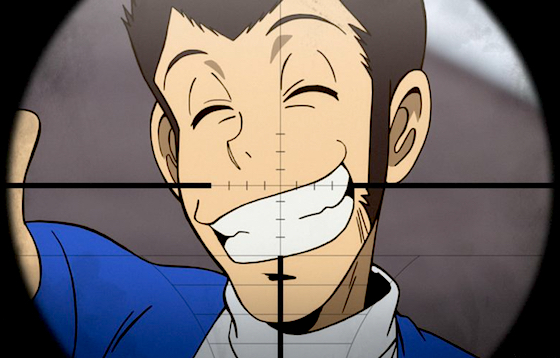
    50 years in the crosshairs

    Appropriately for a 50th anniversary special, Is Lupin Still Burning is loaded with references (both major and minor) for diehard fans to enjoy. As someone who has enjoyed a couple of Lupin’s adventures but is a long way from being well-versed in his world, I could tell a load of stuff was flying over my head — almost everything, in fact — which was unfortunate, but understandable. This is clearly a celebration that’s primarily aimed at dyed-in-the-wool fans rather than pleasing or initiating newcomers. That said, it still just about works as a madcap one-off adventure. It’s particularly enjoyable in the kinetic action sequences, like a destructive car race — being held in Nomaco (work out the ‘pun’ for yourself) — that plays out during the opening credits.

    The franchise’s only regular female cast member, Fujiko Mine, spends most of the film captured by the villains, strapped to a torture table with her clothing mostly torn off, being tickled by robot hands and stuff like that. Your feelings about all this are your own; I describe it merely for context. Put another way, not all of the “fan service” requires prior knowledge to be, er, serviceable.

    I expect if you’re a long-term fan of Lupin III, this fan-service-filled short is deserving of at least 4 stars. As someone without that depth of knowledge, it’s unmistakeable that you’re missing out on plenty. The callbacks aren’t little asides or background nods, but fundamental to the plot of the piece. Nonetheless, I’m giving it a positive score, because it is still enjoyable, even if it’s clearly not really made for the likes of me.

    3 out of 5

    2022 | Week 22

    Maybe I should’ve called this post “Weeks 21–22”, to ensure that the titles of these roundups had a complete run of weeks throughout the year. But I didn’t actually watch anything new in Week 21 (my only film that week was the Challenge-qualifying rewatch of On the Town), so it seemed inaccurate to include it.

    Week 22, on the other hand, was moderately busy, with this lot…

  • This Means War (2012)
  • To Be or Not to Be (1942)
  • An Unsuitable Job for a Woman (1982)
  • The Pajama Game (1957)
  • The Contender (2000)


    This Means War

    (2012)

    McG | 98 mins | digital (HD) | 2.35:1 | United States / English | 12 / PG-13

    This Means War

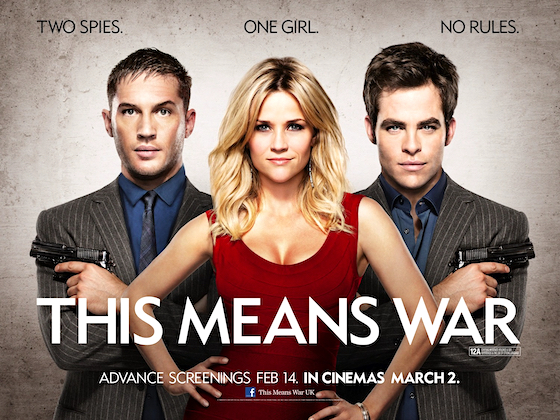
    I bet whoever came up with this thought they were a genius: “spyfi action-adventure + rom-com? It’s the perfect date movie!” Of course, what you actually end up with is a film that struggles to do either part well.

    It stars the unlikely combo of Chris Pratt and Tom Hardy (you definitely can’t imagine Hardy doing a movie like this today) as BFF CIA agents who independently fall for the same woman, played by Reese Witherspoon. Uh-oh. Hilarity ensues as the guys deploy their CIA tricks and tech to influence the relationships. Yeah, it’s the kind of concept that once upon a time sounded like a fun and quirky rom-com, but nowadays seems at best morally dubious, at worst downright creepy. And, indeed, that’s how it plays out, with situation after situation that’s played for laughs but feels a little uncomfortable.

    Of course, the big question is “who ends up with who?” This is one of those films so committed to its storyline, so structured to lead to one correct answer, that… they shot multiple endings so they could decide in post. The one they went with doesn’t feel quite right, but, if you imagine the alternatives, most of them don’t either. Well, I say that: I don’t think it’s really a spoiler to tell you that Witherspoon ends up with one of the guys, when the correct choice would’ve been “neither of them. Run from the stalker-ish CIA agents! Find a normal man!”

    2 out of 5


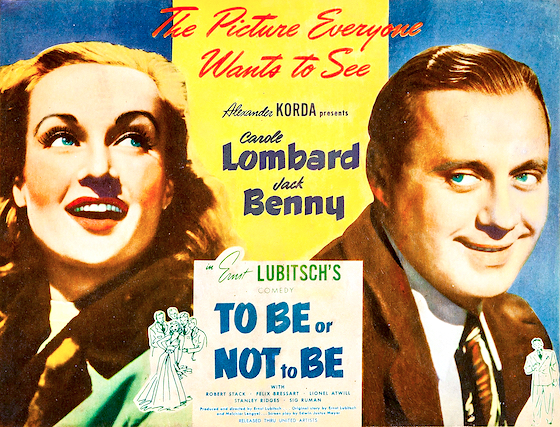
    To Be or Not to Be

    (1942)

    Ernst Lubitsch | 99 mins | digital (HD) | 1.37:1 | USA / English | U

    To Be or Not to Be

    Ernst Lubitsch’s satire concerns an acting troupe in occupied Poland who become mixed up in a soldier’s efforts to capture a German spy before he can undermine the resistance. Made while World War II was still in full force, the film attracted criticism in some quarters for being a comedy about such tragic and ongoing real-life horrors. Lubitsch defended his work, writing to one critic to say, “What I have satirized in this picture are the Nazis and their ridiculous ideology. I have also satirized the attitude of actors who always remain actors regardless how dangerous the situation might be, which I believe is a true observation.” He’s right, of course; at least about the first part. Ridiculously, such debates about whether you can satirise the Nazis persist to this very day — just look at some of the responses to Jojo Rabbit.

    Lubitsch’s film is subtler than Waititi’s, though still undoubtedly a comedy. I mean, with its plucky resistance members taking occupying Nazis for fools, I couldn’t help but think of this as a classier version of ’Allo ’Allo… but I’ve never actually seen a whole episode of that show, so don’t hold my comparison in too high a regard. Whereas that sitcom is famous for its catchphrases and bawdy gags, To Be or Not to Be is less overt, preferring to paint the Nazis as fundamentally incompetent and derive its humour there.

    Despite the distaste some felt, it obviously works for most people, as it appears on several “great movies” lists, not least both the IMDb and Letterboxd Top 250s. To be honest, I feel like I need to give it another spin to digest it more fully, but these thin thoughts will have to suffice for now.

    4 out of 5

    To Be or Not to Be is the 35th film in my 100 Films in a Year Challenge 2022. It was viewed as part of Blindspot 2022.


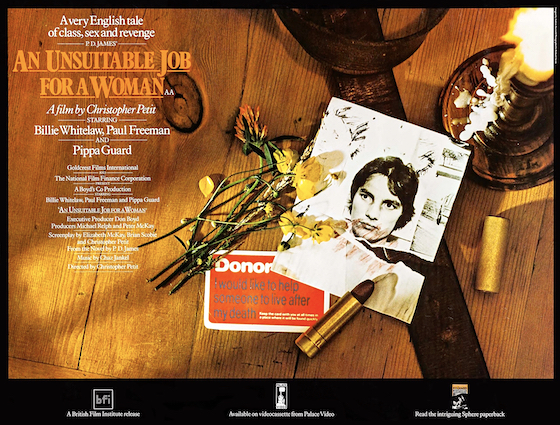
    An Unsuitable Job for a Woman

    (1982)

    Christopher Petit | 94 mins | Blu-ray | 1.85:1 | UK / English | 15

    An Unsuitable Job for a Woman

    I’ve never read the P.D. James novel on which this is based, but I’m assured it’s longer and more complex — the film rather lacks for plausible suspects, making the central murder mystery thoroughly guessable.

    That said, I’m not sure co-writer/director Christopher Petit is all that concerned with producing a true whodunnit. Put another way, I think he’s more interested in the characters, who happen to be involved in a mystery, than in the mystery itself. Which is fine, but I’m also not sure the film does as good a job as it could digging into those characters. I mean, the way the kinda-naïve young investigator becomes obsessed with the deceased subject of her inquiries — almost falling in love with him, it seems, like some kind of gender-flipped riff on Laura — is more nodded at than explored.

    In the end, I felt like I wanted to like the film more than it was actually giving me things I needed to really like it. It’s not bad, but perhaps it could have been great.

    3 out of 5


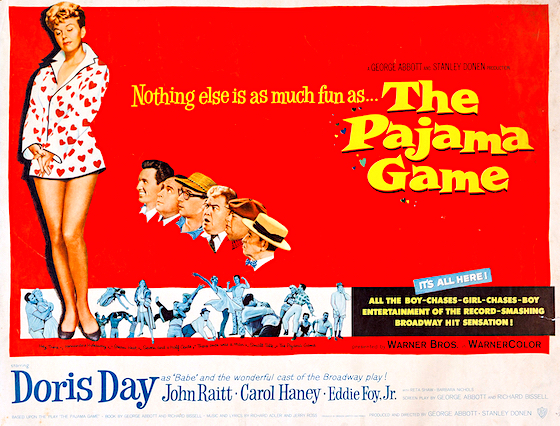
    The Pajama Game

    (1957)

    George Abbott & Stanley Donen | 101 mins | digital (SD) | 4:3 | USA / English | U

    The Pajama Game

    This minor musical is primarily of note for two things: the original Broadway staging featured the choreography debut of one Bob Fosse; and it features the song Hernando’s Hideway — if you don’t recognise the title, I’m sure you’ll recognise the tune. I had no idea this is where it originated.

    The story is about a pay dispute in a pyjama factory (given the current strikes and arguments here in the UK, you might think I watched this deliberately. Nope, total coincidence). On one side there’s the leader of the union’s grievance committee (Doris Day, one of just a handful of replacements made to the original cast when they transferred the stage production to the screen). On the other, the new superintendent (John Raitt, clearly a success on Broadway but less so on film). Of course, they fall for each other, before the pay conflict tears them apart. Can their love overcome such trials? What do you think?

    I saw someone describe The Pajama Game as an overlooked classic, which is taking things a bit far. It’s mostly likeable and quite fun, but rarely transcends that level. The undoubted highlight is Fosse’s choreography, which gives even the lesser numbers a polished dynamism. There are a couple of decent songs, but nothing really stands out, bar the aforementioned. It gets a bit too farcical in places, with some of the storylines ultimately taking a turn into very broad territory that feels misjudged. One primarily for genre fans only.

    3 out of 5


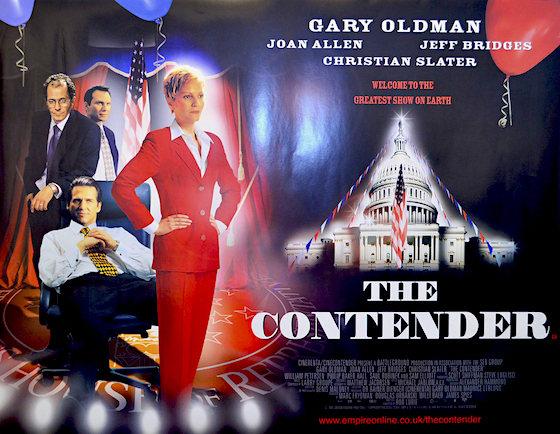
    The Contender

    (2000)

    Rod Lurie | 126 mins | Blu-ray | 16:9 | USA, Germany & UK / English | 15 / R

    The Contender

    I only picked this up on disc because it was part of a bundle of other titles I really wanted, but it also sounded like the kind of thing I’d like. Strange that I’d not heard of it before, then. I guess some films just get lost in movie history, especially when they’re a lesser member of a whole wave of movies. This is a political thriller of the kind they seemed to make quite a few of during the ’90s and into the early ’00s, but don’t really do anymore. I guess they exhausted the well, especially after 156 episodes of The West Wing.

    In this case, the story revolves around Laine Hanson (Joan Allen), the first woman nominated to be Vice President (it only took another two decades for that to happen in real life). There’s the familiar battle between the Democrats to get her confirmed, and the Republicans who’d like to do anything to thwart the Democrats. Amongst the scheming between the two sides, the big revelation is that Laine possibly engaged in a scandalous sex act while in college. She refuses to confirm or deny the rumour — it’s her personal business and shouldn’t affect her appointment. Except, of course, it does.

    Various other allegations come and go throughout the confirmation process, the two sides continuing to go back and forth in their attempts to win. It’s not necessarily the point the film is making, but it’s a reminder that politics is all a game to those involved, even as it can have serious effects on the lives of the rest of us. More overtly, the film tackles the different standards a woman is held to when trying to take public office. Fortunately, it’s not as overbearing with that as it could be. Indeed, all round the film is fairly understated. It’s a solid, unflashy, procedural-based kind of thriller.

    That is until the end, when it throws away the understatement for a grandstanding speech based around a fundamental belief in the greatness and goodness of the American political system. It would be heavy-handed in any circumstance, but the past few years (if not longer) of American politics have shown it for the total lie it always was. It doesn’t wholly undermine what’s gone before, but it does end the film on a sour note.

    4 out of 5


  • Bank Holiday (1938)

    aka 3 on a Week-End

    Carol Reed | 82 mins | digital (SD) | 4:3 | UK / English | U

    Bank Holiday

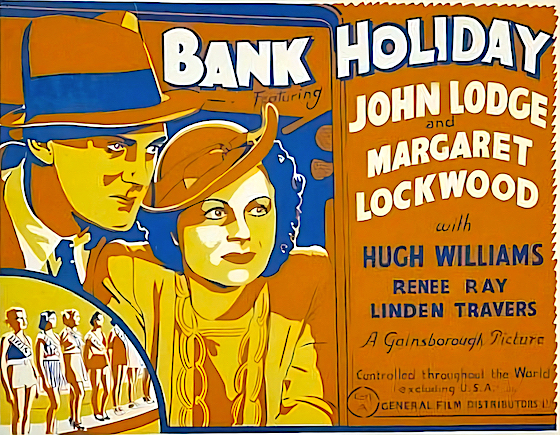
    You’ll be forgiven for not having heard of this one, even though it’s directed by Carol Reed (The Third Man, Oliver!, etc) and stars Margaret Lockwood (The Lady Vanishes, etc), because it seems to be pretty obscure. I only discovered it when browsing the online offering of UK digital channel Talking Pictures TV, and it mainly caught my attention because that was just before the weekend of the Queen’s Platinum Jubilee, when we had a double Bank Holiday. “What appropriate viewing,” I thought. Well, sometimes chance smiles on us, because this definitely doesn’t deserve to be so overlooked.

    As the title indicates, the film is set on a Bank Holiday weekend — the August one, to be precise — and, this being the interwar years (i.e. well before the ease of popping overseas for a quick holiday), city folk flock to the seaside en masse. In terms of the film, a variety of melodramatic and comic plot lines unfurl for an array of characters. The primary one follows a nurse (Lockwood) getting away for a rare holiday with her young fella (Hugh Williams); but he’s not planned it very well, and she’s distracted by thoughts of a man (John Lodge) who was suddenly made a widower on her last shift. That particular storyline gets a bit heavy (death in child birth; attempted suicide), but its balanced by comic antics in other plot lines. Overall, the mix of drama and humour gives a “something for everyone”, all-round entertainment feel that you tend not to get within a single work anymore.

    Two outta three ain't bad

    Nowadays, the film arguably has greatest value as a snapshot of 1930s British society. There’s a degree to which it feels ‘of its time’ as a work of cinema, but not in a terribly dated way. Indeed, while some things have changed a lot in the ensuing nine decades, but there are definitely behaviours, attitudes, and meteorological phenomena that’ll be familiar to any British viewer and their experience of a summer holiday weekend. And it remains entertaining in its own right. The comic bits still mostly work. Even when they’re not hilarious, at least they’re not embarrassing. The drama is similarly solid: the handling of romantic relationships remains relatable, rather than feeling terribly old fashioned (in fact, it had to be edited for release in the US due to its implication that an unmarried couple had a sexual relationship. And they think us Brits are the prudish ones…)

    To call Bank Holiday a “forgotten classic” or similar would be to overstate the point somewhat, but it does seem to be a largely forgotten film that merits being better known.

    4 out of 5

    2022 | Weeks 18–20

    These three weeks take us most of the way through May. When I first started writing this batch of reviews, I thought that would bring me almost up-to-date… but then I realised we were already over halfway through June, and, as I finish it, June is almost over. Time flies!

    It’s partly because I haven’t been watching as many films over the past couple of months (so it doesn’t feel like I watched these as long ago as I actually did), instead spending a lot of my leisure time on finally watching Apple TV+ series For All Mankind (I’ve just finished season one, which was really good, and I hear only gets better) and replaying all the Monkey Island games (I’m on the fifth and, to date, final one now).

    But I digress. Because I already posted Shang-Chi and Frances Ha separately, the remaining reviews from this period are…

  • The Monolith Monsters (1957)
  • Hannah and Her Sisters (1986)
  • Chip ’n Dale: Rescue Rangers (2022)


    The Monolith Monsters

    (1957)

    John Sherwood | 77 mins | Blu-ray | 2:1 | USA / English | PG

    The Monolith Monsters

    I watched this film in Eureka’s box set of ’50s B-movies, Three Monster Tales of Sci-Fi Terror. As you can tell from its inclusion there — and, indeed, its title — this is one of a wave of “monster movies” from that era. Except it isn’t, really. In fact, it’s a sci-fi disaster movie jerry-rigged into what I guess was the prevailing B-movie trend of the day: the eponymous ‘Monolith Monsters’ aren’t monsters at all, but an alien rock that expands relentlessly.

    Whatever you want to call it, the film offers a mix of B-movie daftness and real-sounding science that’s quite appealing. For example: our heroes discover this crazy, hitherto unknown multiplying rock; then realise they have maybe two days to stop it before it destroys their town; and rather than, say, alert the government, or call in expert help, they decide to… figure it out for themselves. But it does make you wonder: is this poor B-movie logic, or just 1950s Americanness? I love the thought that some crazy extraterrestrial incident may have occurred in some backwater town in the middle of nowhere, and no one ever knew about it because the locals just dealt with it themselves. “Oh yeah, aliens invaded back in ’57, but we didn’t see the need to bother nobody else with it, just shut ’em down ourselves.”

    Yet for all that silliness, there’s some scientific logic in play too. Whether it’s real science or “close enough”, I don’t know (let’s be honest, it’s probably the latter), but they manage to make it sound convincing. It helps contribute to an exciting climax, in which a plan to stop the monoliths can only be executed at the last moment before the town is overrun. Rocks don’t normally move fast enough to create race-against-time tension, but hey, these are alien rocks.

    The more I reflect on The Monolith Monsters, the more I like it. For a pulpy B-movie, it has an appealing seriousness. Sure, there’s some schlockiness that I wager is inevitable thanks to its era and budget range, but it feels like it’s trying to be more than trashy entertainment, aiming instead to be a more grounded, almost realistic sci-fi thriller. In reaching for that end it becomes a little slow going at times, but overall it’s quite fun.

    3 out of 5

    The Monolith Monsters is the 31st film in my 100 Films in a Year Challenge 2022.


    Hannah and Her Sisters

    (1986)

    Woody Allen | 107 mins | digital (HD) | 1.85:1 | USA / English | 15 / PG-13

    Hannah and Her Sisters

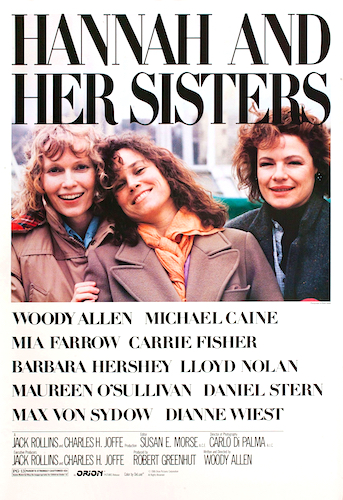
    Hannah and Her Sisters is one of writer-director Woody Allen’s more popular and successful films. For example, it was nominated for seven Oscars, winning three; and nowadays, it’s his third highest-rated film on Letterboxd, above the likes of Manhattan and later-career highlight Midnight in Paris. All of which I mention because, personally, it’s the kind of film I’d describe as “something and nothing”, because I liked it well enough, but also didn’t really get what it was going for overall.

    It’s the story of… well, Hannah (Mia Farrow) and her sisters. They’re three middle-aged women who all live in New York City (of course) and, over the course of a couple of years, we follow their lives and relationships, with a focus on the latter. Actually, if anything, I might argue the biggest focus is on Elliot, played to Oscar-winning effect by Michael Caine, who is married to Hannah but finds himself pining for her sister, Lee (Barbara Hershey).

    I say “might argue” because Hannah and Her Sisters is one of those films that feels like a collection of subplots. All of the storylines play out, then they stop, with happy endings almost across the board, and that’s your film. I expect it’s based around a theme of some kind, but all I really got it from it was the old “the grass is always greener” adage. Apparently Allen particularly wanted to make something about the relationship between sisters, because he thought that was more complex than between brothers. Fair enough, but I’m not sure it really comes across in the finished film. There are only about two or three scenes in which the sisters actually interact. They’re mostly off on their own subplots; and while those subplots do effect each other, I don’t think they truly speak to the sisters’ relationships; not in any revelatory depth, anyway.

    I’ve enjoyed quite a few of Allen’s films that I’ve seen, but Hannah and Her Sisters won’t be cracking my personal favourites of his work. It was fine to watch — not exceptionally funny or dramatic or insightful or original, but fine — and then it ends, and we go on with our lives. It’s not bad, but it also wasn’t anything much. Not to me, anyway.

    3 out of 5

    Hannah and Her Sisters is the 32nd film in my 100 Films in a Year Challenge 2022. It was viewed as part of “What Do You Mean You Haven’t Seen…?” 2022.


    Chip ’n Dale: Rescue Rangers

    (2022)

    Akiva Schaffer | 97 mins | digital (UHD) | 2.39:1 | USA / English | NR* / PG

    Chip ’n Dale: Rescue Rangers

    On the surface, there’s nothing here for me — a live-action remake/reboot of a late-’80s/early-’90s cartoon that I don’t remember ever watching — but something persuaded me to watch the trailer, and that convinced me to watch the film the moment I could. If you’ve missed said trailer, or any of the attendant hype or reviews, what sold me is that this isn’t just an update of a children’s cartoon with modern tech, but a Who Framed Roger Rabbit-style riff on cartoon celebrity.

    Like Roger Rabbit, it’s set in a version of our world where cartoons are ‘real’ and living alongside us, and they act in the TV shows and movies we know them from. Decades on from the Rescue Rangers TV show, Chip (voiced by John Mulaney) and Dale (Andy Samberg) no longer get along, but when an old friend goes missing, they’re thrust into investigating his disappearance together.

    Frankly, the plot and character arcs feel like stuff you’ve seen before — probably because we have. Although Roger Rabbit is the obvious reference, the film’s storyline feels very similar to the Melissa McCarthy-starring Muppet version of the concept from a couple of years ago, The Happytime Murders. It works better here, though, because it’s not leaning on crudeness as a comedic crutch. If you didn’t see that film, it might be to Chip ’n Dale’s advantage in terms of feeling fresh.

    Instead, the best bit of the film is that it’s full to bursting with fun nods and references to pretty much every facet of (Western) animation. These are often tucked away in the background or on the periphery for the eagle-eyed to enjoy, with the film rarely (if ever) stopping to show them off. To its credit, that means the abundant Easter eggs aren’t allowed to overshadow the story, and so the film avoids using them in the same way Happytime Murders used its vulgarity. It’s just a shame that said story is a little well-worn.

    Ultimately, Chip ’n Dale gave me the same kind of entertainment as its trailer, but for 95 minutes. Which, in a way, is fair enough — no one can accuse the trailer of being misrepresentative. On the other hand, it would be nice if there’d been something more to substantive to discover. It’s no contender for Roger Rabbit’s throne, but nor is it another Happytime mess. My score rounds up, because I did have fun.

    4 out of 5

    Chip ’n Dale: Rescue Rangers is the 33rd film in my 100 Films in a Year Challenge 2022.

    * There was no certificate listed on the BBFC website at time of review. As you may or may not know, there’s actually no legal requirement for streamers to have their content certified, and so it seems Disney haven’t bothered. For what it’s worth, Disney+ lists the film as “9+”, which I guess equates to PG. ^