Conquest Program No.9

2018 #158a-d
30 mins | DVD | 4:3 | USA / silent (English)

Conquest Program No.9 advertisement

We all know the cinema experience of today: 20 minutes of TV adverts that we’d fast-forward at home but have no say in on the big screen, followed by 10 minutes of movie trailers that we’ve already watched on YouTube, and, finally, the film we’ve paid to see. But back in the day the theatrical programme was less unedifying, with short films of various stripes preceding the headline film (hence the term “feature film”, obv.)

For her DVD release of the 1917 feature Kidnapped (more about that in my review here), Fritzi Kramer of Movies Silently was able to source the four short films that were bundled with it as part of “Conquest Program No.9”. The Conquest Programs were the idea of distributor George Kleine and created by Thomas Edison’s film company. Eleven were created in all, each one bundling together a feature film and a mix of shorts to create a complete bill of wholesome entertainment. By specifically recreating Program No.9, the Kidnapped DVD doesn’t just offer an approximation of what a night at the movies in 1917 might’ve been a bit like, but rather a genuine was-definitely-shown-in-theatres programme from the time.

Friends, Romans and Leo

The programme opens with a twelve-minute comedy short, Friends, Romans and Leo, directed by Alan Crosland, who also helmed Kidnapped, and featuring several of the feature’s leading players too. It’s a bit of Roman farcing about, concerning an “emperor” who’s so in debt he lets the moneylender marry his daughter rather than call in the mortgage on his garage. I’m sure that’s exactly how Roman politics worked. Then, an unwanted and useless servant is cast into the gladiatorial ring to face the hulking Brutal Brutus, and also Leo, a man in a lion costume… er, I mean: Leo, a lion. This bit, at least, has some amusing pratfalling. It’s not big (it’s a short film, after all), it’s not clever (characters speak in a mix of Olde Worlde English (“thou hast been good to me”) and modern slang (“that’s a twenty-karat rock, girlie!”)), and it’s not particularly amusing to today’s eyes either, although the second half is at least diverting enough. Certainly, a grown man titting about in a lion suit has its own kind of charm.

Up next is a seven-minute “fairy tale in silhouette”, Little Red Riding Hood. I’d assumed it was going to be some kind of puppet animation job, but no, it’s live-action shot in silhouette, presumably for a kind of stylistic, picture-book-ish look. This means we’re treated to another man in an animal costume — the wolf, of course — but this outfit is less good than Leo’s, something even the silhouetted visuals can’t hide. The short rattles through the traditional story with no significant variations, which feels a little quaint viewed from the vantage point of over a century later. That said, it does include this immortal line: “It must be grandmama for it is her cap, but how very strange this bad cold makes her look!” Because people can always be identified by their caps, and colds make you look like a wolf.

Little Red Riding Hood

Talking of quaint, that clearly wasn’t a concept alien to 1917 audiences, as the third short implies. Titled Quaint Provincetown, it’s a seven-minute travelogue about a quiet little seaside town and its almost throwback way of life (even for 1917!) A series of lifestyle scenes rather than a narrative documentary, it’s a fascinating window into the past, which arguably makes it the most interesting of these films for the modern viewer. That said, how much of it was captured actuality and how much was staged, who knows — for example, at one point we watch a couple of boys have a fight in the street while their friends egg them on, which you feel the filmmakers can’t’ve just happened upon. Still, kids, eh? I guess some things never change.

Finally, Microscopic Pond Life is a four-minute look at… well, what it says on the tin. This is, broadly speaking, stuff we’re nowadays familiar with from a young age thanks to science lessons and whatnot, but I imagine it must’ve been quite incredible to see these minuscule organisms in action for the first time. You’re not going to learn a lot of detailed scientific information from a 100-year-old short like this, but it remains a fascinating glimpse of the tiniest of lifeforms.

Microscopic Pond Life

Viewed today, this selection of short films is, at worst, an insight into a time long gone — one of the nearest experiences we’re likely to get to time travel. At best, the films themselves retain some inherent interest and entertainment value. As Fritzi puts it in her booklet accompanying the DVD, “the ninth Conquest program is not filled with hidden masterpieces, just good solid programmers that would have entertained the average American audience in 1917.” Very true, and fair enough.

3 out of 5

Read my review of Conquest Program No.9’s feature film, Kidnapped, here.
The DVD is now available to purchase from Amazon.com.

Christopher Robin (2018)

2018 #180
Marc Forster | 104 mins | cinema | 2.39:1 | USA / English | PG / PG

Christopher Robin

Disney appear to have found a rich seam to mine for box office gold when it comes to live-action remakes of their most popular animated properties. Some have been variations different enough to almost stand on their own two feet; others have been straight-up remakes, because why mess with success. Christopher Robin is, perhaps, the most original so far. There have been many Winnie the Pooh adaptations down the years, as well as original movies and TV series featuring the same characters, so rather than remake any of those, here Disney have set about telling another brand-new story (although it begins with an adaptation of one of A.A. Milne’s very best Pooh stories, which is nice). This new tale justifies its live-action form by moving beyond the confines of the Hundred Acre Wood; and it also, smartly, trades on our own childhood nostalgia for the silly old bear.

We all remember Christopher Robin as a small boy, but small boys grow up, and now Christopher (Ewan McGregor) is an adult in post-war London with a wife (Hayley Atwell) and young daughter, Madeline (Bronte Carmichael). He works for a luggage company that is facing the prospect of firing most of Christopher’s team, unless he can find 20% of cuts; so instead of going away with his family for a nice weekend in the country, he must stay and work — again. With both his personal and professional lives on the brink of collapse, Christopher is very stressed.

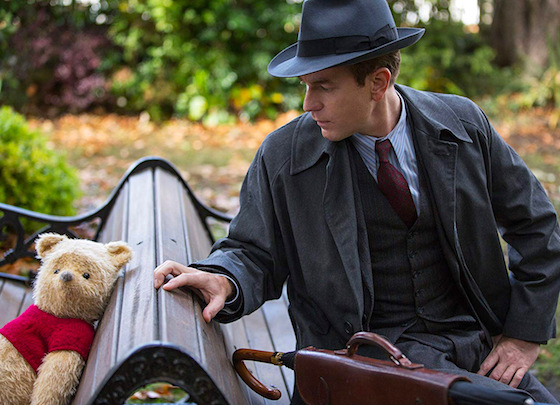
Pooh in the park

Meanwhile, in his childhood playground of the Hundred Acre Wood, Winnie the Pooh (a convincingly cuddly CGI creation, given voice by Pooh’s regular performer, Jim Cummings) awakens one morning to find all his friends are missing. Deeply concerned, he wanders through the door through which Christopher Robin used to appear, and finds himself in London, where who should he bump into but his old childhood friend — now all grown up and serious. But Pooh is still a childlike innocent, of course (don’t worry, they haven’t given him a Ted-style makeover), and maybe that attitude is just what Christopher needs.

Having said they haven’t made Pooh into Ted (thank goodness — I like Ted, but that really isn’t the spirit of this franchise), there’s more than a little whiff of Paddington here. It’s not the exact same plot, but the overall theme — of a naïve but good-hearted bear arriving to help humans overcome their problems with kindness — is certainly similar. Indeed, many beats of the story that unfolds are familiar — the climax is somewhat borrowed from Mary Poppins, for example; and you’ll know how every subplot will end as soon as it’s introduced. For some viewers, this will render the film pointless and clichéd. For others… well, it’s not really the point.

The joy of Christopher Robin is it takes those recycled elements and filters them through the prism of Pooh. If you too loved Pooh as a child, or an adult, then Christopher’s journey to rediscover that connection is relatable and supportable. And it’s simply a delight to spend time with the characters, as Pooh casually (and accidentally) dispenses heartfelt wisdom that both delights and, occasionally, may even cause you to think.

Tigger on the loose

The other denizens of the Hundred Acre Wood do pop up too: miserable old Eeyore (Brad Garrett) stole the show for the audience I watched with; Tigger (also Cummings, after test audiences objected to Chris O’Dowd’s English-accented take on the character!) is as exuberant as ever; and Piglet (Nick Mohammed) remains the voice of caution and cowardice, and as sweet as ever. As “the main ones”, those four get the most to do in the story, but there are also appearances from Rabbit (Peter Capaldi), Owl (Toby Jones), Kanga (Sophie Okonedo), and Roo (Sara Sheen) to complete the set; and with actors that good providing the voices, they make their mark.

But, really, this is all about Pooh. Well, Pooh and Christopher Robin — the title’s not inaccurate. For those who don’t feel a connection to the bear of very little brain, I guess the familiarity of the narrative he’s part of in this film will drag down enjoyment — this, I presume, is why the reviews have been somewhat mixed. But, in my opinion, a little Pooh goes a long way — as Christopher says, he may be a bear of very little brain, but he’s also a bear of very big heart. The combination makes for a film that is amusing, sweet, and thoroughly delightful.

4 out of 5

Christopher Robin is in UK cinemas now.

A Quiet Place (2018)

2018 #177
John Krasinski | 90 mins | download (UHD) | 2.39:1 | USA / American Sign Language & English | 15 / PG-13

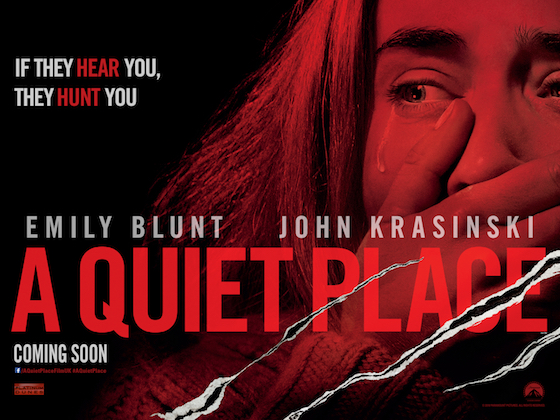
A Quiet Place

Not, in fact, the directorial debut of John Krasinski (aka Jim from the US remake of The Office, aka Mr Emily Blunt, aka Jack Ryan Mk.V later this month), but the first one that’s really gained any attention (to the tune of a sizeable $332.6 million off a budget of just $17 million), A Quiet Place is a post-apocalypse survival movie cum horror thriller. In the near future, the human race has been seemingly decimated by a race of aliens that hunt via sound. The film introduces us to a family — parents Emily Blunt and John Krasinski, kids Millicent Simmonds, Noah Jupe, and Cade Woodward — who have managed to survive by living on an isolated farm and communicating via sign language, which they’re fortunate to know thanks to a deaf daughter. Naturally, their carefully-constructed safety is threatened when Something Goes Wrong and the creatures are attracted to the farm.

A Quiet Place’s USP is the “must stay quiet” aspect, which reportedly led to less chatter and popcorn-munching during cinema screenings. If only all moviegoing experiences were so blessed. Of course, a similar conceit was only recently deployed in Don’t Breathe, but here the threat level is upped by the almost supernatural enemy. The film’s PG-13 rating in the US means it occasionally pulls its punches on going all-out terrifying, but, as the UK 15 certificate may indicate, it’s still loaded with sequences of tension and suspense.

Fingers on lips!

Some have questioned the film’s adherence to its own rules, or the practicalities of the characters’ decisions, or the ‘luck’ of them having a deaf child and so being able to communicate via sign language. I don’t hold much truck with any of those criticisms. In the latter case, is it not logical that those who already know non-verbal communication have an advantage when it comes to silent survival? Maybe everyone who didn’t know sign language just got killed already. In the first, I think the film sticks closely enough to its conceit: small or disguised noises can go unnoticed, but anything big or obviously human is going to attract attention. Besides, there are only two or three of the creatures in the area — even with their super-hearing, surely some stuff is going to pass them by.

The issue with the characters’ decisions perhaps comes down to the fact that the film leaves a lot unsaid (ho-ho) when it comes to their relationships and thought processes. Big events and the emotional fallout have occurred offscreen, leaving the family in the position we follow them for most of the film. Those viewers demanding 100% foolproof logic from every aspect of the movie are clearly left out in the cold by the lack of exposition, but more creative minds can fill in the blanks. Arguably it leaves the film wanting as a character drama, even as it strives for the kind of subtly and understatedness that is usually lauded in such a genre.

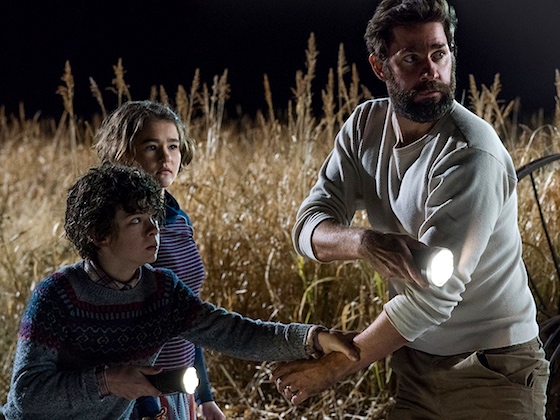
The family that stays together fights sound-hunting aliens together

But, really, it’s a horror-thriller, designed to have you biting your nails and on the edge of your seat as you wonder where the monster will spring from next and whether the characters can survive the assault. As a genre piece of that kind, half the running time is the film’s climax, and it’s an effective one at that.

4 out of 5

A Quiet Place is released on DVD, Blu-ray and UHD in the UK this week.

Zatoichi and the Doomed Man (1965)

aka Zatôichi sakate-giri

2018 #157
Kazuo Mori | 78 mins | Blu-ray | 2.35:1 | Japan / Japanese

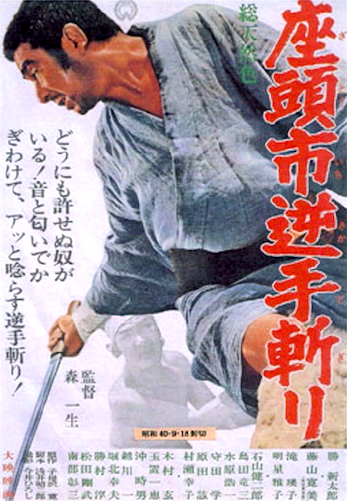
Zatoichi and the Doomed Man

The eleventh film in the Zatoichi series is perhaps the first one that could legitimately be described as bad. It’s not outright terrible, but the plot doesn’t hold together very well, and there are only a couple of redeeming scenes.

The first of these is at the very start, when the film opens on the striking image of Ichi receiving lashes as punishment for an initially-unspecified crime. They seem almost a minor inconvenience to our hero, however, who is more concerned with questions he has for his punisher about this cellmate of the previous night. It turns out he was the eponymous “doomed man”: a fellow who’s been incarcerated on a murder charge, but claims he’s innocent, and urges Ichi to track down the gang bosses who can vouch for him. Uncharacteristically, Ichi resolves not to help, but fate has other plans…

That reliance on fate to marshal Ichi around led me to dub this Zatoichi and the Coincidental Coincidences of Coincidence. He’s constantly stumbling back onto the film’s plot even when he tries to avoid it, or bumping into the people he needs to find, or bumping into people who happen to be connected to other people he happens to know. It’s easily the most poorly-constructed story of the series so far. That’s not limited to its dependence on coincidence, either: half the stuff it sets up doesn’t even pay off or come together in a reasonable fashion. Although the initial “wrong man” setup is enticing, rather than do anything interesting or different with that, it just turns out to be the series’ usual: some bosses have betrayed the chap as part of a scheme to control the area. And to rub salt in the wound, we learn about this in a scene where one conspirator explains what they’ve already done to his co-conspirator. Oh dear.

Shenanigans

It’s a very slight story — not even enough to sustain the brief sub-80-minute running time, it would seem, as we’re ‘treated’ to an array of unrelated shenanigans. The primary one is a young man who starts following Ichi around, then later impersonates the famed blind masseur for financial gain — and, supposedly, for comic effect. He’s played by Kanbi Fujiyama, who (according to Chris D. in his notes accompanying Criterion’s release) “was a noted funnyman in mid-to-late-sixties Japan, appearing in sidekick roles in many of Toei studios’ ninkyo (chivalrous) yakuza films.” Reading other reviews, a lot of people seem to find his schtick hilarious, but I thought he was the most irritating comic relief character the series has yet foisted upon us — and he’s basically the co-lead of this instalment, so we get to see far too much of him. He eventually turns out to have a connection to the main plot too, which is emblematic of the whole movie: the connection is a complete coincidence, dumped on us via random exposition late in the game, and then not paid off in any way. It’s entirely pointless. At one point he disappears from the film entirely. Due to how it was handled, I began to wonder if we were meant to infer he’d died off screen. But then he turns up again in the epilogue, as it merely to confirm that wasn’t the case.

That stands in opposition to the film’s main plot — you know, the titular one about the “doomed man” — which is resolved offscreen while Ichi’s already going on his merry way. It’s just one aspect that feels rushed (despite the short running time and ‘comedy’ distractions), or as if scenes were deleted. This is particularly noticeable as it pertains to the female interest, Oyone (Eiko Taki). Ichi rescues her thanks to a little trick she pulls, but then she seems ungratefully indifferent to him… until she’s suddenly hanging around near the end, hoping (as the women in these films always do) that he won’t run off while her back’s turned. Which is exactly what he does, of course.

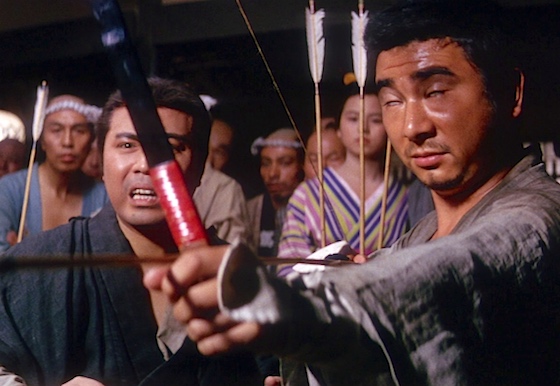
Zatoichi with the doomed man

You may remember I said there were some good bits. One is the pre-titles, which I already partly discussed. They’re effective thanks to some strong photography from Hiroshi Imai and the way they flip around with our expectations to create mystery (even if the reason Ichi’s receiving those lashings is completely irrelevant to the rest of the film). The other is the finale. As usual, the movie climaxes with Ichi having to take on an army of goons single-handed, but this one adds some spice with a seaside location, strewn with fishing nets (which get brought into the action) and covered with an early morning sea mist. It’s also beautifully shot, and there’s nicely choreographed combat. It’s easily the highlight of the film.

Other reviewers are not so harsh on The Doomed Man, going so far as to call it a “fine entry” in the series, or “thoughtful [and] hilarious”. And yet, those reviews can’t seem to help spotting the flaws in spite of themselves. Walter Biggins’ review at Quiet Bubble is a series of questions about why the film is so poor, with the last query being the most baffling of all: “why, despite all this opacity all my questions, did I end up liking this movie so much?” I’ve no idea, mate. Several other reviews make comments along the lines of, “Ichi behaves uncharacteristically here, but there must be a good reason for that” — or it’s just crappy, inconsistent writing. At least Letterboxd users agree with me: it’s ranked 24th out of the main series’ 25 films (the only one lower is the 23rd film, Zatoichi at Large — which, incidentally, is by the same director).

“Here's the end of the plot — go give it to someone and get this over with!”

For me, The Doomed Man is by a clear margin the weakest Zatoichi film so far. As nowadays I very much look forward to my regular appointments with Ichi, being so underwhelmed left me feeling disappointed: it wasn’t worth the wait since the last film, nor was it really enough to tide me over until the next one. For those reasons I considered giving it a lowly two stars, but that felt a bit harsh: it certainly isn’t without merit (the climactic fight is a stunner), and it’s always nice to spend time in Ichi’s company, even if he is being inconsistently written. Nonetheless, it only earns that third star by the skin of its teeth. This is a “for completists only” instalment.

3 out of 5

When Harry Met Sally… (1989)

2018 #77
Rob Reiner | 95 mins | streaming (HD) | 1.85:1 | USA / English | 15 / R

When Harry Met Sally...

Written by the queen of the romcom, Nora Ephron, When Harry Met Sally is almost a deconstruction of the genre: its titular protagonists are just friends, but (the film asks) can a man and a woman ever be ‘just friends’? It perhaps feels like a dated question today, when almost 30 more years of gender equality have pushed heavily towards the answer being “yes, of course”, but that doesn’t matter for two very good reasons: first, the film still stands as an insight into the nature of relationships in the ’80s and ’90s; and second, it’s just a really good film.

It begins in 1977, when Harry (Billy Crystal) and Sally (Meg Ryan) are recent graduates who meet through a mutual friend. They soon go their separate ways, and then the film catches up with them in 1982, and again in 1987 — and that’s just act one. It’s an interesting opening gambit to chart the pair’s backstory. It dodges the usual romcom thing of people who’ve just met falling instantly in love, but also does more than introducing us to two friends and telling us “they’ve always been friends” — it shows that friendship. I don’t think I’ve read anyone else talk about this part of the film, I guess because it really ‘gets going’ in the ’87 segment, but I think it’s an interesting way of beginning things, and gives a different grounding to the relationship drama we then see unfold.

It’s an immaculately constructed film all round, both on a macro and a micro scale. For the latter, there’s a single-take four-way phone call between the two protagonists and their respective best friends that is a thing of beauty (and apparently took 60 takes to get right!) It also manages to make New Years and Auld Lang Syne feel relevant to the plot, rather than just an obvious big occasion on which to set the finale. That’s a neat trick to pull off. Even the seemingly-random interludes showing interviews with long-married couples have a pay-off at the end that, once again, reiterates my point about how put-together this is.

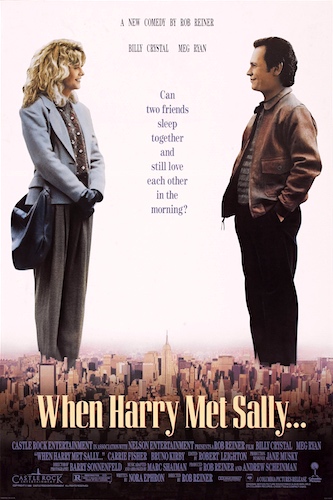
Just friends...?

On that macro scale, it again subverts the usual romcom structure simply by having the characters be hyper-aware of the possibility they could sleep together, and regularly discussing whether they should or will. They’re not just bungling through this relationship, happening to fall into all the usual clichés, like so many romcom characters before and since — instead, they’re actually thinking their way through it, aware of the pitfalls. And yet they fall into some anyway, and the film does sometimes follow predictable structure and does hit some of those clichés — but it always manages to make them ring true.

This truthfulness — about male-female friendships, mainly — is probably the film’s biggest asset. Is it still accurate about those dynamics almost three decades later? Despite what I said earlier, maybe it is. And even if it isn’t, I reckon it was bang on point for the ’80s and ’90s, and isn’t that enough? It tells you about the time it was made, even if it doesn’t tell you about today. It all adds up to mean that, when the inevitable happens at the end, it doesn’t feel like an obvious outcome, but something earned and emotional.

4 out of 5

Killing Gunther (2017)

2018 #83
Taran Killam | 93 mins | streaming (HD) | 1.85:1 | USA / English, German & Spanish | 15 / R

Killing Gunther

Do you ever have that feeling where you want to watch a film but you don’t want it to be anything too demanding or important? I do. I’ve watched (and subsequently reviewed) plenty of films with that underlying motivation. Killing Gunther is the latest that absolutely fits that bill. I had paid it absolutely no heed whatsoever until I happened to see a trailer that looked moderately amusing. Bolstered by a Rotten Tomatoes pullquote that described it as “a very affectionate take on the [hitman action] genre, so it’s much easier to overlook its shortcomings if that happens to be a genre that you’re a fan of,” I decided it was worth a punt.

Framed as a mockumentary, it’s the story of a hitman (Taran Killam) who sets out to kill the world’s greatest hitman, Gunther (Arnold Schwarzenegger), and assembles a team of oddball fellow hitman to do so. Unfortunately for them, Gunther is so damn good that he’s always several steps ahead.

As a comedy, I thought it was funny. Not always super original or absolutely hilarious, but ticking enough. As an action movie, some of the single-take assassination scenes are done quite well. It was clearly produced on a low budget, so the action sequences don’t really fulfil on an adrenaline-junkie level, but they work decently in context.

Gunther vs... that other guy

For Arnie fans, it’s worth noting that he doesn’t actually turn up until over an hour into the movie. Put another way, he’s not in 72% of the film. Really, it’s just an extended cameo. It would’ve been a neat surprise if his appearance was a secret, but the whole marketing campaign is based around him (which makes sense, but still).

If you hate mockumentaries, or indie comedies with more ambition than budget, or are coming just to see plenty of Arnie, then Killing Gunther is one to skip. If the concept and style appeals, however, it’s a decent 90 minutes for a lazy evening.

3 out of 5

Review Roundup: 15-Rated Comedies

You don’t have to be an adult to like today’s reviewed movies, but… you do have to be a teenager. Still being a teenager would probably help you enjoy them, too.

In today’s roundup:

  • Airplane II: The Sequel (1982)
  • Hot Tub Time Machine (2010)
  • Sausage Party (2016)


    Airplane II: The Sequel
    (1982)

    2018 #17
    Ken Finkleman | 81 mins | DVD | 16:9 | USA / English | 15* / PG

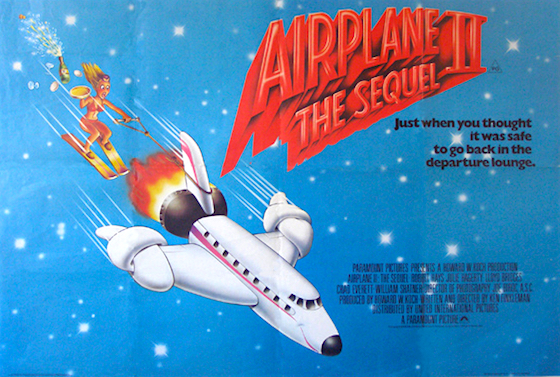
    Airplane II: The Sequel

    Comedy sequels are a funny business. Generally the first film’s been a big enough hit that people want to cash in, but can lightning strike twice? Well, the number of comedy trilogies (or more) suggests the answer is “yes”… or at least that enough people liked the first one enough that they went to see the second one and, regardless of what they actually thought of it, that persuaded people there should be a third.

    Airplane is widely regarded as one of the best comedies of all time. There is no Airplane III. Those two facts might suggest something about Airplane II — though it’s a film which even included a gag in its title, so it’s off to a good start.

    Watched now, over 35 years after its release, Airplane II has a certain vein of humour that hasn’t aged well. Ha ha, those two men kissed like they were a couple! Ha ha, that priest was looking at Altar Boy magazine like it was Playboy! Ha ha, everyone has to slap an hysterical woman! At least one of those gags would probably get you fired from a directing job at Disney nowadays… But to focus on those is to pick on the film’s weak points. Another would be that it has a few too many rehashes of jokes from the first one. Well, what comedy sequel doesn’t? That aside, much of the rest is pretty darn funny.

    3 out of 5

    * This was rated PG on its original theatrical release, but that was cut. The uncut version has consistently been rated 15 on video. ^

    Hot Tub Time Machine
    (2010)

    2018 #51
    Steve Pink | 97 mins | streaming (HD) | 1.85:1 | USA / English | 15*

    Hot Tub Time Machine

    I don’t know why I felt the need to watch Hot Tub Time Machine. Maybe just because it found its way onto my 50 Unseen list back in 2010 (I guess people talked about it at the time. Has it lasted? I don’t think so). Maybe because it’s got “time machine” in the title and so the sci-fi implication draws me in, especially as a Doctor Who fan. I don’t know. Whatever, it’s been vaguely on my radar for the past eight years and, when I wanted something undemanding one Friday night, its time finally came.

    As the title implies, it’s about a hot tub… that’s a time machine. Four dudes get in it and find themselves in the bodies of their ’80s selves. Except for one who wasn’t born at the time, who just finds himself in the past. Yeah, the logic of it is really shaky.

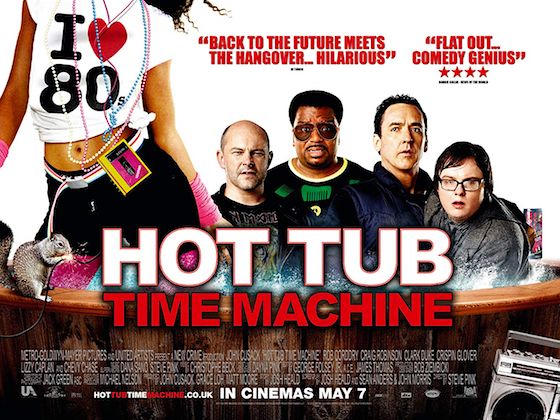
    Nonetheless, it actually has a couple of solid thematic and plot ideas buried away, to do with fate and second chances and stuff, but those are mired in execution that’s both derivative (of both Back to the Future and stuff like The Hangover — and, I swear, I hadn’t seen the quote on the above poster when I wrote that) and often unfunny (unless you really like that lowest-common-denominator gross-out stuff). There are some genuine laughs, but they’re infrequent enough that they might just’ve been accidents. Another part of the problem is that for the eventual pay-offs to work you need to be invested in the characters. The film makes half an attempt to give us reasons to care about the guys, but they didn’t connect for me. Maybe if that worked better, the later stuff would land too.

    I didn’t hate Hot Tub Time Machine — it was passably amusing for a time-filler — but it wasn’t great either. My score errs on the harsh side, because I definitely liked it less than other movies I’ve recently given 3 stars.

    2 out of 5

    * I watched the extended “unrated” version, hence no MPAA certificate. It’s less than two minutes longer (comparison here), with no material that would challenge an R rating. ^

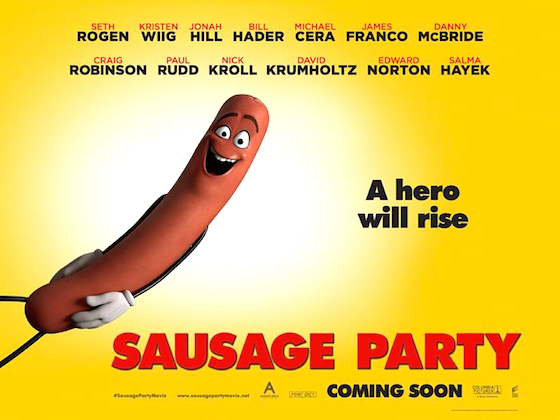
    Sausage Party
    (2016)

    2018 #37
    Greg Tiernan & Conrad Vernon | 85 mins | streaming (HD) | 1.85:1 | USA & Canada / English | 15 / R

    Sausage Party

    A movie about sentient food that parodies the inherent stupidity of religion — I mean, what’s not to like? Well, it’s from the minds of Seth Rogen, Evan Goldberg, and co (Jonah Hill as a story co-credit), so if you don’t like their kind of humour…

    Certainly, it’s incredibly rude and crude — even more so than they’d necessarily intended: they were so certain they’d get an NC-17 rating from the MPAA that the version they submitted included some extra extreme material, the hope being that would act as a distraction so that what they actually wanted in the film would pass as an R. However, the MPAA only insisted on one relatively minor change. I imagine that was to the massive, long, graphic orgy scene. There are no words for it. And yet, it only got a 15 over here — you really have to be very extreme to get an 18 these days, huh? Or maybe it’s just because it just involved food…

    For all the eye-watering content, at least the film has the good grace to also be quite witty and clever at times. I guess some of the ‘satire’ is a bit on the nose, but it works for what it is. I mean, no one comes to a film like this expecting subtle social commentary, do they? And if the analogies for religious belief are a bit on the nose, well, maybe that’s what it takes to get through to those people…

    4 out of 5

  • Train to Busan (2016)

    aka Busanhaeng

    2017 #140
    Yeon Sang-ho | 118 mins | streaming (HD) | 1.85:1 | South Korea / Korean | 15

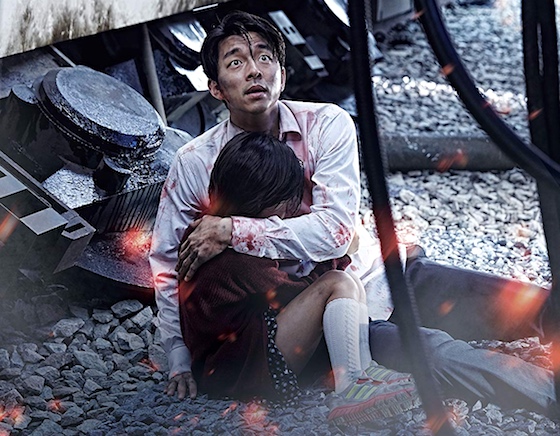
    Train to Busan

    Zombie movies have really risen to prominence this decade, for whatever reason (the success of The Walking Dead is an obvious culprit, though it would seem to have begun slightly before that, with Zombieland coming out in 2009, for example). You’d think that would result in the subgenre feeling played out, and there are certainly plenty of lesser efforts churned out, but films like the exceptional Train to Busan show there’s still quality to be found.

    The film centres on Seok-woo (Gong Yoo), a fund manager living in Seoul with his young daughter, Soo-an (Kim Su-an). Seok-woo’s work-focused attitude has left his relationship with his daughter strained and distant, so he acquiesces when she requests to visit her mother in Busan. As they board the train — alongside other passengers that represent a cross-section of society, natch — a zombie apocalypse breaks out. Initially safe in their carriage, the passengers must hope they can make it to safety.

    The family that fights zombies together...

    As you might expect, the mismatched group of passengers fall prey as much to their own infighting and prejudices as they do to the zombie hordes, and the situation works wonders for the father-daughter relationship of the lead characters. Despite that apparent predictability, co-writer/director Sang-ho Yeon and his cast earn our sympathies and create an attachment to these characters, such that we’re along for the journey with them. Whether or not you guess the letter of the plot is beside the point if you feel it along with the characters — when you’re on edge to see if they can make it, upset by their failures, and cheered by their victories. This also contributes to some effective suspense sequences, and the film is also peppered with intense, pulse-racing action scenes that have been impressively mounted. World War Z may’ve seemed to corner the market for “zombie movie as action epic”, but there are sequences here that give it a run for its money.

    Train to Busan shunts aside any tiredness you may feel about zombie flicks to demonstrate that, however overdone a genre may seem, there’s almost always room for fresh voices and creativity to produce remarkable work.

    5 out of 5

    Train to Busan placed 14th on my list of The 17 Best Films I Saw For the First Time in 2017, which can be read in full here.

    And that completes the reviews of my 2017 viewing (at last!)

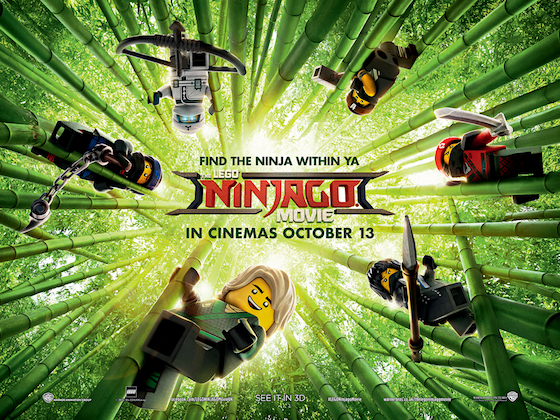
    The LEGO Ninjago Movie (2017)

    2018 #167
    Charlie Bean, Paul Fisher & Bob Logan | 101 mins | Blu-ray (3D) | 2.40:1 | USA & Denmark / English | U / PG

    The LEGO Ninjago Movie

    After the somewhat surprising success of The LEGO Movie, both critically (96% on Rotten Tomatoes) and commercially ($469.2 million worldwide), Warner Bros and LEGO realised they were on to a good thing and so did what any movie studio does in such circumstances: plowed ahead not only with a sequel (out next February), but also spin-offs. The first one, The LEGO Batman Movie, continued the trend (90% Tomatometer; $312 million gross); the next one — this one — …didn’t. With a rotten 55% on the Tomatometer and a worldwide box office take of just $123.1 million (less than either previous film’s domestic gross alone), what went wrong? Did they flood the market with LEGO movies too quickly? Was Ninjago just not as attractive or familiar a brand as Batman or LEGO generally? Or is it just not a very good movie? Well, I’ll come to that.

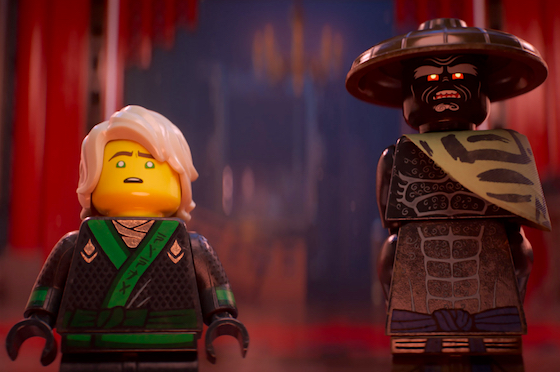
    The film sets its scene in Ninjago City, which is constantly terrorised by villain Garmadon (Justin Theroux) and his armies. Fortunately for the good folk of Ninjago, they have a team of mech-driving colour-coded super-ninjas to protect them. In real life, those ninjas are just high school kids, and not particular popular ones — especially Lloyd (Dave Franco), aka the Green Ninja, who everyone knows is Garmadon’s son. When Lloyd’s daddy issues lead him to slip up, the ninjas have to save the city — and, in the process, Lloyd and Garmadon have to sort out their differences.

    The Garmadons

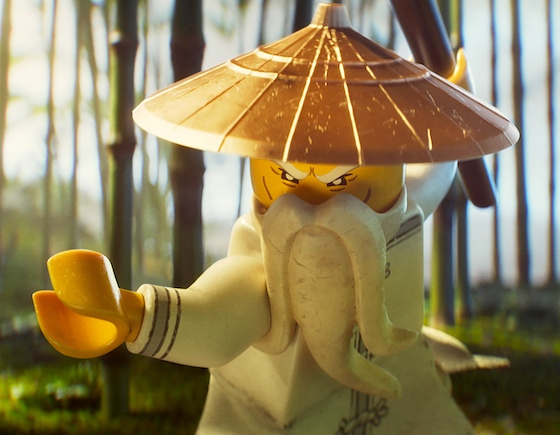
    The LEGO Ninjago Movie is quite clear that the focus of its story is the relationship between Lloyd and Garmadon, but it’s perhaps a little too focused on that. There are a bunch of other characters thrown into the mix — Lloyd’s five teammates; their master, Wu (Jackie Chan); Lloyd’s mother (Olivia Munn) — but the film doesn’t afford the screen time to do any of them justice. In fact, the film probably would’ve been a lot better if it had cut back on the number of beats in the Lloyd/Garmadon story and devoted a bit more time to giving everyone a little subplot. If it kept busy doing that it might’ve picked up the pace a bit as well, because although Ninjago is more or less the same length as the two previous LEGO movies, it feels much longer.

    Partly this is because it just doesn’t feel as inspired as the other movies — it lacks the spark of ingenuity that ignited their characters, humour, and stories. At times it feels entirely half-hearted. For example, Lloyd’s big mistake makes his teammates all hate him, but they immediately go on a journey with him anyway; Master Wu says the length of that journey will give them time to come back round to Lloyd, but the film never bothers to suggest that’s happening — as soon as they need to all get along again, they do. Clearly this was meant to have some emotional effect on Lloyd (even the handful of people who used to like him don’t anymore), but that’s never really given the emphasis to be felt either — so what was the point of them falling out with him in the first place?

    Even in LEGO, Jackie Chan kicks ass

    That said, it does muster suitable amusement in places, though not as regularly as the other two films. And if you’re a fan of Eastern genre movies — kung fu, giant monsters/mechs, samurai, etc — the whole shape and style of the film is a broad reference to that kind of cinema, which is fun for those in the know. Unfortunately, it comes up somewhat short in the action stakes — the mech sequences seem to be inspired by the Michael Bay school of throw tonnes of visual information at the screen and whizz through it at lightning speed, making some of it hard to distinguish, even with the separation benefits of 3D.

    Despite all these negatives, I didn’t actively dislike The LEGO Ninjago Movie. It’s good in places, most of it ticking along at a level of passable entertainment — but it ticks along for too long, it’s not funny enough, and it can’t bring it all together in the way the other two films did. It suffers most of all from those comparisons, because it’s simply not a patch on the other two LEGO movies.

    3 out of 5

    The LEGO Ninjago Movie is available on Sky Cinema from today.

    Mission: Impossible – Fallout (2018)

    2018 #164
    Christopher McQuarrie | 147 mins | cinema | 2.39:1 | USA & Hong Kong / English & French | 12A / PG-13

    Mission: Impossible - Fallout

    You can keep your Infinity Wars and your Incredibles 2sthis is the movie I’m most hyped for in 2018. I’ve been looking forward to it ever since it was announced we’d be getting another impossible mission from writer-director Christopher McQuarrie, who knocked it out of the park with the superb Rogue Nation. Anticipation only intensified with the fantastic trailers (that first one, scored to a Lalo Schifrined-up version of Imagine Dragons’ Friction, is a work of art in itself), and reached fever pitch with the influx of super-positive reviews in the past couple of weeks. Living up to the hype began to seem like an impossible mission all of its own.
    Well, if there’s one thing Ethan Hunt and his IMF teammates can pull off, it’s… a rubber mask. But if there’s another, it’s the impossible — and how!

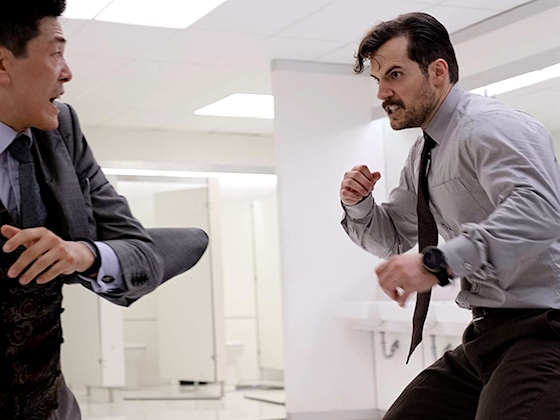
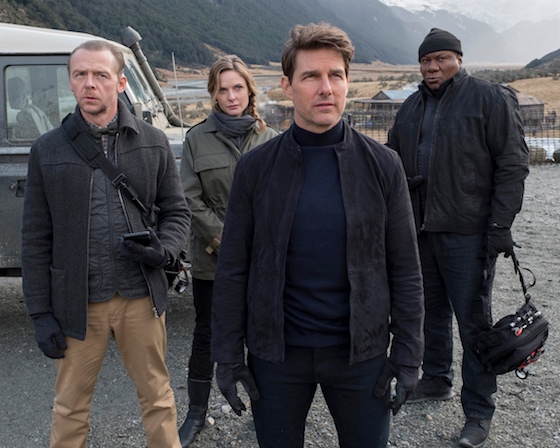
    Two years after the events of Rogue Nation, Hunt (Tom Cruise, obv.) and his regular sidekicks Benji Dunn (Simon Pegg) and Luther Stickell (Ving Rhames) are after three stolen plutonium cores that could be used to make nuclear bombs. They must stop them falling into the hands of The Apostles, a radical group seeking to execute the manifesto of John Lark, a shadowy figure the intelligence services have been unable to identify, who seeks to bring about a seismic change in the world order. When the IMF’s attempt to acquire the plutonium goes sideways, Hunt is assigned a CIA minder, August Walker (Henry Cavill), with orders to let nothing get in his way of finding The Apostles — including Hunt.

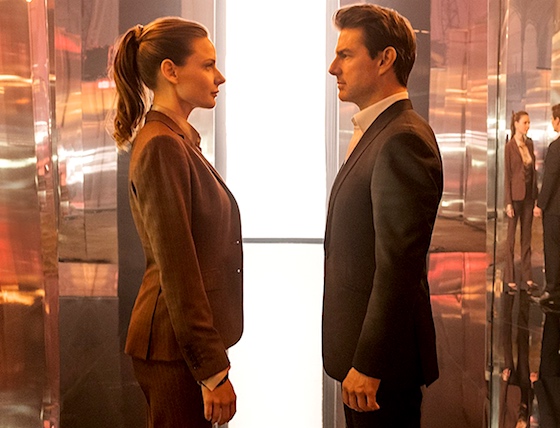
    From there, we’re heading into proper spoiler territory (I already rewrote that last paragraph to avoid giving away an early twist. You’re welcome, readers). However, as the trailers have already revealed, the storyline brings back into action the last film’s antagonist, Solomon Lane (Sean Harris), as well as Ilsa Faust (Rebecca Ferguson), the MI6 agent whose allegiances were constantly under question in Rogue Nation. She was ultimately confirmed to be on the side of good, but was supposed to be leaving the game. Why is she back? And whose side is she on now?

    Faust-Ethan pact (that's a pun, FYI)

    The plot that mixes all of this together gets… complicated. In some respects there’s a clear throughline from one action set piece to the next, but in others it can leave you reeling as it rockets from twist to reveal to counter-twist to counter-reveal. Mostly I think you have to go with the flow and accept whatever’s happening in the moment — if you start to think about the bigger picture (how people knew what when, and how they planned for this, that, and the other), it’ll make your head spin. Naturally, I was trying to do the latter, and got completely lost at one point in the middle when there’s an assault of back-and-forth twists about who has the upper hand. Again, if you just accept it and go with it, it’s fine, but try and unpick the logic of the whole thing in the moment and, well, you’ll be so busy thinking that you’ll probably miss another twist. Personally, I have a lot of faith in McQuarrie as a screenwriter, and I have no doubt the whole thing does make sense (or enough of it, at any rate), but he’s too busy racing along to let the film stop and allow you to confirm it for yourself.

    Fiddly plots are nothing new to the Mission franchise, of course: the very first one was (and often still is) criticised for having a story that’s more impossible to follow than a typical IMF mission is to execute. What is new to Fallout’s story is that it’s a sequel. Obviously, there are four other Mission: Impossible sequels, but they’re all standalone movies really. With the return of Lane and Faust, plus some of the baggage they had with them, a lot of Fallout spins out of Rogue Nation — it’s unquestionably a direct sequel. And, once again without wanting to get spoilery (though, again, this is partially given away in the trailers), it also picks up on hanging threads from movies even further back in the series. In this respect it’s a great film for certified Mission fans: there are a number of payoffs and answers to questions that are only still thought about by such devotees; but it’s also done in such a way that it never obstructs the fun for casual viewers. That goes for the whole sequel thing: although the storyline is grounded in the events of Rogue Nation, Fallout gives you enough info that you could watch it as a standalone.

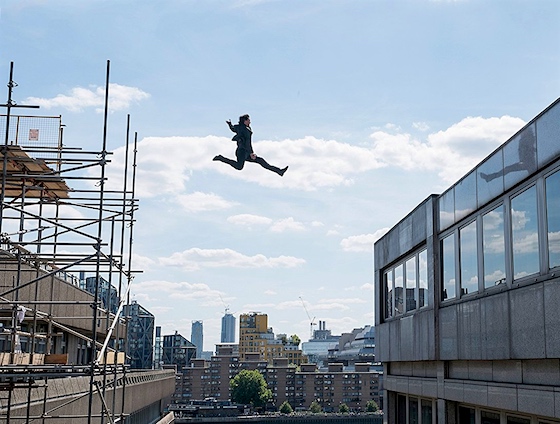
    Long walk off a short aeroplane

    Talking of Rogue Nation, about 24 hours before seeing Fallout I listened to Empire’s legendary three-hour Rogue Nation spoiler podcast, in which McQuarrie talks a lot about the writing process of a Mission movie, and what he learned about that during Rogue Nation. With his observations fresh in my mind, it shed an interesting light on Fallout — how and why it was doing certain things, as well as about when it chose to do them. Perhaps that’s why I was able to spot some of the reveals and stuff, because I knew the (self-imposed) rules McQuarrie was playing by. But there are some fascinating contrasts, too. For one not-really-spoilery example (because I’m going to talk about literally the first scene of the movie now), in the podcast he talks about how Mission films have to begin with a burst of action — no plot, no story, just straight into an action scene. It’s partly about giving the audience an instant thrill, but it’s more about letting them settle into watching the movie before you throw important information at them. But Fallout does literally the opposite: the first scene sees Hunt receive one of the series’ famous briefings (delivered, as always, in a completely different manner to how we’ve seen it done before), and that, as it’s precisely designed to do, delivers a massive infodump of plot. Now, how much of it you need to take in I’m not sure — various bits are explained again later as they become pertinent — but it certainly implies you should be paying attention. I’m in no way criticising this (I really liked everything in the pre-titles), it’s just an interesting contrast to how McQuarrie said things ‘needed’ to be done last time.

    Another thing from the podcast: one rule they set themselves on Rogue Nation, which ended up being a massive thorn in their side, was that there had to be constant escalating tension, meaning the film had to end with the biggest action sequence of all. This was a self-imposed rule, but they struggled with it for ages before they finally realised it just wasn’t what the story demanded, which was when they alighted on the ending that saw Hunt outsmart Lane rather than engage in a massive action scene with him. Clearly McQuarrie came into Fallout more prepared, however, because while there are big stunts and action scenes throughout the film, the finale is the largest, most complicated, most dynamic, and most impressive sequence of the lot.

    Watch that ankle...

    And so we’ve come to the real point of the movie; the thing the trailers and posters and behind-the-scenes videos have all sold it on: the action sequences. Simply, they’re incredible. Cruise’s dedication to giving the audience something new and exciting and awe-inspiring to watch is second to none. He spent literally years preparing for this film, learning to fly a helicopter and perform HALO skydives. That’s him flying the helicopter. That’s him jumping out of a plane. That’s him doing all sorts of other stuff too, like riding against traffic on a speeding motorbike, or jumping across rooftops, or falling off the side of a mountain. The only effects work here is for the odd spot of safety-rig removal or, I presume, one or two moments that would be impossible to achieve safely in real life. And this dedication has paid off: it’s so much more thrilling when you know this has all been performed for real than it is to watch some pixels or someone on a green screen. Those kinds of effects have their place in other movies, and can provide a thrill within the context of the story, but they nonetheless lack the tangibility that doing it for real provides, and the knowledge it’s a genuine feat you’re watching adds a whole extra thrill of its own.

    In filmmaking terms, McQuarrie does all he can to match Cruise’s drive to entertain us with his daring — not by being daring himself, but by showing off Cruise’s efforts in the best way possible. McQuarrie favours going without score for the action scenes, letting the sounds of revving engines, squealing brakes, thumping punches, and all kinds of crunching and smashing and thudding, be the only music you need. The tension and excitement comes purely from the physical feats on display, plus the camerawork and editing that showcase them. It works like a charm. I’ve seen music-less action sequences in the past where you feel the absence on the soundtrack; like something more is required. Early on in Fallout, I noticed the absence of music during these scenes only because I was aware McQuarrie favoured it that way, and because of how much it wasn’t needed. But by the end of the film, I was too hooked to care — I honestly can’t tell you if Fallout’s big finale sequence has music or not, because it grabs the attention so thoroughly that I’d just stopped being aware.

    Arms fully loaded

    Of course, other parts of the movie do have a score, provided by Lorne Balfe. Thanks to where it’s been applied, much of it is atmospheric rather than the pulse-racing theatrics you expect of an action movie score, though he makes nice use of Lalo Schifrin’s original themes — both the main one and The Plan — to provide grace notes where required. Plus there’s the big title sequence to really show off that iconic main number — and, like Rogue Nation, we’re treated to it twice. At my screening the houselights came up and people started walking out during the second one, which kind of bugged me — it’s not just names scrolling, it’s part of the movie, McQuarrie using it as a kind of final hurrah to send you away with (just as he did in Rogue Nation — he’s repeating the ‘trick’ because it works so damn well). Personally I prefer Joe Kraemer’s rendition of the title theme from last time, but Balfe’s is a worthy alternative.

    Also new to the franchise is cinematographer Rob Hardy, who’s delivered some gorgeous photography here. Not in a showy way, but there’s a richness to some shots, plus consistently great choices of angles and camera moves. The entire thing is about forward momentum — from set piece to set piece to set piece — and that’s conveyed by the way the camera moves, too. Even, for example, when cars drive up to buildings: rather than just observe it, the camera’s behind them, low to the ground, speeding along. Rarely has some people arriving at a near-empty airfield to get on a plane felt so exciting. I believe the film was shot mostly on 35mm, and those who care about such things will surely notice the benefit in many sequences. The big exception is the couple of sequences that use an IMAX ratio if you attend such a screening, which were shot in digital 8K (the need for small, light cameras precluded the use of genuine IMAX ones). Long gone are the days when mixing film and digital would make the difference obvious, however, and the switch between formats is entirely unnoticeable.

    IMF class of 2018

    If there’s one disappointment, it’s that the trailers gave too much away. Technically there’s a shedload of plot stuff they didn’t reveal, but honestly, the plot’s not where the real entertainment value lies. For one thing, seasoned viewers will see most or all of the twists coming. Maybe they could’ve kept some returning characters a surprise, but they’re all in the trailer too. No, this film is all about the incredible action, and story context only adds so much to that. What it does add, at least, is tension: the “oh my God, Tom Cruise is doing what?” factor may’ve been burned up by the trailers, but the edge-of-your-seat suspense about whether Ethan Hunt can achieve his goals is still there. And while the mind-boggling-ness of a first impression may be gone, the stunts are still genuinely spectacular — so much so that you can watch them again and again and still be thrilled, which means they do survive being in the trailers. Of course, if you were lucky (or sensible) enough to avoid those advertisements… boy, are you in for a treat!

    Even if you didn’t, I still think it’s a treat — they went and put all the best bits in the trailer and yet it’s still bloody spectacular. I think Rogue Nation may’ve had a better story, but nothing beats Fallout for adrenaline and spectacle. Well, every Mission movie is different in its own way, has its own strengths, and it’s clear what Fallout’s are. Personal preference will therefore dictate where you rank it next to the other movies, but what I’ll say is this: in a series where the level of consistency is so high that my personal favourite is usually whichever one I happen to be watching at the time, Fallout easily stands toe to toe with the rest.

    5 out of 5

    Mission: Impossible – Fallout is in UK cinemas now, and in the US from this evening.

    It placed 1st on my list of The 26 Best Films I Saw For the First Time in 2018.