
Rhian Skirving | 89 mins | DVD
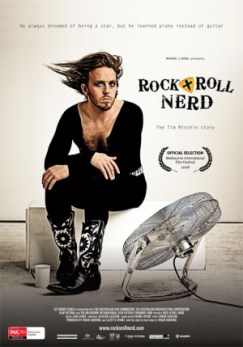 I don’t usually bother with plot summaries at the start of my reviews, working on the assumption most readers will know (or know of) the film and so don’t really need one. My assumption here is that most won’t have even heard of this film, though.
You may’ve heard of Tim Minchin, however, the Australian musician/stand-up who’s done a couple of tours, released a DVD or two, and popped up for guest spots on things like Never Mind the Buzzcocks and The Secret Policeman’s Ball. Back in 2005, no one knew who Minchin was — a struggling musician at the time, on the verge of quitting and finding himself a Real Job. He happened to live next door to aspiring filmmaker Rhian Skirving who, in more or less the same predicament, decided to film Minchin’s last ditch attempt at making it: trying his hand at comedy. They expected to film, at best, a small-scale suburban documentary about a wannabe failing to become a somebody, but what they wound up with was something rather different.
Almost as soon as filming began, Minchin was a hit at the Melbourne International Comedy Festival, where he was spotted by an Edinburgh producer and whisked off to the famous Fringe where (as the film’s own blurb describes it) he had “the most successful first season of any performer in the history of Edinburgh… walking away with the prestigious Perrier Newcomer Award, 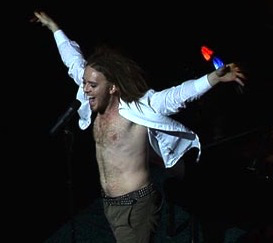 TV appearances, offers from Hollywood and the West End, the best management in the business and a gig at Albert Hall.” Not what either Minchin or Skirving had expected, that’s for certain!
What this tale creates is an unusual rockumentary. It’s obviously not a concert film, nor a tour film, nor a retrospective on someone’s career; instead, it’s the chronicle of someone’s relatively meteoric rise to fame, from two unique perspectives: the camera is there as it happens, not belatedly once Minchin’s become more widely known; and the writer/director/cameraperson is a close friend, not just any old filmmaker hoping to cash in. One almost has to wonder if Skirving has psychic powers, so perfectly timed was her idea.
Minchin is pretty honest with the camera in tow. When he’s a success, we see him struggle with things like management: does he owe it to the person who discovered him to make sure she’s cut in on the deal? Is it right to just abandon her and move on? Does she just see him as a potential cash cow rather than genuinely wanting to support him? And so on. His honesty extends to the awards — his show is so hyped he winds up half-expecting the near-impossible, to win the biggest award in his first year. He’s not even nominated, having to ‘settle’ for a win as Best Newcomer. His confounded expectations 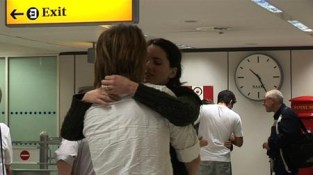 aren’t boastful or immodest, the viewer privy to how his hopes were unrealistically raised in spite of himself.
Alongside this, Skirving and Minchin allow us to see the toll his professional breakthrough takes on Minchin’s personal life. His wife — newly pregnant — is left behind in Australia while he’s becoming the toast of Edinburgh. The timing of some events in his personal life also couldn’t be worse, and Skirving documents them without ever becoming ghoulish or intrusive. It is, in a way, brave of both Minchin and his wife to allow their inclusion, but good filmmaking on the part of Skirving to know where to draw the line.
Documentaries such as this often rely on the viewer having a pre-existing affection for either the performer or their work. Though it seems impossible to believe, I’m sure there must be some who dislike Minchin (his show did get one bad review, after all)  and it may be they wouldn’t engage with this film because of it. However, some stories are capable of transcending one’s feelings about the subject covered, and Rock n Roll Nerd may just be one of those: even if you don’t enjoy Minchin’s songs, or indeed comedy music in general, the tale of his success — and what it’s like for an ordinary person to live through such a thing — is a story whose unique interest extends beyond fans-only territory.

Rock n Roll Nerd: The Tim Minchin Story is currently only available on an Australian Region 0 DVD, available from the distributor, your favourite Australian DVD retailer (y’know, like EzyDVD), or importers on Amazon. The film’s official website can be found here — sadly no trailer, but there are comments from Minchin and Skirving.
Rock n Roll Nerd placed 6th on my list of The Ten Best Films I Saw For the First Time in 2009, which can be read in full here.
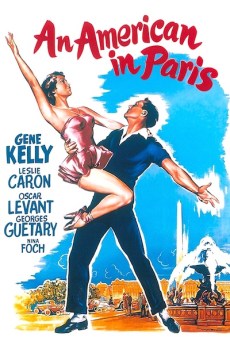 If anyone is interested in An American in Paris and has found this alleged-review in search of something interesting to read, I’m afraid you’re going to be sorely disappointed. Not because I didn’t like the film, but because I’ve not got anything to say about it.
 It doesn’t seem like 18 months since the RSC brought Hamlet to the stage with British TV’s biggest star actor (probably) as the titular Dane, but it is (more or less). Thanks to sold-out performances and largely positive reviews (theatre critics seem even less keen to agree on anything than film ones), we’re now treated to this film adaptation, shown on BBC Two on Boxing Day and released on DVD (but not Blu-ray, boo
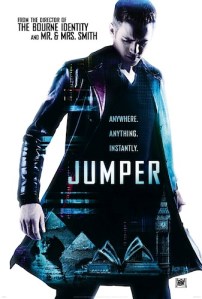 In honour of Jumper’s central conceit — that certain people can instantaneously transport themselves to any other point on the planet — I will conduct this review by jumping about through paragraphs I wrote without bothering to link them properly. (Also done in honour of my laziness.)
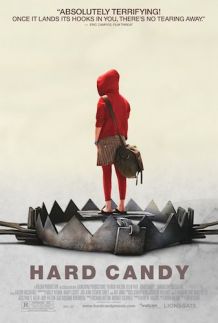 Hard Candy’s director David Slade has followed this up with vampire horror with
  Children of Heaven is an Iranian film, which means it’s in a Foreign Language and it’s Subtitled. And yet, it was on ITV. Sometimes the mind boggles. Still, it was relegated to a post-midnight showing, so some things never change. Indeed, the one thing that inspired me to watch it is that it’s referred to by Roger Ebert in his wonderfully evangelical (about film, not Christianity (thank God!))
  The
The  Murder on the Orient Express is arguably Agatha Christie’s most famous novel, perhaps because of its widely-known twist ending, or perhaps because it’s inspired in part by a high-profile true story, or perhaps because of this multi-Oscar-nominated all-star adaptation.
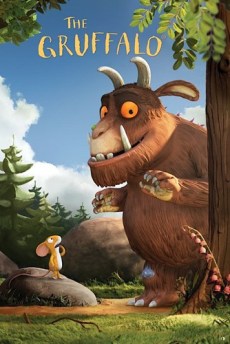 Julia Donaldson and Axel Scheffler children’s book The Gruffalo was a bit after my time but, I’m told, is incredibly popular with The Youth Of Today (not the ones that hang out on street corners earning ASBOs, obviously). It’s certainly a pleasant read, with rhythmic poetry and the kind of repetition that allows children to join in with ease, but it’s also quite short — fine for a children’s book, but not so good for attempting a screen adaptation of any length.
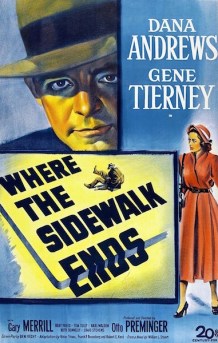 Otto Preminger’s film noir — scripted by Ben Hecht, adapted from William L. Stuart’s novel by Robert E. Kent, Frank P. Rosenberg and Victor Trivas, and quite what the difference between “adapting” and “writing” are I’m not sure — offers complex characters in a multi-layered plot. The ending particularly underlines this: the filmmakers could’ve killed anti-hero Dixon, could’ve had him choose to not open the letter, etc; but the decision he takes and the reactions of others are all relatively complex. Earlier, the sequences following Paine’s death are well constructed to produce the maximum amount of tension; their plotting clever, allowing for multiple (albeit similar) interpretations of events. Things happen which seem irrelevant, but are of course none-more-relevant later. Few films today are so brave as to not explain such things immediately.

