
James Mangold | 138 mins | Blu-ray | 2.40:1 | USA & Australia / English & Japanese | 12
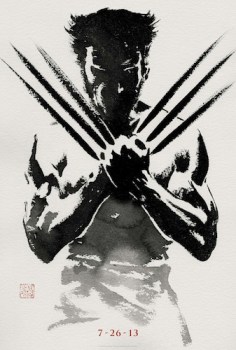 Rather than a sequel to the poorly-received X-Men Origins: Wolverine (which I mistakenly gave four stars back when it was in cinemas — hey, everyone else was too harsh), Fox’s X-Men film franchise here jumps back to the present day (after a ’60s aside for the excellent First Class) for the first time since 2006, to see what happened to fan-favourite Wolverine (Hugh Jackman) after he (spoilers!) killed the love of his life to save the world in poorly-received (though, again, it’s not as bad as most people think) X-Men trilogy-closer The Last Stand.
We catch up with Logan as a recluse in the wilds of his native Canada. He’s soon sought out by swordswoman Yukio (Rila Fukushima), who has been sent to bring him to Japan. There, a man whose life Logan saved in World War II (Haruhiko Yamanouchi) has become a technology giant, and wants to offer Wolverine the one thing no one else has: the removal of his healing factor, and with it the chance to finally die a normal death. Of course things aren’t all they appear, with numerous threats emerging to the old man, to his family — including his daughter, and Logan’s love interest, Mariko (Tao Okamoto) — and, of course, to everyone’s favourite beclawed mutant.
For the most part, The Wolverine feels refreshingly different to other superhero movies. That’s largely thanks to its Japanese setting and supporting cast, the primary element inherited from the acclaimed Chris Claremont/Frank Miller comic book miniseries that loosely inspired the film (not that anyone gets a credit for that). Those might sound like superficial differences, but the change of faces, scenery and culture seems to have infused the film’s attitude. Couple that with a plot that is more of a thriller than one of the usual three Superhero Movie storylines, 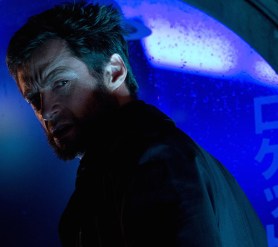 and the end result is a moderately unique movie. OK, it doesn’t ooze originality, but nor does it feel quite like your run-of-the-mill powered-people-punch-each-other comic book yarn.
Indeed, in places it threatens to become a proper character study. Although almost all of the X-Men movies have focused on Logan, it’s debatable how much they’ve dug in to him as a person before now — they’ve not dwelt on what his mutation means for his life or personality, merely used his memory loss as the chance for a mystery. There’s lots more exploration of the former here, at least by the standards of a summer blockbuster; and alongside that, the plot incorporates issues of honour and familial responsibility, which are suitably echoed by the Japanese setting and culture.
While it may be Jackman’s film — something only emphasised by a sprawling array of new characters that there isn’t quite enough time for — he’s not the only one who stands out. It’s Fukushima and Okamoto who are memorable in particular, and having such effective female characters once again distances the film from the majority of its genre brethren. It seems a shame neither feature in Days of Future Past — not that there’d be room for them, I suppose — but if the mooted third Wolverine solo outing comes to pass, I hope one or both are back.
 Talking of women, you can’t overlook Logan’s lost love, Famke Janssen’s Jean Grey. Considering the build-up pitched The Wolverine as a standalone film, with perhaps the occasional nod to the wider X-universe, including rumours of a Jean cameo, the final film is surprisingly tied-in to previous events: there’s actually loads of Jean (how? Well…), and Wolverine’s personal journey is very much grounded in the events of The Last Stand. I’m sure you could watch this without having seen or remembered a previous X-movie, because the bulk of the plot is indeed standalone, but the emotional journey is invested in what came before.
Unfortunately, a couple of things spoil the party — for starters, another woman: as Viper-lady, Svetlana Khodchenkova camps it up too much. When the rest of the film is more serious, almost plain dramatic in places, her OTT comic book stylings jar uncomfortably. It doesn’t help that the movie is bizarrely overstuffed with villains. Considering the general dramatic emphasis, it needs them even less than usual; plus, when it’s been observed for over 15 years (i.e. since Batman & Robin) that a superhero movie suffers under the weight of too many antagonists, there’s no excuse for it anymore.
More of a let down is the regular-superhero-schtick climax. A mix of muddled storytelling (things go unexplained, then are suddenly clarified in a rush of exposition) and a trashy “make the villain stronger, then punch him lots” escalation of action, it’s a disappointing end to a film that has otherwise felt on course for “genre classic”-level distinctiveness.  Without seeing all the behind-the-scenes goings-on it’s difficult to know whose fault this was, but it’s equally difficult to imagine the screenplay that Darren Aronofsky (far from your regular blockbuster director) described as “a terrific script” could have concluded this way; and knowing that his replacement, James Mangold, fiddled with the script before shooting commenced… well, draw your own conclusions.
Still, other technical elements shine: there’s beautiful cinematography from Ross Emery, and Marco Beltrami’s score is nice — no bit particularly sticks in my mind, but it felt suitably evocative. Even if the climax disappoints, there’s a smattering of entertaining action sequences before that, including some great claws-on-sword duelling. Some of this has been amped for the twelve-minutes-longer extended cut, though a lot of that additional time actually goes to the dramatic side of things, as detailed here. There are 65 alterations in all, which frankly I couldn’t be bothered to read through. (However, I noticed at least three uses of the F-word, a number which I believe America’s tick-box classification system grants an automatic R. In the UK it seems such antics can be allowed to slide at a 12.)
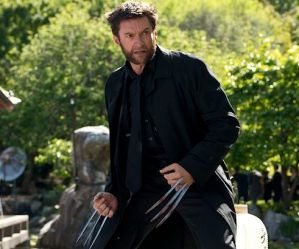 The Wolverine isn’t quite the movie it could have been; nor, I think, quite the one the makers hoped they were producing. Jackman has intimated since that it’s studio interference that pushes for silly-big action sequences and the like, but that fan feedback might slowly be winning them around to the things viewers actually care about. Whether that’s true or not, I guess we’ll see in the next instalment…

X-Men: Days of Future Past is released in the UK today, the US tomorrow, and pretty much everywhere else at some point this week. The next Wolverine movie is currently scheduled for release on 3rd March 2017.
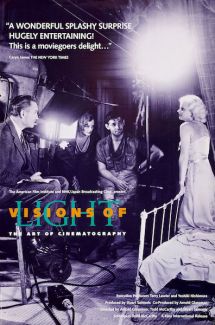 Cinematographers discuss cinematography in this AFI-produced documentary. Initially a whistlestop history of film photography, it segues into analysis of movies the interviewed DPs had shot. Unfortunately, casual film fans may judge it monotopical, while hardened cineastes may find it a haphazard, Hollywood-centric overview.
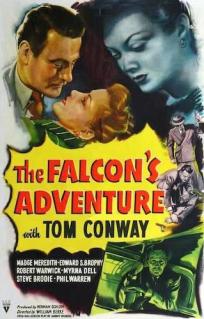 The final Falcon film to star Tom Conway (three more were made a few years later, but there seems to be debate about whether that was the same character) sees our avian-monikered detective planning to take a fishing holiday… until he can’t resist saving a damsel in distress and gets dragged in to a plot involving kidnap, theft, and murder. I think I saw someone jaywalking too, so it’s a veritable hotbed of criminality.
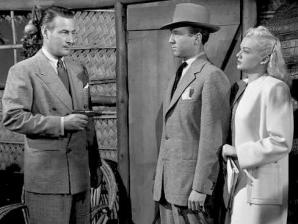 The Falcon’s Adventure is a terribly generic title for a film that isn’t the series’ very best, but is a solid upper-end instalment. They’re mostly quite formulaic films, naturally, but Adventure gets the mix right with some good sequences and gags. As the last film it doesn’t represent much of a conclusion, but then they didn’t really go in for big “series finales” back then, did they.
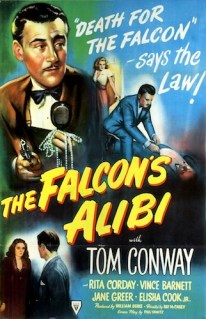 Once again smitten by a pretty lady, the Falcon finds himself co-opted into guarding a wealthy woman’s jewellery. But when said jewels are promptly stolen, and murders ensue, our charming hero is implicated. Who would do such a dastardly thing? And what’s going on with the DJ in the roof of the hotel?
 Among the rest of the cast, Vince Barnett becomes the fourth actor to play the Falcon’s sidekick, Goldie; and Jean Brooks and Rita Corday each appear in their fifth Falcon films! Brooks was previously in
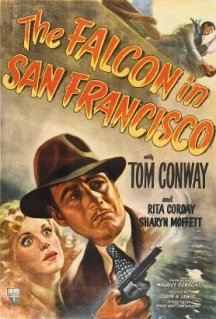 The Falcon is often dragged into adventures by beautiful women he can’t resist, but here it’s a female of a different kind — a little girl. After her nanny is murdered on the train to San Francisco, the Falcon offers to take her safely home… only to get arrested for his troubles, and then be picked up by a mysterious woman and her heavies and given a good beating. What the blazes?!
 At least there’s some comic relief thanks to the return of the Falcon’s sidekick Goldie, who’s been absent since
 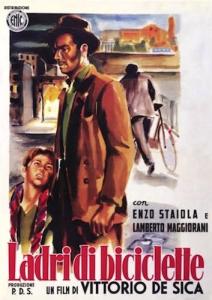 The victor of Sight & Sound’s inaugural “greatest film” poll (though it’s slipped down the rankings ever since), this is the simple story of a man hunting for his stolen bicycle, which is vital for his job, hard-won in a time of unemployment and poverty.
 The year 1600: British ship’s captain Solomon Kane is not a nice man, a mite too fond of pillagin’ and killin’ and quite possibly other not-nice things ending in —in’. That is until he has a run in with the Devil’s Reaper. Hell has claimed his soul, and its time to collect. Solomon does not plan on being collected, renouncing his former life and trying to hide at a monastery in England. But as a gang of possessed men lay waste to the countryside, burning its towns and enslaving its people, will Solomon be able to stick to his newfound pacifism? Yeah, we all know the answer to that…
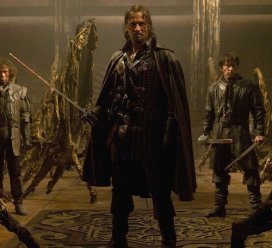 but also a more-than-requisite amount of swordfighting and the like — all told, Kane is more period action-adventure (with demons) than period horror.
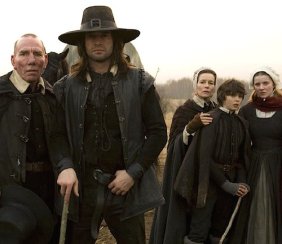 In support there’s the likes of Pete Postlethwaite, Alice Krige and Max von Sydow, all of whom bring instant heft to roles that need it. I don’t mean to say the screenplay doesn’t contain it, but the shorthand the actors bring with them certainly does favours. Cameo-sized appearances by Mackenzie Crook and Jason Flemyng are also effective, and watch out for a pre-
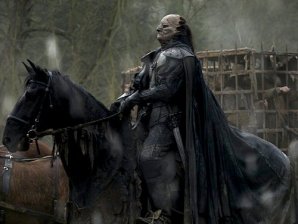 My praise also extends to those responsible for the film’s location shooting. Shot in the Czech Republic, for once that genuinely looks like Britain. OK, the style of some buildings give the game away occasionally (in particular the monastery), but until I read different, I just assumed the fields, forest and coastline had been found in our real South West, on the moors or what have you.
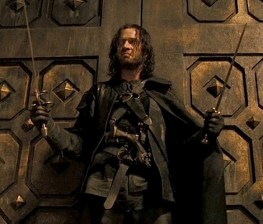 At the end of the day, Solomon Kane is a period fantasy action-adventure, something which doesn’t seem to be everyone’s taste — it has relatively weak scores on the likes of IMDb and Rotten Tomatoes (though, in the context of how this kind of movie often performs in those arenas, they’re far from awful). For my money, however, it’s a great little film. It looks beautiful, it renders the tone of pulp fantasy brilliantly, its action sequences are exciting (so many swordfights! Heaven!) and its creepy bits unnerving. It may not be ‘trash’ elevated to art — it’s not a Tarantino movie — but it is pulp fiction treated with due reverence.
 The director of Disney’s woeful
 The writer-director of
 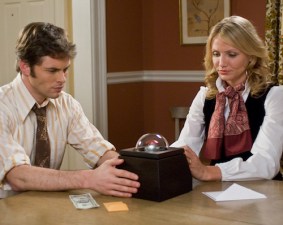 What a nice tribute to his supportive parents and their devotion to one another, eh? At the start, perhaps, but by the end of the film you may be wondering what the writer-director’s subconscious wants to do to his ma and pa…
 What could function well as an indie-level thriller is further undermined by abundant, therefore costly, CGI. Whether that’s Langella’s facial disfigurement (what could’ve been make-up is actually a complex array of tracking dots, green face-paint, motion-control cameras, and so on; all used merely to place him in simple dialogue scenes), or wide shots of ’70s Virginia, with a computer-adjusted skyline, computer-animated cars, and computer-painted snow. It’s not that the effects work is poor (though don’t look too closely at those cars), but that it screams “this must be special effects!” when you don’t want such distractions.
 The Box should have been a film we all discussed for years to come, its “what would you do”-ness providing an
 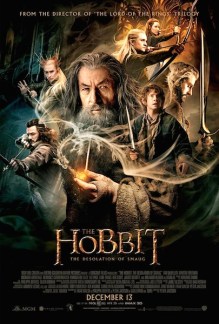 The Desolation of Smowg-not-Smorg begins in the same way
 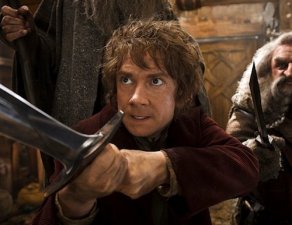 It’s my understanding that the originally-planned (and shot) two-part version of Jackson’s Hobbit adaptation was transformed into a trilogy by, essentially, taking what was to be film #2 and splitting it in half. That might explain why individual sections are allowed to go on so long here: to bulk up the running time to the kind of epic proportions audiences expect from a Middle-earth movie. Anything less than two-and-a-half hours isn’t going to cut it. But when your climax is a battle between a giant dragon (cool!) and a small army of dwarves (kick ass!) around a deserted underground city (hell yeah!), but my main thought afterwards is, “God that went on a bit”, then you’ve failed at something.
 Meanwhile, Luke Evans’ Bard is as Welsh as the actor’s name suggests, which is a little bit of a surprise. But then the dwarves’ accents have all the rest of the UK covered, so why not. Benedict Cumberbatch sounds like Benedict Cumberbatch playing ‘big’ as Smowg-not-Smorg. It feels like this should be an iconic villain performance but, while good, I found it somehow lacking. Expectation may be scuppering him; maybe I’ll warm to it on future viewings.
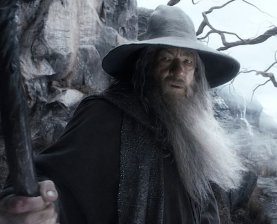 I haven’t picked apart everything that’s wrong with the film (what purpose is there switching from one made-up-for-the-film orc general to another?!), but then nor have I praised everything that works (there are some quality actors in amongst all that crashing and banging). It seems a fair few people liked this Hobbit instalment more than the first; the best explanation I can find is, “because it’s got more action”. Far be it from me to accuse other film viewers of being shallow, but… really? I genuinely enjoyed An Unexpected Journey as a return to the beloved realms and peoples of Middle-earth. The Desolation of Smowg-not-Smaug has some of that, and the charm of introducing us to new parts of the world too, but it’s drowned out by so much aimless noise. Here’s hoping it improves with repeat viewings and/or the inevitable extended edition, because this time I nearly slipped down to a lowly 3 stars.
 100Films.co.uk