
Ben Affleck | 130 mins | Blu-ray | 2.40:1 | USA / English & Persian | 15 / R
 2013 Academy Awards
7 nominations — 3 wins
Nominated: Best Supporting Actor, Best Original Score, Best Sound Mixing, Best Sound Editing.
 Argo is probably the most traditionally entertaining from 2012’s crop of Best Picture nominees. I know a lot of people awarded that honour to American Hustle, but David O. Russell’s film left me largely cold, and, even with OTT performances and funny lines, I think it is actually a very awards-y kind of film.
Argo, on the other hand, is a straight-up espionage thriller. Based on a true story that you’d dismiss as too ridiculous if someone had made it up, it tells the tale of CIA extraction expert Tony Mendez (Ben Affleck), charged with rescuing six US officials who escaped the 1980 attack on the US embassy in Iran and are hiding at the Canadian ambassador’s residence. Tony’s plan is to fake the production of a Star Wars-style movie, fly in to Iran on the pretence of location scouting, and simply fly the officials out posing as his crew. To make the story look genuine, he enlists Hollywood makeup artist John Chambers (John Goodman) and producer Lester Siegel (Alan Arkin) to all but set up the movie for real. Then all Tony has to do is pop over to a country where Americans are despised and fly their six most-wanted fugitives out on a commercial airline flight.
I think Argo is a winner — with audiences, that is — because of its deft mixing of humour and tension. It begins with the latter, showing the siege in Iran in accurate detail (the end credits contrast photos of the actual event with the film’s recreation, lest you were in any doubt). The US public are concerned about the dozens of embassy employees held hostage — there’s wall-to-wall news coverage, plenty of gung-ho vox pops, etc. The US government, meanwhile, flounder about what to do about the escapees — in very-need-to-know secret, of course, because if news gets out… well… With no good plans, this is when Tony cooks up his Hollywood idea, and he jets off to California to set it up and prove it can work.
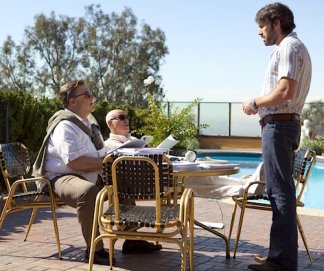 This is where we get the humour, mainly directed at the movie industry. Some say this is why it won the big awards: Hollywood loves a look at itself, and here it’s both satirical (“So you want to come to Hollywood, act like a big shot, without actually doing anything? You’ll fit right in!”) and congratulatory — after all, the plan goes ahead and so (spoilers) Hollywood saves the day. The film creates just the right balance between taking the mick out of Hollywood and bigging-up its role in saving some lives, while also not spending too long on this section that we forget the perilous situation on the other side of the world. After all, once all the fun and games in Tinseltown are over, it’s back to the serious business in Iran.
When we return there, lives are very much at stake, under genuine threat from the Iranian militia if the six are discovered. The latter sequences where Tony sets about actually extracting them are loaded with unease, particularly when, to maintain their cover, they actually have to go on a location scout, complete with government guide. These six embassy employees — secretaries, effectively — are of course not trained spies, but nonetheless must know and be convincing within their cover stories. They have overnight to learn complete identities in case they are quizzed, knowing that even the slightest mistake could spell their capture, and their capture would inevitably lead to their death.
As director, Affleck’s one arguable misstep during all this is the OTT climax. (Spoilers follow, naturally.) In some respects it’s an awkward case: in reality, Tony and the rescuees boarded their flight home with no problems — their tickets were pre-booked and the flight left at 5:30am, so there weren’t even any guards on duty. That would make a bit of an anti-climactic ending to a Hollywood thriller, though, so of course it needs to be jazzed up. 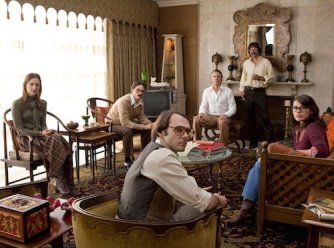 That’s just artistic licence, really — it’s not as if these people were safe, they just had a damn good plan; and, as I said, you need a dramatic ending for a thriller. However, all the “chasing them down the runaway” stuff is a bit full-on and action-movie-ish. It’s not even accurate to how it would go in real life, if it had happened, because the militia’s cars would need to be travelling phenomenally fast to keep up with the plane, and they aren’t seen to be affected by its jets either. For me, the rest of the climax — the guards checking the ‘crew’ out, phoning the LA office, later running up to the control tower, etc — all works; assuming you accept the film is still a Hollywood thriller, not a fact-bound documentary, and so needs a suitably dramatic climax. It’s a shame they didn’t leave it at that, but not a deal breaker either.
This extended version adds about nine minutes of material, primarily in the form of a subplot with Tony’s wife and kid, which from what I can tell was all but excised entirely from the theatrical cut. It’s a humanising subplot rather than an essential part of the narrative, but I also didn’t feel it got in the way of what else was going on, and was surprised to learn it had been removed so thoroughly. There are also a variety of little moments reinserted, plus some alternate shots and takes used, often for little apparent reason. For the interested, it’s detailed in all its infinite intricacies here.
Argo is perhaps an unusual Best Picture winner in the current era. It’s the kind of film that would have been a mainstream hit back in the ’70s or ’80s, back when adults still went to see adult movies rather than solely committing themselves to comic book effects extravaganzas. (A fact I stumbled across the other day: Kramer vs. Kramer earnt over $100 million at the US box office. 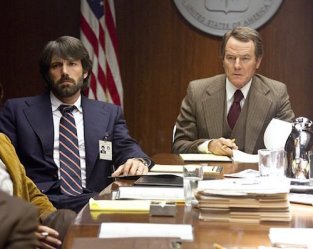 That was in the ’70s — adjusted for inflation, it comes to over $350 million. For a drama about a couple divorcing and arguing over custody of their kid! Today, it’d be lucky to earn a tenth of that, even if it was up for Oscars. But I digress.) It’s a surprising Oscar pick these days because it’s a genuinely enjoyable watch, rather than a gruelling look at something-or-other serious.
Occasional slips aside, it’s a well-made, highly-entertaining, real-world spy thriller. Was it the best picture of 2012? Maybe not. The best movie? Maybe.

 As
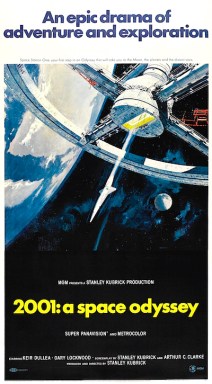
As 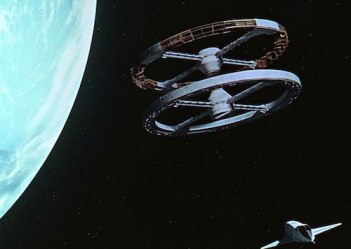 with this kind of pace and uncertainty would be unthinkable, but I guess audiences were a little more mature in the Good Old Days. Even then, Kubrick cut 19 minutes after the film’s premiere in order to “speed up the pacing”. Maybe he succeeded, but no one’s going to be calling this a fast-paced thrillride any time soon.
 Technically, then, 2001 is undeniably stunning. Thematically, though… what’s it all about? What does it mean? Author Arthur C. Clarke once said that “if you understand 2001 completely, we failed. We wanted to raise far more questions than we answered.” Some find such goals unsatisfying, especially when it comes to storytelling, but the very spirit of space exploration, of science, is to keep asking questions that don’t necessarily have answers. Of course, the ending is actually very easy to explain: the evil alien monolith kidnaps Dave, ages him to death, then mutates him into a giant Space Foetus, which it sends back to Earth. Why they didn’t make 2002: Invasion of the Giant Space Baby, I don’t know. Who doesn’t want to see that movie?
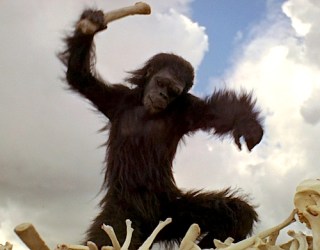 and almost immediately use them to kill, first a beast for food, then another ape for territory. Then, in a literal split second, we jump forward millennia, as that simple tool turns into a nuclear weapon drifting in orbit — the entirety of human technological innovation summed up in a single cut.
 In the end, I think 2001 is a film that’s very easy to admire, for all sorts of reasons, but to enjoy in the traditional sense of “enjoyment”? Surely it’s far too removed, too obtuse, too joyless, for that? Some people will like those qualities, of course, and all power to them. For me, 2001 is a film to be impressed, even awed, by; but not one to love.
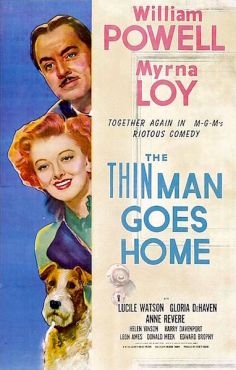 After four glamorous adventures, high-living sleuths Nick and Nora Charles (William Powell and Myrna Loy) head to small-town America to visit his parents (Harry Davenport and Lucile Watson), and naturally find themselves embroiled in a murder plot.
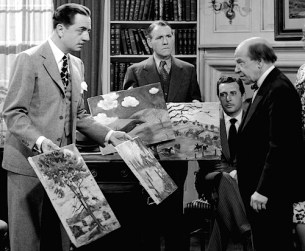 then no one would’ve been murdered. (Probably.)
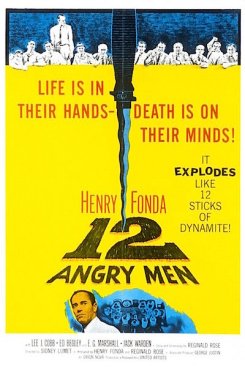 Twelve people sit around in two rooms and talk for an hour and a half in more or less real time — sounds like a recipe for dull pretension, and yet 12 Angry Men is anything but. In fact, it’s probably one of the most gripping thrillers ever made.
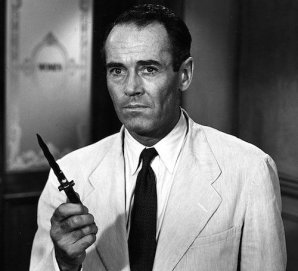 Slowly, steadily, surely, Fonda’s juror leads a recap of the evidence, analysing it, picking it apart, challenging presumptions and suppositions. Gradually, other jury members begin to be won over. This could be trite — of course our hero has to start convincing the others — but this is where the writing and cast shine again, because even men who seemed unswayable have their minds changed in a plausible fashion. Even then, the outcome rarely seems certain, each victory hard won, so that the film holds you rapt, desperate for sense and reason to prevail. There are moments of tension which may literally push you to the edge of your seat; moments of exultant success which may elicit an exclamation of approval similar to a point scored in a sports match.
 For all that 12 Angry Men seems to show justice being served in the face of adversity, what it actually shows is justice being served thanks to blind luck: if Juror Eight had been a weaker-willed man, or another who was just as prejudiced as his eleven compatriots, then the debate would never have occurred, the teenager condemned to death in the blink of an eye. What are the odds on every jury room containing a Henry Fonda? I don’t fancy them myself.
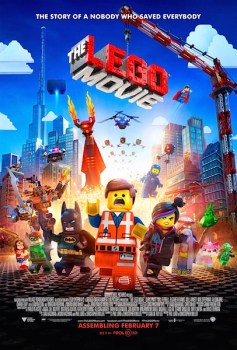 Despite looking like a 100-minute toy commercial with an irritating theme song, plus a moral message about nonconformity that seems like it’ll get bungled (but doesn’t), The Lego Movie is so much more — and better — than that.
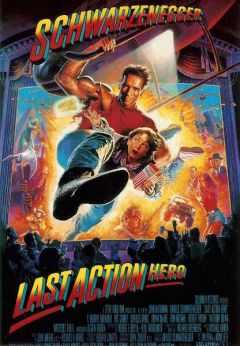 The first film to be advertised in space (
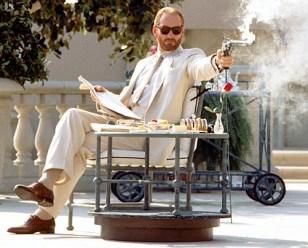 That said, it’s probably a good thing this isn’t a whole movie of “fictional characters in the real world” — you can imagine how that would play out; all the predictable “fish out of water” hijinks. However, at just over two hours, this isn’t a short film, and cutting out some of the middle wouldn’t have hurt.
 The first manned mission to Mars is reaching the end of its six-month tour. As they count down the final hours, battling a dust storm and its attendant power outages and communications blackouts, one of the team secretly discovers bacterial life on the surface. Attempting to recover further samples, a sink hole opens beneath him. When the rest of the crew try to recover his body, it’s not there. Then he arrives back at base… only, he’s not quite himself anymore…
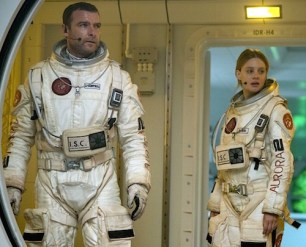 These faults persist despite the best efforts of a quality cast, particularly Romola Garai as (in functional terms) the capable sidekick, and Olivia Williams as the bitch whose heartless practicality becomes an asset when the going gets tough. First-time feature director Ruairí Robinson assembled his cast on the principle of “people who aren’t normally in sci-fi movies”, and that does feed in to the sense of realism. It also looks great, the production, costume and effects designs gelling to create a believable Mars mission, all in spite of a tiny budget (funded by the BFI and the Irish Film Board, it had about a tenth of Gravity’s budget, for example). Credit, too, to cinematographer Robbie Ryan for lensing the Martian surface convincingly (it’s actually the Jordanian desert). The editing may descend into fast-cut blurriness during action scenes — only emphasised by Max Richter’s predictably derivative horror movie score — but during calmer moments the film looks very good.
 and was more sure of its tone. There may be elements to commend The Last Days of Mars in this comparison (the much bigger budget pays off in the scope of the visuals, of course), but as a story and viewing experience, The Waters of Mars wins hands down.
 This time it’s not personal for Nick and Nora Charles (the joyous William Powell and Myrna Loy), as they stumble upon the murder of a race-fixing jockey and the subsequent killing of a corrupt journalist… and then one of their friends (Barry Nelson, aka
  As murder mysteries go, the Thin Man series tends to offer plots that are somewhere between perfunctory and over-complicated to the point of being unsolvable, and Shadow is a typical example. But that doesn’t matter a jot, because the story’s abundance of incident keeps things moving, and the real entertainment value lies in the comedy chops of the three leads: Powell, Loy, and, of course, Asta the dog.
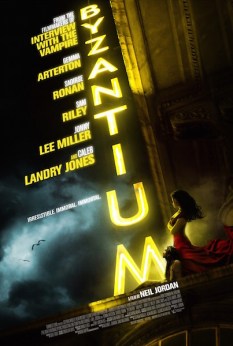 18 years after he adapted Anne Rice’s seminal vampire novel Interview with the Vampire into a seminal vampire
  The most effective part of the movie isn’t so much its plot or its mythology, though, but its atmosphere. Vampire movies take place in castles or drawing rooms, or high schools in more modern iterations. They are grand and sensuous. Any glamour in Byzantium is discarded and decrepit, like the titular hotel that Clara reshapes as a whorehouse; faded and left to ruin. The seafront is characterised by graffitied concrete, the glaring lights of arcade machines, heroin-chic Eastern European prozzies. The pier appears to have burnt down at some unspecified previous time and just been left. The only people left behind are the ones without a means of escape, stuck with their miserable lot. Clara and Eleanor fit in almost seamlessly.
 Other alleged faults include the film not giving enough time or heft to facets individual viewers want it to cover. For one example, someone criticised it for not fully exploring the issue of voluntary euthanasia. I’d argue it doesn’t explore it at all, because it’s not trying to. That Eleanor chooses to only kill people she perceives as wanting to die is not her making a moral statement on a contentious issue, but finding a way to marry her conscience and upbringing with the necessities of her vampiric life; and it’s probably practical, too. That’s not to say a vampire movie can’t be used to explore a topic like voluntary euthanasia, but if you want that I’m afraid you might have to write your own.
 Technically, DoP Sean Bobbitt grants us some gorgeous cinematography. There’s a cruel, aptly soulless beauty to the faded town, while some countryside vistas, both past and present, offer more traditional scenic pleasure. A remote rocky, misty isle — central to the mythology and so repeatedly visited — is particularly notable. Captured entirely on digital cameras, it seems sometimes that Bobbitt tried to push his equipment too hard: some shots during the climax look flat-out weird, as if someone has applied a Photoshop “comic book” filter or something. Also of note is the score by Javier Navarrete, which makes particularly good repeated use of The Coventry Carol.
 For all its dual-period storytelling and its grubby settings, it’s a resolutely modern kind of take on vampire mythology.
 The debut of director Daniel Minahan — who’s since helmed episodes of over a dozen TV shows, including HBO hits
  100Films.co.uk