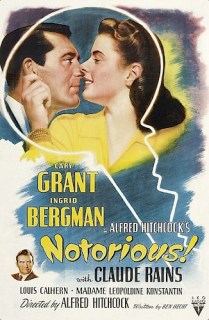
The Dark Knight (2008)

2008 #47
Christopher Nolan | 152 mins | cinema | 12A / PG-13
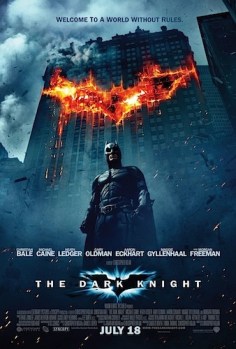
The Dark KnightThe Dark Knight — the sixth film in the modern Batman series (though not connected to the first four) — comes with a heavy weight of expectation on its back. It’s the sequel to the last film, Batman Begins, which relaunched the flailing series in style and is one of the best comic book movies ever — so Nolan and co had to top that. There was Heath Ledger’s death, a sad accident that has heaped extra focus on his penultimate performance here (his final one, in The Imaginarium of Doctor Parnassus, is currently in post-production with no release date) — especially as some sources cited his appropriation of the Joker’s mindset as related to his death. And then there were the trailers too, which caused ridiculous levels of excitement among some — personally, I found them a tad lacking. But I was fairly confident that, a bit like Begins, The Dark Knight would turn out to be the sort of film that doesn’t necessarily trail all that well but is excellent when seen.

And I was right. In this respect, it’s because the action sequences aren’t the point of the film. They occur when required by the story, while still being well-spaced and appropriately exciting, rather than serving as check-boxes for a plot designed primarily to link them together — the latter being what most blockbusters seem to settle for these days. Many are pleasantly old-school in style, the stunts performed largely for real, and at least one major example is even left without music. On the odd occasion when effects must have been used, they’re seamlessly achieved. The most obvious use of CGI — which I won’t describe for the sake of spoilers, though many will already know about — is incredibly well done. All of this helps ground the film in a perhaps-surprising (for some) degree of reality, one that goes far beyond what other ‘realistic’ superhero movies have strived for.

In fact, this realism is probably The Dark Knight‘s main strength. Obviously there’s never going to be a real city where a billionaire dressed in bat-inspired armour protects the populace from a deranged man in clown make-up, but if there were then this is how it would be. Where Burton’s two Bat-films were “dark”, and Schumacher’s were “gaudy” (or “crap”), Nolan’s pair are “real”. It’s an excellent thriller as well as everything else. The focus of the plot — at least at first — is on the mob and their control over Gotham, and it’s from their criminal desires — plus the very existence of Batman — that the Joker grows. Ledger’s performance is as outstanding as you’ll have heard said elsewhere, and while it still feels like a supporting role it receives more attention than the psychology of Bruce Wayne/Batman — which, considering that’s what Batman Begins focused on, seems fair enough. Every other performance is equally as flawless (I’ll name names in a moment), but it’s Ledger’s disturbing, engrossing turn that will stay with you. He is the Joker, in a way Jack Nicholson certainly never was, and — among obviously more upsetting effects of his premature death — the fact we’ll never see him in a rematch is a huge shame.

As Harvey Dent, Aaron Eckhart’s role is much larger than I was expecting. The floating-head posters that seemed to divide the film between him, the Joker and Batman are spot on — they’re the three central characters, everything revolves around them, their actions, choices, and emotions. While Ledger may dominate with his (appropriate) theatricality, Eckhart is more the heart of the film, with a genuinely tragic story. Viewed in this light, the order of the film’s final scenes — which I think some may see as incorrectly balanced, perhaps even anticlimactic — make all the more sense. However, I don’t mean to undersell the rest of the cast by highlighting Ledger and Eckhart — in their supporting parts, Michael Caine, Maggie Gyllenhaal, and especially Gary Oldman and Morgan Freeman, all do brilliant work. The talented Christian Bale manages to hold his own as the ambiguously heroic crimefighter, even against the more obviously attention-grabbing performances of Ledger and Eckhart.

As with other superior superhero sequels like X2 or Spider-Man 2, The Dark Knight uses the groundwork of its successful predecessor to craft an experience that’s even greater. In fact, there’s an awful lot more that could be said about the qualities of The Dark Knight. At two-and-a-half hours, it’s a packed epic of a movie — which makes Nolan’s confident juggling of plot threads, character development, several large performances, action sequences, and more, all the more impressive. I certainly enjoyed seeing it with a large, American (importantly), opening-weekend crowd — several moments produced whoops and sustained applause from the audience, as well as a good number of well-deserved laughs.

The Dark Knight is great entertainment, with a good deal of meat on its bones too — the performances and emotional stories are as engrossing as the thriller-ish plot and impressive action. When all is considered, it’s possibly as perfect a thriller/blockbuster as they come. In fact, as I publish this, The Dark Knight sits at #1 — the best film of all time ever — on IMDb. It will drop, of course, because that’s opening-weekend fan-led gut reaction for you… but, even when time’s passed, I’m certain it deserves to remain high on the list.

5 out of 5

Sadly (though not surprisingly) the Manhattan IMAX was booked solid all through opening weekend (and most of next week, at least). As soon as I manage to see it on the extra-big screen, I’ll share my thoughts here. You can also read even more of my thoughts on the film (this time when considered next to Batman Begins) here.

The Dark Knight placed 1st on my list of The Ten Best Films I Saw For the First Time in 2008, which can be read in full here.
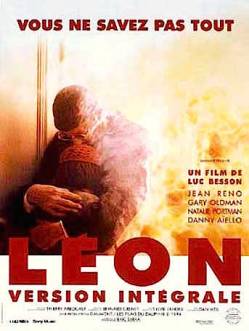
Léon: Version Intégrale (1994/1996)

2008 #42
Luc Besson | 127 mins | DVD | 15*

Léon: Version IntégraleI first saw Léon about 10 years ago, back when video was still an acceptable way of watching things. A friend leant it to me, insisting it was a film I absolutely had to see, and he wasn’t wrong. It’s remained one of my favourite films ever since, though typically I haven’t watched it more than once or twice in the intervening decade. (It also fostered a love for Sting’s closing song, Shape of My Heart, which is criminally missing from a Greatest Hits CD my dad owned (even though his dire song from Demolition Man is on there), and in moderately recent years was indifferently reused by both Sugababes and Craig David.)
I became aware of this extended cut a few years ago, a little while before it was released on R1 DVD. Having held out for a UK R2 release for about half a decade now, I gave in and bought the (apparently superior, and also in a Steelbook, which always has a way of persuading me) German R2. It’s labelled as a “Director’s Cut” but, as Besson states in the relatively lengthy booklet (translated with the aid of [the now defunct] Babel Fish), “the second version is neither better nor worse than the original” — it’s not a preferred cut, just a different, extended one.

But personally, I prefer this version. Not because there’s anything wrong with the original — far from it — but because this one has more. Sometimes you can have too much of a good thing of course, but I don’t think that’s happened here. The additions build on the characters and relationships, primarily between the two leads, and also add extra doses of humour and action. Besson wasn’t necessarily wrong to remove these things from his original cut — the extent of Léon and Mathilda’s relationship is especially controversial for some, and the extended scenes of Léon training Mathilda as a Cleaner are arguably extraneous — but they all add to the experience. Wisely, he doesn’t seem to have touched what was already there. Everything that was great about the original — from the astounding performances of Jean Reno, Natalie Portman and Gary Oldman, to the thrilling action sequences, and plenty else in between — remains intact. They’ve not been buggered about with, just expanded around.

Ultimately, the reason I prefer this version is quite simple: I love the film and the characters, I could happily take more of them, and I very much enjoyed all of the added material. I can understand objections to the insinuations about Léon and Mathilda’s relationship, but I didn’t find it any creepier here than it was before (besides which, any paedophilic notions come from her and he quashes them). The quality of the performances in the new scenes, plus other solid additions, make all the new bits worthwhile.

The version intégrale isn’t too much of a good thing, then, just more of a great thing. To my mind, Léon (in either cut) is unquestionably essential.

5 out of 5

* The original cut of Léon was last classified in 1996 and given an 18. The longer version was classified in 2009 and received a 15. That must be a pretty rare case of a longer version (technically) having a lower certificate. ^

Throne of Blood (1957)

aka Kumonosu jô

2008 #33
Akira Kurosawa | 105 mins | DVD | PG or 12

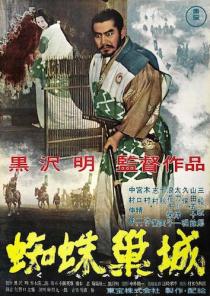
Throne of BloodKurosawa moves Macbeth from Scotland to 16th Century Japan in this retelling of Shakespeare’s infamous Scottish Play. I’ve heard this described as a loose adaptation — perhaps those reviewers have never read the play. Kurosawa sticks very closely to the structure of Shakespeare’s version of the story (though based on real events, Shakespeare changed key details), often choosing to adapt it scene-for-scene. It works well in the new setting, with some of the themes — honour, respect, betrayal — perhaps becoming more understandable when placed in samurai culture. Kurosawa changes other elements too — character names are understandably localised, there’s only one witch, there’s no version of the famous “Is this a dagger which I see before me?” monologue, and so on. It’s not all omissions however, as Kurosawa adds imagery and symbolism of his own. Again this helps to place the story in its new context, but also covers the loss of Shakespeare’s original language (a major sticking point for some critics).
Beyond the Shakespearean similarities (or lack of), there’s much to see in Throne of Blood — literally, thanks to the atmospheric cinematography. Most of the exteriors are doused in fog, and while this is sometimes over-done (an extended sequence of Washizu and Miki riding in and out of it goes on too long) it also makes for some amazing moments, such as when the trees of Cobweb Forest drift menacingly forward. The interior of the forest is suitably oppressive and scary too, the perfect location for encountering a witch. Kurosawa was inspired by Japanese Noh theatre in his construction of the film, so there are a lot of longer shots that allow the characters to be blocked as if on stage. It’s not overly theatrical, thankfully, and works suitably.

Cinematic techniques are not entirely abandoned however. The most memorable is the banquet scene, in which Washizu sees Miki’s ghost: we see Miki’s empty seat, the camera tracks forward to a shocked Washizu, then back to reveal the ghost of Miki sat at his place, before tracking and panning around the room to follow Mifune’s brilliant performance. It’s an infinitely more effective reveal than any amount of jiggery pokery with dissolves or CGI could provide. Similarly, Washizu’s iconic death scene — in which hundreds of arrows puncture him and the surrounding walls — is impressively achieved (using real arrows), including one seamless shot when an arrow pierces his neck.

Macbeth is my favourite Shakespeare play — it’s a great story, with great themes, imagery and language. Throne of Blood obviously loses some of this, but it doesn’t matter in the slightest — Kurosawa has constructed an excellent and well-conceived retelling with a few of his own flourishes.

5 out of 5

A note on the classification: the UK DVD from the BFI is rated PG, classified in 1991. A few months after the DVD’s release in 2001, the film was re-submitted to the BBFC and received a 12. Quite way the rating was raised isn’t explained, and copies of the DVD still bear a PG on the cover.

L.A. Confidential (1997)

2008 #26
Curtis Hanson | 132 mins | DVD | 18 / R

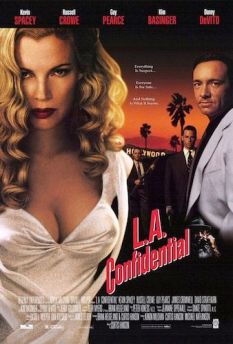
L.A. ConfidentialOnce again I’m watching an adaptation shortly after plowing through the source novel, a situation that has so far proved awkward for giving films a fair assessment. L.A. Confidential is an especially tricky one: how does a 480-page, densely written, intricately plotted crime novel, spanning seven years and “no fewer than four and perhaps as many as a dozen major crimes”, translate into a two-and-a-quarter-hour film? With more than a few surprises, as it turns out, because the apparently minor changes near the film’s start turn out to be the proverbial pebble in a pond: their ripples spread so far that, by the second half, not even a reader who can remember the many details of the novel’s complex plot will know for sure what’s coming.

This isn’t necessarily a bad thing. If screenwriters Hanson and Brian Helgeland had tried to squeeze in everything the movie would have been rushed even at three hours. Instead they’ve excised several unnecessary subplots and trimmed others to the bare minimum. Most impressively, they’ve picked apart several of the multitudinous plot threads and completely restructured them. It’s an incredible feat of adaptation. The downside is that some great strands are lost. Ed Exley’s father plays a huge role in the novel but is completely absent here; Inez Soto, the victim of a brutal gang rape, is reduced from a key supporting character to a couple of lines. Another connected loss is some characterisation. Jack Vincennes and Exley lose the most, though Bud White’s development is tied too closely to the main storyline. That said, the characters are still mostly there, painted quickly and precisely; they may lack some of the depth and complexity the novel can offer, but that’s an almost unavoidable difference between a film and a long, well-written novel. To make a good film such sacrifices are necessary — even though it’s been simplified, the novel’s complex plot is still a long way from becoming straightforward.

What impressed me most about L.A. Confidential is that, despite spending huge chunks of the film pondering what they’d cut and changed, I still enjoyed it immensely. Even while distracted with thoughts of the novel, its differences and its relative merits, I could still enjoy the fantastic filmmaking. The casting is perfect, especially Spacey, Pearce and Crowe (perhaps the last most of all, considering his penchant for real life violence). For once it really is as if the roles were written for them, making it easy to forget that Pearce and Crowe were virtually unknown at the time. They’re supported by a cracking screenplay (which I think I’ve praised plenty already) and beautiful direction, which manages to evoke the period without being shot like a period film — Hanson has stated that he aimed to make it period-accurate but shoot it like a modern thriller, and he’s succeeded. There may be one or two imperfections (the music felt a little repetitive to me, for example), but they’re slight and it seems churlish to pick on them in any depth.

I look forward to watching L.A. Confidential again without the novel hanging over my head. I’ve made my comparisons now, and my memory’s weak enough that, by the time I get round to watching it again (perhaps when the long-rumoured special edition re-release turns up), I’ll have forgotten enough of the novel’s specifics to not be bothered by them. I expect I’ll enjoy it even more then. It’s an excellent achievement, both as an adaptation and a film in its own right. You can’t say fairer than that.

5 out of 5

Rashomon (1950)

2008 #24
Akira Kurosawa | 88 mins | DVD | 12 / PG-13

RashomonOne has to wonder if Dr. Gregory House was exposed to Rashomon at a young age. House’s universal truth — “everyone lies” — is also the conclusion of Kurosawa’s much-lauded film, in which four witnesses tell different versions of the events surrounding a samurai’s murder.

The “Rashomon” of the title is one of two gates to Kyoto, built in 789 and in disrepair and disrepute by the film’s 12th Century setting, but thanks to this film the word has come to signify a narrative that retells the same event from multiple perspectives. Mentioning it seems unavoidable when writing about a film (or episode of TV, or novel, or…) with such a structure, as reviews of recent thriller Vantage Point would attest. However, most similar tales aren’t quite as radical as this ‘original’ (which is based on two short stories by Ryunosuke Akutagawa), in which the four tales differ wildly.

Justifiably, much has been written about Rashomon, both critically and analytically. As such I’m not going to dig too deeply here, but instead just highlight a couple of reasons why it’s so acclaimed. For one, it looks great. Kazuo Miyagawa’s cinematography is exemplary, producing gorgeous rain at the gate, wonderful shadows in the forest, and employing numerous inventive shots and moves, always effective rather than showy. Fumio Hayasaka’s music underscores proceedings beautifully, coming into its own during long dialogue-free sequences. The performances are also accomplished, especially Toshiro Mifune as laughing bandit Tajomaru, but also Masayuki Mori’s largely silent turn as the murdered samurai, and Fumiko Honma’s chillingly freaky medium.

As I said, there’s much more that could be (and has been) written about Rashomon — I’ve not even touched on the intricacies of the plot, the presentation of the courthouse scenes, the significance of the fights, and so on. Certain viewers might be put off by the subtitles, the black and white photography, the film’s age, and its occasional ‘arthouse’-ness — and, I confess, I’m one of the first people to get fed up with films like Tati’s Play Time or Ozu’s Tokyo Story — but, for me, Rashomon was an incredibly enjoyable first encounter with Kurosawa.

5 out of 5

Rashomon placed 5th on my list of The Ten Best Films I Saw For the First Time in 2008, which can be read in full here.

Notorious (1946)

2008 #21
Alfred Hitchcock | 101 mins | TV | U

NotoriousCary Grant, Ingrid Bergman and Claude Rains star in Alfred Hitchcock’s 7th best film (according to the ever-changing IMDb Top 250, where it currently resides at #108). Grant is Devlin, an American spymaster who recruits a Nazi spy’s daughter, Alicia Huberman (Bergman), to infiltrate a group of Nazis in Brazil, via her old acquaintance Sebastian (Rains).

Initially the film focuses on the will-they-won’t-they relationship between Devlin and Alicia. A lesser film would have happily made this last the duration, but Notorious moves on to the question of how far an undercover agent should go in the line of duty. Once it has an answer for that it’s on to what the Nazis are actually plotting, and beyond that to the effects of the spy being uncovered. It’s not that the film is restless or doesn’t deal with any of these threads in depth — indeed, my implication that it drops each to move on to the next is disingenuous, as they overlap and weave around each other — but it doesn’t over-analyse or stretch them out interminably. It’s all the better for it.

The second half is where Notorious really comes into its own. Detailing the relationships and situations in the first half is time well spent to set up the second, which contains a brilliant sequence at a society party and a wonderfully tense climax. Hitchcock’s direction shines here, with swooping crane shots and dramatic close-ups — who’d’ve thought a cup of coffee could be so menacing? The villains’ plans may be under-explained, but no matter, because the focus is on how they’re uncovered rather than how they’re prevented. All in, it makes for a highly effective and entertaining spy thriller with a not insignificant dash of romance.

5 out of 5

Notorious placed 7th on my list of The Ten Best Films I Saw For the First Time in 2008, which can be read in full here.

Double Indemnity (1944)

2008 #20
Billy Wilder | 108 mins | download | PG

This review could be seen to contain some spoilers.

Double IndemnityDouble Indemnity is perhaps the archetypal film noir — unsurprising, really, when you have Raymond Chandler co-adapting a novel by James M. Cain. Present and correct are the femme fatale, dry-witted lead man, voice-over narration, shadowy photography, murder, cover-ups, investigations, twists… The difference to films such as The Big Sleep is that the hero is the villain: our narrator, insurance salesman Walter Neff, conspires with Phyllis Dietrichson to murder her wealthy husband for the payout from an accident insurance policy — the double indemnity clause of the title. Neff even has the perfect plan… but, perhaps, too perfect…
Once again I’m viewing this in the context of its source novel (see previous such reviews), and it makes for a very faithful retelling of Cain’s novel. Some of the subplots are sadly lost, not only for time but probably for reasons of taste (Wilder struggled to get the film made in the first place, as the ostensible heroes are both murders and adulterers), some of the names are changed (maybe there was something objectionable about “Huff” and “Nirdlinger”?), and the ending is modified, perhaps with an eye to partially redeeming Neff. In some ways the film’s variant finale is more in keeping, especially for the character of Keyes, but I expect the merits of both versions could be debated. Chandler’s influence as screenwriter is clear in the dialogue. Many lines and exchanges ring with his unmistakable style, which is generally much wittier than that found in the novel.

The real feat of Double Indemnity The Film is that none of these changes jar too much, leaving us with that rare thing: a film that changes the original, but leaves both as excellent pieces of work.

5 out of 5

Rebecca (1940)

2008 #10
Alfred Hitchcock | 125 mins | download | PG

This review could be seen to contain some spoilers.

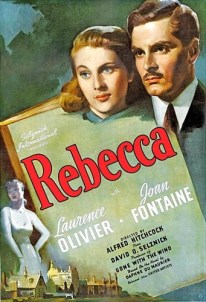
RebeccaI must confess that I don’t think I’ve come to Rebecca under the best circumstances for judging it as a film in its own right. As with last week’s Great Expectations, Rebecca is on my current University module, which means I arrive at it having just read both Daphne du Maurier’s original novel and, the afternoon before viewing, a detailed and very interesting account of the film’s genesis and production from Hitchcock and Selznick: The Rich and Strange Collaboration of Alfred Hitchcock and David O. Selznick in Hollywood (nothing like a snappy title, eh?) by Leonard J. Leff. Such reading conspires to lead me into direct comparisons with the novel (which, as with most adaptations, are ultimately unfavourable due to things having to be cut), as well as a preoccupation with what was going on during production.
But, trying to put such distracting things aside, Rebecca has a great many good points. The cast, for one thing, are perfect. There were serious doubts about Joan Fontaine as the lead, but she is spot-on as the shy, almost childish, Mrs de Winter. Laurence Olivier is equally effective as Maxim, and Judith Anderson’s Mrs Danvers is suitably scary, if significantly younger than I imagined. The production’s technical aspects are also highly admirable: while the early Monte Carlo scenes may be nothing especially exciting, the plot whizzes past and we soon find ourselves at the infamous Manderley, all large halls, fog-filled grounds, dramatic lighting and big camera moves. Especially of note is Maxim’s confession — a long chunk of dialogue in the novel, it would have been all too easy to just use a flashback, but Hitchcock instead employs a camera move across the empty room to suggest the narrated action.

Further comparisons with the novel are inevitable, of course. The film skips nothing of importance, condensing events effectively so that the plot moves at a decent pace. Some events, such as the fancy dress ball and following ship wreck, are even made more dramatic by combining them. Some choices are thoroughly bizarre though: the novel is well known for its first person narrative, something the film attempts to retain by featuring Mrs de Winter in every scene… until the end when, in a deviation from the novel, she remains at Manderley while we follow Maxim and co. to London for some final twists. This does lead to a dramatic reunion upon Maxim’s return to Manderley, but I’m not convinced such a brief moment was worth the modifications.

As expected, viewing in such close proximity to the novel also forces comparisons that aren’t especially warranted — for example, the film loses much of the characterisation of Mrs de Winter by unsurprisingly finding no way to adapt her frequent flights of fancy and imagination. But then, one can always read the novel for those things (and I’d recommend it — get past the famous but dull opening and it often rattles along), and so, judged purely on its own merits, there is a considerable amount to recommend in Rebecca.

5 out of 5

Atonement (2007)

2008 #7
Joe Wright | 118 mins | DVD | 15 / R

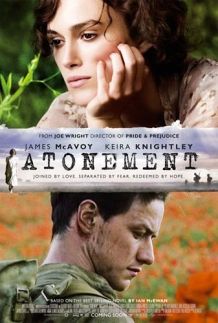
Atonement“The Most Nominated Film of the Year” proudly proclaims a sticker on the cover of Atonement’s newly released DVD. Well, not quite: according to IMDb, Atonement stands at 68 nominations while No Country For Old Men has made it to a whopping 108! Nonetheless, it’s received a near ridiculous amount of acclaim on its way to awards season, and now, having missed it at the cinema, I can finally offer my opinion, just before it does its best to sweep the board at tomorrow’s BAFTAs.

There are certainly a lot of things in Atonement that definitely warrant their nominations, and in many cases the award itself would not be badly placed either. James McAvoy gives a strong lead performance (he is, of course, up for Best Actor at the BAFTAs) and even more astounding is 13-year-old Saoirse Ronan as Briony, wise beyond her years as the over-imaginative girl who causes so much misery. In many ways she’s the lead character, but as she shares the role with two other, older actresses, it’s no surprise she’s up for Best Supporting Actress — she probably stands more of a chance there anyway. She’s certainly one to watch, and can next be seen in Peter Jackson’s adaptation of The Lovely Bones, again as a leading character who’ll probably be designated supporting status because she’s so young. Keira Knightley’s performance, which has earned her a Best Actress nod, is certainly good, but if she wins it’ll be the strength of the film as a whole that carries her through against such tough competition. I should also mention the ever-excellent Benedict Cumberbatch, in a role too small to receive much recognition, yet central to the plot and well played.

Elsewhere at the BAFTAs, Atonement’s up for a slew of awards I’m not especially qualified to comment on in depth: production design, costume design, make-up & hair, sound, editing… Suffice to say the film looks luscious all round. The cinematography is certainly beautiful, capturing the lazy summer days of 1935 equally as well as the tumultuous wartime vistas. Arguably the stand-out sequence in this respect is the much heralded five-minute shot of the beach at Dunkirk. It’s perhaps over-hyped by this point but is still an impressive achievement, if not in the camerawork itself then in the staging of so many consecutive set pieces without a cut.

With all this considered, Joe Wright is a strong contender for Best Director, and also Christopher Hampton for Best Adapted Screenplay. The story jumps back and forth in time, occasionally to slight confusion but always clear enough to follow. The languid first half never drags, and the second half never feels weak despite the essential mystery already being solved. I won’t give away too much here, but the ending is also effectively pulled off, and the final twists feel more natural than tricksy. I haven’t read the novel so can’t compare it to that, but by all accounts it’s a very faithful adaptation. The only thing that really bothered me was that the dates didn’t seem to add up — apparently, World War Two had begun three-and-a-half years after the summer of 1935 (more like four-and-a-bit). A couple of other dates are unclear too, but that strikes me as the main one.

To digress to general BAFTA speculation for a bit (as if I haven’t already), for the directing win, Wright has to face (amongst others) last year’s winner, Paul Greengrass, though as (to my mind) United 93 was a stronger film than The Bourne Ultimatum, I don’t see him winning it again. In both of those awards it’s up against strong Oscar favourites No Country For Old Men and There Will Be Blood — when we’ve got our own film to praise, I’m not sure they’ll be able to stave off Atonement too much. The same goes for Best Film. But then there’s always Best British Film. In theory, if Atonement was good enough to take Best Film then it would take this too, but that’s often not the way — in effect, it’s a chance to reward two different movies. I can’t see Eastern Promises winning, but This is England, Control and The Bourne Ultimatum are all reasonable alternatives. If Atonement wins British Film I won’t be expecting it to go on to get Best Film as well. Of course, you can never be sure.

I appreciate this review has (quite deliberately) focused on Atonement’s BAFTA chances as much as its own merits, but hopefully that has still illuminated my thoughts on the film. It’s a very strong effort from all involved, with an unusually structured but no less engaging plot, beautiful cinematography, nice direction and admirable performances. All round, it’s just about enough to warrant 2008’s second

5 out of 5

Dark City (1998)

2008 #2
Alex Proyas | 97 mins | DVD | 15 / R

Reposted today in memory of the great Roger Ebert, this was a film he championed and, as you’ll soon see, I adored.

Dark CityA little while ago I wrote about not falling in love with new films any more. Well, put bluntly, here’s one.

Dark City is probably the most underrated film I’ve ever seen. It is, to my mind, absolutely brilliant. It’s an intelligent and engaging neo-noir thriller with wonderful sci-fi twists. The imagery is fantastic — the film is beautifully designed and shot in a wonderfully stylised and highly effective manner. The sets and effects are breathtaking — not showy like so many blockbusters, but utterly effective and impressive. The script and story are complex (though never too much) and interesting, allowing you to piece together the mystery of just what is going on. To my mind, it’s much more effective than the whole “what is the real world” thing of The Matrix.

Incidentally, on that subject, if you’ve seen all of that particular trilogy you may find some bits of Dark City eerily familiar — to say which would spoil things, but many are so obvious you don’t have to be a film buff to spot them. Either both universes are based on similar philosophical ideas, or the Wachowskis just ripped this off (in case you hadn’t noticed, it predates The Matrix by a year, and many of the most recognisable elements are in the sequels anyway). Considering there hasn’t been a lawsuit (to my knowledge), I’ll guess it’s the former. But Dark City does it all better: there are no rambling, incomprehensible speeches and it doesn’t batter you around the head with philosophical claptrap when all you want is the story to move forward.

The film’s single major flaw is the studio-imposed opening narration, which gives away far too many plot twists — honest to God, if you ever watch this, mute it during the New Line logo and don’t turn the sound back on til the first close-up of Kiefer Sutherland’s fob watch. If you don’t, you’ll find most of the mystery of the plot ruined, as this narration shockingly gives away most of the answers. (There are rumours of a director’s cut, 15 minutes longer and without that narration, slated for release back in 2006. Maybe this year it’ll turn up as a “10th Anniversary Edition”.)

I could witter on for pages about how much I’ve fallen for Dark City. It’s a superb movie, massively underrated, that I hope I haven’t over-hyped for any reader who wants to seek it out. But please, if you do, heed my warning about muting the opening narration — it really is worth it.

5 out of 5

Dark City placed 3rd on my list of The Ten Best Films I Saw For the First Time in 2008, which can be read in full here.