2011 #16a
David Fincher | 139 mins | Blu-ray | 18 / R
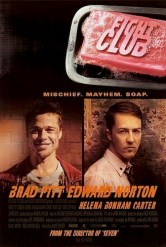
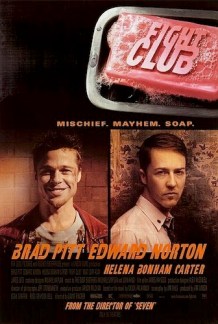 I used to have a friend who loved all kinds of action movies and rap movies and other kinds of violence-obsessed forms of entertainment. He once tried to watch Fight Club, in the wake of the praise poured upon it and no doubt interested in the visceral thrill of the fighting element, but got bored about halfway through and turned it off. He was not impressed. Please note that halfway through is certainly after the titular club, and all its associated antics, begins.
I start with this story because I’m now going to pick on Roger Ebert’s 1999 review of Fight Club. I don’t know if his opinion has changed in the intervening decade — a decade which has seen Fincher’s adaptation of Chuck Palahnuik’s novel quickly canonised as a generation-defining modern classic — but we’ll take his review as an example of all the critical ones (the reasonably critical ones, anyway — unreasonable critics are impossible to argue against after all), because he’s respected and because I can’t be bothered to trawl through too much more of the big pile of reviews Rotten Tomatoes offers up. But more so, actually, because I’d be here forever batting away criticism after criticism if I did.
Incidentally, the film has there an 81% approval rating. This is perhaps negated by the fact it includes more recent reviews — some are of the Blu-ray, for instance — but a debate about whether it should be an archive of original-release critical opinions or of all-time critical opinions is for somewhere else. My point is, critics who dislike Fight Club are in the minority (29 ‘rotten’ reviews vs 122 ‘fresh’ ones), so it might just be a little cruel to go picking on them all. Though rubbish like “Fight Club undermines any seriousness it might have harboured with an avalanche of smirky cynicism designed to flatter the hipper-than-thou fantasies of adolescent moviegoers,” doesn’t so much need rebuttal as offering of some literature to the reviewer. Plus it comes from a Christian magazine/website so it’d be a bit like picking on a kid with learning disabilities.
So, Ebert.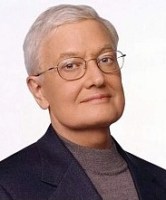
Of course, Fight Club itself does not advocate Durden’s philosophy. It is a warning against it, I guess
At least he starts here. To miss that would be… well, I’ll return to that point later. On the other hand, he’s surely using it to preemptively cut-off criticism of his criticism — Ebert is adept at predicting ways people might defend a movie and telling them they were wrong in advance, as we have seen.
Although sophisticates will be able to rationalize the movie as an argument against the behavior it shows, my guess is that audience will like the behavior but not the argument. Certainly they’ll buy tickets because they can see Pitt and Norton pounding on each other; a lot more people will leave this movie and get in fights than will leave it discussing Tyler Durden’s moral philosophy.
…whatever Fincher thinks the message is, that’s not what most audience members will get.
This is the primary reason I’ve chosen Ebert’s review to pick on, and it was this paragraph that led to my opening one. My guess is, the kind of person liable to buy in to Tyler’s moral philosophy and engage in similar fights will get bored by the movie and go watch something that’s more straight-up action (or just go get in a fight, of course). To say that only “sophisticates” will be able to comprehend the points the film is actually making does a disservice to most viewers. Now, I’m not going to be one of the first to jump to the defence of the great unwashed — when programmes like The X Factor rule our TV schedules it’s quite clear their cultural taste is highly questionable — but I don’t think you have to be exceptionally gifted to get what Fight Club’s driving at. 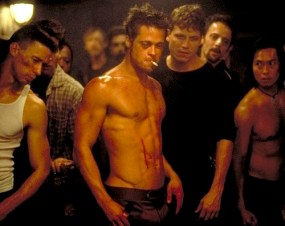 Perhaps I’m coming at it from too privileged a background? I don’t know. But I still don’t believe people would be so easily led as Ebert implies; and those that might be probably got bored and switched off.
Maybe at the time it was a genuine fear that Fight Club would inspire violence (a different review compares the potential effect to A Clockwork Orange’s over here), but history has proven it near groundless. In over a decade since its release, there have been no more than a handful of incidents one might directly and solely attribute to Fight Club’s influence.
And just maybe, it was already covering the thoughts of a generation — rather than being the spark that set them off, it was reflecting back a mentality that already existed and saying, “look, don’t go this far with that thought”. It’s not groundless to think that: Palahniuk interviewed young white-collar workers while writing the novel and widely found opinions which he worked into the novel, about the influence of a lack of father figures and the resentment of the lifestyles advertising promoted. All of this is carried over into the film.
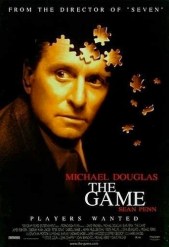
In many ways, it’s like Fincher’s movie The Game… That film was also about a testing process in which a man drowning in capitalism (Michael Douglas) has the rug of his life pulled out from under him and has to learn to fight for survival. I admired The Game much more than Fight Club because it was really about its theme
Hm.
For better or worse, I think Fight Club is far more tied into its themes than The Game is. Fincher’s earlier film, as I discussed yesterday, is a well-made and entertaining thriller, and it does have a similar thematic basis to Fight Club — Douglas’ character is effectively stripped of his lifestyle to show how hollow it is and what he’s lacking as a human being. That just underscores the action, however; it adds something to the film, certainly, but there’s nothing there to lead viewers to “leave the movie… discussing [its] moral philosophy”. Fight Club, on the other hand, is more forward about its thematic points. Both the Narrator and Tyler spout philosophical tidbits at various points, and their differing reactions to the path they take considers this too. It still works as a story — it isn’t just facilitating an essay on the subjects of free will and consumerism — but it’s more present, and presents more to consider, and perhaps discuss, than The Game does.
Later, the movie takes still another turn. A lot of recent films seem unsatisfied unless they can add final scenes that redefine the reality of everything that has gone before; call it the Keyser Soze syndrome.
…the third [act] is trickery
Ah, the twist.
Despite what Ebert implies, Fight Club’s twist works. It makes sense. “Sense” in the sense that the characters are mentally ill and we’ve been let into their experience — quite literally, an unreliable Narrator — but that fits. Clues are littered throughout. You can argue they’re not fundamental to the story — most are lines or asides that hint at it — but I don’t think it’s a nonsensical turn of events. In fact, one could argue that it contains perhaps the film’s biggest point: beneath the veneer of consumer-focused office-working modern life, every man has a Tyler Durden who wants to put society to rights. The question becomes, should he be let out; 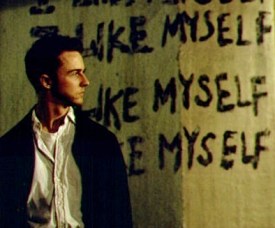 Fight Club explores what might happen if he were, but leaves it up to the viewer to decide if it turned out for the best (while strongly erring, despite what Ebert suggests, to the side of “no”).
The twist also calls to mind The Game again. Whereas knowing the end result of that film’s twist (or twists, really) can scupper it after only another viewing or two, Fight Club doesn’t suffer in the slightest from the revelation that… well, y’know (and if you don’t, that’s why I’ve not said it). You can watch it again and pick up the clues and see how it works — and, as I said, it does — but you can also still enjoy the film, its story and its ideas without the need for the twist to remain a surprise. A bit like Se7en, I suppose.
Another point that interests me here is the audience’s reaction to a filmmaker who uses twists. As we’ve seen, Fincher produced three films in a row that had considerable twist endings; two of them often number in lists of the best movie twists ever. So how is it that he didn’t gain a particular reputation for twist endings, whereas M. Night Shyamalan gained one after… well, one film. I’m not complaining about this — the constant need to provide a shocking last-minute rug-pull has gone on to scupper Shyamalan’s career — but the difference of reaction/public perception is intriguing. I’m sure there are reasons — the sheer size of The Sixth Sense’s twist relative to those in Fincher’s films (it’s only Fight Club’s, his third such film, that changes everything we’ve seen in the same way); the way Shyamalan appeared to court the reputation; and so on.
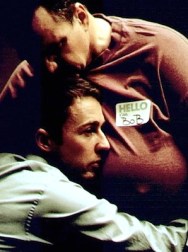
As a means of dealing with his pain, [the Narrator] seeks out 12-step meetings, where he can hug those less fortunate than himself and find catharsis in their suffering. It is not without irony that the first meeting he attends is for post-surgical victims of testicular cancer, since the whole movie is about guys afraid of losing their cojones.
That, however, is some reasonable analysis. I liked this.
 To round off this defence of Fight Club, let’s call up the BBFC (this is the point I said I’d return to). You may remember they cut four seconds of violence from the film (reinstated in 2007. Incidentally, the MPAA had no problem whatsoever with the violence but questioned some of the sex, such as Tyler being seen wearing a rubber glove. American values regarding sex/violence on film and TV are seriously questionable.) In 1999, when asked to ban the film for glamourising and encouraging the kind of behaviour it contains, the BBFC refused, and in no uncertain terms:
The film as a whole is — quite clearly — critical and sharply parodic of the amateur fascism which in part it portrays. Its central theme of male machismo (and the anti-social behaviour that flows from it) is emphatically rejected by the central character in the concluding reels.
Maybe it’s just me, but such a definitive statement — underlined by the relatively informal addition of “quite clearly” — from an authoritative body, one that is (theoretically) objective about a film’s quality in lieu of deciding which age groups its content is suitable for, feels unusual to me; and, by extension, worth taking into consideration. Not as the be-all-and-end-all of the debate, of course, but if the BBFC are prepared to dismiss such criticism of the film with a “quite clearly” — a “if you missed it, you’re dim” kind of phrase — then you have to think it’s pretty obvious.
A couple of stray points before I go:
 If you’ve not read it, know that the film keeps a lot of Palahnuik’s novel. The narration often takes it verbatim. With the exception of the ending — changed, for the better — it’s a remarkably faithful adaptation.
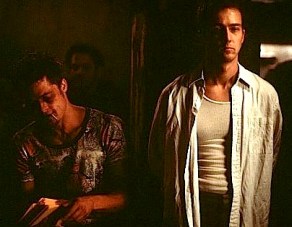
Fincher’s films often look great, but Fight Club is surely the most visually inventive. A list of exciting spectacles could be endless, but for some: the title sequence, pulling back from the fear centre of the brain, through the brain, and down the barrel of a gun in extreme close-up; the IKEA catalogue condo shot; big sweeping flybys of tiny things — the contents of a trash can, kitchen appliances, bomb wiring; the meditation cave bits; flash frames of Tyler; the “let me tell you a bit about Tyler Durden” sequence, with the fourth-wall-obliterating to-camera narration and the interaction between ‘flashback’ & narrator; the crazy mutating sex scene… To top it off, the ‘regular’ cinematography is grounded in Fincher’s trademark darkness, as if every shot was conceived as just black and he added only what light was necessary.
And a pet peeve: Look at the end credits. See how Ed Norton’s character is credited as Jack? Oh, that’s right — he isn’t. He doesn’t have a name. The film makes a point of drawing our attention to this point: early on, Marla asks him his name; there is no answer. And that’s because his name is (shh, whisper it) (…oh yes, I’m keeping this spoiler-free). There are counter arguments to that being his real name (his colleagues never call him it, only those who met him… after), but that’s beside the point. Stop calling him Jack. (I believe I read somewhere that, on the relevant DVD commentary, Ed Norton says he calls the character Jack. Not good enough reasoning for me.)
That’ll do, then.
At one point consensus seemed to have it that Fight Club was easily Fincher’s best movie, a generation-defining statement, “the first great film of the 21st Century” despite being released in 1999 (I can never remember who originated that quote). I don’t know if times have changed that as a widespread opinion, particularly with the acclaim The Social Network has received. That’s been called a generation-defining movie too, actually — two in as many decades; nice work. But I digress; such talk is for a few days’ time.
I’ve always preferred Se7en myself. I still do. But Fight Club is nonetheless an exceptional film.
I watched Fight Club as part of a David Fincher Week. Read my thoughts on all his films to date here.

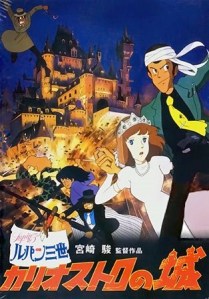 The Castle of Cagliostro, the second animated big-screen spin-off from manga-inspired anime TV series Lupin III, was the first film directed by Hayao Miyazaki, who even non-anime fans have heard of these days thanks to Spirited Away’s Oscar win (eight years ago now!) and Pixar’s recent championing of him.
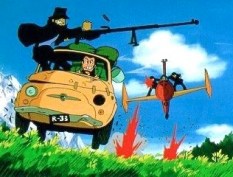 As I mentioned, this is the second spin-off film from a TV series, and at times it does feel like it: characters turn up under the impression the audience already knows who they are and what their connection is to the others. It’s not a major problem — most are introduced well enough within the context of the film that it can still be easily followed — but it’s there.
 Um, where was I? Oh yes: Indiana Jones; Roger Moore-era James Bond — it’s that kind of tone, more or less, and if you enjoy that kind of film then I don’t see why you wouldn’t enjoy this. Unless you think cartoons are for kiddies only (in which case, see the long sentence at the end of the last paragraph).
 Roman Holiday is the kind of film where its list of achievements don’t quite precede it — Best Picture nominee (it lost to
 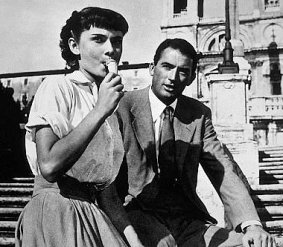 the Princess as they take her on a day messing about in Rome.
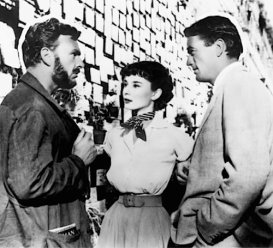 If, instead, you remember that he’s Fundamentally Kind, it might be less troubling that he has a secret plan most of the time.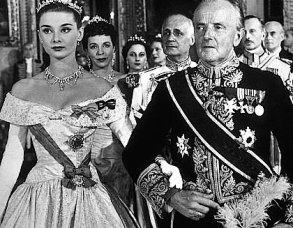
 Oskar is a 12-year-old loner in Sweden in 1982, spending his days at school being bullied and filling his evenings with fantasies of revenge. Then a girl, Eli, and her father move in next door and it looks like he might finally make a friend.
 For instance, when the usual skills do crop up, they’re presented in a very grounded way — any CGI required is used subtly and incredibly effectively — or kept off screen. They’re at the best when used to slightly emphasise Eli’s weirdness — the way she drops ever so slightly slower than is natural from the climbing frame when she first meets Oskar, or to shape and manipulate her face almost imperceptibly at times.
 The story’s central relationships — mainly, Eli/Oskar and Eli/Håkan, he being the ‘dad’ figure who helps Eli survive — can be read various ways. The author/screenwriter, John Ajvide Lindqvist, has one interpretation — indeed, based on what I’ve read, the novel is quite clear on these points — but the film leaves many facts ambiguous. Is Håkan related to Eli? Does he love her? In what way? Does she love him? Does she even like him? Is he just a facilitator? Was he once in Oskar’s position? If he was, is she just manipulating Oskar? Or is it really love? Or is it just friendship? The joy of such well-placed ambiguities in a story is that each viewer can bring their own interpretation, without anyone being clearly right or wrong and without undermining the quality of the story being told. I think I know what I think; but, just as much, I enjoy the fact there are numerous possibilities. (Of course, equally valid is the argument that there are no ambiguities because most if not all have been cleared up Lindqvist and/or Alfredson in interviews. But where’s the fun in that?)
 Though most of Let the Right One In’s irregular take on vampires seems genuinely unique, one of those unusual elements — a 12-year-old girl being a vampire — immediately draws comparison to
  if they’d filmed some of the stuff in the novel, the filmmakers would’ve gone to prison — but also about refocussing the story to be a two-hour film instead of a novel. I’m not sure, therefore, how faithful the climax is, but it’s a sequence that seems made for the screen. I shan’t say much more on this point, just in case you’ve not seen the film and still read this far (tsk tsk), but it seems having a vampire for a best friend is a great way to deal with bullies.
 I like a good swashbuckler. I don’t know exactly what it is about sword fights, but they’re probably my most favourite kind of action sequence. The 1973 Three Musketeers, then, is a film I’m slightly amazed I’ve not seen before. Especially as I absolutely loved it.
 Thanks to this most of the fights aren’t strictly sword fights, I suppose. Indeed, Oliver Reed seems to dispense with his blade at the earliest opportunity and turn instead to sticks, wet towels, whatever else happens to be at hand. It lends a certain kind of organised chaos to proceedings; the kind that elevates a technically proficient duel into a funny, exciting, memorable segment of cinema. I would list standouts, but instead may I recommend you watch the film and, every time an action sequence starts, count it as one I mentioned. But particularly the one in the laundry and d’Artagnan and Rochefort’s lightbox-lit nighttime duel. And also— Now, this is why I said I wasn’t going to list any.
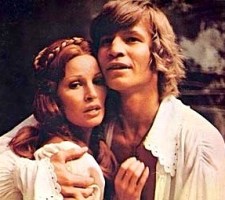 Constance and Faye Dunaway as the conniving Milady de Winter. York earns his place as the lead amongst such company, though, making a d’Artagnan who is by turns athletic, clumsy, hot-headed, loyal, and funny. As I said, everyone pitches the lightness just right, but York perhaps most of all — he doesn’t send up the youngest musketeer, doesn’t make him a pun-dispensing action hero, but finds all the humour in his actions and dialogue.
 It also means the film ends with a sort of “Next Time” trailer, which feels very bizarre indeed, but is also a tantalising glimpse of what’s still to come.
 One thing this week has achieved is re-confirming that Fincher is one of my favourite directors. Another is to remind me that I’ve not seen a single one of his films at the cinema.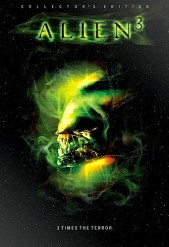


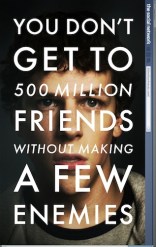
 Fresh from winning three BAFTAs (out of six nominations), the Aaron Sorkin-written David Fincher-directed telling of the birth of Facebook arrives on DVD and Blu-ray in the UK today. Notice that Sorkin and Fincher have equal-sized billing on
 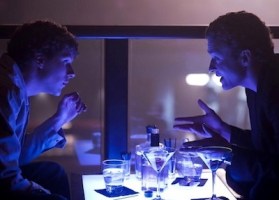 Conversely, look at all the film’s conversations. Let’s draw on one that’s discussed in the making-of material, the scene between Mark Zuckerberg and Sean Parker in the club: as Fincher says, he could’ve had a Steadicam endlessly circling them or something similar to make it seem Fast and Hip, but in reality you need to see the conversation, and especially Mark’s reactions, so instead it’s just a good old fashioned shot-reverse-shot. For all his visual prowess, it’s understanding this need for simplicity and (g)old standard techniques when appropriate that Fincher has had a handle on throughout his career.
 Also, that it’s going to be funny and exciting. That style colours the film: fast talk, complex talk, but funny. As people admit in the special features, this is a very dialogue-driven film. Don’t misunderstand me, though: the dialogue scenes are not one-note by any means — there are slow scenes, and even scenes without any dialogue — but anyone anticipating the full implications of “Screenplay by Aaron Sorkin” will not be disappointed.
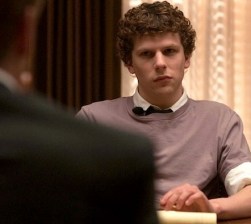
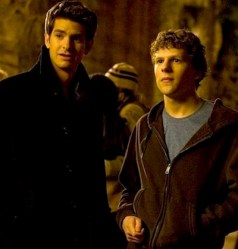 Nominated but unvictorious were stars Jesse Eisenberg and Andrew Garfield, for Best Actor and Best Supporting Actor respectively. They’re not the only ones deserving praise though, because every performance is bang on. Eisenberg manages the enviable feat of making Mark a plausible genius, an entertaining friend and an absolute bastard, not in different scenes but, often, all within the same line of dialogue. There are lines that made me laugh out loud while at the same time thinking “what a [four-letter name of choice]”. That’s Sorkin’s writing too, of course, but Eisenberg nails it.
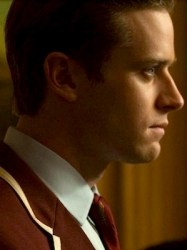 Then there’s Justin Timberlake. I can understand why people would be wary of such casting, and playing the bad boy/playboy part of Napster creator — and destructor — Sean Parker might not seem too much of a stretch. Actually, there are moments that require a little more than that, and Timberlake’s up to the task. Armie Hammer tackles the dual role of the Winklevoss twins. You can’t tell which is which, beyond that in any given scene one will be hotheaded and one calmer. I expect it’s always the same one that’s whichever, but as they both look exactly the same…
 it’s set to an addictive electronic rendition of In the Hall of the Mountain King, and though the whole sequence is a showpiece, that’s as much thanks to the music as the visuals. These are just two specific examples — throughout, the music excels.
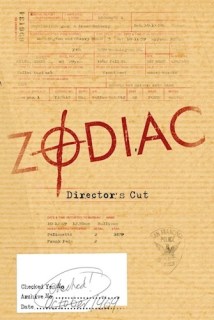 How time flies — I’ve been meaning to re-watch Zodiac ever since I
 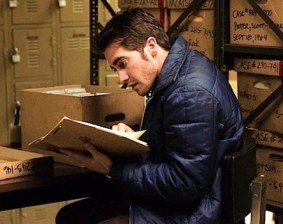 As the changes have little impact on the film’s fundamental quality, the points in
 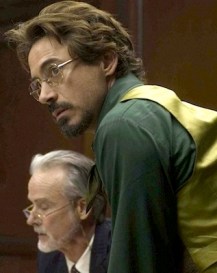 but the sheer weight of evidence the other way seems to leave little room for doubt. More so, then, is that the murders are done with before the halfway mark. That’s because it’s still following the story of the investigation, true, but a lesser filmmaker could have weighted it differently, rushing through Graysmith’s later enquiries in a speedy third act. Instead, Fincher’s focus throughout is on the people looking into the crime, and it’s as much the tale of their obsession — and what it takes to break their obsession, be it weariness or pushing through ’til the final answer — as it is the tale of a serial killer.
 and place-and-time subtitles too, but hey, sometimes you need specificity.
 I usually say that Se7en is my favourite film.
 Black seems to be its default position — everything else is cut out of the darkness with as little light as possible. Often backgrounds and locations are better lit than foregrounds or actors, making the viewer focus on silhouettes with minimal light offering splashes of detail. Even the scenes that occur at daytime (most, anyway) do so in the middle of ferocious, ceaseless rain that ensures it never gets too bright.
 all but one of
 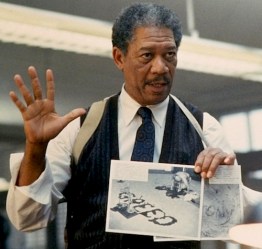 Mills delivers his riposte with greater hyperbole — of course, because that’s the character — perhaps bedded in a form of naivety and idealism, ending with a repetitious “I do not agree. I do not.” Then we see Freeman’s face, completely static, but you can read in it everything you need to — his anger at Mills for making him realise that it’s all a lie he’s been telling himself, and anger at himself for believing the lie. That’s one scene; Freeman is incredible throughout.
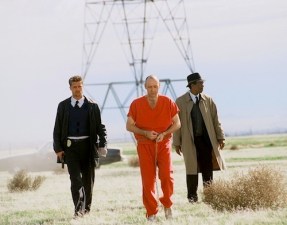 This is where liking the characters pays too, because we are on Somerset’s side and we’re on Mills’ side and we agree with both and disagree with both and don’t necessarily know who’s right or what to do or what we would do. I can spend the whole film anticipating this scene, knowing exactly what will happen in it, how great a piece of filmmaking it will be, yet it still makes my hair stand on end.
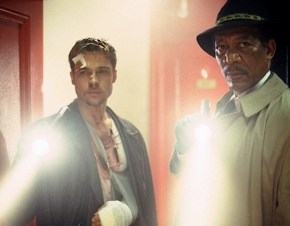 The quality of a crime thriller is often so tied to its mystery that the film can only sustain so many viewings — sometimes, only one — before you know it too well. I have seen Se7en at least seven times now, which for me is a lot — a helluva lot, even — and yet I still get something from it every time. That’s a rarity, that’s a reason to love it, and that is why it may well be my favourite film.
 I saw the Richard Attenborough-starring
  Which, considering the whole story is about a man who thinks he’s Santa Claus, and whether or not he really is, is an impressively underhand piece of marketing.
 100Films.co.uk