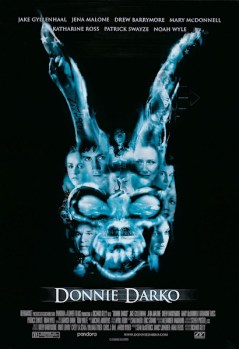
Donnie Darko (2001)

100 Films’ 100 Favourites #26

Twenty-eight days, six hours,
forty-two minutes, twelve seconds…
that is when the world will end.

Country: USA
Language: English
Runtime: 113 minutes | 134 minutes (director’s cut)
BBFC: 15
MPAA: R

Original Release: 26th October 2001
UK Release: 25th October 2002
First Seen: cinema, November 2002

Stars
Jake Gyllenhaal (Brokeback Mountain, Prince of Persia: The Sands of Time)
Jena Malone (Saved!, Batman v Superman: Dawn of Justice – Ultimate Edition)
Noah Wyle (A Few Good Men, The World Made Straight)
Drew Barrymore (Never Been Kissed, 50 First Dates)
Patrick Swayze (Dirty Dancing, Ghost)

Director
Richard Kelly (Southland Tales, The Box)

Screenwriter
Richard Kelly (Domino, Southland Tales)

The Story
Troubled teen Donnie Darko is saved from a jet engine falling on his bedroom by a vision of a grotesque rabbit that tells him the world will end in less than a month. Over the coming weeks, more strange and possibly supernatural events occur, and it all gets quite complicated and stuff.

Our Hero
“Donnie Darko. What the hell kind of name is that? It’s like some sort of superhero or something.” “What makes you think I’m not?” The eponymous teenager is a troubled young man, possibly suffering from paranoid schizophrenia, who begins to perform acts under the influence of his imaginary rabbit friend.

Our Villains
Who’s the greatest evil: Frank, the six-foot imaginary rabbit who proclaims the world is going to end; Jim Cunningham, the motivational speaker with dark secrets; or moral-crusading gym teacher Kitty Farmer?

Best Supporting Character
New girl in town Gretchen may be the only person who ‘gets’ Donnie. Bonus points to Kelly for writing a geek-fantasy girlfriend character who doesn’t conform to the Manic Pixie Dream Girl stereotype.

Memorable Quote
Donnie: “Why are you wearing that stupid bunny suit?”
Frank: “Why are you wearing that stupid man suit?”

Quote Most Likely To Be Used in Everyday Conversation
“Sometimes I doubt your commitment to Sparkle Motion.” — Kitty Farmer

Memorable Scene
Donnie wakes up in the middle of nowhere at dawn, in his pyjamas but with his bike discarded nearby. As he rides home, we see snapshots of his small town and his family, all set to The Killing Moon by Echo and the Bunnymen.

Memorable Music
The film makes strong use of contemporary pop music. It all seems to sit perfectly, which is a little ironic as a good number of tracks were changed because they couldn’t afford the rights on such a low budget. The director’s cut restores some of the original choices, which was a mistake. The film’s soundtrack composer, Michael Andrews, and his chum Gary Jules recorded a cover of Tears for Fears’ Mad World for the film, which wound up being the coveted UK Christmas number one for 2003 (beating the likes of The Darkness’ Christmas Time (Don’t Let the Bells End), and Bill Nighy’s Christmas is All Around from Love Actually).

Next time…
Whoever owns the rights attempted to cash in with sequel S. Darko, about Donnie’s younger sister. Richard Kelly wasn’t involved at all. It was not well received.

Awards
Toronto Film Critics Association Awards special citation for “the best film not to receive a proper theatrical release in Canada”.

What the Critics Said
“has a texture and tang all its own, despite its remarkable mixture of genres and expressive modes — horror, romance, science fiction, teen flicks, and Robert Bresson meets Generation Y, to name a few. There’s also a dry realism in its evocation of suburban life, which abrades nicely against the bouts of slow- and fast-motion photography that jiggle time and make the ordinary shiver. Kelly, who also wrote the script, has a great ear for family dinner-table arguments about politics, teenage debates about the sexual habits of Smurfs, and the quotidian absurdities of small-town colloquy. Local busybody Kitty Farmer’s near-hysterical complaint to Donnie’s mother, “Sometimes I doubt your commitment to Sparkle Motion” (the name of their daughters’ dance troupe), is for some unfathomable reason my favourite line of dialogue this year.” — Leslie Felperin, Sight & Sound

Score: 85%

What the American Critics Said About the Director’s Cut
“First-time writer-director Richard Kelly’s breathtakingly ambitious Donnie Darko was one of the best pictures released in 2001. Now that it has returned in a 20-minute longer — and richer — director’s cut, it seems sure to be ranked as one of the key American films of the decade.” — Kevin Thomas, Los Angeles Times

What the British Critics Said About the Director’s Cut
“If it’s your first viewing, you should still be wowed by an astounding masterpiece. But this is undoubtedly the lesser of the two cuts, and since you have the choice, you should stick with version one. […] All this director has done is cut a star off his five-star debut.” — William Thomas, Empire

Score: 91%

What the Public Say
“Maybe Richard Kelly’s fate is to be the cult circuit’s Michael Cimino — forever admired for one great film amid subsequent missteps, including a director’s cut of the same movie. Kelly has yet to match the mysterious mood or magnitude of his filmmaking debut […] a collision of time-travel sci-fi, commentary on ’80s Reaganomics malaise and teen angst that’s simultaneously witty and poignant. Non-Darkolytes should start with the enigmatic theatrical cut and proceed further if curious.” — Nick Rogers, The Film Yap

Verdict

When it finally made its way to UK shores, about a year after its initial US release, Donnie Darko was something of a hit — it made more money here than Stateside, in fact. I know several people who stumbled upon it “just because it was showing”. Conversely, I made a special trip to see it at a distant cinema at an inconvenient hour, having heard about it from US reviews. I would’ve been 16, which is probably the best kind of age to become enamoured of its misunderstood teen hero and its complicated, semi-inexplicable sci-fi story. I haven’t actually watched it for years, and never made time for the divisive director’s cut, but (whatever I’d think of it now) it remains a key touchstone in my teenage film experience.

#27 will be…

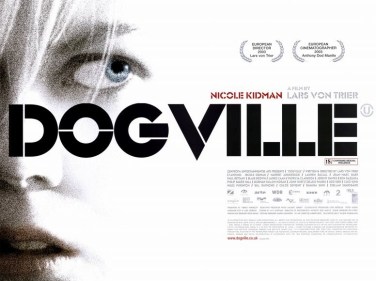
Dogville (2003)

100 Films’ 100 Favourites #25

A quiet little town not far from here.

Full Title: The film “Dogville” as told in nine chapters and a prologue

Country: Denmark, Sweden, UK, France, Germany & the Netherlands
Language: English
Runtime: 178 minutes
BBFC: 15
MPAA: R

Original Release: 21st May 2003 (Belgium, Switzerland & France)
UK Release: 13th February 2004
First Seen: DVD, c.2005

Stars
Nicole Kidman (Moulin Rouge!, Stoker)
Paul Bettany (A Beautiful Mind, Priest)
Lauren Bacall (The Big Sleep, The Shootist)
Stellan Skarsgård (Insomnia, The Girl with the Dragon Tattoo)
John Hurt (The Tigger Movie, Perfume: The Story of a Murderer)

Director
Lars Von Trier (Breaking the Waves, Antichrist)

Screenwriter
Lars Von Trier (The Idiots, Melancholia)

The Story
On the run from the mob, Grace arrives in the remote town of Dogville. Its residents agree to shelter her in order to prove their community values, though in return she must do chores for them. As the search for the missing woman repeatedly visits the town, the people’s demands for recompense for the risk they are taking intensifies…

Our Hero
Grace is a sweet, desperate young woman, happy to work for the good Christian people of Dogville in payment for their kindness. As her good nature is gradually worn down, she becomes enslaved by them — though it may turn out there’s more to her than meets the eye…

Our Villains
Of course there aren’t any villains in the town of Dogville — everyone’s a morally upstanding citizen.

Best Supporting Character
Not technically a character, but the Narrator is a palpable presence in the film. The material Von Trier has written for him is just the right side of verbose, and John Hurt delivers it with inestimable class.

Memorable Quote
“Whether Grace left Dogville, or on the contrary Dogville had left her — and the world in general — is a question of a more artful nature that few would benefit from by asking, and even fewer by providing an answer. And nor indeed will it be answered here.” — Narrator

Memorable Scene
The scenes that stick in the mind from Dogville — aside from the opening shot I shall discuss next — are either harrowing, spoilersome, or both, and so don’t merit discussion in a format potentially perused by neophytes.

Technical Wizardry
The famous bare set — a black soundstage with chalk markings on the floor to represent the houses, and minimal other features or props — was inspired by the theatre of Bertolt Brecht; as was the film’s plot, so it’s rather apt. The set (or lack thereof) seems like a very “art house” idea, and a distancing one for the viewer, but it’s surprising how quickly you forget and accept it.

Making of
The opening bird’s-eye shot of the town: physically impossible, because the studio’s roof wasn’t high enough, so the final result is actually 156 separate shots stitched together.

Next time…
Supposedly the first part of a trilogy called “USA: Land of Opportunities”. The second part, Manderlay, was released in 2005, starring Bryce Dallas Howard in Kidman’s role. The concluding part, Wasington, seems to have fallen out of Von Trier’s interest.

Awards
Nominated for the Palme d’Or.
Won the Palm Dog.

What the Critics Said
“Von Trier’s detractors – and there are many – will argue that this is nothing more than filmed theatre. […] But Anthony Dod Mantle’s digital video camera isn’t simply documenting a performance. It restlessly and fearlessly intrudes into this place and into these lives. Its close-ups – capturing key emotions as they flicker across the characters’ faces – are vital to describing the moral arc of the story. This is something that can only be achieved cinematically, an intensity that’s impossible to render elsewhere, not even from the front row of a playhouse’s stalls.” — Alan Morrison, Empire

Score: 70%

What the American Critics Said
“what most reviews are discussing is the success or failure of the film as a critique on America. There’s a sense of discussion, not of the themes dissected, but more of whether the film deserved consideration as an anti-American film, and whether it was a bad film because of it. Released in an altogether post-9/11 world, attacking America in any way shape or form, cinematic, politically, or philosophically, constituted an echo of the violence of two or three years before. […] now that we’ve learned to accept critique not as an attack, but for exactly what it is, critique, we can get to the real heart of Dogville, and we can stop nitpicking whether or not it was a deserved attack on American culture, or whether it should be written off as an “anti-American” movie” — Karl Pfeiffer
(That piece goes on to be a very interesting analysis of the film, by-the-way, particularly with regards to it being an allegory for Christianity.)

What the Public Say
“Lars, despite his ever intrusive camera, keeps us at a distance from his characters. This is not a criticism nor do I think this is unintentional. I think he does this to make sure we don’t lose sight of the message he is trying to share with us. He wants us to look at ourselves through these people, not get lost in their drama. The message of Dogville is a pessimistic one: At humanity’s core, we are bad people who will turn on our brother to protect ourselves. Altruism does not exist. Americans are smugly self-righteous. And even those of us who deem ourselves most pure are never above revenge.” — Cineaste

Verdict

It’s no surprise that Lars Von Trier would be responsible for such a provocative, difficult, divisive film — indeed, that’s what all his films are, aren’t they? Whether that works or not is often down to the individual, with each of his films being hailed as masterpieces by some and condemned as drivel by others. Dogville is no different. A three-hour movie that takes place in a black-box theatrical-style environment may sound tough, but engrossing performances and a symbolic storyline with a cathartic ending keep it… not enjoyable, exactly, but fascinating.

#26 will be… 28 days, 6 hours, 42 minutes, 12 seconds from the end.

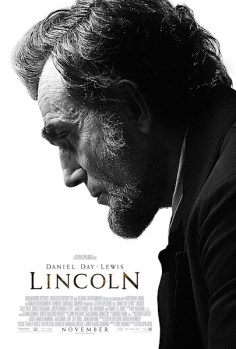
Lincoln (2012)

2016 #62
Steven Spielberg | 151 mins | Blu-ray | 2.40:1 | USA & India / English | 12 / PG-13

Oscar statue2013 Academy Awards
12 nominations — 2 wins

Winner: Best Actor, Best Production Design.
Nominated: Best Picture, Best Supporting Actor, Best Supporting Actress, Best Director, Best Adapted Screenplay, Best Film Editing, Best Cinematography, Best Costume Design, Best Score, Best Sound Mixing.


Daniel Day-Lewis allegedly stars in this account of the final months of President Abraham Lincoln’s life, which might more pertinently be called The 13th Amendment due to where its focus lies. I say “allegedly” because I’m not convinced they didn’t find a way to resurrect Lincoln to appear as himself, then just pretended it was Day-Lewis acting.
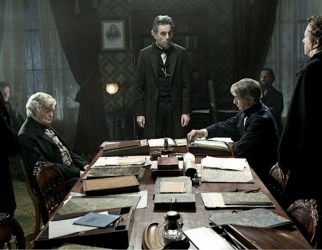
Although this project started life as a traditional biopic of the 16th President of the United States, as director-producer Steven Spielberg developed it over several years, it was eventually whittled down to what we have here. Most reviews and the like describe it as being about the final four months of Lincoln’s life, and in a literal sense that’s true because the last couple of months are covered at the tail-end of the movie. However, it’s really about one month: January 1865.

With the American Civil War not yet over, though clearly in its final stages, and an election recently reaffirming Lincoln’s presidency but bringing changes in the House of Representatives — changes that, importantly, don’t take effect for a few more weeks — the president decides now is the time to push through the unpopular 13th Amendment to the Constitution, which will abolish slavery. He wants it passed because it’s the right thing to do, though there is far from consensus on this point. However, the passing of the amendment would likely bring about the end of the war, which leads some to back it even though they don’t agree with the amendment in and of itself; and the forthcoming changes in the House mean there are a raft of senators soon to be looking for new jobs, whose votes might be bought with the promise of a cushty position in the near future.

If that all sounds very political, it is. I wouldn’t be the first to observe that Lincoln plays like a period version of The West Wing, but it bears repeating because it’s true. If the idea of men standing (and sitting) in rooms debating political manoeuvres — who might be persuaded to vote which way, and how they might be persuaded, and what they will want in return, and what deals need to be struck, and so on and so forth — sounds like it might make for an engrossing movie, then there’s a fair chance Lincoln will be your cup of tea. A not-insignificant proportion of viewers protest that it is boring, however, and while I in no way agree with them, your mileage may vary.
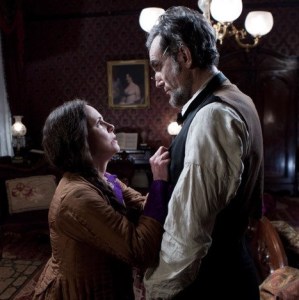
From a filmmaking perspective, this is first-class work. Spielberg shows a more restrained side to his proclivities than in the similarly-themed Amistad, but exhibits perhaps a little more flair than in his next film, Bridge of Spies. Much like that latter movie, his sentimental streak only really manifests itself in one short scene right near the end… though historians who contest the commonly-taught history of Lincoln as an upstanding man (a view this film clearly maintains) may argue the whole film gives in to this aspect of the director’s work. Either way, the film is a visual triumph, its production design award well-earned. Even more so, however, is the work of Spielberg’s regular DP, Janusz Kaminski, whose candle-and-gaslight photography of interiors is breathtakingly good. The whole picture exhibits a richness and a sharpness that, perhaps for the first time, made me wonder if 4K might be a really worthwhile idea after all.

The real meat of the film comes in the performances — not the actual political debate, because we all know how that should go, but the men performing said debate. Of course the title performance dominates the movie, but Day-Lewis does not. As I alluded to at the start, it’s hard to see the actor’s presence in the role — it’s not a performer, it is Abraham Lincoln. Not to do anyone else in the film — or, indeed, any other performance in any film ever — a disservice, but Day-Lewis embodies the President in a way few other actors have ever embodied a role. It’s quite remarkable.

It’s a real testament to the rest of the cast, then, that in the face of this powerhouse performance they all do such sterling work. Sally Field tackles a complex, potentially thankless role with aplomb. The movie is about the titular man, so her scenes are really about illuminating the President’s psyche and so creating the biopic side of the movie (i.e. the reason why it isn’t actually called The 13th Amendment), but that doesn’t mean she doesn’t make Molly a believable human being in her own right. Tommy Lee Jones also stands out as hardline abolitionist Thaddeus Stevens. Stevens doesn’t get on with Lincoln and thinks the 13th Amendment doesn’t go far enough, but will he concede it’s better than nothing in a social climate where many think the opposite? And then there’s James Spader as behind-the-scenes political persuader W.N. Bilbo (yes, like the Hobbit). When he first tumbles onto the screen he looks like a misplaced comedy creation, and he does bring some much needed levity to the film, but in a measured way that doesn’t tip the scales too far. It makes the whole better because of it.

They’re still the tip of the iceberg, however, because in the film’s expansive two-and-a-half-hour running time there’s space for accomplished performances from David Strathairn, Joseph Gordon-Levitt, Hal Holbrook, Jackie Earle Haley, Jared Harris, Lee Pace, Peter McRobbie, David Oyelowo, Adam Driver… I’m just naming them in the order they are in the cast listing. Some of them are only in one scene. I still think I’ve missed some people.

For me, there are few black marks (unfortunate choice of phrase…) to be held against Lincoln. Does it give in to Spielberg’s sentimentality? Yeah, a little — but it’s a long, long way from the worst case of that, and I think you’d be nitpicky (or have a different opinion on history, which, you know, is a matter of opinion) to criticise the film too harshly for that. As to whether it’s boring, that’s entirely a matter of preference. If you think The West Wing is boring, people who write lists of “the greatest TV shows ever” will disagree with you, and you also likely won’t like Lincoln. I like The West Wing, though.

Lincoln is going to be remembered for Daniel Day-Lewis’ performance, and in many respects that’s fine, because (as I’ve said a couple of times now) it is an astonishing piece of acting. Fortunately for the viewer seeking out that performance, there’s an awful lot more to Spielberg’s polished political drama.

5 out of 5

The UK network TV premiere of Lincoln is on Film4 tomorrow at 9pm.

It placed 13th on my list of The 20 Best Films I Saw For the First Time in 2016, which can be read in full here.

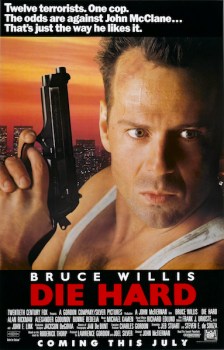
Die Hard (1988)

100 Films’ 100 Favourites #23

Twelve terrorists. One cop.
The odds are against John McClane…
That’s just the way he likes it.

Country: USA
Language: English
Runtime: 132 minutes
BBFC: 18 (1988) | 15 (2007)
MPAA: R

Original Release: 15th July 1988
UK Release: 3rd February 1989
First Seen: DVD, 2003

Stars
Bruce Willis (Twelve Monkeys, The Sixth Sense)
Alan Rickman (Robin Hood: Prince of Thieves, Sense and Sensibility)
Reginald VelJohnson (Turner & Hooch, Die Hard 2)
Bonnie Bedelia (Die Hard 2, Presumed Innocent)

Director
John McTiernan (Predator, The Hunt for Red October)

Screenwriters
Jeb Stuart (Another 48 Hrs., The Fugitive)
Steven E. de Souza (The Running Man, Beverly Hills Cop III)

Based on
Nothing Lasts Forever, a novel by Roderick Thorp.

The Story
While off-duty cop John McClane is visiting his estranged wife at her office Christmas party, a gang of terrorists enter the building and take the guests hostage. McClane avoids capture, making him their only hope of rescue…

Our Hero
One of New York’s finest unfortunately caught in the wrong place at the wrong time… or, as it turns out, the right place at the right time. They’re currently working on an “origin story” movie for cop John McClane, which is daft because Die Hard is his origin story — he may’ve become an action hero in later movies (I wouldn’t know, I still haven’t got beyond the second), but here McClane is just an ordinary cop. Well, a very committed ordinary cop, anyway.

Our Villain
Smart, witty, and thoroughly ruthless, Alan Rickman’s big-screen debut is a flawless turn that defined thriller villains (British-accented terrorists with a secret plan) for at least the next half-decade. No one does it better, though.

Best Supporting Character
McClane’s only real friend, Sgt. Al Powell is a beat cop on the outside who just happens to pick up his signal. Fortunately, he’s much smarter and more helpful than a team of FBI agents. Well, aren’t we all?

Memorable Quote
Hans Gruber: “Do you really think you have a chance against us, Mr. Cowboy?”
John McClane: “Yippee-ki-yay, motherfucker.”

Quote Most Likely To Be Used in Everyday Conversation
See above.

Memorable Scene
As Gruber lectures the collected hostages on how the terrorists have planned for every eventuality, a nearby elevator door pings open. One of the hostages screams, Gruber and co rush over, to find one of their compatriots dead with a message scrawled on his sweatshirt: “Now I have a machine gun, ho-ho-ho.”

Truly Special Effect
When the bomb in the elevator shaft blows out the side of the building, the effect was accomplished by collecting virtually every camera flashbulb of a particularly powerful type and wiring them to the outside of the actual building to simulate the flash, then superimposing a shot of an actual explosive blowing a hole in an all-black miniature of the building.

Making of
The filmmakers struggled to find a way for McClane and Gruber to meet prior to the movie’s climax. The scene in which they do, where Gruber pretends to be one of the hostages, was dreamt up after it was discovered Alan Rickman could do a good American accent.

Previously on…
Die Hard is adapted from a novel, which is a sequel to one called The Detective, which was filmed in 1968 starring Frank Sinatra as the lead cop (called Joe Leland rather than John McClane). When production began on Die Hard, Fox were obligated to offer the lead to Sinatra. Fortunately for them, he turned it down.

Next time…
Lightning struck twice for unlucky John McClane when he got embroiled in another Christmastime terrorist incident in Die Hard 2, aka Die Harder; then Gruber’s brother sought revenge in trilogy-forming Die Hard with a Vengeance. Years later, someone realised there was money to be made, leading to poorly-received cash-in sequels Live Free or Die Hard, aka Die Hard 4.0, and A Good Day to Die Hard. A sixth is in development.

Awards
4 Oscar nominations (Editing, Sound, Sound Effects Editing, Visual Effects — or, to put it another way: Sound, Effects, Editing, Sound Effects Editing)

What the Critics Said
“From its trailer, Die Hard looks like a typical action movie of the ’80s: a sweaty, bare-chested, all-American hero battles swarthy, heavily accented terrorist villains, accompanied by lots of high-tech explosions, vast sheets of breaking glass and enough sophisticated weaponry to account for the Pentagon’s budget overrun. As directed by John McTiernan, it turns out to be something more — the archetypical action movie of the ’80s, the perfection of the form. Sleekly engineered, impeccably staged and shrewdly dosed with humor and sentiment, Die Hard has everything but a personality.” — Dave Kehr, Chicago Tribune

Score: 92%

What the Public Say
“Vulnerable but witty, McClane is a very well realised action hero who has set precedence as far as similar roles are concerned. […] Unlike Schwarzenegger and Stallone, Willis’ McClane is not the archetypal heroic figure that is invincible and untouchable. He gets his butt handed to him regularly and often finds himself panicking with frequent looks of nervousness and even fear.” — Billy’s Film Reviews

Verdict

The action movie to end all action movies… or, y’know, spawn endless sequels and rip-offs. But Die Hard really did perfect the mix: a capable but not superhuman hero, a genuinely threatening but enjoyable-to-watch villain, plenty of thrills and tension, but also humour and eminently quotable dialogue. And it’s set at Christmas (though originally released in July — what?!), which makes it ideal for seasonal counter-programming. What more could you ask for?

Prepare thyself… for #24.

Cube (1997)

100 Films’ 100 Favourites #21

Don’t look for a reason.
Look for a way out.

Country: Canada
Language: English
Runtime: 90 minutes
BBFC: 15
MPAA: R

Original Release: 11th July 1998 (Netherlands)
UK Release: 25th September 1998
First Seen: TV, c.2000

Stars
Maurice Dean Wint (Rude, Nothing)
David Hewlett (Scanners II: The New Order, Cypher)
Nicole de Boer (Star Trek: Deep Space Nine, Corrupt)
Nicky Guadagni (Crash, Lars and the Real Girl)
Wayne Robson (Interstate 60: Episodes of the Road, Survival of the Dead)

Director
Vincenzo Natali (Cypher, Splice)

Screenwriters
Andre Bijelic
Vincenzo Natali (Splice, In the Tall Grass)
Graeme Manson (Rupert’s Land, Orphan Black)

The Story
Six strangers wake up inside a mysterious 14-foot cube, its walls covered with circuit-like designs and each wall containing a door… which leads to another cube, identical but for the colour scheme. They soon realise that some of these rooms are boobytrapped with death-dealing devices. If they combine their different backgrounds and strengths, perhaps they can find a way out…

Our Heroes
The six individuals we follow are a fractious bunch. You may side with one or two, but at any given moment something might happen to make you rethink who should or should not be trusted.

Our Villain
The Cube itself is the enemy here… although with the amount our group fight amongst themselves, maybe it’s not the only problem…

Best Supporting Character
Part way through the film, our gang come across Kazan, who clearly has some kind of mental problem. I thought Andrew Miller’s performance was decent, but pretty much every other review of the film criticises all of the acting, and I’ve never seen Rain Man (a regular point of comparison), so who knows?

Memorable Quote
Holloway: “What does it want? What is it thinking?”
Worth: “‘One down, four to go.'”

Memorable Scene
The opening scene, which quickly establishes the danger of the environment so succinctly and memorably that Resident Evil ripped it off a few years later.

Technical Wizardry
The characters move through many rooms in the cube, a challenge for a low-budget production… unless, of course, all the rooms are nearly identical: there was only one cube set, with coloured panels changed to suggest the different spaces.

Making of
All of the characters are named after famous prisons around the world. Not only that, but their personalities reflect the characteristics of those prisons. To say too much might spoil parts of the film for those who’ve not seen it, but the curious can find a fuller explanation here.

Next time…
There are two sequels to Cube, Hypercube and Cube Zero, each worse than the last. Don’t waste your time.

Awards
1 Saturn nomination (Home Video Release)
Toronto International Film Festival — Best Canadian First Feature Film

What the Critics Said
“They don’t agree on the best course of action, and might one of them be a spy for whomever is in charge? The grating mechanical noises that echo through the Cube all around them seem to be the manifestation of the stress they’re under, stress they act out on one another. Holloway estimates they have only a few days without food and water before they’re too weak to continue, and yet they slow themselves down with their virulent bickering. […] As Rennes says, “Ya gotta save yourselves from yourselves,” and they’re not doing a terribly good job of that.” — MaryAnn Johanson, flickfilosopher

Score: 62%

What the Public Say
“you can’t make [the plot] sound interesting — “for 90 minutes, people move through largely identical cubic rooms that want to kill them”. But it is interesting, mainly, and here’s where the Twilight Zone comparison is useful. […] the cast ends up filling somewhat allegorical roles: the Teacher, the Authoritarian, the Intellect, the Survivalist. And Cube, in finest Rod Serling fashion, plays out as a series of conundrums in which the audience is invited to think about how these different types, that is to say, these different worldviews and moral codes, interact with each other in a patently allegorical environment” — Tim Brayton, Antagony & Ecstasy

Elsewhere on 100 Films
I offered some thoughts on Cube when I watched the two sequels back in 2008: “In its series of careful, measured, necessary reveals, the film strikes a perfect balance between what it lets the viewer know — and the revelations are expertly paced throughout — and what it keeps hidden, either for the viewer to deduce or interpret for themselves, or simply because one doesn’t need to know. […] everyone interested in the more intelligent end of the sci-fi spectrum should see Cube.”

Verdict

Regular readers will know of my fondness for the single-location thriller. A lot of that likely stems back to Cube, which I think pioneered the form as a popular one for new filmmakers making low-budget genre pictures, and is the yardstick all others must measure up to, at least for me. Throw a mismatched group of characters into a confined, mysterious setting and, hey presto, instant drama. Cube remains one of the best because of both the mysteries of its location, and the pure tension director Vincenzo Natali creates as the cast try to avoid or evade the deadly traps.

Next… yippee-ki-yay, #23 !

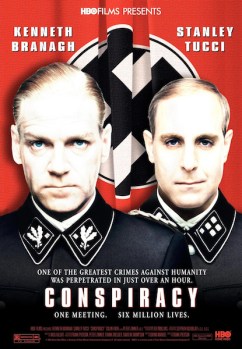
Conspiracy (2001)

100 Films’ 100 Favourites #20

One meeting. Six million lives.

Country: UK & USA
Language: English & German
Runtime: 96 minutes
BBFC: 15
MPAA: R

Original Release: 19th May 2001 (USA)
UK Release: 25th January 2002
First Seen: TV, 25th January 2002

Stars
Kenneth Branagh (Henry V, Valkyrie)
Stanley Tucci (The Terminal, The Hunger Games)
Colin Firth (Bridget Jones’s Diary, The King’s Speech)
David Threlfall (Scum, Nowhere Boy)
Kevin McNally (Pirates of the Caribbean: The Curse of the Black Pearl, Valkyrie)

Director
Frank Pierson (The Looking Glass War, A Star is Born)

Screenwriter
Loring Mandel (Countdown, The Little Drummer Girl)

The Story
1942, Berlin: a group of high-ranking Nazis gather for the Wannsee Conference, its purpose being to determine the method by which they will implement Hitler’s policy of making Germany free of Jews. Put another way, this is the meeting that created the Final Solution.

Our Heroes
I mean, they’re all Nazis, plotting the Final Solution — heroes are in short supply. That said, some object… just not very many, and not for long.

Our Villains
I mean, they’re all Nazis, plotting the Final Solution — there are plenty of villains. Chief amongst them, however, is SS-Obergruppenführer Reinhard Heydrich (Branagh), whose calm and charming demeanour hides a will of steel and a sure belief in their terrible purpose.

Best Supporting Character
There’s a strong cast of British character actors (as well as those mentioned above, we have Ian McNeice, Ben Daniels, Brendan Coyle, Owen Teale, Peter Sullivan, Nicholas Woodeson, and Jonathan Coy — you might not know all the names, but you’ll likely know the faces), so it’s hard to name just one stand-out. However, Dr. Wilhelm Stuckart (Colin Firth) is particularly memorable: he’s a nice guy because he only wants to sterilise the Jews. He’s also one of the few men in the room who’s aware of how the rest of the world will judge them if they proceed down a path of extermination.

Memorable Quote
Hofmann: “Evacuation to where?”
Heydrich: “Let us postpone that question for a while.”
Klopfer: “To hell, one hopes.”
Lange: “Many already have.”
Luther: “Do they even have a hell?”
Heydrich: “They do now. We provide it.”

Memorable Scene
Although it’s bookended by arrivals and departures, and occasionally broken up in the middle with pauses for food, etc, the film is essentially one long meeting. Which sounds incredibly dull, but of course isn’t.

Making of
Pierson chose to shoot the film’s meeting sequences in long takes, sometimes getting through 20 or more pages at a time. A highly unusual method for a screen production, so the fact most of the cast had a stage background must’ve been a boon. It was shot on Super 16 film for similar reasons: it has longer film magazines and smaller cameras, allowing the cameramen to get closer to the actors.

Awards
1 Golden Globe (TV Supporting Actor (Stanley Tucci))
2 Golden Globe nominations (Best Miniseries or TV Movie, Best Actor in a Miniseries or TV Movie (Kenneth Branagh))
2 Emmys (Actor in a Miniseries or Movie (Kenneth Branagh), Writing for a Miniseries or Movie)
8 Emmy nominations (Outstanding TV Movie, Supporting Actor (both Colin Firth and Stanley Tucci), Directing, Cinematography, Editing, Sound Editing, Sound Mixing)
1 BAFTA TV Award (Single Drama)
1 BAFTA TV nomination (Actor (Kenneth Branagh))
Peabody Award

What the Critics Said
“What a week for thoroughly exceptional, audaciously gripping fact-based dramas. We had Bloody Sunday on Sunday and now here’s Conspiracy. […] The performances are uniformly outstanding, but out of all of them it will be images of Kenneth Branagh as Heydrich you will take away with you. They may even haunt your nightmares. Branagh, who won an Emmy for the role, is flawless, and in Heydrich this fine actor has re-created a monster. Just watch the iron come into his eyes when he is contradicted or questioned. Watch that smooth charm slip as he calmly threatens those who are not completely on his side.” — Alison Graham, Radio Times

Score: 100%
(Sort of.)

What the Public Say
“to see the planning of the Final Solution played out is chilling, to say the least. Obviously, it’s not an easy watch, but it’s an important film. If you’re at all interested in how scary and terrible things happen in this world, and how the death of millions can be plotted the same way your company runs a board meeting, this is definitely a movie to see.” — Dan Bergstrom @ Letterboxd

Verdict

“A group of men have an administrative meeting” is possibly the least exciting logline for a movie you could ever read, but when those men are Nazis, at the height of the Third Reich’s pomp and opulence, and the businesslike meeting is to plot one of the greatest atrocities ever committed by mankind, it becomes horrendously fascinating. For that we can also thank Loring Mandel’s precise screenplay, and perfectly calibrated performances from a magnificent cast of seasoned actors.

#21 will be… nothing to do with Phillip Schofield.

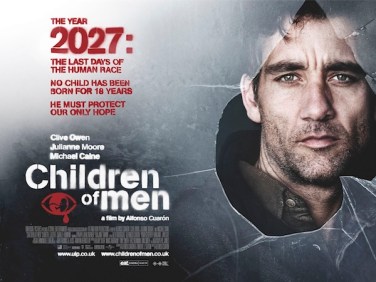
Children of Men (2006)

100 Films’ 100 Favourites #19

The year 2027:
The last days of the human race.
No child has been born for 18 years.
He must protect our only hope.

Country: USA & UK
Language: English… and German, Italian, Romanian, Spanish, Arabic, Georgian & Russian, apparently.
Runtime: 109 minutes
BBFC: 15
MPAA: R

Original Release: 22nd September 2006 (UK)
First Seen: cinema, October 2006

Stars
Clive Owen (Inside Man, Shoot ‘Em Up)
Julianne Moore (The Hours, Still Alice)
Michael Caine (The Italian Job, Batman Begins)
Chiwetel Ejiofor (Serenity, 12 Years a Slave)
Danny Huston (The Proposition, X-Men Origins: Wolverine)

Director
Alfonso Cuarón (Harry Potter and the Prisoner of Azkaban, Gravity)

Screenwriters
Alfonso Cuarón (Y Tu Mamá También, Gravity)
Timothy J. Sexton (Live from Baghdad, The Liberator)
David Arata (Brokedown Palace, Spy Game)
Mark Fergus (First Snow, Iron Man)
Hawk Ostby (First Snow, Cowboys & Aliens)

Based on
The Children of Men, a novel by P.D. James.

The Story
In the near future, mankind has become infertile, and no child has been born for 18 years. The world has gone to hell, with Britain one of the few countries that still has a functioning government, albeit a controlling, totalitarian one. In this world, government drone Theo is persuaded by his ex-wife, now head of an activist group, to escort a friend out of the country. Turns out that friend is a young woman… who’s pregnant — a situation that interests a lot of dangerous people…

Our Hero
Theo, disillusioned former activist, who’s roped back in, initially by kidnap, later with the promise of a hefty payday. Before long it turns out he’s actually a good guy at heart, of course.

Our Villains
“The rest of humanity” wouldn’t be a wholly bad answer here, as Theo and co keep bumping up against people violently concerned with their own interests. Within that, there’s the issue of if the activist group’s motives can be trusted…

Best Supporting Character
Theo’s friend Jasper, a former political cartoonist turned pot dealer, played by Michael Caine as a John Lennon-inspired old hippy.

Memorable Quote
“As the sound of the playgrounds faded, the despair set in. Very odd, what happens in a world without children’s voices.” — Miriam

Memorable Scene
Any of the (faked-)single-take action sequences is a worthy pick here. Alternatively, fans of a certain rock group will appreciate the inflatable pig floating over Battersea Power Station.

Technical Wizardry
As our heroes escape in a little Fiat, they’re attacked on a country road, the camera moving around the small person-filled vehicle in a single take. They used a special camera rig, along with a car modified to allow the windscreen to tilt out of the camera’s path, and seats that tilted to lower the actors out of the way too. The “single” shot took six takes in four locations, transition effects to seamlessly join shots, and CGI to create the motorbike, windscreen, blood, roof, and more.

Making of
The other most memorable single take is near the end, a running street battle during which Clive Owen’s layperson does his best to not get killed. It took 14 days to prepare the shot, with a delay of five hours every time it had to be reset. It was filmed over the course of two days, but only one complete take was actually captured. In the middle of one take, some blood spattered on the camera lens; Cuarón shouted “cut”, but was drowned out by the sound of tank and gunfire. Cinematographer Emmanuel Lubezki persuaded the director to leave it in, and that’s the shot in the final film. Pay attention during the sequence and you can see the liquid and dirt that gets splattered on the lens disappear during one of the ‘seamless’ cuts.

Awards
3 Oscar nominations (Adapted Screenplay, Cinematography, Editing)
2 BAFTAs (Cinematography, Production Design)
1 BAFTA nomination (Visual Effects)
1 Saturn Award (Science Fiction Film)
2 Saturn nominations (Actor (Clive Owen), Director)
Nominated for the Hugo for Best Dramatic Presentation, Long Form.

What the Critics Said
“[Cuarón] increasingly shoots the film’s set pieces in virtuoso long takes — gliding tracking shots that evoke Tarkovsky and handheld work that suggests Kathryn Bigelow. What makes these scenes stunning is not only mind-boggling choreography and timing, with Emmanuel Lubezki’s camera somehow capturing multiple planes of action even while continuously changing position, but also their ability to realistically evoke the frightening chaos and simultaneous madness of war. […] Such overwhelming studio work might be too arty for those who like their genre served sans showiness. But Cuarón is implementing a verisimilitude that both matches the film’s edge-of-your-seat escalations and demonstrates a new understanding of blockbuster realism.” — Michael Joshua Rowin, Stop Smiling

Score: 92%

What the Public Say
“Cuarón uses sequences evocative of Holocaust imagery and detention camps to implicitly communicate a world rife with injustice and pain. In designing the look of the film, Cuarón told his art department that he did not want inventiveness, but reference, so that an audience would be able to adequately recognize a distorted form of their own reality. For the reader and viewer who encounter this uncanny world, it feels all the more real because of its familiar elements.” — Mariel Calloway

Verdict

I saw Children of Men on a whim back in 2006. I can’t even remember why — I don’t think I’d seen any trailers or reviews, and it had been open for a good few weeks already. It was a time when I went to see loads at the cinema, though (in those days I paid good money to see Fun with Dick and Jane — does anyone even remember that?), and I think it may’ve been the only thing still on. Anyway, it meant I actually got in a little ahead of the hype that has gradually (and justifiably) grown around the film since, and still loved it. Cuarón mixes intelligent near-future sci-fi with exciting, and excitingly-realised, action sequences to create an action-thriller of a movie that stimulates both the mind and the adrenal glands. A fantastic film in every respect.

#22 will be next… to give the Devil his due.

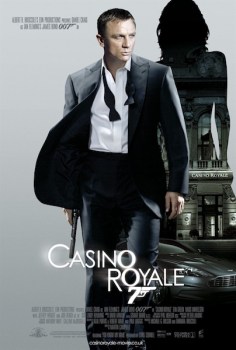
Casino Royale (2006)

100 Films’ 100 Favourites #18

Everyone has a past.
Every legend has its beginning.

Country: UK, USA, Czech Republic & Germany
Language: English
Runtime: 144 minutes
BBFC: 12A (cut, 2006) | 15 (uncut, 2012)
MPAA: PG-13 (cut)

Original Release: 14th November 2006 (Kuwait)
UK Release: 16th November 2006
US Release: 17th November 2006
First Seen: cinema, 16th November 2006

Stars
Daniel Craig (Layer Cake, The Girl with the Dragon Tattoo)
Eva Green (The Dreamers, Sin City: A Dame to Kill For)
Mads Mikkelsen (Valhalla Rising, The Hunt)
Judi Dench (Iris, Philomena)
Jeffrey Wright (Shaft, The Hunger Games: Catching Fire)

Director
Martin Campbell (GoldenEye, Green Lantern)

Screenwriters
Paul Haggis (Crash, The Next Three Days)
Neal Purvis (Die Another Day, Johnny English)
Robert Wade (Stoned, Skyfall)

Based on
Casino Royale, the first James Bond novel by Ian Fleming.

The Story
British agent James Bond, newly promoted to exclusive double-oh status, investigates a terrorist plot that leads him to Le Chiffre. Banker to the world’s terrorists, Le Chiffre has managed to lose a lot of his clients’ money, and intends to win it back in a high-stakes poker game at the eponymous establishment. Bond is charged with joining the game and bankrupting the banker, with treasury employee Vesper Lynd along to keep an eye on the money and off Bond’s perfectly-formed arse.

Our Hero
“James before he was Bond,” as the awful US tagline went. Daniel Craig instantly disproved the not-that-numerous-but-certainly-vocal critics (remember all the “Bond isn’t blond” rubbish?) by being perhaps the most convincing actually-is-a-highly-trained-agent Bond since Connery.

Our Villain
Le Chiffre, a total banker. Fond of poker, bleeds from his eye, brilliantly played by Mads Mikkelsen, who has deservedly gone on to many other things, no doubt some wholly due to this.

Best Supporting Character
Eva Green is Vesper Lynd, a woman so remarkable that Bond names his personal Martini recipe after her. He also falls in love with her. Considering the rest of the Bond canon, that’s not likely to end well.

Memorable Quote
“I’m afraid your friend Mathis is really… my friend Mathis.” — Le Chiffre

Memorable Scene
At dinner on the train to Montenegro, Bond meets Vesper for the first time. They verbally size each other up. She wins. “How was your lamb?” “Skewered. One sympathises.”

Write the Theme Tune…
Easily the best Bond theme of the Craig era (though I like the QoS one more than most, and my main objection to Adele’s is that it’s about a flying baby horse and its receptacle for bread waste), You Know My Name was co-written by the series’ regular composer since the mid ’90s, David Arnold. That meant he could integrate the tune into his score, which was a Good Thing.

Sing the Theme Tune…
Far removed from Bond’s Bassey-imitating default style, the slightly gravelly sound of Soundgarden’s Chris Cornell (the first male vocalist on a Bond theme for nearly 20 years) helped indicate the series’ harder, manlier new direction.

Technical Wizardry
After four films of honing the Maurice Binder “naked silhouettes” style, title designer Daniel Kleinman cuts loose with an array of inventive playing card-based imagery. The most original Bond title sequence since at least Thunderball and, by being so atypical, the most unique of them all.

Truly Special Effect
Chasing after a kidnapped Vesper in the middle of the night, Bond suddenly sees her in his headlights, tied up in the middle of the road. He swerves, his Aston Martin crashes, and barrel rolls… seven times. The stunt team set a world record with that, which (despite Fury Road’s best efforts) is still unbeaten a decade later.

Making of
James Ferguson, a doctor from Aberdeen, came up with the idea for the scene in which Bond is poisoned and then remotely diagnosed by experts at MI6 HQ in London. Ferguson, a Bond fan, was retained as medical adviser for future Bond films.

Previously on…
Casino Royale was adapted for TV in 1954, starring the great Peter Lorre as Le Chiffre, and its title (and little else) was used for the awful 1967 Bond spoof. This version is the 21st in the canonical James Bond film series, and the first time that series has performed a reboot: the film opens with Bond attaining his famed double-oh status, something we’ve never seen before.

Next time…
Daniel Craig’s second outing, the somewhat misunderstood and underrated Quantum of Solace, was the first direct sequel in the Bond canon, picking up on various plot threads from Casino Royale and even resolving a few of them. After Craig’s third, Skyfall, went off on its own, last year’s Spectre tried to tie together the entirety of Craig’s era, with mixed success. Beyond that, James Bond will return indefinitely, though Craig may not.

Awards
1 BAFTA (Sound)
8 BAFTA nominations (British Film, Actor (Daniel Craig), Adapted Screenplay, Music, Cinematography, Editing, Production Design, Visual Effects)
1 Saturn Award (Action/Adventure/Thriller Film)
4 Saturn nominations (Actor (Daniel Craig), Supporting Actress (Eva Green), Writing, Music)
2 World Stunt Awards (Best High Work, Best Stunt Coordination and/or 2nd Unit Director)
1 World Stunt Awards nomination (Best Fight)

What the Critics Said
“I never thought I would see a Bond movie where I cared, actually cared, about the people. But I care about Bond, and about Vesper Lynd, even though I know that (here it comes) a Martini Vesper is shaken, not stirred. Vesper Lynd, however, is definitely stirring, as she was in Bertolucci’s wonderful The Dreamers. Sometimes shaken, too. Vesper and James have a shower scene that answers, at last, why nobody in a Bond movie ever seems to have any real emotions.” — Roger Ebert

Score: 95%

What the Public Say
“While there is very much a dramatic and sensitive undercurrent to this Bond film, Casino Royale doesn’t shortchange the audience on action. From Bond chasing a skilled free runner enemy to a brutal staircase battle, Casino Royale delivers a harsher and bleaker sense of violence that had been missing from some of the predecessors and not seen since Timothy Dalton’s dark turn in Licence to Kill.” — vinnieh

Elsewhere on 100 Films
Just before Quantum of Solace was released in 2008, I wrote that Casino Royale was “a damn fine Bond film, returning to Fleming and resetting the character without losing anything truly essential about the franchise. […] this one’s up there with the very best, not just of Bond but of action-spy-thrillers in general.”

Verdict

In the early ’00s, it didn’t feel like the Bond series was in need of a reboot. Die Another Day had been a huge hit at the box office and gone down pretty well with critics (no, really, it did), and Brosnan was all set to do a fifth (though, considering his age, likely final) film as Britain’s top secret agent. Then Bourne happened, shifting the playing field of the spy-action genre, at the same time as Bond’s producers finally regained the rights to Fleming’s very first Bond novel. For the first time in the series’ 40-year history, they decided to reboot.

What Casino Royale does skilfully is acknowledge the changes brought by Bourne, but adapt them to Bond’s slightly more classical style (something Quantum of Solace fumbled). At the same time, it acknowledges and frequently subverts that Bond formula (“Shaken or stirred?” “Do I look like I give a damn.”), the antithesis of DAD’s uber-referentiality. In itself, it took Fleming’s relatively slight novel, with its lack of action by modern blockbuster standards, and expanded and modernised it effectively to fit current tastes. The result is arguably the best Bond movie ever made.

#19 will be… the last days of the human race.

Macbeth (2015)

2016 #23
Justin Kurzel | 113 mins | Blu-ray | 2.39:1 | UK, France & USA / English | 15 / R

Macbeth is my favourite Shakespeare play. Not that I’m a great scholar of the Bard, but I’ve seen and/or read enough to have a favourite. I also think it’s one of his most accessible works: its story and characters are relatively straightforward without being devoid of complexity; it’s got some immensely effective imagery and dialogue, including a solid compliment of famous lines; and it’s not excessively long either (it’s Shakespeare’s shortest tragedy, in fact). I also studied it twice over in secondary school, so I know it fairly well. Now, this doesn’t mean I have exacting standards when it comes to film adaptations (Shakespeare is plenty open to interpretation), but it does mean I have my expectations up, especially as there isn’t a film version of Macbeth that could reasonably be described as “definitive” (though I know Polanski’s has its fans). After this latest effort, that’s still the case — but that doesn’t mean it’s without merit. Far from it.

For thems that don’t know, Macbeth is set in 11th Century Scotland, where the eponymous character (Michael Fassbender) is a lord and general in the army of King Duncan (David Thewlis). After winning a decisive battle, Macbeth and his BFF Banquo (Paddy Considine) bump into a coven of witches, who forecast Macbeth will receive a new title and eventually become king. Although the men are naturally dubious, they soon learn that Macbeth has indeed been granted the prophesied thaneship. With the prospect of being king too tantalising to ignore, Macbeth’s ambitious spouse (Marion Cotillard) eggs him on to plot regicide…

Although director Justin Kurzel (of Snowtown, a film I have no intention of watching thanks to ghost of 82’s review) wasn’t hired until after the film was in development and Fassbender had been cast, the final film has been very much guided by his vision. The text is heavily cut (a copy & paste & delete-bits job that somehow took three screenwriters), to the displeasure of some critics, though this is primarily because Kurzel chose to supplant some of the dialogue with Filmmaking. In a film?! How very dare he! What I mean, more specifically, is that he’s visualised parts of the text; applied the old rule of “show don’t tell”. So rather than a messenger giving the King a full account of Macbeth being awesome in battle, we see some of the combat; Banquo has hardly any lines early on, but we still understand his friendship with Macbeth just from the way they look at one another and go into battle together.
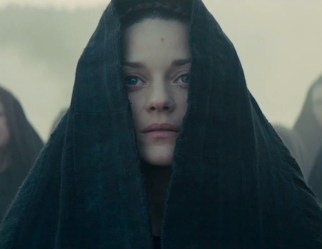
Throughout, it’s the imagery that Kurzel and DoP Adam Arkapaw have crafted that’s the real standout of this particular adaptation (however good the cast are, and I’ll come to them). The compositions, the unusual use of almost tableaux-like blocking, the lighting, the colour palettes, the rhythm of the editing and the use of slow-mo… This is a highly filmic film, in a good way. At times, it manages to turn Shakespeare into an action movie, a feat rarely (if ever) accomplished previously. At others, it’s just mighty purdy. The pictures are well complemented by the score, composed by the director’s younger brother, Jed Kurzel (he’s also scored the likes of The Babadook and Slow West, so it’s not just nepotism). His work here is appropriately haunting and folksy.

To say the text has been cut and the film is strongest in its visuals does not mean this is an empty-headed version of Shakespeare, however. The director and his cast have some interesting variations on the usual depictions of the characters, in particular Lady Macbeth’s motivations. Normally shown as greedy and power-mad, here she is grief-stricken — there’s a single line in the play that’s interpretable as the Macbeths having lost a child, which here is both made explicit and highlighted in an opening funeral scene. These characters are acting out of some kind of desperation or emptiness rather than pure greed. When, later, she (spoiler!) goes mad, it’s subtle and sad, rather than frantic and delirious. Cotillard is fantastic in all of this, and certainly worked hard for it: the way the French language applies emphasis is not suited to delivering iambic pentameter, apparently, so she worked hard with a dialect coach to nail her delivery. Her accent clearly marks Lady Macbeth as the only non-Scottish character here, which becomes another layer added to this interpretation.

As Macbeth, Fassbender negotiates well the accomplished general who is also dominated by his wife. Here the guiding concept was Macbeth The Warrior; to portray him both as someone looking to replace what he’s lost by the battle being over, and as suffering from PTSD after what he’s witnessed, hence repeated hallucinations of a boy killed in battle. This isn’t out of place with the text, of course — “is this a dagger I see before me” and all that. Fassbender is on furious form, particularly as Macbeth gives in to his paranoia later on. A word too for the supporting cast, in particular Sean Harris as Macduff, who makes the character feel more essential to the story (as he should, considering the climax) than I remember him being in previous versions.

Some of this analysis is thanks to the short handful of featurettes found on the UK Blu-ray (the US release, out tomorrow, has different special features, so I’ve no idea what the overlap will be, if any). There’s no commentary track, which is a real shame. I don’t often get round to listening to them, but I’d be interested to hear Kurzel talk through his and his cast’s decisions on a scene-by-scene basis. The special features that there are give some insight into how thoroughly they thought through their adaptation and prepared for it, but that only means the lack of further insight is even more pronounced. And Kurzel, Fassbender, Cotillard, and Arkapaw are all now working on the film of Assassin’s Creed, out this December, which is an intriguing prospect — is it going to be an arthouse video game adaptation? I suspect not, but maybe it will be the rarest thing in cinematic history: a good film based on a computer game.

I was initially on the fence about whether this Macbeth was a 4-star or a 5-star achievement, especially as I maintain it’s not the be-all-and-end-all of Macbeth on screen. But it’s one of those films that, whatever the experience of actually sitting and watching it is like (at times: odd), its imagery and feel really stay with you.

5 out of 5

Macbeth is released on DVD and Blu-ray in the US tomorrow, and is out in the UK already.
Next month, Polanski’s
Macbeth is one of the initial releases in Criterion’s new UK range (yay!)

Casablanca (1942)

100 Films’ 100 Favourites #17

They had a date with fate in Casablanca.

Country: USA
Language: English
Runtime: 102 minutes
BBFC: U
MPAA: PG (1992)

Original Release: 7th December 1942 (Brazil)
US Release: 23rd January 1943
UK Release: December 1942 (BBFC)
First Seen: DVD, 2006

Stars
Humphrey Bogart (The Maltese Falcon, The Big Sleep)
Ingrid Bergman (Notorious, Autumn Sonata)
Paul Henreid (Now, Voyager, Deception)
Claude Rains (The Invisible Man, Notorious)
Conrad Veidt (The Cabinet of Dr. Caligari, The Thief of Bagdad)

Director
Michael Curtiz (The Adventures of Robin Hood, Mildred Pierce)

Screenwriters
Julius J. Epstein (Arsenic and Old Lace, Cross of Iron)
Philip G. Epstein (Arsenic and Old Lace, The Last Time I Saw Paris)
Howard Koch (The Letter, Letter from an Unknown Woman)

Based on
Everybody Comes to Rick’s, an unproduced play by Murray Burnett and Joan Alison. (Despite the film’s popularity, a legal dispute between the playwrights and Warner Bros meant it wasn’t staged until 1991.)

The Story
Controlled by the German-subservient French government, Morocco in 1941 is a congregation point for German officials, collaborating French, and refugees attempting to get to neutral America. When letters of transit allowing that passage come into the possession of nightclub owner Rick Blaine at the same time as the love of his life, Ilsa Lund, walks into his joint with her husband, Resistance leader Victor Laszlo, Rick has some tough decisions to make — and quickly, with corrupt police captain Renault hunting for the letters and German Major Strasser gunning for Laszlo…

Our Hero
Of all the gin joints in all the towns in all the world, everybody comes to Rick’s. That’s because Rick is Humphrey Bogart. You’d go to a bar run by Humphrey Bogart, wouldn’t you?

Our Heroine
The most beautiful woman to ever visit Casablanca (a gross understatement), here’s looking at you, Ingrid Bergman. (Yes, I added this section pretty much just to say that.)

Our Villains
It’s set during World War 2 so, I mean, who do you think?

Best Supporting Character
Claude Rains was the Invisible Man, but here he’s Captain Louis Renault, a corrupt copper who — despite being fourth-billed in a film packed with memorable dialogue — still gets a good many of the best lines.

Memorable Quote
“Of all the gin joints in all the towns in all the world, she walks into mine.” — Rick

Quote Most Likely To Be Used in Everyday Conversation
“Louie, I think this is the beginning of a beautiful friendship.” — Rick

The Most Famous Misquote in Movie History
“Play it again, Sam.” — Rick
(Ilsa says “Play it once, Sam,” and “Play it, Sam.” Rick says, “You played it for her, you can play it for me. If she can take it, I can take it, so play it!”)

Memorable Scene
As Laszlo boards the plane out of Casablanca, Ilsa thinks she’s staying with Rick… until he convinces her to go. Standing in the doorway of an aircraft hanger, it’s probably the film’s most iconic scene — if you’ve not seen it, you’ve certainly seen it parodied.

Memorable Song
You must remember this: a kiss is just a kiss, a sigh is just a sigh. The fundamental things apply, As Time Goes By. Play it again, Sam!

Making of
Casey Robinson re-wrote the film’s romantic scenes and was offered a credit, but turned it down because he only took credit for screenplays he wrote entirely himself. Of course, with that decision he missed out on winning an Oscar.

Awards
3 Oscars (Picture, Director, Screenplay)
5 Oscar nominations (Actor (Humphrey Bogart), Supporting Actor (Claude Rains), Black-and-White Cinematography, Editing, Score)

What the Critics Said
“bear in mind that it goes heavy on the love theme. Although the title and Humphrey Bogart’s name convey the impression of high adventure rather than romance, there’s plenty of the latter for the femme trade. Adventure is there, too, but it’s more as exciting background to the Bogart-Bergman heart department. Bogart, incidentally, as a tender lover (in addition to being a cold-as-ice nitery operator) is a novel characterization” — Variety

Score: 97%

What the Public Say
“the script’s greatest strength is not quotability. It’s character development. Rick, Ilsa, Renault and Laszlo are complex individuals, about whom we care, no matter their flaws. Sam (Dooley Wilson), an African American pianist, is layered by loyalty to Rick and emotional acuity, while Major Strasser, the antagonist, is not a comic book villain. Because he’s a Nazi, we do not like the Major, but director Michael Curtiz and his writers are smart enough not to make him stereotypically evil, instead opting to develop him as determined and efficient. Because all of the characters are so genuine, the filmmakers earn our emotional investment” — Josh, Cinema Parrot Disco

Verdict

Casablanca is remembered now as much for its selection of ever-quotable lines as for anything else — you don’t have to have seen the film to know that if you go walking into all the gin joints in all the towns in all the world and someone’s looking at you, kid, then maybe not today, maybe not tomorrow, but soon you should round up all the usual suspects again, Sam, for the beginning of a beautiful friendship. Or something. It’s much more than that, though: an engaging romantic drama, with enough overtones of noir to keep it snappy, set in perhaps a ’40s equivalent of the Wild West. It may be three-quarters of a century old next year, but it still merits playing again.

#18 will see… Bond begin.