2010 #105
Robert Rodriguez & Quentin Tarantino | 191 mins | Blu-ray | 18 / R
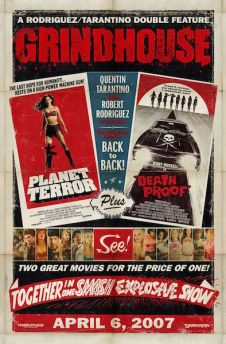 Infamously, on its release in America the much-hyped Rodriguez/Tarantino double bill was an almighty flop, so much so that it wasn’t properly released in its full form outside the US. Which is a bit ironic, if you think about it, because the US is the market least likely to respond to something a little bit experimental.
A grindhouse, for those still unacquainted with the concept, was a second-run cinema in the pre-home video days that generally showed trashy films from poor-quality much-screened prints. It should come as little surprise that this is the kind of film and viewing experience Tarantino enjoys, and so he and best chum Rodriguez set about recreating the style for a wider audience. Which was probably why it flopped — it was, almost by definition, not a mass audience-aimed style of cinema.
What this means for Grindhouse is a double-bill of exploitation movies, more-or-less with a horror bent, with grainy, dirty, decrepit prints that are missing shots, scenes, and even whole reels, and complete with trailers for similar films and ads for local restaurants. Clearly, it sets itself up to be as much about the experience of viewing the work of RR and QT in this context as it is the films themselves. So, to take the viewing programme in order…
It opens with one of the several fake trailers — except in this case the trailer is no longer fake, as Rodriguez has since gone on to turn Machete into a genuine feature (out next month over here). It sets the tone well: cheesy dialogue, stagey acting, an emphasis on gory violence over any other element, and plenty of utterly ludicrous moments. Plus breasts, naturally. 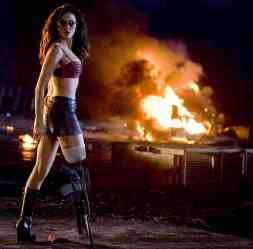 Chances are, if you don’t find this opening salvo entertaining in some way the rest of the film is going to prove a struggle.
And then the film launches into its first feature: Robert Rodriguez’s zombie horror Planet Terror. In short, this is a completely entertaining pitch-perfect 90-minute proof-of-concept. Rodriguez packs every scene with at least one element you should expect from this style of cinema: graphic blood-spurting violence, horrific mutations, vicious zombies, over-the-top logic-light gunfights, entirely random explosions, clichéd dialogue, stock characters, extended shots of the female form… Have I missed anything? If I have, it’s probably there too.
Rodriguez’s skill lies in making this both homage and hilarious. You don’t need to have much experience of this kind of cheap horror/exploitation movie to see how well he’s hit on the stereotypical plot, characters and sequences. His direction hits the nail on the head too, discarding his usual style for angles and cuts that feel thoroughly genuine. But he also recreates it in a way that’s amusing; not so much in a “look how stupid they are” way, but by levying elements in a way that is consistently entertaining. In particular, he uses the self-imposed print damage to excellent effect — the sex scene literally burns out from over-play, for instance, while the “Missing Reel” card elicits a laugh by jumping the plot forward so ridiculously, as well as skipping a whole chunk of exposition.
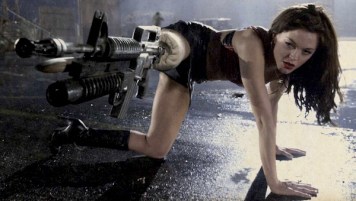 It probably works better in context than described on the page, but Rodriguez has marshalled every disparate element to create a cohesive whole that’s exciting and funny. At this point, Grindhouse is firmly headed for a full five-star conceptual success.
Following “The End” card, there’s a handful of trailers before the second part of the double-bill. From directors Rob Zombie (The Devil’s Rejects, Halloween remake), Edgar Wright (Shaun of the Dead, Hot Fuzz) and Eli Roth (Cabin Fever, Hostel), they showcase different archetypes within the overall grindhouse style. Zombie’s Werewolf Women of the S.S. is all Nazis, cheap werewolf costumes and (naturally) boobs — very video nasty. Wright’s Don’t takes on British ’70s horror with a nightmare-filled country mansion and a deliberately repetitive trailer (“don’t go in there”, “don’t see it alone”, etc). Also, for a British viewer, its sub-two-minute running time is packed to bursting with recognisable faces, some you’d expect (Mark Gatiss, Nick Frost) and others you wouldn’t (Katie Melua!) Finally, Roth’s Thanksgiving is a teeny slasher in the Halloween mode, 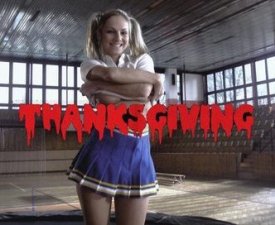 though Roth can’t resist adding his own especially twisted brand of humour (I shan’t describe the final shot here).
While the trailers won’t necessarily convince you to see the films featured (good thing they don’t exist then), they perfectly capture the feel of various horror styles from the intended era, and — with the various “coming attractions” slides — sell the grindhouse experience.
And then we have the second film, Quentin Tarantino’s Death Proof. And here the concept falls apart.
It seems Tarantino can’t let go of his own style. With a handful of exceptions, Death Proof feels less like a well-considered grindhouse homage (which Planet Terror certainly was) and more like a typical Quentin Tarantino Film launched from a grindhouse-ish concept. He can’t even sustain the literal veneer of grindhouseness: after some early print damage, obviously missing scenes, the clearly-labelled “Missing Reel” (which, in one of the film’s few authentic-feeling touches, is a sexy sequence), and — in the best grindhouse-style touch — a shoddily-replaced title card, the picture quality gradually loses its flaws until a climax that seems visually faultless. Perhaps QT’s imagined behind-the-scenes story was that every projectionist got bored of the film by this point so the latter reels survived in pristine condition…
 But it’s not just the increasing lack of dilapidated print quality that prevents Death Proof from selling its concept. The screenplay is clearly a QT work, much more so than most of Kill Bill or even Inglourious Basterds, especially when the girls indulge in long dialogue scenes of the real-world-natter variety. It’s like the opening of Reservoir Dogs, only with girls instead of guys and repeated two or three times throughout the film. One such scene is even shot in a very long single take, the camera constantly roving around the four girls sat round a table. It’s a technically impressive bit of work for any film; as a supposed product of a low-budget horror-thriller flick destined for the grindhouse circuit, it’s beyond improbable. In short, it’s all too well written and directed to convince as grindhouse. Though he does get to indulge in a couple of lingering shots of the female form, in particular his regular foot fetish.
QT almost makes up for all this with the final twenty minutes, featuring some impressive car stunt action. As noted, by this point any pretense of being a grindhouse-style film has been done away with: the image is devoid of all but minor damage, the stunt work — all done for real, I believe — pretty impressive. Whether it conforms to the style statement of the film or not (that’d be a “not”), it does manage to entertain. Tarantino’s decades of studying action-filled trash clearly pay off here as well as they did in Kill Bill, 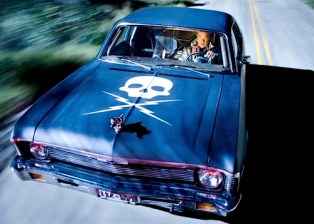 and if he chooses to create some more action-centric pictures in the future it would be no bad thing.
One thing that left me uncertain was the decision to slaughter his main cast halfway through. Firstly, the death-inducing crash is another sequence that’s too well done for such a pretend-cheap film, repeating the impact four times to show the imaginative fate of each victim. Brutal, yes, but one of the few moments that matches Planet Terror for effectiveness. The actual act of removing the three lead characters is audacious, maybe, but mainly so because QT’s spent so long apparently trying to invest us in these characters and their lives. It makes all the dialogue scenes we’ve sat through feel even more pointless, especially those setting up slightly dull romantic-ish subplots.
It also leads to a cameo appearance for a handful of Planet Terror characters, which could be fun but ultimately feels ill-conceived to me. In no other way do these films appear to be set in the same world, or have any other connection — indeed, cast members such as Rose McGowan and Tarantino himself appear in completely different roles in each film. The crossover didn’t feel in the grindhouse spirit to me; it felt in the “Rob and I are buddies and did this for no good reason” spirit. And it certainly took me out of the film.  In fact, it might’ve played better if the films were the other way round, as it means Death Proof must be set before Planet Terror. I’d approve of this switch not only for chronological reasons, but because seeing one-scene bit-parters turn up in the-same-but-larger roles in the second film seems like it would be more satisfying as a viewer, rather than re-encountering these (in any case, minor) characters the way we do.
A length-based aside: as I mentioned, both films were released separately outside the US, and in both cases were extended. By my calculations, the Grindhouse cut of Planet Terror is just under 15 minutes shorter, while Death Proof is around 20 minutes shorter. More on that when I get round to watching the individual versions.
Grindhouse ends up being every bit a film of two halves, as you might expect a double-bill to be. Up until the end of the trailers, I was loving its commitment to the concept and the fun it was having with it — all credit to Rodriguez for that, as well as the trailer directors of course.  But Tarantino’s entry lets the side down by seeming to fail in its execution of the film’s conceit. I’m not convinced it would be any better viewed as a standalone Quentin Tarantino Film, but in context it certainly disappoints.
If QT could’ve produced an effort as successful as his mate’s, Grindhouse would’ve been on course for full marks; not because it’s a Good Film, but because it would have fully realised its potential-filled concept in a thoroughly entertaining way. The finished product is still entertaining, but not thoroughly. It loses a star, but does retain a moderate chance of appearing on my Best Of Year list.
Grindhouse is out on Blu-ray, exclusive to hmv, from today.
Grindhouse’s constituent parts, Death Proof and Planet Terror, are on TCM tonight from 9pm until 1:30am.

 This is one of those films I always feel horrendously under-qualified to bother offering any kind of thought on. It’s the kind of film you suspect benefits most not just from repeated viewings and a desire to dig deep into its themes, but also a wider understanding of the director’s work and thematic concerns. This is only compounded in the case of Ozu by the fact I watched Tokyo Story a few years ago and didn’t get on with it in the slightest (but more on that whenever I get round to re-watching & reviewing it).
 (which bolsters my belief that his most renowned work is indeed worth a second shot). One issue, I suspect, is that I knew nothing of Ozu before my first experience; having read up on him (if only a little), his idiosyncratic squared-off shots and straight-on close-ups feel less blatant and frequent here, and being aware of their deliberateness perhaps makes them less intrusive. That said, I remain unconvinced by it as a guiding notion — I’m sure there’s a reason beyond the proliferation of American cinema that the visual style we’re used to seeing in most film and TV is, well, the visual style we’re used to seeing.
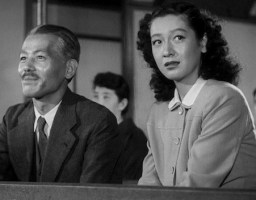 when the prospect of marriage and leaving her father seriously raises its head. (And I’m afraid that’s the closest to analysis you’ll find here.)
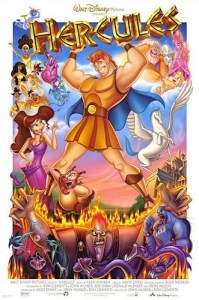 Hercules is the first post-me Disney; the point where, for whatever reason, I stopped watching their output. But, of course, Disneys — good Disneys, at any rate — are suited to every age group.
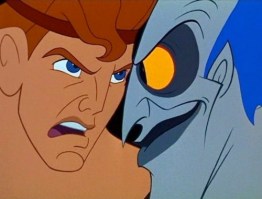 animal-sidekicks-with-no-dialogue-who-can-still-convey-their-thoughts-and-feelings-perfectly (I feel this tradition needs a snappier name.) Love interest Meg, meanwhile, starts out intensely irritating but is gradually redeemed. Good work, I say to the film’s
 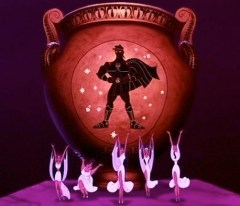 (though even mentioning it in the same sentence as that number makes it sound better than it is). Only love interest Meg gets a passable song, not that I could remember it within hours of watching the film. Maybe it’s not all that bad really, but when early-’90s Disneys could produce several unforgettable tunes per film, it feels like a weak album from a band you usually enjoy.
 Notorious for having numerous cuts forced upon it by censors, over 40 years after its initial release Witchfinder General — now uncut — seems almost tame. But gore and sadistic violence certainly aren’t the main attractions — there’s a lot more to the film than that.
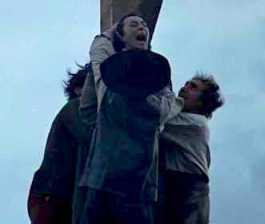 shot against Reeves’ wishes, featuring needlessly topless wenches. This is the cut shown by the BBC.)
 Witchfinder General is more action-adventure than horror.
 Best of all is the witchfinder himself, excellently portrayed by horror stalwart Vincent Price. Indeed, all the credit may lay with him, because it’s his line deliveries and uncertain looks that make the character conflicted early on, a man who may believe he is genuinely doing good for Christian values, but is seduced down darker paths by money, power, lust, and the prospect of revenge. When he allows himself to be lured to Sara’s bedroom as payment for leniency on her uncle, we’re uncertain if he’ll take what’s intended or use her loose ways as proof of witchery. That it’s the former quickly indicates how seriously he takes his espoused Christianity.
 to near-silhouette levels of blackness. It’s even less convincing than that fake blood. I enjoyed the score too. A completely new one was written for the US release, but I presume this was the original because it was slightly calmer and more haunting than one might expect from an action-adventure-horror movie (which I presume was the reasoning for the replacement).
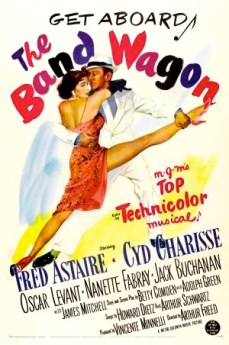 In this behind-the-scenes musical, Fred Astaire plays Tony Hunter, a slightly washed-up star of stage and screen. One can’t help but wonder if his performance has an autobiographical edge. It’s of no concern to the viewer though, because he’s as wonderful as ever.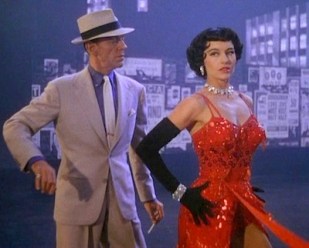
 Gigi is a film about largely horrid people doing morally dubious things. But of course it’s a musical from the ’50s, so it all has a veneer of loveliness and respectability.
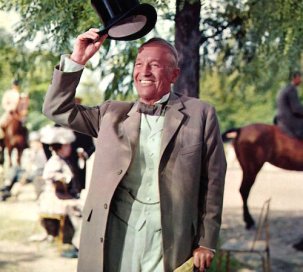 eventually Gaston realises he loves Gigi and her training is stepped up so she can become his latest conquest. I won’t go into the details of the ending, but their part of the story ends well.
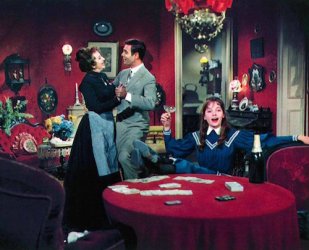 I’m Glad I’m Not Young Anymore is also a nice change of pace, celebrating old age for a change.
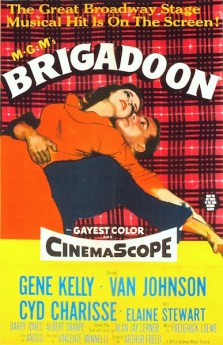 “Oh dear,” is surely the initial reaction to Brigadoon. The Scottish accents are appalling, the costumes and setting gratingly twee, the Highlands recreated entirely on a soundstage. I wonder if many Americans visited Scotland in the wake of this film expecting to find such things? If they did, I imagine they were sorely disappointed.
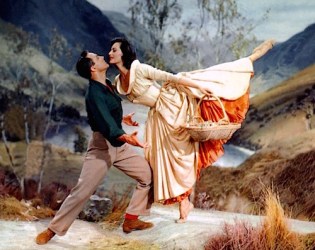 I think it’s fair to say this isn’t the greatest of musicals (though I know some might disagree). The poor realisation of Scotland takes some getting used to — and remains either irritating or amusing, depending on your mileage for such things — and generally there’s a dearth of particularly memorable songs or dances. But it’s not bad either, once things get underway.
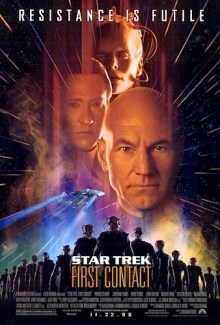 “Even ones good, odd ones bad.” So went
 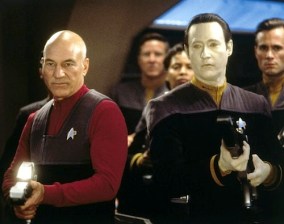 For all that, I still got the sense of it being a bit like two or three episodes of TV stuck together, albeit two particularly epic stories with a slightly bigger budget. The story on Earth is a bit of a sideline, for example, the kind of thing that’s added to give half the cast something to do. Perhaps that’s unfair — it’s a decent enough tale, with significant relevance to the Trek universe, but it’s also low-key and, aside from being kicked off by a Borg attack, entirely unrelated to the goings-on on the Enterprise. Visually it’s even more of a mixed bag. Borg costumes and effects are at times impressive — the Queen being lowered into her body, robotic spine dangling, still looks good today, and her makeup is exemplary — but other drones seem to be clad in cheap bodysuits… which the actors surely are, but it looks it.
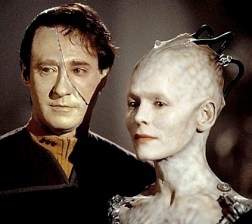 For a newbie, or a viewer light on Trek knowledge, it all works fine. There’s an awareness one’s missing out on something — Picard’s previous encounter with the Borg is alluded to often but not explained in full; even for me, as someone well aware that it’s one of sci-fi’s Big Stories, but who has never actually seen it, there’s a certain lack of explanation. Featuring a couple of new characters from hundreds of years before TNG’s regular timeline helps, because the crew occasionally have to tell them things everyone else would know; the downside is they’re not meant to be telling them everything, so some stuff still passes us by. But, importantly, none of this ever swamps the story; they’re just touches and moments that I know I’m not getting.
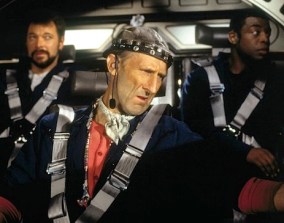 early on Picard explains that they won’t be noticed until they seem a threat… but they’re all carrying whopping great guns. And surely the very fact the humans have turned up deems them a threat? Also, why don’t the Borg recognise Picard? And later, during the largely fantastic sequence on the Enterprise’s hull, Picard, Worf and Hawk are clearly up to something nefarious and yet the Borg let them carry on. One or two Borg stop to intervene; Picard & co dispatch them; the rest of the Borg just keep working. Surely the fact these humans have just done away with several of your compatriots qualifies them as a threat that needs to be dealt with? It’s all a bit too convenient.
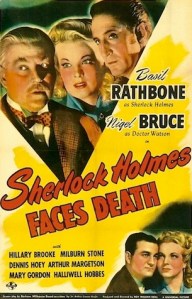 He’s put down the
 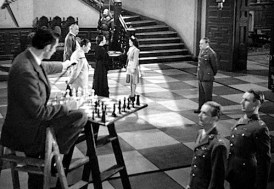 Relocated in the war years, the Musgrave manor is currently a home for convalescent soldiers, providing no end of potential suspects. Some may guess the culprit from the off, others will land upon them at other places throughout proceedings, but it seems to me there’s still enough going on to keep us guessing.
 The interest of the piece for us normal, sensible folk, then, lies in what it exposes about this world: the ludicrous lengths they go to; the shockingly inflated sense of self importance. As with The September Issue, it presents no narration and a lot of long takes of documentary footage, leaving the viewer to draw their own conclusions. But there are conclusions to be drawn. Wintour is as much a closed book here as in the main film, but there are moments — glances, affectations, turns of phrase — that reveal a little bit more of the truth behind her icy demeanour.
 100Films.co.uk