
Roy William Neill | 71 mins | DVD | 4:3 | USA / English | PG
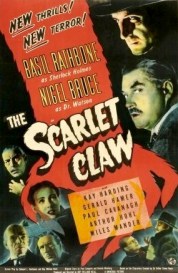 According to Wikipedia, “David Stuart Davies notes on the film’s DVD audio commentary* that [The Scarlet Claw is] generally considered by critics and fans of the series to be the best of the twelve Holmes films made by Universal.” That’s always a bold kind of assertion to make (it’s never trouble-free to define an entire fandom’s favourite), but I can still believe it’s true: The Scarlet Claw is marvellous.
When looking it up before viewing I was surprised to find it had a spot on the Top 500 Horror Movies (voted by users of IMDb’s horror boards, apparently), where it had a place in the lower 300s. I was surprised — Holmes is a detective series, not one I’d think of nominating for such a list. But there is one arguable exception to that — The Hound of the Baskervilles, of course — and it’s clear that Scarlet Claw draws significant inspiration from that preeminent entry in the Holmes canon. Lists of similarities are available for them that wants them, because I think Scarlet Claw does enough to merit consideration in its own right.
And it really is a horror movie too. There’s not just the elements of occult in the myth of the Canadian town Holmes and Watson find themselves in almost by chance, which you always know will be debunked in a Sherlock Holmes plot, but also the way the production is staged. Indeed, the film’s scariest sequence occurs after it’s revealed that the killings are being committed by a mere human —  a properly chilling murder scene, quite out of step with the film’s age and PG certificate.
A lot of this is thanks to director Roy William Neill. On a previous review of mine, Ride the High Country’s Colin noted that Neill “turned out some quality low-budget stuff for Universal. He had a real knack for creating a spooky and mysterious atmosphere that’s evident in his horrors and thrillers.” This film demonstrates that fact more than any Holmes yet. His direction is incredibly atmospheric, from a wonderful mist-covered opening scene, replete with an incessantly tolling bell, to regular instances of shadow-drenched photography afterwards; not to mention various pleasing camera angles and moves.
The story — in which townsfolk believe a mythical beast has returned to murder its residents — presents a well-constructed mystery all round, though as it moves into the second half some of its twists become all too guessable. There simply aren’t enough supporting characters to provide any meaningful sense of having to ponder who the villain might be (because, as I noted, you know it’s not really a beast). 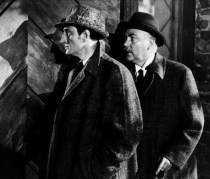 There’s also a hefty dose of coincidence that everyone involved, both on screen and off, conveniently ignores.
If we’re looking at the flaws, there’s a return for the painful closing speech from Rathbone, this time a Churchill-quoted ode to the wonder of Canada. Ugh. Still, you half expect it from this series, and it’s very easy to ignore.
The other little niggles may stop the film from being perfect but, like the similarities to The Hound, while they’re certainly there, they’re easy to overlook in the name of a rollicking good horror-mystery-adventure.

The Scarlet Claw merited an honourable mention on my list of The Best Films I Saw For the First Time in 2012, which can be read in full here.
* I could verify this for myself, but I haven’t, so… ^
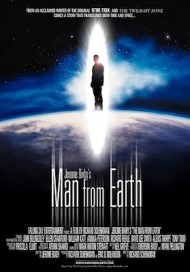
 Judged on its own terms, however, The Man from Earth is what one might call Proper Science Fiction. Most films classed as sci-fi just feature aliens or what have you; they’re space opera, or just action movies where Americans fight off-planet enemies instead of out-of-country enemies; the kind of thing Ray Bradbury termed fantasy rather than sci-fi (I’m inclined to agree, but that’s a discussion for another time). Instead of Shooting And Blowing Up Stuff, or even comedy antics with a twist, The Man from Earth deals in Ideas.
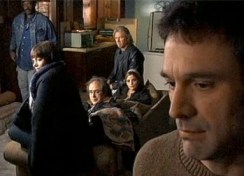 and are prepared for all the slowness of pace that involves (because compare the experience of doing anything in real life for an hour and a half to how much gets crammed into a movie’s 90 minutes — that’s the speed Man from Earth moves), and are open to a movie that posits an idea and then explores it — including twists and turns of variable merit — then you might enjoy this film. I did.
 I’m a bit young to have experienced seminal ’80s TV series
 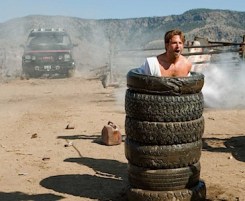 As much as I like serious action, I enjoy this kind of film too. I gave RED four stars; Shoot ‘Em Up the same. You may see where this is going. I am, once again, probably being too generous.
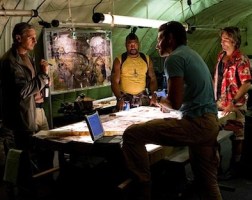 if that doesn’t or didn’t interest you, there’s no need for it. That said, one scene is apparently “big and puts some drama and emotion into the movie, maybe a bit too much for a PG rating”. (In the UK,
  If 2009’s
  though perhaps not always as memorably, and Ritchie crafts an array of interesting action sequences. Some still accuse it of being a sub-
 Yet for all that, that climax is a game of chess: Sherlock and Moriarty come face to face while in the room next door Watson and gypsy Simza try to spot an assassin. It’s one of a couple of scenes where Downey Jr.’s hero comes face to face with his nemesis, played by Jared Harris, and these scenes are definitely some of the film’s high points. Harris makes a perfect addition to the cast, the only disappointment being that we don’t get to see even more of him. Downey Jr.’s become such a Movie Star recently that it’s easy to forget he’s a multiple Oscar-nominee, and he and Harris give as good a hero-villain act-off as you’re likely to find in a blockbuster.
 Better served is Stephen Fry as Mycroft, a role normally rendered as a brief cameo. And indeed it’s little more than that, but there’s more of him than I was expecting (certainly so in one (pointless aside of a) scene that I’m sure you’ve heard about), and Fry of course excels — it’s the kind of role he was made for. Meanwhile the award for best agent goes to Eddie Marsan’s: Lestrade appears late on for all of two shots, but Marsan is still billed high enough to be on the poster, above most of the cast.
 A Game of Shadows comes out as a fun ride with several stand-out moments, but not as a particularly exceptional version of Sherlock Holmes. It’s very enjoyable as a comedy-action movie with amusing characters and entertainingly-staged action sequences, but while my affection for the first has grown to make it one of my favourite movies, this is just an entertaining follow-up.
 Sometimes you watch one of the most acclaimed films of all time and find yourself with very little to say about it. La Règle du jeu — or, as it’s commonly known in America thanks to Criterion’s incessant title translation (in fairness, that’s probably the most sensible way to combat the mass attitude of “argh! it’s in Foreign!”), The Rules of the Game
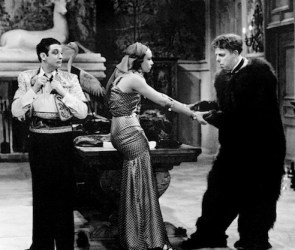 There’s a lot packed in, and I can see how multiple viewings could reveal even more going on. Perhaps a better researched awareness of the period (beyond the obvious Eve Of War, though that’s important) and of French class structure at the time is necessary to get the full richness of Renoir’s vision. The fact it was banned by the French government due to being bad for morale, then also banned by the occupying Nazis, suggests it did have a lot of social relevance.
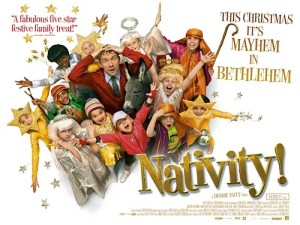 Yes, this is exactly the kind of review I should be posting in April. But hey, it’s Easter! That’s about Jesus too, right? (It’ll have to do, I’m not hanging on ’til next Christmas.)
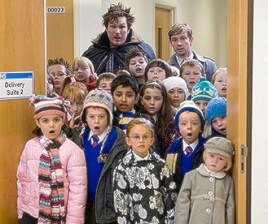 No one promised grim social realism — it’s a Christmas family film, with some moral messages and a sort of romance and sweet kids and a cute dog. And regular readers know how much I love a cute dog.
 Included on releases of
  The quality of the action sequences outweigh anything seen in the main Year One feature. They’re original, exciting and very fluidly animated. Apparently Montgomery is known in fan circles for liking a bit of violence and trying to add it to the action in DCU films she’s worked on, and that’s in evidence here too. It gives it an edge, I think.
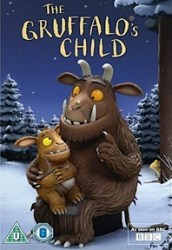 Shown on BBC One over Christmas, this animated adaptation of Julia Donaldson and Axel Scheffler’s The Gruffalo’s Child is the sequel to the Oscar-nominated adaptation of Julia Donaldson and Axel Scheffler’s The Gruffalo (of course). For my money, it’s every bit as good as the first film.
 RED here stands for “Retired, Extremely Dangerous”, a description bestowed by the CIA on a group of former agents who, for reasons I won’t go into — because, quite frankly, I can’t remember — fight back against the Agency when someone starts trying to kill them.
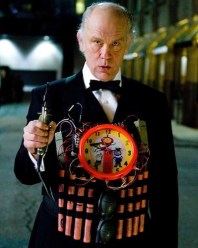 Naturally, considering the theme, the cast is made up of older actors — a neat twist on the usual action movie format of making people younger and younger. Expect this to spread, especially as anyone that could still just about be dubbed a movie star is ageing, replaced only by flash-in-the-pan teen idols. They’re all great because they’re all great actors. Well, Bruce Willis isn’t a Great Actor like Helen Mirren or Morgan Freeman, but he can do an action movie and he can do humour well enough. John Malkovich is as barmy as he always is, but here it works. Sometimes things just line up like that. Karl Urban also gives another solid supporting turn. I’m sure he’s had a few lead roles at this point, but maybe this autumn’s
 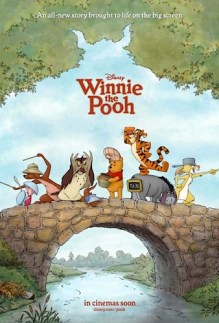 Winnie the Pooh, as many reviews on its release were keen to point out, is for small children. It doesn’t have the attempts to placate adults with their own jokes that elevate/plague most American animation; it’s only an attention-span-friendly hour long; and it has a lovely, genial, friendly tone, with brightly coloured characters, plinky-plonky songs and heartwarming moral messages.
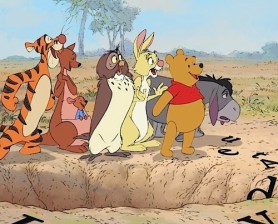 The majority of the film’s other elements click into place nicely too. The traditional animation is gorgeously executed, the voices are the ones we surely all know from growing up alongside Disney’s Pooh output, particularly Jim Cummings pulling double time as both Pooh and Tigger, as he has for decades. The exception I’d make is Bud Luckey’s Eeyore. I don’t know if he’s always sounded like that and I’d forgotten, but his voice didn’t work for me. It’s not the only problem: the songs can be a bit insipid; equally, a couple transcend that to work beautifully; and there’s no denying that it is a bit short; but then it doesn’t outstay its welcome, and hey,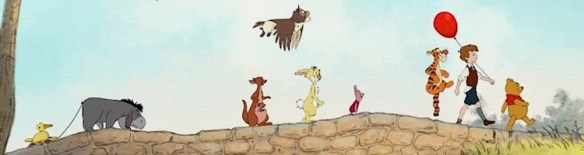
 100Films.co.uk