
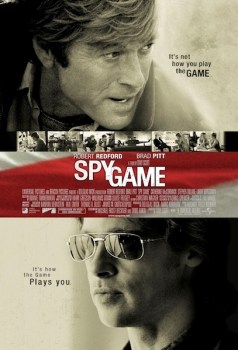
It’s how the game plays you.
Country: USA, Germany, Japan & France
Language: English, German, Arabic, French & Cantonese
Runtime: 126 minutes
BBFC: 15
MPAA: R

Original Release: 21st November 2001 (USA)
UK Release: 23rd November 2001
First Seen: DVD, c.2002
Stars
Robert Redford (The Sting, All is Lost)
Brad Pitt (Twelve Monkeys, Ocean’s Eleven)
Catherine McCormack (Braveheart, 28 Weeks Later)
Stephen Dillane (Welcome to Sarajevo, The Hours)
Director
Tony Scott (Crimson Tide, Man on Fire)
Screenwriters
Michael Frost Beckner (Sniper, To Appomattox)
David Arata (Brokedown Palace, Children of Men)
Story by
Michael Frost Beckner (Cutthroat Island, Prince Valiant)
The Story
When a retiring CIA agent’s one-time protégé is captured by the Chinese, he recalls their years training and working together, while battling internal agency politics to free his former friend.
Our Heroes
Nathan Muir is on the cusp of retirement, a former CIA field agent who’s now desk-bound and disregarded by his superiors. Previously, he recruited sniper Tom Bishop into the agency, training him to be a spy with Muir’s own values — which Bishop didn’t necessarily share, and his reaction against has ultimately led him into the hands of the Chinese. But how? Well, that’s what flashbacks are for.
Our Villains
Lots of Johnny Foreigners — but also some factions within the CIA itself…
Best Supporting Character
One of the CIA agents handling Bishop’s capture, and so attempting to handle Muir, is his oleaginous colleague Charles Harker. He’s played by the always-excellent Stephen “Stannis Baratheon” Dillane, who is perfectly snide in the role.
Memorable Quote
Bishop: “You don’t just trade these people like they’re baseball cards! It’s not a fucking game!”
Muir: “Oh, yes it is. It’s exactly what it is. And it’s no kid’s game either. This is a whole other game. And it’s serious and it’s dangerous. And it’s not one you want to lose.”
Memorable Scene
After an asset is killed, Bishop confronts Muir on a rooftop about the morals of what they do and why they do it. See also: Memorable Quote; Making of.
Technical Wizardry
The cinematography and editing haven’t yet reached the crazed heights Tony Scott would later display in Man on Fire and Domino, but it’s not without its affects. The flashbacks occur in a few different eras, so Scott decided to give each period a distinct look to remind the viewer of that time. For example, Vietnam is desaturated to a “strange sepia green”, while the colours in Beirut are heightened to mimic news clips from 1985. Conversely, Scott found the talky scenes within the CIA to be the “most challenging part of the movie” — without all his usual tricks, he had to rely on the quality of his actors to bring the scenes to life.
Making of
For the Berlin rooftop confrontation between Muir and Bishop, Tony Scott asked for more money to rent a helicopter. The producers refused — not unreasonably, when you consider it’s a dialogue scene. But Scott believed it was important and so rented the helicopter with his own money. Robert Redford was reportedly baffled by Scott’s use of a helicopter to film such an intimate conversation, but when he saw the final result he was impressed by how dynamic it made the scene.
What the Critics Said
“beneath the film’s nostalgic veneer and tooth-rattling visual and aural effects lies a mature ambiguity that’s unusual for a holiday blockbuster — and all but unheard of in a Tony Scott movie. […] the portrayal of Muir, Bishop, and their employers as significantly less than moral beacons makes the film surprisingly demanding as a whole. Rather than requiring us to take its desperate heroes and their dubious redemption entirely at face value, Spy Game slips in a refreshing dose of uncertainty with its cinematic jolts.” — Mark Holcomb, The Village Voice
 Score:
 66%
66%What the Public Say
“I have seen it three times now, and I still don’t have a full grasp of all the phone calls and cutaways and violent edits. This aspect, rather than being a distraction, is one of the film’s virtues. The idea is that Redford’s Nathan Muir is so smart that he is hoodwinking the CIA. Part of the game that the movie plays is that we the viewers are given just enough of a hint that we can appreciate his cleverness, but even we aren’t intended to fully ‘get it’. Tony Scott’s hectic, pulse-pounding visual style is largely responsible for this mesmerizing and confusing effect. Similar to (but far superior to) Guy Ritchie’s penchant for seemingly random visual tampering, Scott hits more often than he misses in Spy Game” — Ian Kay, Taking a Look

Spy Game is not normally considered the pinnacle in the careers of anyone involved, but there’s something about it that really works for me. In part it’s the chemistry between Redford and Pitt, a pair of actors who look like they could be father and son and exude a similar level of connection. The dual timeline structure keeps things rattling along, with Redford entertainingly running rings round the CIA in the present, while the flashbacks consider “the greater good” — how far should they go, and is it ever worth it? Possibly such questions weren’t appreciated on the film’s immediately-after-9/11 initial release, but they’ve since become more relevant than ever.

That’s no moon… it’s #88.
 You wouldn’t think the 2008 financial crisis would make good fodder for a comedy-drama — it’s both too complicated and too grim — but
  The narrative is laden with concepts that are so complicated even people within the industry don’t properly understand all of them (however did the market fail?!), but the movie nonetheless attempts to explain them in an accessible way. It’s half successful: you kind of understand them at the time, about enough to follow along, but the chances of remembering them later are next to naught. One of McKay’s tricks to engage us with these explanations is to wheel in random celebrities to deliver analogies. It’s a fun idea, though it’s success is debatable — I mean, I’ve just about heard of Selena Gomez, and I guess the “famous chef” that turns up must have a TV show in America, or something, maybe? Yeah, the ‘names’ he’s chosen are going to date this movie far more than its 2008 setting ever will.
 Though the conceptual explanations may fade almost as soon as you’ve heard them, what does stick with you is how it all ends. Essentially, the financial industry that destroyed peoples’ lives in pursuit of never-ending profit not only got away with it, but they actually started doing the same stuff all over again, just with new acronyms. What’s even more sickening is that people are clearly aware it’s going on — I mean, we’ve been told as much in an Oscar-winning movie — but they’re still doing nothing about it.
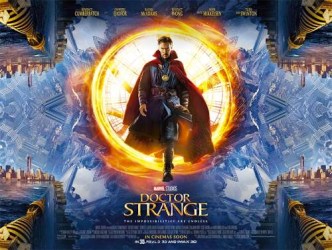 The latest from Marvel (or Marvel Studios, as they’re now branded, presumably in a bid to differentiate themselves from the properties owned by other studios that have been only too keen to use the Marvel logo and blur the line for the casual moviegoer) opens the door on a new facet of their shared cinematic universe, though does so in a movie whose plot follows the familiar “superhero origin story” rulebook. On the bright side, Doctor Strange has several other qualities to recommend it.
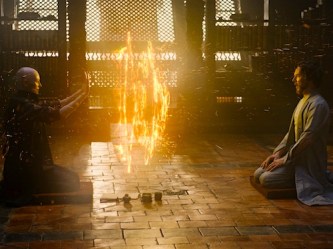 where the incredible effects are half the point — seemed dead in an era where every movie has CGI and every blockbuster has its share of once-impossible visuals. Strange demonstrates the form can be alive and well. The way the effects are created — with green screen and pixels — is the same as any other movie, but the designs and the visual imagination are exciting.
 Then there’s the cast. Obviously keen to avoid being typecast after playing an arrogant British genius in both
 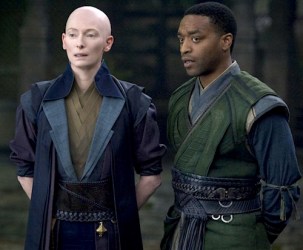 Besides, one of the film’s best characters is of Asian ethnicity, so it kinda balances out. That’s Benedict Wong as the sorcerers’ librarian, who’s likely to emerge as the film’s most popular character. It helps that viewers aren’t likely to expect much of him. Conversely, Chiwetel Ejiofor and Rachel McAdams are seriously underserved, perhaps hoping for more meat in the no-doubt-intended sequel(s).
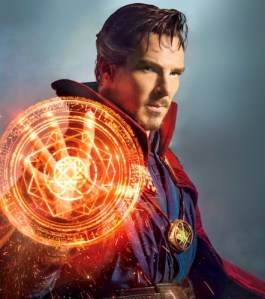 a teaser for another Marvel film, the other relates to the plot of the movie we’ve just seen. The former is first (and about 10% of my screening walked out before it came on) and the latter is, obviously, second (by which time about 90% had left). Those percentages ‘matter’ because, a) how do people not know Marvel’s rep for these scenes by this point?, and b) I think the scene related to the film you’ve just watched is the one that should be more attached to it, with the ‘teaser trailer’ being a fun bonus for those dedicated to stick around to the bitter end. But maybe that’s just me.
 One of a couple of films John Carpenter directed “for hire” in an attempt to restore his Hollywood reputation after the box office failure of
  Even if Carpenter was doing it only for kudos with the studios, he still turned in solid work. Christine may not be scary, but she is menacing, and her attacks work as individual sequences. Unsurprisingly it’s not his strongest film, and it’s not the greatest adaptation in the Stephen King movie canon either, but if all movies by jobbing filmmakers were this good then we’d be luckier moviegoers.
 By many accounts this is the greatest film I’d never seen (hence it being this year’s pick for #100). How are you meant to go about approaching something like that? Probably by not thinking about it too much. I mean, something will always be “the greatest you’ve never seen”, even if you dedicate yourself to watching great movies and the “greatest you’ve never seen” is something pretty low on the list… at which point I guess it stops mattering.
 Hollywood is notorious for adapting novels by grafting on happier endings, but here they did the opposite, removing even the glimmers of justice that the novel offers. In the book (according to Wikipedia), when McMurphy strangles Ratched he also exposes her breasts, humiliating her in front of the inmates; when she returns to work, her voice — her main instrument of control — is gone, and many of the inmates have either chosen to leave or have been transferred away. Conversely, in the film there is no humiliation, and we explicitly see that she still has her voice and that all the men are still there. Of course, McMurphy’s ultimate end isn’t cheery in either version. It’s almost like the anti-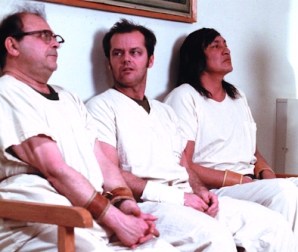
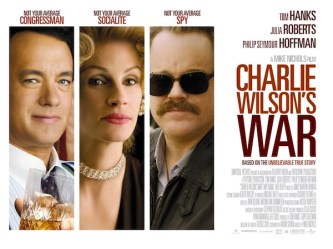 Unlikely stories can make great movies, or at least fun ones, and if this isn’t the former then it’s largely the latter.
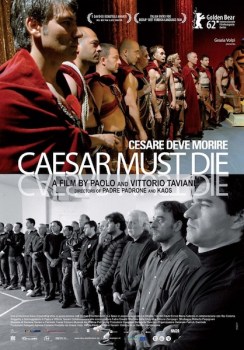 On the surface, this is a documentary about the inmates of Rome’s high-security Rebibbia prison — many of them with mafia connections — putting on a performance of Shakespeare’s Julius Caesar. However, it becomes clear fairly quickly that it’s all been staged, which is only more apparent when you learn some behind-the-scenes details (at least one prisoner had been released years earlier and returned to participate in this project).
 The directorial debut of uber-hearththrob movie star Ryan Gosling is not what you might expect someone of that particular adulation to produce. It’s not just that it has a dark heart, but that it’s slow, opaque, perverted, and not easily summarisable.
 It comes to a very cathartic ending, on multiple levels. I almost didn’t realise I needed that catharsis at the end — I knew I wanted certain characters to get their comeuppance, but the load that seems to lift at the end, with all the different climaxes combined, including parts that might not seem ‘good’… well, it’s almost like Rat is right about Bones’ actions lifting a bad spell.
 The director of minor horror
 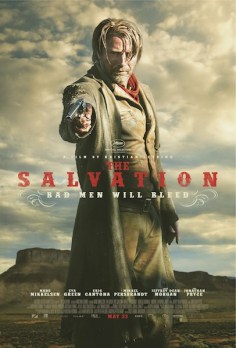 The spirit of the Spaghetti Western is kept alive in this Euro-minded South Africa-shot revenge Western.
 100Films.co.uk