Guardians of the Galaxy 3D (2014)

Rewatchathon 2017 #8
James Gunn | 121 mins | download (HD) | 2.40:1 + 1.78:1 | USA & UK / English | 12 / PG-13

Guardians of the Galaxy 3D

So, I just got a 3D TV. Well, it’s a 4K TV, but we’re interested in the fact it does 3D right now. And, to cut a long story short (literally — I wrote a 1,200-word post about this before deciding it was rambling and pointless), the impetus to get one now came from the fact that all TV manufacturers are ditching 3D from this year and I always kinda wanted it. (As to why I got a 4K one, apparently it makes for better quality 3D; plus it’s future proof — “future” being the operative word because I’m not replacing my Blu-ray player, I don’t keep a regular Netflix subscription, and Amazon Prime’s UHD selection (found on an otherwise-secret menu when you access it from a 4K device!) is quite pitiful.)

The first thing I watched was… the opening seven minutes of Doctor Who’s 50th anniversary episode, actually (which has superb 3D). But the first thing I watched in full was Guardians of the Galaxy, because I’d been meaning to rewatch it before the sequel lands at the end of the month, and because I’ve long been curious about the 3D version’s shifting aspect ratio.

Regular readers may remember that I love a good shifting aspect ratio, and Guardians does not disappoint. As usual for these things, most of the film is at 2.40:1, opening up to 1.78:1 for selected sequences. Director James Gunn uses it in a similar way to Christopher Nolan, with a scattering of expanded shots here and there alongside some whole sequences, mainly used for action scenes and epic establishing shots. (That’s as opposed to something like The Hunger Games: Catching Fire, which has more-or-less half the film in one ratio and the second half in the other.) Even on a TV the effect is immense, the screen-filling interludes feeling genuinely larger and more impactful. This was helped no small amount by my new TV being 12″ larger, which doesn’t sound like much but actually makes a huge difference (as the actress said to the bishop). That said, pausing a moment to do the maths, it’s nearly a whole third bigger than my old TV, so no wonder the difference is noticeable. But I digress…
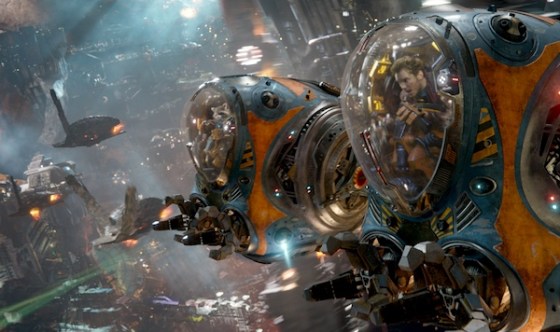
Knowhere's better in 3D

As with so many 3D blockbusters nowadays, Guardians was a post-conversion. Nonetheless, I commented in my original review that some sequences seemed to have been designed with 3D in mind — specifically the chase through Knowhere, which I described as “little more than a blur.” I feel like past-me was correct, because I had no such issues with the sequence this time out. Even though I enjoy it, I’m still one of those people who regard 3D as fundamentally little more than a gimmick (though I’ve yet to see Hugo, so I guess there’s still room for my own conversion to considering it a Serious Filmmaking Tool), but it does lend a scope, scale, and pizzazz throughout the movie that’s a lot of fun, especially during the big action sequences. Indeed, particularly when combined with the shifting aspect ratio, it makes for some very striking moments.

I’d hesitate to say the 3D improved my opinion of the film as a whole, but I think the second viewing certainly did. My aforementioned original review was pretty darn positive, though I think I’d remembered enjoying it less than I did because the praise it received in some other quarters went into overkill. On this viewing I didn’t feel the problems with pace that bothered me before; and while I continue to think Nova City could do with more development before the climax (I still can’t even remember its proper name), I found said climax to be less overlong and more structured. Obviously the film itself hasn’t changed (well, other than that extra visual dimension), but my perspective on it clearly has (in addition to that extra visual dimension).

Badasses of the Galaxy

For all the benefits of bigger screen sizes, extra dimensions, and an adjusted appreciation of its pacing, Guardians’ greatest asset remains its characters and how much fun they are to be around. They are primarily what make it a mighty entertaining movie, whether in two dimensions or three.

4 out of 5

The UK TV premiere of Guardians of the Galaxy is on BBC One tonight at 8:30pm — in 2D, of course.
Star Trek Beyond (2016)

2016 #183
Justin Lin | 122 mins | Blu-ray | 2.39:1 | USA, Hong Kong & China / English | 12 / PG-13

Star Trek Beyond

The cover of Star Trek Beyond’s Blu-ray proudly proclaims that it’s “the best reviewed action movie of the year”. I don’t think that’s true (Civil War, anyone?), but it does indicate the mindset producing these films nowadays: they’re not the serious-minded sci-fi the Trek franchise was once known for, but action-orientated summer blockbusters.

As that, Beyond is pretty entertaining. An overall lighter tone than the heavy-handed Into Darkness, plus competently executed action sequences and fewer incredulity-inducing contrivances, make for a fun adventure.

Surprisingly, it doesn’t succumb to the modern franchise proclivity for forcing third movies to be trilogy-formers. Maybe that shouldn’t be surprising though: it was confirmed before Beyond’s release that a fourth (aka fourteenth) movie is in development, so obviously this shouldn’t feel like the end of the road for this crew. The upside of this is that Beyond can get on with its story, unworried about being Epic.

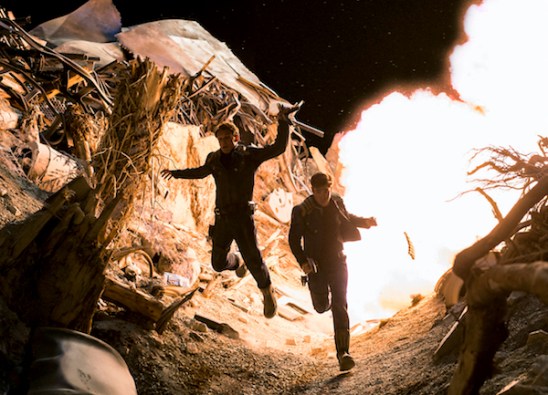
Explosive

The downside is it creates a “just another adventure” feel to the plot — a bread-and-butter situation for Star Trek’s original TV format, but underwhelming in an expensive blockbuster movie franchise. Consequently Beyond feels inessential. That’s an odd sensation in a franchise nowadays, where the usual MO sees every movie feed into a bigger multi-film narrative. But with Into Darkness being deliberately ignored here (thanks to its unpopularity with hardcore Trekkies) and Beyond functioning as “just another adventure”, Trek is almost a franchise-out-of-time, where individual instalments can be entirely enjoyed in isolation.

Not that I think that’s a bad thing. Beyond may lack a certain epicness, but it’s entertaining enough for what it is.

4 out of 5

Star Trek Beyond is available on Sky Cinema from today.

Swiss Army Man (2016)

2016 #177
Daniel Scheinert & Daniel Kwan
(aka Daniels) | 97 mins | Blu-ray | 2.40:1 | USA / English | 15 / R

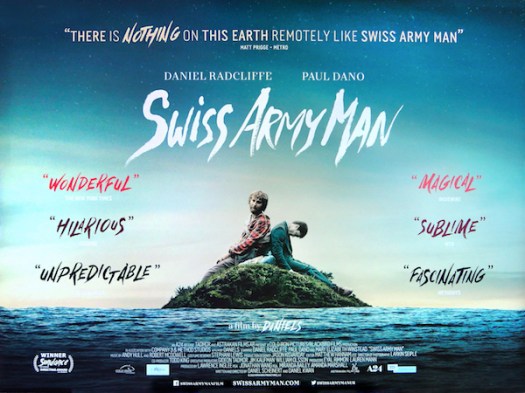
Swiss Army Man

If you’ve heard of Swiss Army Man, it’s likely for one thing and one thing only: this is the movie where Daniel “Harry Potter” Radcliffe plays a farting corpse with an erection. But rather than the childish super-gross-out comedy that short pitch would seem to suggest, Swiss Army Man is actually quite a sweet indie comedy-drama. With some super-gross-out comedy thrown in, natch.

The plot that leads us to the farting boner corpse begins with Hank (Paul Dano) stranded on an island and, in his lonely despair, attempting suicide. Then he spots a body washed up on the nearby beach. It turns out this isn’t a new friend, because he’s dead. Hank dubs him ‘Manny’. One thing leads to another and Hank uses Manny’s gastric expulsions to create a kind of jet ski that propels them off the island. Hank soon discovers the corpse has myriad potential uses (hence the title), especially when he starts to talk…

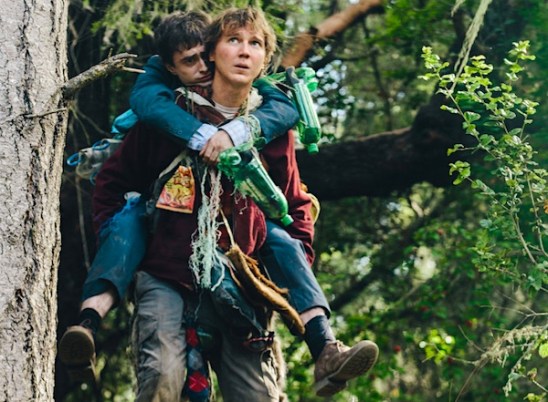
Swiss Army Man is kind of like Cast Away if Wilson the volleyball was a farting corpse. Hank despairs at his situation, chats to the technically-inanimate Manny about it, and together they begin to work through the human condition. In between using Manny’s rigor mortis-powered limbs to chop wood, or his boner as a magic compass to guide them home, that is. I was going to say “it’s that kind of movie”, but I’m not sure there’s ever been another movie quite like Swiss Army Man.

He ain't heavy, he's my farting boner corpse

As well as the indie ruminations on the purpose and meaning of life, there are some mystery plots in play, just to keep things engaging. Who is the woman Hank keeps seeing in flashbacks? How many of Manny’s abilities are real and how much is just in Hank’s head? I mean, Manny can’t really talk… can he? What if Manny’s not the only one who’s dead? Maybe these shouldn’t be given so much focus — I don’t think the film wants to be about such plot mysteries — but they were the kind of things running through my head while watching, because you know there’s bound to be some kind of twist or reveal for what’s actually happening. Naturally, I won’t spoil that here; but perhaps the film plays even better on repeat viewings, when you can set aside such wonderings and focus even more fully on the friendship between man and corpse.

That’s naturally powered by the two lead performances. Dano is very good as a man who’s feeling suicidal for, as it turns out, more reasons than “I’m alone on an island”; though enacting such patheticness (as a human trait rather than a criticism of his mental condition) seems very much within Dano’s wheelhouse. Radcliffe, however, is simply brilliant. Manny comes back to ‘life’ as a kind of innocent, unsure of how the world works and driven by his basest feelings; a reflection of all our inner psyches, in a way. Physically constrained by being, y’know, dead, Radcliffe manages to convey so much despite — or perhaps even partly because of — the limitations imposed upon him.

Corpsehood

Made for a relative pittance, technical merits are also strong, with neat special effects to convey Manny’s abilities, and a very indie-ish but fitting vocal-driven score by Andy Hull and Robert McDowell. Interestingly, the Blu-ray contains an option to watch the film without the score, which (based on the few bits I sampled) creates a remarkably different experience. That’s true of most films, of course, but here it dramatically changes the mood of some scenes. It’s less magical, in a way, and sadder, and maybe creepier, which is not the point or message of the film.

“The farting boner corpse movie” is the kind of pithy description that will put many viewers off, but hiding behind the gross-out facade is a sweet comedy-drama about human interaction that, in its own way, is an incredibly moving, perhaps even heartwarming experience.

4 out of 5

Swiss Army Man is released on DVD and Blu-ray in the UK today.

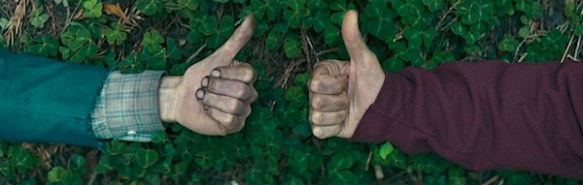
Thumbs up

The BFG (2016)

2017 #51
Steven Spielberg | 117 mins | Blu-ray | 2.39:1 | USA & India / English | PG / PG

The BFG

The writer/director team behind E.T. reunite for another tale of a young kid befriending a strangely-proportioned otherworldly creature who can’t quite speak English properly and has an acronym for a name. This one, of course, is adapted from Roald Dahl’s beloved children’s book, here rendered into live-action — or, for a large part, realistic computer animation — by director Steven Spielberg.

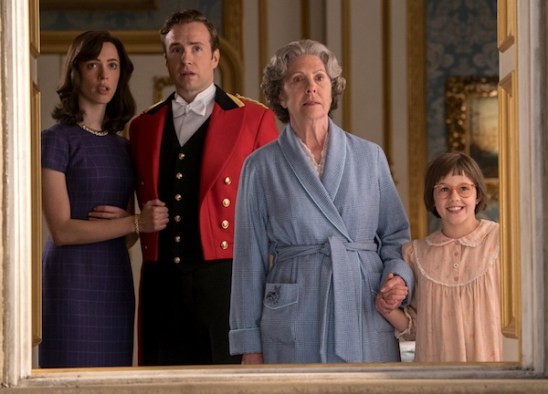
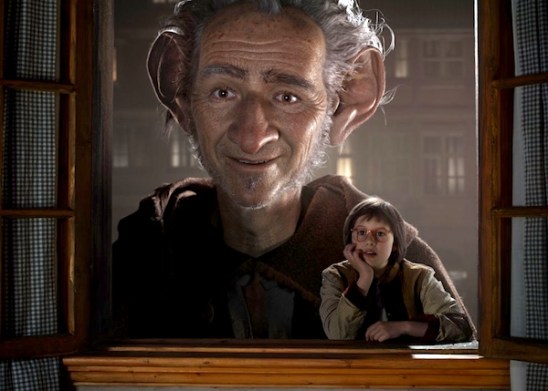
If you don’t know the story, it concerns insomniac orphan Sophie (Ruby Barnhill), who one night spots a 24ft giant outside her window. Wary of her informing the rest of the world of his existence, he snatches her up and carries her off to giant land. Despite Sophie’s fears, he doesn’t eat her, because he’s actually the Big Friendly Giant (Mark Rylance, motion captured) — but his fellow giants are a different story. Led by Fleshlumpeater (Jemaine Clement, also motion captured), they bully the comparatively tiny BFG and are a constant threat to Sophie’s life, so she concocts a plan, which involves a trip to see the Queen (Penelope Wilton).

For all its CGI — and, in creating a fantastical other-world adjacent to our own, there is a lot — much about The BFG feels pleasantly traditional, almost like a throwback to kids’ movies of a couple of decades past. This is partly the re-teaming of Spielberg and screenwriter Melissa Mathison, I suppose, but perhaps also the decision to retain the novel’s original 1982 setting. Not that you’d know it for most of the running time, until the Queen makes some telephone calls to “Nancy and Ronnie” (Reagan) and “Boris” (presumably Yeltsin, though that means someone’s got their eras mixed up); references that, coming quite near the end of the film, made me pause in the realisation that it wasn’t just set today (the reference to Boris made me assume the Queen was phoning our foreign secretary).

Window dressing

More than dated references, though, the throwback feel is thanks to the pace. I’d hesitate to call The BFG slow, but it’s certainly gentle for a good long while. I don’t think it needs to be a fast-paced thrill-ride, but a little extra speed early on, bringing the luxuriant two-hour running time down closer to the 90-minute mark, might’ve been beneficial. There’s certainly magic and wonder to be found throughout, which are very important aspects of a story like this, but I do wonder if kids might get a bit fidgety nonetheless, which would destroy the effect.

There is a lot to admire, however. The production design is superb, the giants’ environment full of stuff pilfered from the human world and re-appropriated into useful things — a ship for a (water)bed, for example, or a road sign for a tray; in one sequence, cars and trucks become roller skates. It’s all realised with startling detailed CGI. Okay, you’re not going to mistake the giants for upsized real humans (which kinda makes me long for a Hook-era version of the film, when they would’ve done it all for real with optical effects), but look at the small details — the texture of the giants’ skin, for example — and it looks phenomenal.

More importantly, the acting is pitched perfectly. Clement and his cohorts manage to be both menacing and comical by turns, Wilton brings easy class to the Queen, and Rafe Spall has an amusing little supporting role as a palace footman. However, Rebecca Hall is utterly wasted in a strangely nothing-y part as the Queen’s assistant — I can only presume this was either one of those “I love the book so will take any role” situations or one of those “my part was mostly cut” situations.

Big star, little star

But the real stars are the two leads. Ruby Barnhill was the result of a months-long search for the perfect Sophie and it was worth the effort. Called upon to be confident, scared, awed, and ingenious, Barnhill’s performance is precisely calibrated — “subtle” would perhaps be overselling it, but she lacks the histrionics you get from weak child actors. She’s overall charming, which is important in engaging us in the relationship between her and the BFG. In the giant role, Mark Rylance is, of course, sublime. He may have been recreated in the computer, but all of his personality shines through, his expressions and mannerisms both believable and familiar if you’ve seen him in his corporeal form. It’s one of the best-yet advocacies of so-called “performance capture” (where the actor’s whole performance is captured by those grey jumpsuits with little dots on, as opposed to just “motion capture” where it’s only their physical moves being digitised and supplemented by animators — both are the same process really, it’s just someone coined a different term to indicate when more of the actor’s own work is retained).

Considering the level of challenge The BFG clearly presented to Spielberg (in the special features he talks about how at times he was unsure how to make the movie, with all the tough requirements of different scales, etc; he and his team actually spent a whole summer making the movie in previsualisation before they did it for real the year after), it’s something of a shame that it’s destined to be regarded as a minor work in his canon. I’m not going to argue it deserves a greater status among his venerable output, but it would be a shame for it to go ignored because of that.

4 out of 5

The BFG is available on Amazon Prime Video UK as of this week.

The Witch (2015)

aka The VVitch: A New-England Folktale

2016 #171
Robert Eggers | 93 mins | Blu-ray | 1.66:1 | USA, UK, Canada & Brazil / English | 15 / R

The Witch

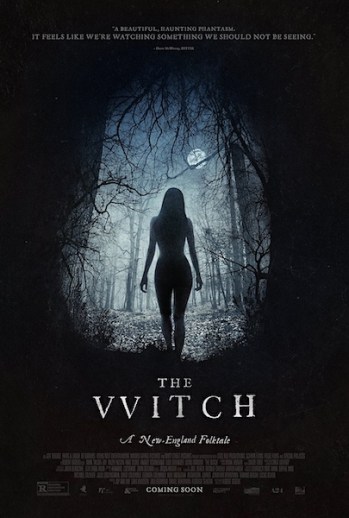
There’s a lot to commend in this debut feature from writer-director Robert Eggers, the story of English settlers in 17th Century America who are banished from their community and begin to be affected by a supernatural force in the woods.

With dialogue lifted from contemporary reports of witchcraft, it has a level of period authenticity that is rarely seen. I thought it was an immensely effective choice for evoking an entirely different era, but others find it a distracting affectation. Also distancing for some viewers is the understated style — it’s more of an arthouse period flick than a gore ‘n’ guts chiller; like a horror movie made by Terrence Malick. Much like the dialogue, I thought that gave it a level of realism. You know this isn’t a true story because such occult happenings aren’t real… but if they were, they’d be like this.

It’s not a horror movie that suits all tastes, then, but I thought it was v.v. creepy and v.v. good.

4 out of 5

Tokyo Tribe (2014)

2016 #149
Sion Sono | 112 mins | streaming (HD) | 2.35:1 | Japan / Japanese | 18

Tokyo Tribe

Adapted from the manga Tokyo Tribe 2, the film version is a hip-hop musical, sung (or rapped) through by an expansive cast who make up the titular tribes — gangs who rule the streets of a divided near-future (or possibly alternate reality; or possibly it doesn’t matter that much) Tokyo. The world of the story is pretty barmy, and much of the plot follows suit — I’m not going to attempt to describe it, but suffice to say it involves kidnapped girls, rescue attempts, and brewing gang warfare.

Much of the film does feel like a cartoon brought to life, with the ultra-heightened scenario and larger-than-life scenery-chewing villains — as the big bad, Riki Takeuchi hams it up so ludicrously his performance circles back round into genius. It’d definitely be an adult cartoon, though, because director Sion Sono brings a kind of trash-art, exploitation vibe, with gratuitous helpings of nudity and violence. Indeed, that direction is indicated early on when a young female police officer ventures into gang territory and is grabbed by one of the villains who, in front of a baying crowd, rips open her shirt and begins to trace a knife around her naked breasts to explain the various gang factions. It’s kind of kinky, kind of nasty, kind of distasteful, kind of not (I mean, he is a bad guy) — if you wanted to summarise the feel of the whole film in one sequence, it’s actually not a bad start.

When too many tribes to keep track of go to war

I watched Tokyo Tribe out of pure curiosity (a rap musical isn’t exactly my usual kind of thing) but I ended up rather loving it, which is why it made my 2016 top 20. There I summarised that its mix of “battle rap, comic grotesques, ultra violence, gratuitous nudity, more barmy notions than you can shake a stick at, and probably the kitchen sink too, [made it] possibly the most batshit-crazy movie I’ve ever seen.” So those extremes don’t bother me per se (other than to the extent they should bother me), but there’s an undoubted not-for-everyone-ness to a lot of it. That, plus some rough edges, are all that hold me back from giving it 5 stars.

4 out of 5

Tokyo Tribe placed 19th on my list of The 20 Best Films I Saw For the First Time in 2016, which can be read in full here.

Room (2015)

2017 #37
Lenny Abrahamson | 118 mins | streaming (HD) | 2.35:1 | Ireland, Canada & UK / English | 15 / R

Room

Oscar statue2016 Academy Awards
4 nominations — 1 win

Winner: Best Actress.
Nominated: Best Picture, Best Director, Best Adapted Screenplay.


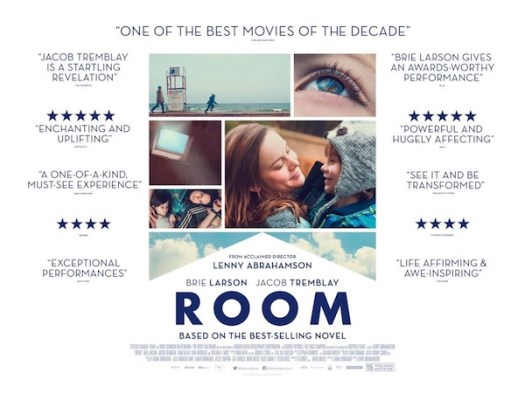
Inspired by the infamous Josef Fritzl case (but most decidedly not a a direct fictionalise thereof), Room is a drama about a horrific crime — at times it could even be said to be a crime thriller — but it’s not interested in dealing with the usual outcomes of such filmic narratives; namely, justice or revenge (or both). Rather, it has a goal both more realistic and humane: it’s about the victims, and the psychological toll the crime exerts upon them.

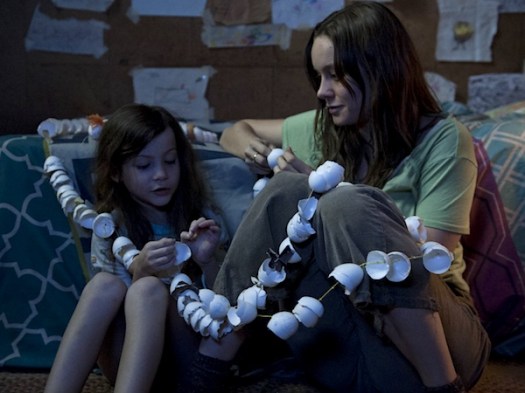
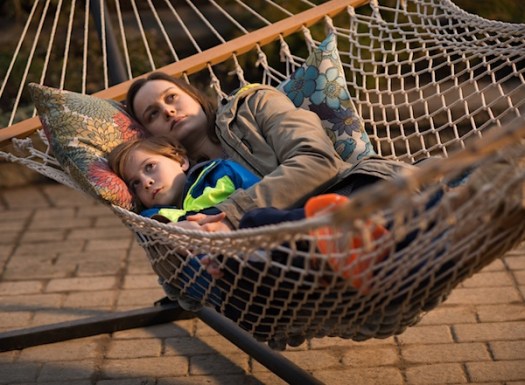
It’s told primarily from the point of view of Jack (Jacob Tremblay), a five-year-old boy whose entire world is Room, the small space he lives in with his mother, Ma (Brie Larson). What Jack doesn’t understand, but is quickly obvious to the viewer, is that they’re being held captive by ‘Old Nick’ (Sean Bridgers), who visits nightly for… well, you can guess what for. Ma has tried to keep Jack sheltered from the reality of their situation, not telling him properly about the outside world — until one day she hatches a plan for their escape.

Which possibly makes Room sound more action-packed than it is. There’s a sequence of edge-of-your-seat tension in the middle of the film, when Jack and Ma execute their plan, but otherwise this is a very grounded movie. Obviously the situation the characters have found themselves in is pretty extraordinary, but we know these things happen (Fritzl is, sadly, not the only example), and Room is committed to being a plausible exploration of such cases rather than an adrenaline-fuelled Movie version.

In Room, no one can hear you scream

This is a spoiler, really, but it’s also vital to understanding the film’s point and focus: that escape attempt, which occurs more-or-less exactly halfway through the movie, is a success. After seeing the existence Jack and Ma endured inside Room for the first half, the second is about how they adjust and cope to being in the real world after their ordeal. This half-time switch-up is the film’s primary strength. A comment I read online taps into why that’s the case: “At the beginning it was great. I thought it was gonna be a claustrophobic thriller/horror film following the line of others like Cube, Panic Room or even Das Boot… I got the feeling that if they would had escaped later on, the film would have been better.” This person is, of course, wrong, and their own comment demonstrates why. Sure, you could make this kind of story into “a claustrophobic thriller/horror film”, but that would be a genre B-movie and nowhere near the psychological realism (and, by extension, respect for real-life victims of such crimes) that Room is clearly interested in. I have to reluctantly agree that the first half is the more gripping and involving, but the second half — the having to cope with the psychological fallout once their ordeal is over, a very real but much less-seen aspect of crime — is where the meat and heart of Room lies. Or wants to.

The thing is, is it the case that the characters’ situation is inherently emotional, and therefore it’s pretty hard for a film about it to not elicit strong responses, rather than that this film in and of itself is doing anything particularly special? Some would give that an emphatic “yes” — criticism of Lenny Abrahamson’s plain direction abounds. I think that does him a disservice. This is not a showy movie, but nor should it be. Saying it’s no better than a cheap cable TV movie shows a lack of understanding for the quality of being understated, and the difference between that and thoughtless point-and-shoot quickie filmmaking. Indeed, the wiseness of the filmmakers in not giving the story an overly histrionic treatment is one of its biggest assets.

If you're happy and you know it stare blankly into space

Another is the performances. Larson is excellent, full of subtleties even when called on to enact more obvious Dramatic Moments. Ma runs the emotional gamut throughout the movie and Larson negotiates every changing facet with believability. Tremblay isn’t half bad either. I stop short of bigger praise for him because, frankly, I found his character pretty irritating at times, but that might be part of the point so maybe I’m being unfair. While those two are the natural focus, there are effective supporting turns from the likes of Joan Allen as Ma’s mom and Tom McCamus as her new partner, who gets one of the best scenes.

Despite these qualities, I was left wondering how much it had dug into Jack and Ma’s psychology, really? The decision to focus on the kid keeps us removed from Ma at some key points, giving us a snapshot of how she’s been affected rather than a detailed portrait. But we never fully get the psychology of Jack either. On the one hand that’s because, well, he’s only five years old; and on the other it’s because he’s lived his entire life in a situation we can only try to imagine — it’s hard to connect with his very unique worldview. That’s not to say the film fails entirely — there are moments, even whole scenes, where we’re able to access some level of understanding for what these characters have experienced — but as for the totality of it? Well, as I said, it’d be hard for the film to not generate sympathy just given the pure facts of the story it tells, but in terms of going further than that, I just felt there was something missing.

Hammock

Make no mistake, Room is a very good, very affecting film, powered by two strong lead performances, but at the end I felt there was more left to understand about these characters and their experiences.

4 out of 5

The UK network premiere of Room is on Channel 4 tonight at 9pm.

It was viewed as part of my What Do You Mean You Haven’t Seen…? 2017 project, which you can read more about here.

Deadpool: No Good Deed (2017)

2017 #32a
David Leitch | 4 mins | streaming (HD) | 2.35:1 | USA / English

Logan

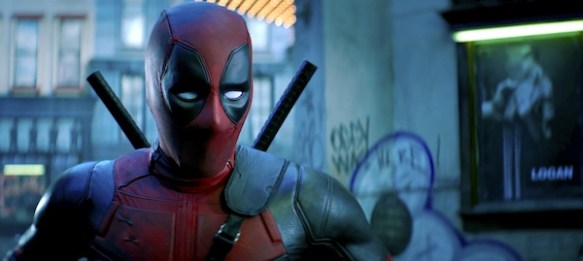
Screened before Logan in the US but only available to us poor disadvantaged foreigners thanks to the magic of the interweb, No Good Deed could be regarded as nothing more than a teaser trailer were it not: (a) about four times longer than your average teaser, (b) almost certainly not actually part of the film it’s teasing, (c) listed on IMDb and so forth as a short film, and (d) a self-contained story that is, all things considered, pretty amusing.

If you were also unfortunate enough to have not had your screening of Logan graced by Deadpool’s irreverent goodness, enjoy:

4 out of 5

All being well, Deadpool 2 will be released on 2nd March 2018.

Logan (2017)

2017 #30
James Mangold | 137 mins | cinema | 2.35:1 | USA / English & Spanish | 15 / R

This review contains major spoilers.

Logan

Little Miss Sunshine meets Hell or High Water via Midnight Special, with more superpowers and (probably) fewer Oscar nominations, in the film some people are calling the best superhero movie since The Dark Knight.

In the not-so-distant future, the man once known as Wolverine, Logan (Hugh Jackman), is living / hiding on the US-Mexico border, his once formidable powers diminished by age. He works as a limo driver to afford meds for an ailing Professor Charles Xavier (Patrick Stewart), whose psychic powers have become dangerous as his brain falters with age. When a woman recognises Logan and asks for his help, the disillusioned former X-Man fobs her off. But soon dark forces and a mysterious girl (Dafne Keen), not to mention his innate moral code, will force his claw-wielding hand…

While Marvel Studios harp on about how they mix other genres into their superhero movies, with such-and-such a film being superheroes-cum-political-thriller, or this-and-that film being superheroes-cum-heist-movie, and so on, everything they produce is really merely colouring within the lines of the superhero picture, they’re just using different crayons to do it. Logan not only uses different crayons, but it’s colouring a whole new picture, too. It’s not the first superhero movie to operate at a remove from the standard big-budget tropes of the genre, but it is perhaps the first from a major franchise to dare to step so far outside the norm. As I intimated at the start, the feel of the piece is more indie neo-Western road movie than CGI-driven superhero spectacular, though to imply it stints on expensive action thrills would be disingenuous. It still cost $97 million, after all, and so works at ways to retain the favour of a blockbuster-seeking crowd. Nonetheless, the overall impression is of a refreshing change for the subgenre, with a more distinctive feel than any of those aforementioned Marvel movies.

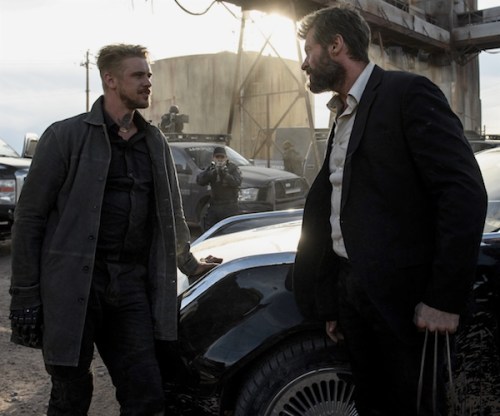
Wolverine vs Robotic Hand Man

That doesn’t mean it’s perfect, sadly. Functionally speaking, Logan barely has a villain. There are some ill-intentioned and dangerous people after X-23, so our heroes have to run away from them — that’s all the role they have to play. Heading up the hunt is Pierce (Boyd Holbrook), a henchman figure who’s de facto lead villain purely because he gets the most screen time. Unfortunately, he has more personality in his defining attribute, a CGI robotic arm, than in the rest of his characterisation combined. The theoretical Big Bad is Dr Zander Rice (Richard E. Grant), an evil scientist who we’re told developed some kind of virus that all but wiped out mutantkind, but now seems incapable of tracking down a group of preteens. He’s not on screen enough to make any kind of meaningful impression. On the bright side, on my “how badly miscast is Richard E. Grant” scale (which ranges from “very badly” to “not that bad, I suppose”) this errs towards the positive end, precisely because of that lack of screen time. Lastly there’s younger, fitter Wolverine clone X-24 (also Jackman), who’s at least intentionally devoid of personality — he’s been bred without it so he’ll be the perfect biddable killing machine. Obviously he’s ripe for some sort of thematic commentary — on ageing; on morality; on heroism; on, frankly, anything — but it never comes.

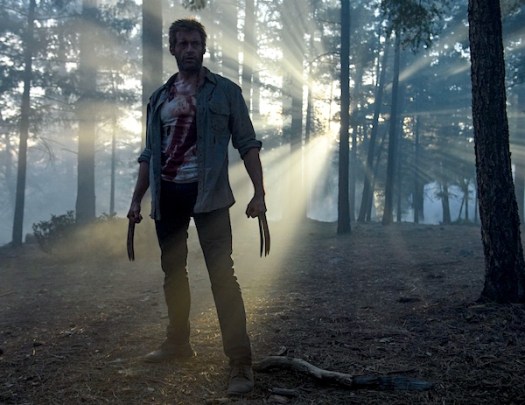
With the villainous side of the equation so unbalanced, we’re left primarily with our heroes. Fortunately, they do take up the slack, mainly through a pair of fantastic performances from Jackman and Stewart. Wolverine is undoubtedly the defining role of Jackman’s career, a part he’s played on and off for 17 years across seven movies (as a lead, plus a couple more cameos). Here he’s the most human he’s ever been. In many ways Logan was always one of the most relatable X-Men, one of our points of entry into their world and taking the piss out of them and the situation when it was called for. He was still primarily a likeable character in a fantastical world though, whereas here he feels more like a real person, struggling with the physical detriments of ageing and (less explicitly) the metaphysical quandaries of what it was all for. As he puts his time with the character to bed, Jackman gets to deliver his most nuanced and affecting turn in the role. Neatly, it mirrors where it all began for this version of the character: protecting a young mutant girl struggling to come to terms with her dangerous powers in a world that’s out to get her.

Professor X-piring

Stewart is every bit as good as a man defined by his mental prowess whose mind is failing. Originally cast to play a statesman-like role in the series, here Stewart gets to have a bit more fun, to be a bit more cheeky, but also to tap into a bit more depth of emotion, as Charles struggles with whatever it was he did to land him in hiding in Mexico (I think there was some dialogue that explained it but, frankly, I missed it in the mumbly sound mix. I’ll catch that on Blu-ray, then).

Of course, they both die. Normally that’d be shocking in a major studio blockbuster, but it’s quite clear Logan is playing by different rules, and in those rules the old good guys die. Heck, nearly everyone dies, but the only deaths that matter are Charles’ and Logan’s. What’s at least a bit interesting is how they die. For Professor X, it’s almost ignominious, — in a bed, not even his own, stabbed by X-24 for virtually no reason, then later fading away in the back of a truck. It’s not a grand heroic self-sacrifice while trying to save the world, the kind of death you’d expect for a character of his stature (and more or less the kind he got in The Last Stand, the first time they killed him off). It’s a great life come to a meaningless end. Well, Logan’s that kind of movie — it has no reverence for such things, just as life itself does not. Conversely, the death of Wolverine / Logan / James Howlett (who is he, in the end?) is a sacrifice, the selfish man of the movie’s opening giving himself up to save some kids; or, in grander terms, to save the future. Ah, but he was never really selfish, was he? It was an act. An affection brought by the hard years. He was always a good guy at heart. Always an X-Man, as the neat final shot emphasises.

Wolverine: The Last Stand

So there is some thematic meat to tuck into here, even with the apparent dead-end (pun not intended) of the X-24 subplot. Couple that with the many uncommon-to-the-genre plot and tonal points and you have a movie that does merit consideration as one of the finer superhero films. However, the perception some espouse of this being brave or bold moviemaking is not inherent to the film. If this were an original story starring new characters, especially if they didn’t have superpowers, it wouldn’t make it a bad film, but nor would it be perceived as being so original or revolutionary. What is uncommon or remarkable is making that kind of movie with a well-known character, and in particular one who’s familiar from leading CGI-fuelled PG-13 summer spectacles.

Is that alone enough to confer greatness? Logan’s consistency of style and tone render it easily the best Wolvie solo movie (as much as I liked The Wolverine on the whole, its climax was horrible), but for this X-fan it’s not enough to usurp the top-draw traditional superheroics to be found in the three or four genre classics produced by the main series. Perhaps time and re-viewing will increase Logan in my estimation, however, because it is a very strong film indeed.

4 out of 5

In a Valley of Violence (2016)

2017 #20
Ti West | 104 mins | download (HD) | 2.35:1 | USA / English | 15 / R

In a Valley of Violence

The spirit of the Spaghetti Western is alive and well in writer-director Ti West’s shoot ’em up; though where they once took inspiration from samurai movies, now Mr West has his sights set on modern-day gun-fu movies — specifically, here he retrofits John Wick into a familiar Old West narrative.

On his way to Mexico with just his horse and dog Abby for company, drifter Paul (Ethan Hawke) passes through an almost-deserted town, where he ends up in a fight with wannabe-tough-guy Gilly (James Ransone). It turns out Gilly is the son of the local Marshal (John Travolta), but he considers the matter settled and lets Paul move on, ordering his son to leave it be. A shamed Gilly has a different opinion, however, leading his gang of friends to assault Paul in the dead of night. But as is the way with halfwit villains, they leave our hero alive, ready for him to ride back into town and exact his vengeance.

If you come to movies looking for an original storyline, you’ll be disappointed here — as I say, it’s basically John Wick in the West (if you’ve seen that Keanu Reeves actioner, you’ll already know the outcome of Gilly’s revenge on Paul). The devil is in the details, however, and in that respect In a Valley of Violence is rather enjoyable. Perhaps the biggest mark in its favour is its sense of humour. It’s not a comedy by any means, but Gilly’s gang are borderline incompetent in a way that’s increasingly laughable.

Do you know what they call a Quarter Pounder with cheese in the West?

Travolta gets in on the act as a man who seems very much in control of his own little kingdom, but when things truly kick off he’s somewhat caught in the middle. Thankfully he’s not just the bullying villainous type, instead getting a nicely balanced reaction to events: he knows Gilly’s done wrong, but stands by him because he’s his son; but when Paul’s pushing comes to shoving… well, familial loyalty only gets you so far.

As Paul, Hawke finds some degree of complexity in the (anti-)hero, but this isn’t exactly a movie built for psychological complexity. Taissa Farmiga is positioned as the love interest, but thankfully isn’t entirely reduced to such a thankless role. As her sister, Karen Gillan reminds us that, while she may be best known for brightly-coloured sci-fi on screens both big and small, her roots are in comedy. But the biggest star is, of course, the dog. You can’t help getting attached, even when you know you’re watching John Wick of the West.

The dog's the star

The film offers many stylistic nods to remind us of its Spaghetti inspiration, like the starkly animated title sequence, or Jeff Grace’s Morricone-riffing score, which some criticise for its obviousness but I thought was fun. It even comes through in the film’s structure, with a slow-burn first half that reminded me of Leone’s attitude to action. Some complain of the pace there, or lack of it, but I rather liked that. It partly functions as a deliberate delaying of gratification: the main reason we’re here is for the bloody vengeance we know will eventually be coming, but West carefully sets the scene and gradually puts characters in place early on so that the second half can more fully concentrate on the violence. The wit is kept alive even then, with more than one of the deaths provoking at least some laughter.

The more I write about it, the more I wonder if this film is something of an acquired taste. It’s not out-and-out comical enough to be classed as a comedy, but action die-hards may feel the lighter elements undermine the violent thrills they seek. I thought it worked, but experience has taught me that I’m more accepting than most of such tonal mash-ups.

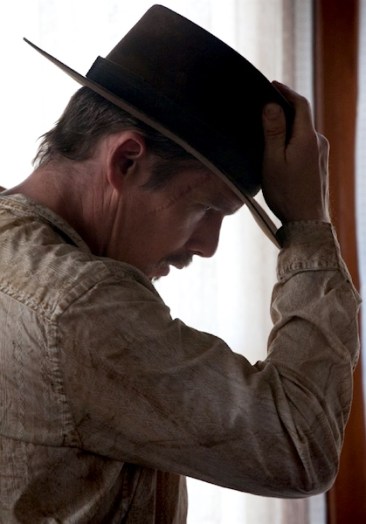
Cool cowboy

Despite the plot similarities, In a Valley of Violence isn’t going to challenge John Wick for ultra-choreographed action satisfaction, but it has many aspects to recommend it for those who like a chuckle alongside their bloodshed.

4 out of 5

In a Valley of Violence is released direct to DVD & Blu-ray in the UK on 6th March.
John Wick: Chapter 2 is in UK cinemas from today.