Road to Singapore (1940)

2008 #61
Victor Schertzinger | 85 mins | VHS | U

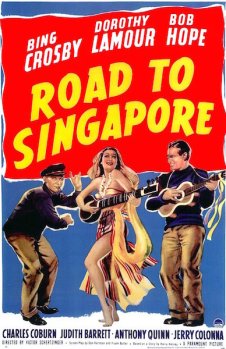
Road to SingaporeBob Hope and Bing Crosby star as a pair of young(ish) playboy sailors who run away from responsibility and family expectations in this comedy that launched the perennially popular Road to… series, which would spawn six sequels over the next 22 years.

Rather than a “comedy”, Road to Singapore might best be described as a “variety film” — it offers a mix of comedy, excitement, romance and song, a selection of entertainment that is more often provided by a few hours of TV these days. While it’s predominately light-hearted, the overall air is still more serious than that of the one other Road to… film I’ve seen, Road to Morocco: the plot seems to have been the film’s starting point, rather than an afterthought to connect the appropriate set pieces, and a couple of fight scenes are not wholly comedic in their choreography.

Unfortunately, in spite of this, there’s nothing here that’s as memorable as in Morocco. Bob and Bing are a great double act, undoubtedly carrying the film, but while it starts well enough it loses it as it goes on — even at a brief 85 minutes, it begins to drag early in the second half. It’s also worth noting that much of it is incredibly dated now, peppered with things like blacked-up natives (and our heroes blacking up to fit in) and the “good little housewife” routine. This is more an observation than a criticism — it’s very much a film of its time.

It might also be worth noting that, while I found Singapore reasonably entertaining, the friend I was watching with — who has enjoyed several other entries in the series, but had yet to see this — found it lacking. The score, however, is solely my own.

3 out of 5

Gentlemen Prefer Blondes (1953)

2008 #56
Howard Hawks | 87 mins | DVD | U

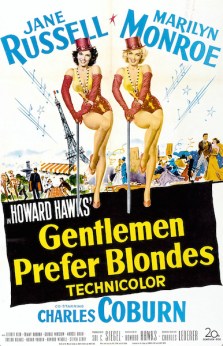
Gentlemen Prefer BlondesIt’s easy to see how Gentlemen Prefer Blondes helped launch Marilyn Monroe as a sex-symbol superstar — her ditzy, breathy blonde, who may just be cleverer than she looks, is clearly the star of the film.

For starters, she gets the lion’s share of the best bits. Diamonds Are a Girl’s Best Friend has justifiably become a classic song and there’s a solid routine attached, but the rest of the musical numbers are disappointingly weak. Jane Russell does get her fair share of good lines, but the most memorable comedic moment is Monroe’s: climbing out of a window, she gets stuck halfway and has to enlist the help of a little boy — and a big coat — to pretend she’s standing outside in the cold. That last one makes more sense in context…

Frankly, it’s all a bit sillier than I expected, more in line with the likes of Texas Across the River and the Road to… series than my memories of Some Like It Hot. That’s not necessarily a bad thing (I enjoyed both those examples), but it didn’t gel with my expectations of a film that’s got a greater reputation than they do.

I suspect said reputation is founded on Monroe’s career-making performance. I don’t have anything against her, but I’m not especially a fan either; yet despite my indifference she’s easily the best reason to watch this. Famously, when told she wasn’t the star of the film Monroe replied, “well whatever I am, I’m still the blonde.” The clue’s in the title, people.

3 out of 5

Gentlemen Prefer Blondes is on More4 today, Monday 6th April 2015, at 12:45pm.

Brideshead Revisited (2008)

2008 #49
Julian Jarrold | 133 mins | cinema | 12A / PG-13

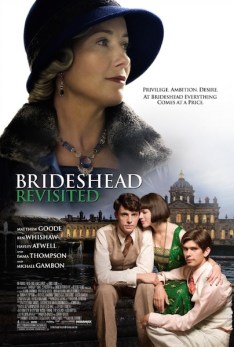
Brideshead RevisitedI’ve not seen the miniseries and I’ve not read the book, but I do know that both are considerably longer than Jarrold’s two-and-a-quarter hours film. So why does it feel so slow? Perhaps it’s the pair of opening flashforwards (easier to refer to them as that than to the majority of the film as one great big flashback), an overused technique these days that here serves no purpose whatsoever: there’s no additional insight on events that follow (or, rather, precede) by placing these snippets at the start, and there’s no new perspective on the snippets when we reach them chronologically (except that, second time round, we actually know who the characters are). It’s the most niggling fault in a film that, like my just-reviewed WALL-E, is of two halves.

The first is very good. It’s entertainingly written and performed, firmly in the tradition of the ‘heritage’ films and TV series that Britain churned out through the ’80s and ’90s — it’s the natural successor to the work of Merchant-Ivory, who of course produced the tonally-similar (at least at first) A Room With a View, which makes this all seem very appropriate. As Sebastian, Ben Whishaw is, perhaps unsurprisingly, the best of the three leads. When he’s off screen you miss him, and the point at which Sebastian leaves the story is arguably when things go off the boil. As Charles, Matthew Goode by and large holds his own — handy really, as he is definitely the centre of the film. Emma Thompson is as you’d expect her to be, which is to say she’s pretty good but ultimately it’s all rather familiar from her other performances.

The second half is where the film falls apart. The focus shifts from Charles and Sebastian’s friendship/possible homosexuality, to Charles and Julia’s love affair. The latter seems to come from nowhere and never takes off, consequently making it hard to accept the lengths they’re prepared to stretch to in order to make it work when they’re finally reunited years later. The plot slowly slides into darker and bleaker territory, needlessly dragging small characters back into proceedings to kill them off and finally pushing towards an Atonement-esque World War II epilogue. Some or all of this is obviously derived from the source, but considering the praise garnered by the novel and miniseries I presume it’s made to work there. Here it doesn’t.

An hour-and-a-half in I couldn’t understand what story there was left to tell, and I continued to be bemused by the sudden import of Charles and Julia’s relationship as the next hour dragged by. It’s a shame, because Brideshead starts out so promisingly and enjoyably, but once it begins to slide it never recovers.

3 out of 5

I Am Legend: Alternate Theatrical Version (2007/2008)

2008 #47a
Francis Lawrence | 104 mins | Blu-ray | 15

This review contains spoilers.

I Am Legend: Alternate Theatrical VersionI only watched the theatrical version of I Am Legend earlier this year (it’s #35), but, for reasons I won’t elaborate on for once, I’ve found myself watching this alternate version already.

Most of the comments in my original review still apply, as this cut only has minimal differences: there are a couple of very short new scenes in the third act, which were presumably excised because they primarily feed into the different ending, the main attraction of this version. Personally, I prefer it. The whole butterfly thing is too God-messagey, recalling the weakest elements of Signs, but if one can put that aside then the new content fits in much better with several threads that develop in the rest of the film (in both versions — in the original cut they’re just ignored). It feels like this was the intended conclusion but, for whatever reason, someone decided it needed changing. Perhaps it wasn’t explosive enough; or, indeed, conclusive enough, as it dispenses with the safe-haven epilogue and its pathetic attempt at justifying the title — another pleasurable loss as far as I’m concerned.

One other element I’ve reconsidered thanks to this repeat viewing are the CGI humans. They’re good enough in and of themselves, and would make more than passable foes in another action film, but here they ruin the ambiance that’s so carefully built up before their first appearance. Yes, the CGI lions are also clearly fake, but with limited methods to create such scenes they seem more acceptable. The arrival of the Dark Seekers, on the other hand, barges the film from thoughtful sci-fi drama into horror action blockbuster stylistically, in a way that using real actors simply wouldn’t. The not-real Dark Seekers may have superhuman jumping abilities, but the film doesn’t need those either, and could easily have crafted a similarly action-packed climax with real performers.

I Am Legend is still as middle-of-the-road as before, with very little to choose between the two versions. However, thanks to a less irritating final few minutes, this version just has the edge — if you ever intend to watch I Am Legend, be it a repeat viewing or your first, I recommend you plump for the alternate cut.

3 out of 5

The theatrical version of I Am Legend is on Watch tonight, Tuesday 14th October 2014, at 10pm.

Wanted (2008)

2008 #46
Timur Bekmambetov | 110 mins | cinema | 18 / R

WantedDid you see the trailer for Wanted? Did you think the loopy, somewhat Matrix-y stunts — like bending bullets, driving cars into trains, and numerous others — looked cool? Did you want to see more? If the answer to these questions is “yes”, watch the trailer on loop a few times, because 85% of the film’s cool bits are in there.

The trailer is Wanted’s biggest problem by far. Those expecting to suspend their disbelief and be treated to an onslaught of ridiculous-but-cool CGI-aided action trickery may be disappointed, not because it’s not there but because they’ll have already seen all the best bits. Of course, two minutes of trailer can’t cover all of the action present in the film, but it certainly managed to contain most of the flagship moments. Wanted’s other major problem is its pacing. The “Wesley is an ordinary guy with a dull life” opening is stretched thin, the traditional “training montage” is actually most of the second act, and, by the time it’s remembered there was a proper plot too, all you’re left with are a few more recycled plot beats (most notably from a certain popular late-’70s sci-fi sequel). Those points aside, there’s nothing really wrong with the plot — it’s an above-average way of linking the action together.

It’s hard not to recycle in this genre, of course, but the only other place you’re likely to have seen most of the stunts is… the trailer! Ahem — or, Bekmambetov’s pair of Russian fantasy films, Night Watch and Day Watch. The prologue explaining about an organisation that has existed for thousands of years is certainly reminiscent of those films, though here Bekmambetov is stuck with text rather than a full-blooded flashback. Throughout the rest of the film he displays a noteworthy visual flair, and while I’m sure some prefer their action to be done ‘for real’ and not boosted by computers, there’s no way the crazy things he’s imagined could be achieved that way. I have no problem with the use of CGI personally, especially as the ludicrousness of its use here doesn’t pretend to be something it isn’t.

The cast are all better than the material — not that anyone seems particularly bored or underachieving, just that the screenplay doesn’t tax them. Marc Warren is especially underused, with barely a line of dialogue to his name, though he is awarded a particularly gruesome death. While there’s nothing wrong with most of the elements that make up Wanted, then, it’s hard to escape the feeling that you’ve been cheated into paying to see all the stuff you already saw in the trailer with a few other bits slotted in. I spent much of the film presuming it would finish on an open-ended note, as the structure reminded me of films like X-Men and Iron Man: all set-up and origin story, with a perfunctory climax-providing enemy, done with an eye (or, indeed, both eyes) on a sequel. Wanted doesn’t really end that way, which in an age where the franchise is everything is admirable… apart from that the film leading to that ending still feels franchise-friendly.

If you don’t mind your action being computer-aided and as realistic as… well, a comic book… then there’s much to enjoy in Wanted. Except, you already enjoyed most of it in the trailer. Perhaps things will look brighter with a few years’ distance.

3 out of 5

The Happening (2008)

2008 #44
M. Night Shyamalan | 90 mins | cinema | 15 / R

This review contains spoilers.

The HappeningWhile others have been lamenting the slide in quality of Shyamalan’s work since his breakthrough 1999 hit The Sixth Sense, I’ve been quietly enjoying most of his films since then. I liked Sixth Sense and appreciated its ingenious twist, but it was the fantastic real-world-superhero tale Unbreakable that did the most to cement him in my affections. Signs was another strong effort, an unusual perspective on alien invasion backed by decent family drama and a few good laughs, helped by the always-watchable Joaquin Phoenix and a sweet kid. On the other hand, it suffered from a stretch of a resolution, and that it starred Mel Gibson. His next was the The Village, in my opinion his biggest misfire thanks to a story disappointingly reliant on an easily-guessed twist, further undermined by a third act structure that bent over backwards to hide the reveal for as long as possible. Most reviewers seem to disagree slightly though, as Lady in the Water was widely panned. Personally I liked it, at least on the level at which it was intended, as a modern fairytale.

This, his latest effort, falls mostly in the middle of the road — a bit like a few of its extras, then. You see, the plot concerns the release of a toxin (from where, no one knows) that causes people to begin committing suicide en masse, by jumping off buildings, or shooting themselves, or a variety of other, more gruesome ideas. It’s in these sequences that The Happening is at its best — Shyamalan can still craft chilling scenes and effective jumps, even if their onset is obvious to a moderately seasoned film viewer. Unfortunately, the rest of the film is a tad weak. Mark Wahlberg’s performance is flat, John Leguizamo struggles to do much better, and Zooey Deschanel gets by in a kooky role that is by turns endearing and slightly irritating. The script is mostly passable, though occasionally heavy-handed, repetitive and clunky — one moment especially jarred for me, when in a middle-of-nowhere diner it seems one person’s dialogue has been split between two actors.

Shyamalan nicely keeps the cause of the toxin up in the air — though the most probable cause is first suggested fairly early on, other theories continue to float around — but with no last-minute revelation such juggling feels unwarranted. Instead there’s just a “it could happen again” final scene, that might be chilling if it weren’t so predictable. Part of the problem with the film’s central conceit is that it’s not very believable. Now, I know, being able to see dead people, developing superpowers or finding a mermaid-like girl in your pool are hardly realistic plot points either, but here it strays too close to the realm of “I expect you to believe this is possible” pseudoscience and so, unlike Princeton gardeners, my belief struggled to be fully suspended.

Ultimately, I’d rank The Happening as Shyamalan’s worst film to date. While it’s pleasing that he doesn’t force everything to rely on a final twist, the overall quality is variable — at least The Village had something going for it before the poor climax. The cod-science explanation feels like a big excuse for a topical eco-message, otherwise just being a basis to string together a collection of well-executed creepy sequences. Perhaps Shyamalan should stop trying so hard to come up with amazing new ideas and just concentrate on telling a good story. There are things to like though, enough to scrape the film into the middle of the road. Sort of the opposite to those suicidal extras then.

3 out of 5

They’ve just watched the film…

They've just watched the film...

I Am Legend (2007)

2008 #35
Francis Lawrence | 96 mins | DVD | 15 / PG-13

This review contains major spoilers.

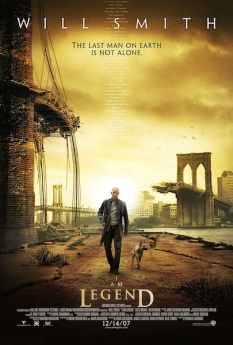
I Am LegendWill Smith stars in this adaptation of Richard Matheson’s classic sci-fi novel from the director of Constantine. The latter is a film I personally enjoyed (and which features a relatively early appearance of the currently prolific Shia LaBeouf) but received some mixed reactions on the whole. By a broadly similar token, I Am Legend has received a fair share of negative reviews, though my opinion is a little more divided.

Things go very well for the first half. It’s nicely paced, concentrating on a depiction of one man’s loneliness taken to the extreme. The script, and Smith’s acting, handle the material well. The deserted and destroyed New York looks as stunning as the trailers promised, while the CGI animals that roam it are as good as any. The flashbacks that punctuate the film are well executed too, drip-feeding clues to what happened while maintaining some mysteries of their own. There are some other good sequences: Neville’s exploration of a pitch-black Dark Seeker-infested building is tense, and the death of his pet dog — his one remaining companion — is moving, even if it was given away in the trailer. That scene is effectively played and shot, showing only Neville’s face as he is forced to euthanize the diseased animal by suffocation.

Sadly, this is where things begin to go down hill. The Dark Seekers — the film’s vampires/zombies/whatever — are crafted with pretty good CGI, but they’re still not life-like enough to work. If it were a mindless blockbuster they would’ve been more at home, but as it’s managed to be an effective drama they feel entirely out of place. It’s true that real actors couldn’t have managed the physical feats the creatures are made to pull off, but do they really need to do those things? I suspect not. The film also leaves several holes in the Dark Seeker’s actions — for example, they copy Neville’s trap, a move apparently beyond their intelligence, but the film neglects to explore why or how they did this.

Instead it moves on to the arrival of some more survivors. Quite where they came from, or how they got into the supposedly isolated Manhattan, is another inadequately explained set of circumstances. After they arrive, the film’s climax comes out of nowhere. It’s as if the screenwriters ran out of ways to keep things going so just bunged on a big climactic action sequence. And what happens in it is pretty silly too, especially Neville’s self sacrifice — why not get in the Magic Safe Hole too and then chuck the grenade out? Perhaps he just has a death wish by that point. It would seem most of the audience did. There’s also a pathetic epilogue, and an even worse final line that attempts to make sense of the title.

I Am Legend is something of a disappointment. The considered and effective first half gives way to an increasingly nonsensical second, marred by numerous flaws that stack up til a near-laughable conclusion comes from nowhere. I’ve been told that the ‘alternate theatrical cut’, with a handful of additional scenes and a new ending, is marginally more effective. I’m sure I’ll watch it someday and share my thoughts. For now, I Am Legend’s two halves of differing quality just leave it in the middle of the road.

3 out of 5

I Am Legend is on Watch tonight, Saturday 11th October 2014, at 9pm. It’s on again on Tuesday, when I’ll (re-)share my thoughts on the so-called “Alternate Theatrical Version”.

Vantage Point (2008)

2008 #27
Pete Travis | 86 mins | download | 12A / PG-13

Vantage Point is nothing like Rashomon.

I don’t imagine you’ve missed the endless comparisons — every review seems to have them, IMDb’s single-line plot description mentions it, the film itself certainly pretends to be like it, and I imagine even the pitch to the studio went, “well, it’s like this Japanese film…”. But, in fact, it’s nothing like it, and here’s why: Rashomon is about four people who tell completely different versions of the same events, some or all of which are therefore untrue; Vantage Point repeatedly shows the same events from different angles, revealing a sliver of new information each time. There are no lies and no real misdirection; none of the characters interpret what they see, we’re just shown it from where they were standing. Nonetheless, it’s a potentially interesting way to construct a thriller, but Vantage Point doesn’t exploit the concept’s full potential.

And then, halfway through, it gives up on it.

At first it seems like the filmmakers have simply lumped the gang of terrorists together as one character for the purpose of their perspective, an example of typically uninsightful American action-thriller ideology. But it soon becomes clear that, instead of continuing the perspective-shifting high concept of the first half, the rest of the story is going to play out like a normal thriller. And suddenly it’s a lot more entertaining, freed of pointless repetition and an irritating tendency to stop each story at an appropriately cliffhanging moment. If only the whole film had been constructed this way! Yes, it would have lost out on the odd mystery and some revelations wouldn’t have been so spread out, but continually retelling the story to pull this off seems a cheap trick anyway. Not that it matters, as most of the twists are blatantly obvious, and possibly the biggest of all was blown in the trailer — and is glossed over in the film as if they expected you to have seen it there.

Of course, the already slim running time would be reduced to the length of an American TV episode if they edited it chronologically, because there are plentiful repeated shots of speeches, explosions and crowds running, as well as the over-egged ‘rewind’ sequence each time the chronology is reset, a trick that’s as pandered to an inattentive brain-dead audience as ever you’ve seen. Another reason for employing this disjointed wannabe-Rashomon style is that the timelines probably don’t add up: some characters seem to squeeze an awful lot into a couple of minutes before their plot has to sync with someone else’s, while others presumably stand around doing nothing now and then.

Ultimately it’s the much-reported attempt to be ‘Rashomon-like’ that really scuppered Vantage Point for me. It only manages the multiple perspectives trick until halfway through, and even then it’s not especially well executed. The style has clearly been foisted upon it to mask a story that isn’t that original — the plot is a bit like half a season of 24 on speed — but it could have made passable enough entertainment for 90 minutes, especially as there are a couple of half decent action sequences. As a straightforward thriller it might not have been a great deal better, but it would have been less disappointing.

3 out of 5

Ocean’s Thirteen (2007)

2008 #11
Steven Soderbergh | 117 mins | DVD | PG / PG-13

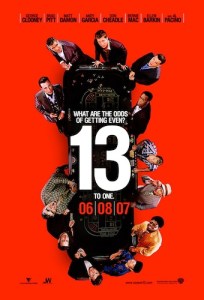
Ocean's ThirteenLast year I reviewed Ocean’s Twelve, and came to the conclusion that it had been slightly harshly treated by critics — while not a patch on the first film, it was a decent enough heist romp. Now it’s the turn of last year’s threequel and, by contrast, I found it to be distinctly overrated.

In fact, I’d personally put Thirteen at about the same level as Twelve. The return to both a Las Vegas setting and the first’s glossy cinematography seem to have fooled many into thinking it’s more like Eleven, but the convoluted and over-long plot (needlessly complicated by some chronologically variable storytelling), relative lack of humour, over-abundance of under-used characters, and lacklustre finale belie the truth.

Thirteen is Twelve with Eleven’s sheen. Its critical success relative to its immediate predecessor is, I think, another of the gang’s expertly executed cons.

3 out of 5

The Hound of the Baskervilles (1939)

2008 #9
Sidney Lanfield | 77 mins | DVD | PG

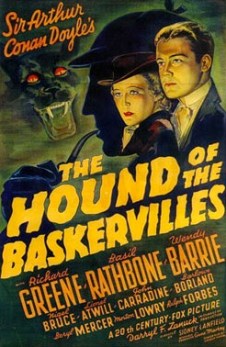
The Hound of the BaskervillesArguably the definitive screen interpretation of Sherlock Holmes and Dr Watson, played by Basil Rathbone and Nigel Bruce, appear for the very first time here, in what would become the first in a series of 14 pictures starring the pair. (Incidentally, this will be the first in an irregular set of reviews of that series. I have the rather lovely Optimum box set, you see, and so shall slowly work my way through it. Though as I’ve already owned it for several years and only just started watching it (as with so many DVDs), I have no idea how long it will be before I finish.)

I’ll start by laying my cards on the table: The Hound of the Baskervilles is a vastly overrated Holmes tale, and one that has been unduly adapted at least 15 other times (that from a quick search of IMDb). As far as I can tell its popularity is primarily due to the circumstances around its original publication (it was the first Holmes story in nearly a decade, following his death in The Final Problem). Holmes is absent for much of the story, which plods along fairly uneventfully (or, at least, inconsequentially) until a slightly dubious climax involving a centuries-old portrait. Naturally, all of these flaws carry over into any faithful adaptation, and this certainly is one.

One of the novel’s strong points is its occasional Gothic styling, and this is something the film version does very well. Dartmoor looks fantastic, like something Tim Burton would have created were he working in the ’30s. It’s clearly a set, but it’s dramatic and moody and completely effective. After the dull and poorly-designed interior scenes in London, it’s fantastic when the film finally moves down into Devon and things… well, don’t exactly get going, but at least there’s something to look at! As with the novel the plot meanders by, diverted by an escaped convict and an entirely pointless (in this version at least) seance, until that painting-based resolution. All is not lost, however, as a particularly vicious-seeming attack by the hound livens things up considerably.

Rathbone is underused as Holmes, which is a shame as he immediately makes the part his own. Bruce isn’t as bungling and comedic as he would later become, though the signs are already beginning to show. And the infamous final line — “Oh Watson, the needle!” — is actually a huge anticlimax if you haven’t seen it before, an entirely pointless, meaningless and misplaced addition.

I feel like I’ve come down a little harshly on Hound of the Baskervilles, mainly thanks to a general unfavourable opinion of the source material. There are many better Holmes stories, often ignored thanks to the fame of this particular one. The following 13 films may be even less faithful adaptations than this, but I’m looking forward to their fun and frivolity, which will hopefully top Baskervilles. The moor really is fantastic though.

3 out of 5