The Aristocrats (2005)

2008 #87
Paul Provenza | 85 mins | TV | 18
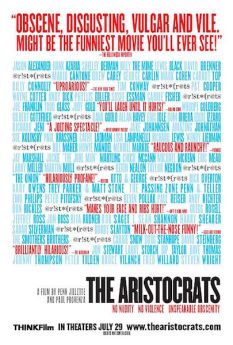
The AristocratsIt’s not unusual for films showing on TV to be prefaced with content warnings about language, sex or violence, but I don’t think I’ve ever previously seen one that feels the need to place such a warning after every single ad break. But if there’s one film that needs that treatment — or, rather, one film they could actually show on TV that needs that treatment — it’s The Aristocrats.

The Aristocrats is, apparently, an incredibly famous joke, well known to all comedians — and, generally, only told to each other, not to audiences — that is flexible enough for anyone to tell in their own way and still have it work. It’s also incredibly vulgar; in fact, the point is often to make it as vulgar as humanly possible. To explain much more would ruin the point of the film, which aims to expose and explain this cultish joke to the masses. Personally I’ve never heard of the thing, and for all I know The Aristocrats could be an elaborate Blair Witch-esque hoax — “oh yeah, all comedians know it”. Note this: the only people you’ll see throughout are comedians, and they all seem to know each other too.

Subject matter aside, there’s not much of a structure to the material presented. Mostly compiled from dozens of interviews, the resultant piece is a jumbled mix of comedians telling their version of the joke, comedians explaining variations on it (those whose telling completely changes it are the ones who succeed), comedians explaining why it’s funny, comedians explaining how it works, comedians explaining how and why it varies, comedians musing on the differences between male and female tellings of the joke…

On the other hand, even though there is a degree of repetition, there’s also a surprising amount to say about it — even by the end, when yet another comedian launching into their version has you reaching for the remote, there’s often another little titbit around the corner. In other notes: for British viewers, the biggest and most widely known names — Billy Connolly, Eddie Izzard — barely feature; for everyone, it features one of the worst ventriloquists I’ve ever seen; and a mime artist who singlehandedly makes the entire thing worthwhile.

The biggest problem with The Aristocrats — the film, not the joke — is quite a simple one: it’s about a single joke. Even the most meandering comedians tell several of those in an hour and a half. To compound the issue, said joke can vary so much as to defy a lot of comedy-killing “why’s it funny?” analysis. What you’re left with is repetitive retellings of a joke that, to be blunt, is rarely funny whatever you shove in the middle. It’s an insider’s film about an insider’s joke; for the rest of us, it rather over eggs the point.

3 out of 5

Ultimate Avengers (2006)

2008 #82
Curt Geda & Steven E. Gordon | 68 mins | DVD | PG / PG-13

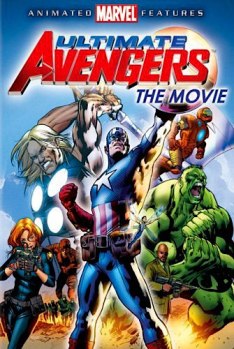
Ultimate AvengersWith the big-screen live-action Avengers movie on its way in just two-and-a-half years — once we’ve had a variety of tie-ins to lead into it, of course — now seemed as good a time as any to check out this direct-to-DVD animated version (and its sequel).

I won’t say too much about the plot because, if the rumours are true, the live action film may follow it fairly closely — indeed, the first 15 minutes of Ultimate Avengers presents a roll call of elements already introduced in this summer’s Iron Man and The Incredible Hulk: the Avengers Initiative, a super solider serum, a black Nick Fury, Captain America frozen in ice (OK, so that was only in a deleted scene…) But to follow this story wouldn’t necessarily be a bad thing… as long as there were some tweaks.

The primary problem is balance. Ultimate Avengers spends the entire first half assembling the team, the story crawling along at a snail’s pace; consequently, there’s nothing like enough time to do the remaining plot justice, leaving much of it to feel rushed. However, the tale itself retains an appropriately comic-book feel — no surprise considering it’s adapted from a specific storyline — while still containing just about enough information to keep newcomers covered. Were it properly paced, and bolstered by the main characters being introduced in their own films, there’s no real reason this wouldn’t suffice in live action.

On the other hand, in its current incarnation it’s very much Captain America’s story — possibly a problem for the 2011 version, as it will follow Cap’s debut feature by just two months. If his solo outing isn’t a success — particularly if whoever plays him is no good — it would likely sink an Avengers movie that was as focused on him as this. Not encumbered with such problems here it works fine, though it’s disappointing how little we see of other major players — Tony Stark/Iron Man barely features and there’s even less of Thor. That said, Bruce Banner/Hulk gets a key subplot which could be even better if fully developed.

Dodging further predictive comparisons for a moment, the animation quality is variable. Some is very good — mainly the opening World War II-set action sequence — but most is no better than you’d expect from a kid’s TV cartoon (unless they’ve got even worse recently). It does the job adequately, but there’s little exemplary. If there’s a theme emerging it’s this: promise is shown, but not fully realised. That’s not the fault of the medium of course, but rather the brief running time and unbalanced structure.

When the live-action Avengers reaches our screens, I suspect this animated outing will be of greater interest — an intriguing point of comparison between a direct-to-DVD fan-aimed version and a Summer Blockbuster mass audience version of (possibly) the same story. Of course, by that point, Ultimate Avengers will be half a decade old and no longer such a contemporary — or memorable — example.

3 out of 5

Ultimate Avengers II will be reviewed tomorrow, Tuesday 21st April 2015. Live-action sequel Avengers: Age of Ultron is in UK cinemas from Thursday 23rd.

Scenes of a Sexual Nature (2006)

2008 #88
Ed Blum | 88 mins | DVD | 15 / R

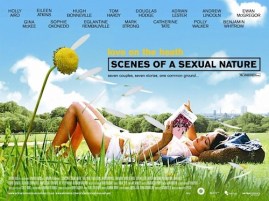
Scenes of a Sexual NatureScenes of a Sexual Nature is a half-accurate and half-misleading title for this low-budget British comedy drama. The first half is spot on — the film’s made up of seven unconnected scenes — while the second implies it’s ruder than it is.
Effectively, Scenes is seven short two-hand plays stuck together, occasionally intercut for no good reason (only one runs throughout), all on a similar theme — which, despite the title, is really “relationships” rather than “sex”. And “plays” is the right word: the styles of dialogue and acting, plus the sparsity of locations and cast members, not to mention the thematic construction, all suggest theatrical roots. In fact, so much does it seem grounded in the stage that I was thoroughly surprised to discover it wasn’t an adaptation. One wonders if writer Aschlin Ditta has perhaps launched his work into the wrong medium then; on the other hand, a stage production would never have attracted such attention or such a high number of recognisable names and faces.

Most of the scenes can be simply labelled — the Gay Couple, the Old Couple, and so on — and, unsurprisingly, some are better than others. The Gay Couple is a textbook example of how to write conflicting motivations both between a loving couple and within a single character, nicely performed by Ewan McGregor and Douglas Hodge. Consequently, it’s probably the film’s best sequence. Elsewhere, the Old Couple are quite sweet, Ditta pleasingly taking their story beyond an obvious, clichéd end point, though it is lumbered with a bench metaphor that’s a touch heavy-handed. Similarly, the Blind Date Couple is initially hilarious but doesn’t seem to know where to go, a problem that afflicts most of the film as every scene is distinctly inconclusive.

Worst is the one starring Mark Strong and Polly Walker, in which nothing at all happens in the name of a closing twist. It’s like the antithesis of the Old Couple bits. The one that stretches credibility the most, however, is the Divorcing Couple. Amicable divorces surely exist, but not that amicable — it’s very hard to believably see why they’re not still together. On the bright side, at least they’re not reunited by the scene’s end; but then, like much of the film, they’re not definitely apart either — it’s inconclusive.

Scenes of a Sexual Nature isn’t a bad film, but it is a bit of a mixed bag. Some stories work, others don’t. It’s not badly directed, but the writing and acting is all very stagey. It’s more like a collection of thematically and stylistically linked shorts than a feature in its own right. Some will no doubt take more from it than others, but I can only fall down the middle.

3 out of 5

24: Redemption (2008)

Extended Edition

2008 #86
Jon Cassar | 98 mins | DVD | 15

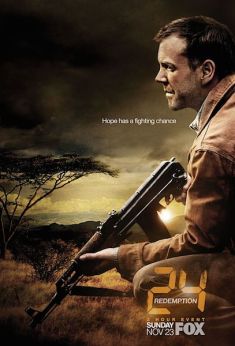
24: RedemptionRemember the ubiquitous Writer’s Strike in the US? It must be about a year ago now, but its effects are still being felt — Dr Horrible’s Sing-Along Blog, Joss Whedon’s rule-breaing internet musical, made during the strike, is about to hit region-free DVD in the US (albeit on DVD-R and only from Amazon.com); plenty of second-year shows are getting canned, probably because their truncated first years didn’t allow time to get decent audiences (that’s one excuse anyway); and 24’s seventh season, kicking off in January 2009, is a year late. Which allowed them to make this in the meantime.
The setup is simple: Jack Bauer’s trekking round the world, currently holed up with an ex-army buddy (played by the ever-excellent Robert Carlyle) in the African nation of Sangal where said buddy has set up a school. Yes, Jack Bauer is living a life of peace. But then Bad Men turn up wanting the kids for child soldiers, and within the hour they’re attempting a military coup — this is still 24 remember, the action all takes place “in real time”. What’s Jack to do? Why, return to his old One Man Army self, of course — if he can’t stop the coup, he sure as hell can save those kids! Meanwhile, it’s inauguration day for America’s new female (black? 24’s been there and done that — twice) President…

For a Fox action series, off screens for almost 18 months and undoubtedly designed as a starting point for new viewers, Redemption (not that that title’s seen on screen) has a surprisingly slow build up. That’s no bad thing — this is a story after all, not a 90-minute shoot-out — but there are times when one feels it should get a wriggle on. This is likely where most, if not all, of this extended version’s new material was added. There’s almost 15 minutes added to the running time here, though some is surely due to a 5-minute credit crawl that must be much longer than the TV version’s. Having not seen the broadcast edit I can’t comment on what new scenes, shots or lines are added, but there’s no greater violence or thematic density than 24 usually produces so I imagine what was cut was cut for time alone.

That said, Redemption certainly tackles its fair share of issues — primarily, the use of child soldiers, and the US involvement (or lack of) in African genocides. It’s certainly admirable and worthwhile for such a popular series to bring these important issues to the attention of a mass audience who might otherwise ignore, or at least not be aware, of them, but they’re still included in a “mainstream American action series” way — that’s to say, they’re ultimately a reason for a shoot-out. There’s also some subtle political commentary, such as the UN Peacekeeper stationed at the school being a coward who runs away at the first sign of violence… and then betrays them to boot! Of course, just because it’s unsubtle doesn’t make it wrong, but Blood Diamond this is not. Whatever the politics, the action sequences — and, once things get going, there are a few — are all carried out with 24’s usual panache.

Is this a suitable jumping-on point for newcomers? Yes, quite simply. It’s several years since the last season and Jack’s in a very new part of this life. Some old faces crop up and there are some backstory references, but these are more nods for returning fans than anything important. Everything you need to know for this story is contained herein, and fortunately that doesn’t involve great slabs of exposition about previous seasons. On the other hand, it fails as a standalone movie. While the main plot — Jack defends school — is kicked off and wrapped up in the space between the title and the credits, there are several US-based plot threads that aren’t even close to being resolved. These are clearly designed to flow on into season seven — presumably they’re either elements bumped from the early episodes up into the movie, or a fleshing out of information that would’ve just been exposition before.

It’s hard not to conclude that Redemption would’ve been better without the US scenes. They add nothing to the main action in Africa and they’re all quite flatly directed, forcibly reminding you that this is just a TV movie by being worse than most TV these days. Their one true benefit is an ending that juxtaposes the new President’s inauguration speech with the civil war beginning in Sangal, which, consciously or not, underlines the hypocrisy at the heart of America.

As a standard season-opening episode of 24, coming on the back of the weakest-yet sixth season, it may well have earned itself an extra star. Judged as a standalone film, however, I fear it has to be just

3 out of 5

Thinking “but that’s not a film”? Then please have a read of this.

Mamma Mia! (2008)

2008 #81
Phyllida Lloyd | 104 mins | DVD | PG / PG-13

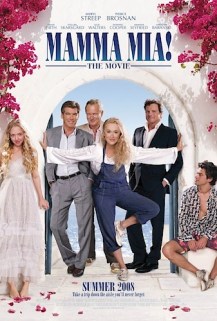
Mamma Mia!If you listen to the critics, no one liked Mamma Mia. If you listen to the public, everyone loved it. It’s the highest grossing British film of all time at the UK box office — at last count, just over £400,000 away from being the highest ever* — and was still playing on the big screen at hundreds of locations the weekend before its DVD release.
Mamma Mia! is the first feature from director Lloyd, who also directed the original stage production — and sometimes both facts show. She doesn’t always quite know what to do with the camera, the choreography is often aimed at a theoretical audience rather than the camera position (a pet peeve of mine), some shots are over-simplistic, others over-done, and there’s a bit of “point and shoot” too, missing opportunities that would be obvious to more experienced film directors. It’s never atrociously directed — at the very least, the scenery looks stunning, and is put to much good use — but it does the job and little more.

The songs themselves don’t need discussion (everyone knows what they think of Abba) but it’s worth mentioning how they’re choreographed and how they come about in story terms. Some have been brilliantly staged (Mamma Mia itself, but especially Does Your Mother Know), though others are flat and awkward (The Winner Takes It All doesn’t win anything as far as I’m concerned). Equally, some emerge naturally from the story (Chiquitita, Money Money Money), while others feel shoehorned in (again, The Winner Takes It All). For others still they seem to have just given up forcing them into the plot, leaving them to be performed by a musical act: Super Trouper, which at least is vaguely appropriate to the juncture it appears; and Waterloo, which is tacked on during the end credits, though at least is amusingly done.

The majority of the cast were clearly chosen for acting skills rather than singing ability, not that it’s done the film many favours. Pierce Brosnan was unfairly singled out by critics for poor vocals, but he’s no worse than several others. On the other hand, Julie Walters is as much of a riot as you’d expect, right from her first line, and earns the lion’s share of the laughs. For any bored male viewers, there’s always Amanda Seyfried, with her often bouncy pair of friends — played by newcomers Rachel McDowall and Ashley Lilley (why, what did you think I meant?) Every cast member is clearly having a ball, so much so that some forget to do more than read lines aloud; but it’s occasionally infectious, the frequency of infection being directly proportional to how susceptible the viewer is to this genre of music and this genre of film.

It may go without saying, but the more you like Abba the more you’ll like Mamma Mia. Conversely, the more you hate them the more you’ll hate it. (Extra stars can be added or subtracted at the end depending on which side of the fence you fall.) It’s therefore easy to see why audiences — especially British audiences — have lapped it up, while the critics have been fairly damning. On the other hand, the often clichéd first-draft-level script and occasionally ungainly first-readthrough-level performances don’t help things any. Luckily it very rarely takes itself too seriously, and consequently is often hilariously funny. Though it attempts both, it clearly works best when being a camp and cheesy comedy rather than a serious romance/family drama. One especially weak note, in my opinion, is the subplot awarded to Colin Firth’s character, who turns gay almost out of nowhere. It’s not a bad idea for a subplot, especially in a film based on Abba music (not that I’m applying any stereotypes here), but it’s poorly executed.

Mamma Mia! never aimed to please the critics, or even your regular movie-goer. Instead it sets its sights firmly on Women Of A Certain Age who can remember Abba from first time round, and students who perhaps listen to them in a more ironic way nowadays. In that sense, it’s clearly an unmitigated success. As camp as a row of tents, disliked by critics, loved by audiences: Mamma Mia! is everything you’d expect from Abba.

3 out of 5

* In the interests of fully-correct information, I feel I should point out that Mamma Mia! has now [December 28th, 2008] overtaken Titanic at the UK box office. (BBC News) ^

Sherlock Holmes and the Voice of Terror (1942)

2008 #74
John Rawlins | 63 mins | DVD | U

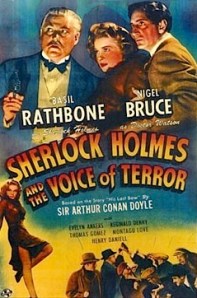
Despite the success of their two Sherlock Holmes films (The Hound of the Baskervilles and The Adventures of Sherlock Holmes, both 1939), Fox decided the character was outdated and resolved not to make any more. Universal clearly disagreed, and the popular pairing of Basil Rathbone and Nigel Bruce reprised their roles three years later for this, the first of twelve Holmes films the studio would make with the duo in just five years.

There’s more change afoot than just the logo at the start, however, as Holmes and Watson are dragged from their typical Victorian setting to London in the midst of World War Two. For a modern audience, who definitively associate Holmes with the Victorian era, this move seems virtually incomprehensible and sacrilegious; but Conan Doyle’s original Holmes stories take him as far as the start of World War One, so bringing the character another 28 years forward is little worse than, say, relocating the 1980 novel The Bourne Identity to 2002. Nonetheless, the filmmakers were aware of the problem even at the time, choosing to open the film with a title card that asserts Holmes to be “immortal… ageless, invincible and unchanging” in the hope that audiences would accept a then-present-day setting.

Whether the setting bothers you or not, the story itself might. The basic concept is a nice idea for a war-set spy-thriller, but not really for a Sherlock Holmes mystery. There are plenty of audience-pleasing applications of his ‘impossible’ deduction skills, such as the moment when Holmes concludes someone dislikes him based on the depth of footprints left in a carpet (never mind that the character huffily ignored Holmes when he came in), but the main plot involves a minimal use of these abilities. It’s also loaded with implausible elements — why would the Nazis waste bombs on empty fields (to disguise one plane going a different route) when they could have used them on genuine targets? Why are recordings shipped to Germany and broadcast back, rather than just broadcast from England? Worst of all, what’s going on with Rathbone’s haircut? The final twist is either genius or ludicrous, I’m not sure which; and the misguided reference to Holmes’ deerstalker (he’s promised not to wear it — why?) is, well, misguided.

It’s not all bad. As mentioned, the basic storyline is a good one, providing decent entertainment once it gets going; Holmes gets plenty of amusing lines, which manage to provide more genuine laughs than Watson’s incompetence; and there’s some lovely shadow-drenched photography — though the film’s even more drenched in patriotism, to the point of propaganda at times.

The consensus seems to be against me, but by the end I was quite enjoying Voice of Terror. It may be a Sherlock Holmes film in name only, but taken instead as a cheap spy thriller it makes for passable entertainment.

3 out of 5

The Invasion (2007)

2008 #72
Oliver Hirschbiegel | 99 mins | download | 15 / PG-13

The InvasionThe Invasion is a modern thriller aimed at a mainstream audience, which naturally means it begins at the end. Is there a reason for this? As is too often the case these days, no. The only explanation I could come up with is that such an opening suggests there’ll eventually be some some actual scares in this sci-fi/horror, and so is designed to help the viewer persevere through the distinctly lacking film that follows.
Things go sharply down hill from the lacklustre opening ending opening: Jeremy Northam accidentally stabs himself with an Evil Alien Parasite Thing in a blatant genre convention that seems to have moved from the “necessary to get on with the plot” to the “badly obvious cliché”. The order of scenes that follow seems to be a random mess — for example, Nicole Kidman’s kid, Olly, begins to have nightmares again; a few scenes later, his dad (Northam, now taken over by the Evil Alien Parasite Thing) phones wanting to see him after a long absence; a few scenes later, Kidman tells a friend that Olly’s nightmares restarted after he was told he was going to see his dad. This is not an isolated example.

Much of the dialogue is on the level of bad exposition, but, to rub salt in the wound, it explains things we’ve already been shown. Normally reliable actors turn in flat performances with such an awkward script, which ponderously works its way through a plot that’s far too slow-moving considering how obvious it is. We know it’s an Evil Alien Parasite Thing within the opening minutes and even a passing familiarity with the genre will let you know how things are going to end up (as if opening with the ending didn’t give you a hint), but we’re still treated to near-endless scenes of our luckily-immune heroes trying to work out why everyone else is behaving oddly. It takes a full 36 minutes for Kidman to finally realise what we’ve all known from the start, but just in case you’ve missed the bleeding obvious there’s a pile of handy flashbacks. More to the point, how come only two people in the entire world (the other being Daniel Craig) have noticed what’s going on? The possessed have all the subtlety of a Jeremy Clarkson joke, walking around in a permanent mechanical daze.

A lot of articles have noted that the studio disliked how the film ended and so brought in other writers and director(s) to re-shoot the final act, aiming to bolster the action. Thank goodness they did, because it’s at this point that there’s finally something worth watching. The aliens’ dominance is a near-inevitable and obvious eventuality from very early on, and so structurally speaking should have been reached sooner. Unfortunately, when it does arrive, the weak early scenes mean we don’t care about the characters, so while some of the more action-packed scenes are well staged they have little genuine impact. Some good moments sneak through though, like a couple’s very public suicide, or… No, that was the only one I noted.

In this structural imbalance The Invasion is reminiscent of I Am Legend: a ponderous dramatic first half turns into an all-action assault as the only uninfected people are relentlessly pursued by the infected majority. In an inversion of the disappointing (but not dreadful) Will Smith vehicle, The Invasion‘s first half is dire while the second at least has some excitement and jeopardy. In Legend it was a shame that they couldn’t keep the first half running for the rest of the film; here you’re glad the studio intervened and forced some actual events on the film. It would be quite interesting to see how it was all meant to turn out originally, but I doubt it would be entertaining in the slightest.

Once it’s all over there’s a truly dreadful info-dump that explains what happened next. Besides making you cringe and wonder how a piece of exposition so blatant could ever have been greenlit, all it achieves is the delivery of a killer blow — not by blatantly stating the film’s subtext (which it does — not so ‘sub’ then), but with what that subtext actually is: when humanity is taken over by aliens, war stops; ergo, war is what makes us human. Lovely.

2 out of 5

The Invasion featured on my list of The Five Worst Films I Saw in 2008, which can be read in full here.

St. Trinian’s (2007)

2008 #71
Oliver Parker & Barnaby Thompson | 97 mins | download | 12

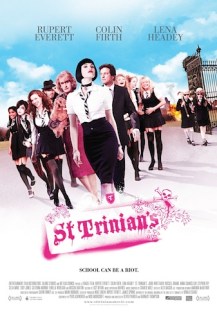
St. Trinian'sI really didn’t think I was going to like St. Trinian’s. It seemed to be aimed squarely at teens whose quality barometer is fixed at Girls Aloud being the best music artists of all time and aren’t old enough to have seen There’s Something About Mary. Certainly, some of the film lives up to these expectations, but other bits are surprisingly good.

For one thing, it has a pleasantly wicked sense of humour, which must be pushing that 12 certificate on moral grounds — 10-year-olds producing black market vodka, for just one example. There’s a number of good, brief, visual gags too, such as the RE department having a Practical Study of the Easter Story with a girl strung up like Jesus on the cross (Christian bating is always funny). On the other hand, it merrily includes some ancient gags too — a dog shags someone’s leg! Hilarity! But then again, it makes no bones about being aimed at a relatively young audience, and for them this probably seems wonderfully fresh and naughty. Thankfully it’s not all down on this level — it has an even better line in Colin Firth spoofing than the Bridget Jones movies, and while some of these references may fly over the heads of that intended audience, they should at least keep any adult viewers amused. My personal favourite was the two 10-year-old girls who keep quoting famous movie lines. Simple, but effective.

A fair number of people seem to have considered the moral vacancy of St. Trinian’s’ style of comedy a bad thing, claiming impressionable girls will copy the characters’ actions or at least be influenced by their anarchic attitude. Not likely, I say — the school is such a fantasy-mess that I think even the very young would struggle to believe it as a potential reality. In fact, I’d go so far as to say that most of it is relatively harmless fun — if only some of The Youth Of Today would copy this lot rather than getting stupidly drunk, pregnant as soon as they’re able, and knifing each other every evening, then we might not be in the state we’re in. But anyway…

Through any weak patches, affairs are buoyed by a rather wonderful cast. The likes of Colin Firth and Rupert Everett are clearly having a ball, the young (though most not as young as their characters) cast all do a good job, with Gemma Arterton standing out in particular, and anything featuring Stephen Fry is at least worth a look. Yes, he’s only playing himself (literally) on a version of University Challenge that no doubt owes something to QI (even if it is just Fry hosting), but luckily he’s given a smidgen more to do than just read out cue cards. In spite of which names may be above the title or which characters get introduced first, it’s decidedly an ensemble piece — every time you think a lead is emerging another takes centre stage. In that respect it might be seen as a bit messy, but each one gets a decent enough through-line.

Incidentally, it’s incredibly British — not just in its setting and style, but also the very current cultural references — which might explain why it still hasn’t had a US release. It wouldn’t look out of place premiering on TV, probably at Christmas considering the scale of it, and I wouldn’t be surprised if the budget had been TV-sized. It’s also got a posh girl played by that girl who plays a posh girl in everything on TV (namely, Lucy Punch). That doesn’t really signify much, but my God she’s done well out of playing essentially the same role in numerous productions.

Despite my preconceptions when starting out, which were all supported by the opening few minutes, I ultimately found St. Trinian’s quite enjoyable. It’s far from perfect, and every time I began to truly warm to it — I even found myself laughing at a final beat for the leg-shagging dog cribbed from a decade-old comedy (I believe I already mentioned it…) — there was another recycled or immature joke to make me despair. In spite of that, the overall impression was adequate enough.

3 out of 5

After the Sunset (2004)

2008 #67
Brett Ratner | 93 mins | TV | 12 / PG-13

After the SunsetI’ve never had as much of a problem with Brett Ratner as some others. I quite enjoyed the first two Rush Hour films (though, admittedly, I was relatively young) and also liked Red Dragon (though, at the time, I hadn’t seen Silence of the Lambs), and would lay the blame for X-Men: The Last Stand at the feet of the producers who decided to save all the Wolverine backstory stuff for a spin-off, in the process disconnecting the threequel from the Wolverine-obsessed first two — what was left was pretty decent, if you ask me. After the Sunset, on the other hand, is like Woody Harrelson’s character: not much cop.
The story concerns a retired jewel thief goaded into performing one last job by the FBI officer who never caught him (that’s Harrelson’s character — you see, he’s not much of a cop! Geddit?) A decent enough premise, suggesting something Ocean’s Eleven-like; but someone didn’t think this was enough story — or, perhaps, couldn’t come up with a complex-enough security system for the jewel — and so tacked on a buddy comedy. It’s a pretty illogical one as well: the two men hate each other, so why would they spend so much time together? It feels like padding around the heist plot, but takes up more screen time. Other subplots, like Don Cheadle as the unspecified Caribbean island’s resident gangster, who wants the jewel to fund something or other, also don’t go anywhere.

Each of these plots seem to have originated in different films — some serious, some light, some thoroughly comedic. When stuck together they make for a constantly varying tone, and it’s difficult to work out which was the intended one. By the end there’s so much going on (though, barely) that the ending goes on forever, wrapping up its various near-unrelated threads in as drawn-out a manner as possible, apparently just to make the film hit a decent length. The final twist is almost good, but remains a bit underdeveloped and consequently isn’t clever enough to be worthwhile — it winds up as just another pointless extension.

Despite all this it does have its moments, thanks primarily to a skilled cast… not that I can remember any specific good bits now. It does at least mean that, if you can put the tonal and structural oddities to one side, it can be a moderately pleasant way to pass an hour and a half.

3 out of 5

Agatha (1979)

2008 #62
Michael Apted | 100 mins | TV | PG / PG

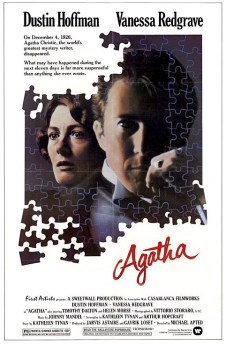
AgathaThere are no giant wasps in sight as Vanessa Redgrave’s Agatha Christie goes missing for eleven days in December 1926, and Dustin Hoffman’s journalist tries to track her down. While the frame of the story is true, the reasons behind Christie’s disappearance, and what occurred during it, aren’t known — which makes it fertile ground for speculation. Sadly, a fantastical plot about jewel thieves and shapeshifting aliens is much more exciting than the down-to-earth mystery we’re offered here.

It’s easy to see the attraction of Christie’s disappearance: it’s a real-life mystery about arguably the greatest mystery author ever, with enough unusual events surrounding it to make it extra suspicious and a long enough gap for something significant to have happened. But while the idea is initially exciting, when it comes to retelling it there isn’t a great deal there — the facts of her disappearance are just the ‘before & after’, amounting to little more than an abandoned car, an assumed name and some amnesia. Unless one invents something to fill those missing days, there’s little to tell (she went to a hotel and forgot what happened, essentially) — so, of course, this film fills in the gap. With a murder mystery, naturally. Sort of, anyway.

To be honest, I found it a tad confusing for the most part. While the initial setup is well handled, showing what drives Christie to run away (consciously or not) and the beginning of the police search, it begins to flounder once the plot slides into its fully fictional phase. Hoffman’s journalist, who had been hoping to interview Christie, manages to stumble across her at the hotel, where he pretends not to know who she is, while she… has health treatments… It’s only at the conclusion, when Christie’s plan begins to come together, that one realises there was a plan at all. It’s a shame the revelation comes so late because it’s actually not that bad a plot, and makes for quite a neat and almost plausible (providing you can accept Christie as a potential murderess (sort of)) explanation for everything.

The performances do nothing to raise the film. Redgrave is lumbered with little to do, mostly wandering around looking dazed. Her performance is decent but the material she has is lacking. Hoffman, on the other hand, is just flat, while Timothy Dalton’s sneering Colonel Christie sadly barely features. On a more technical level, the police investigation subplot is disappointingly forgotten halfway through, and everything is shot with too little light. Sometimes the latter is effective, such as during a train journey where occasional flashes of light illuminate Christie’s uncomfortably blank face, but at other times it merely obscures events. (It’s possible this is just the print, of course.)

Christie’s disappearance remains a fascinating mystery, though in all likelihood the true causes were either very internal or mental health related — not the easiest thing to depict in a movie, especially when your audience is likely expecting a thriller. Agatha has a game stab at weaving an interesting tale into the gaps in the facts, but by the end I was wondering if a straightforward biopic mightn’t have been a better idea.

3 out of 5