
Louis Leterrier | 102 mins | TV (HD) | 2.40:1 | USA / English | 12 / PG-13
 The thoroughly blockbusterised remake of ’80s fantasy favourite Clash of the Titans came in for a sound critical drubbing on its release last year, much of it focused on the post-production cash-in 3D applied to the film. I didn’t watch it in 3D so won’t have much to say about that, but I found the film itself to be passably enjoyable.
Firstly, it’s brief — little more than 90 minutes before the credits roll. That can feel stingy in cinemas these days, where we have to pay so much for a ticket getting your money’s worth is important, but at home especially it’s suited for a quick bit of fun. Still, Titans could’ve done with more length to allow characters to grow — at times it feels like a genuinely epic tale reduced to a lengthy plot summary, speeding over the fine details in search of the next big plot beat.
There’s a fairly impressive cast — nearly everyone is famous or at least recognisable — and all of them are massively underused. Perseus’ team are dispatched in various fashions, but we don’t really care because their group dynamic has only been built a tiny bit. And I wanted to care, because there were actors I like and characters who had potential — even if most were built from band-of-warriors stereotypes — but the film didn’t do enough to allow me to. Every time it produces a good bit, it throws in some groan-inducing sentiment or cheesily pompous dialogue.
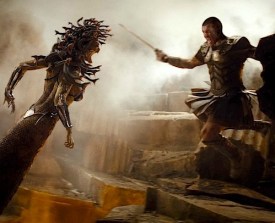 What the film is built to do is provide action sequences, though these are passable and rarely more. They’re fine while they’re happening, but pretty much forgotten after — none of it shows a great deal of inspiration. The history of film is littered with far worse examples, but that’s about the best I can say. I can see why it would be painful in 3D too: quite aside from the use of always-criticised post-conversion, and the apparent rush job on that, Letterier favours the modern action style of handheld jiggly shots and fast cuts, neither of which lend themselves to the 3D experience. Heck, even Michael Bay acquiesced to adapt his similar style when shooting Transformers 3 in 3D, so you know it must be true.
In fact, the action sequences would probably benefit from the expansion of character I mentioned before: caring about them would add jeopardy when their lives are in danger and some emotional impact when they snuff it. As it stands, Titans is an emotionally empty experience, much more so than, say, Inception, which was frequently criticised for similar shortcomings. In fairness, this is probably because critics thought Inception might deliver in such respects, while no one expected a pre-summer blockbuster like Titans to bother. And they were right to an extent, but while it’s never going to be an affecting human drama, it should bother more than it does.
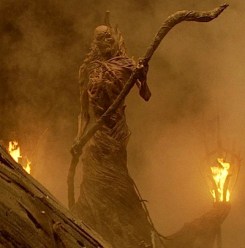 Design is probably the film’s strong point, particularly sequences that feature the three witches and the ferryman. Clearly these dark, borderline-horror-film settings are the design team’s strongpoint. Elsewhere, the gods have an appealingly retro lens-flared-silver-armour look about them — I don’t remember the ’80s original very well, but one could imagine this iteration of the gods being dropped in without anyone noticing.
The CGI is complaint free, as with most well-budgeted modern flicks, apart from one glaring exception: Medusa looks almost as fake as the Rock’s Scorpion King from The Mummy Returns, which you may remember was lambasted even at the time — “the time” now being ten years ago. Oh dear. Maybe the passing years and abundance of CGI has affected my critical faculties here — that is to say, maybe side by side this Medusa would look a lot better than the decade-old Scorpion King — but, in the context of the rest of the film, that level of distracting fake-ness sprang to mind.
I’m laying into it almost as much as anyone now, but in spite of all that I sort of quite liked Clash of the Titans. It’s massively flawed in many areas, but good bits occasionally shine through. Unlike most blockbusters of the past few years, which tend to be bloated affairs in need of a good chop down, it would actual benefit from being a bit longer — 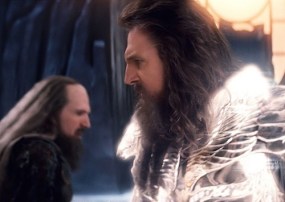 some plot elements could do with greater clarity, most of the characters could do with some depth.
It’s probably all the studio’s fault for forcing major last-minute changes and reshoots. While I wound up enjoying what we got, the other version — as detailed by CHUD.com — does sound more interesting.

 David Mitchell and Robert Webb move from the small screen to the big one in this comedy from the writers of their sitcom
  while Webb is adept at dancing sillily and, increasingly, hosting / voice-overing quickly-made cheap rubbish for various channels. These are all skills in their own way, but they don’t necessarily demonstrate brilliant acting. But, hey, they’re fine here.
 Sometimes, at least for me, films improve in retrospect. My opinion while watching may be different to when I look back days, weeks, months, or even years later. Films I thought I disliked may benefit from a kind of nostalgia; some films just gain something from extended reflection, even if that isn’t conscious; films I underrated may improve when I gain perspective on their qualities relative to other works; in some cases, it’s just that I’m getting older and wiser.
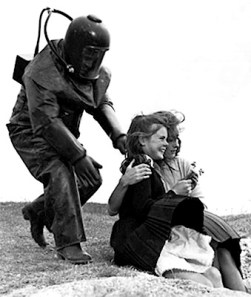 Not necessarily a bad thing, but it has that kind of disconnect from reality that’s markedly ’60s. In
 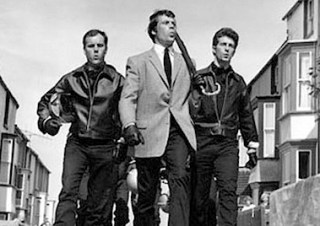 and the kind of inhumanity that might be reached in the quest to survive nuclear war.
 “Sherlock Holmes vs. Jack the Ripper” would be the easiest way to describe this pulpy ’60s effort. It’s far from the only example of this sub-sub-genre:
  and though by the end it’s explained who sent it, I was none the wiser what they’d been intending. And I watched the revelation scene twice too. Still, at least the important bit — who the murderer is ‘n’ all that — is quite neat.
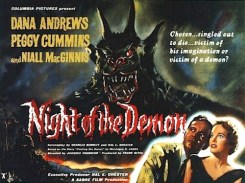 Adapted from an M.R. James story, Night of the Demon sees Dana Andrews as Dr. John Holden, a psychologist arriving in Britain to discredit satanic cult leader Julian Karswell. To cut to the chase, Holden begins to wonder if Karswell has placed a curse on him, and perhaps what he had set out to disprove isn’t such mumbo jumbo after all…
 Tourneur’s film is beloved by some, but I don’t think I quite got it myself. There are some great sequences, but I didn’t always find it hung together in between. Ironically, while many have criticised the actual appearance of the titular beast at the end, I think it works rather well — it’s surprisingly well realised, and you can take it as either a real manifestation or part of one character’s deranged imaginings. It’s an effective climax.
 A faded action movie star (Burt Reynolds) thinks he’s been signed up to play King Lear with the RSC… but when he arrives in England, he finds it’s just a small village amateur dramatics group. Hilarity, and the odd heart-warming message, ensue.
 Imelda Staunton and Derek Jacobi, all ceaselessly watchable, plus a supporting cast of faces you’ll likely recognise from British telly.
 Probably the best bit is the series of films Reynolds’ character is known for: Ultimate Finality 4 plays as a nice, subtly-used background gag.
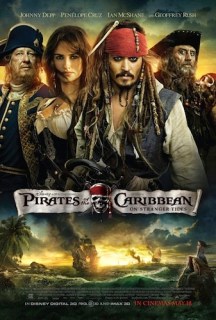 No one had high hopes for
  It still cost $250m, mind, and the fact that’s what’s considered a cutback arguably shows.
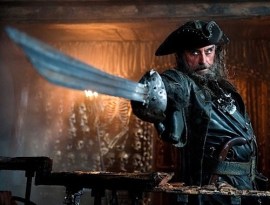
 The love story between a missionary and a mermaid barely factors. Word was this pair would be the series’ new Orlando Bloom and Keira Knightley, but whereas Elizabeth Swann and Will Turner were central to the plot of all the previous films (appearing before even Captain Jack in the first, if I recall), these two turn up late in the day and never have a chance to go anywhere. There’s also a surfeit of villains, meaning they either barely appear (the Spanish) or aren’t given close to enough screen time (Ian McShane’s Blackbeard). Every introduction is rushed, every subplot underdeveloped, every ending unsatisfactory. There’s too much, even for a movie that still runs over two hours.
 (much-heralded work like
  If The Locket is known for anything, it’s for a plot structure that places flashbacks within flashbacks within flashbacks. There’s always the potential for good fun in that kind of structure, though it’s usually the kind of thing that sounds more complicated than it is — the straightforward ‘concentric circle’ arrangement here makes them a doddle to follow; so straightforward, in fact, that it would be easy to miss how it was so structured.
 It might have been more interesting if the doctor had been making it all up; or if it had been left open ended, with Nancy set to ruin someone else’s life. That could well have worked, leaving the audience to come to its own conclusions, etc. Considering the film’s age, however, I’m sure there were demands we see this thief and murderess brought to justice.
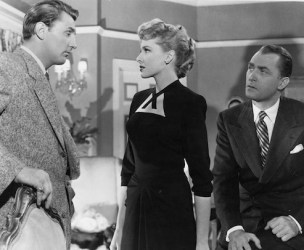 manipulative criminal it seemed all along, but instead a damaged individual doing these things involuntarily. This isn’t the wholly nonsensical part of the film — her apparently-accidental marriage to the son of the house she grew up in would be that bit — but I preferred it when she was just a villain. Psychologically it holds relevance, but at the same time she’s rather taken it to extremes. Or maybe I was just fed up by then.
 Law Abiding Citizen is a revenge movie with a (slight) difference: wronged man Gerard Butler isn’t just going after the two criminals who invaded his home and murdered his wife and daughter — he’s going after the legal system that let one of the men walk free.
 He attends the execution of the aforementioned criminal, but something goes wrong — instead of going to sleep with a lethal injection, the attacker suffers an agonising and horrific death. Someone must have swapped the chemicals. The prosecutors’ thoughts leap to the other criminal, but I’m sure we’ve all guessed who’s really behind this. And so Butler’s sprawling revenge mission begins…
 On the issue of who the film thinks is good and who it thinks is bad,
  It is a little far-fetched, granted, but it’s not so outside the rules the film sets up for itself that I find it unacceptable.
 As an action-thriller that actually has something to think about wrapped up in it, I considered being a bit lenient in my score (much as I was to
 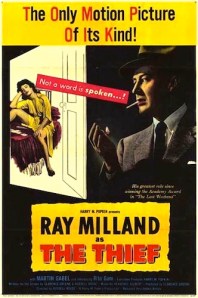 Ray Milland stars as Dr. Allan Fields, a nuclear physicist working at the United States Atomic Energy Commission, who is photographing secret files and passing them to The Other Side, until something goes wrong and the authorities are on his tail. But that’s almost beside the point, because if The Thief is known for anything it’s for its dialogue — as the poster proclaims, “not a word is spoken…!”
 Obviously we can look back to the silent cinema for that kind of thing, but while that era could probably still teach many filmmakers something about visual storytelling, it’s hard to deny that the advent of synchronised sound adds a helluva lot to the ability of film — if it didn’t, it wouldn’t have taken over so fast and remained virtually 100% dominant for the last 80+ years.
 Perhaps this is why the villains are never explicitly named. But they’re definitely not American! Tsk tsk. More crucially, it’s a bit slow at times — it seems to take longer to explain things when stuck doing them through visuals alone. That said, it could probably have survived a speedier approach even doing what it does — perhaps, then, Rouse is playing for time: the film only runs 87 minutes in spite of its pace.
 100Films.co.uk