Review Roundup: 3 Long Films That I Didn’t Enjoy Directed by Martin Scorsese

The title’s pretty self-explanatory, isn’t it?

Those films were:

  • Silence (2016)
  • Casino (1995)
  • New York, New York (1977)


    Silence
    (2016)

    2017 #141
    Martin Scorsese | 161 mins | streaming (HD) | 2.35:1 | USA, Taiwan & Mexico / English, Japanese & Latin | 15 / R

    Silence

    A re-adaptation of Shūsaku Endō’s novel (previously filmed in 1971), Silence is gorgeously produced but torturously dull Christian propaganda. The plot is about two priests travelling to anti-Christian Japan to find their mentor, who’s rumoured to have renounced the Church, but really it’s about faith and the testing of it.

    The foremost of the two priests is Rodrigues (Andrew Garfield), the kind of Christian who lets others die for his faith even as he doubts it. Like many a preacher before him, Rodrigues’ sin is pride — too proud of his faith, his culture, his rightness, his superiority, to consider another point of view; to bend to help others. Conversely, his accusers and persecutors lack compassion or fairness, torturing and killing from exactly the same position as Rodrigues: that their beliefs are correct, all others be damned. Well, of such things are all religious wars made, I guess. At least the Horrible Japanese are better than the Christians’ own Inquisition was: if people renounce Christianity the Japanese sometimes set them free; the Inquisition just used it as another reason to murder them. God, religious people can be shits.

    There are no good people here. The Christians are colonialists with a monomaniacal belief in their own faith. The Japanese are so set against it that they’ll torture and murder their own people just to get back at the Christians. It’s a world full of hatred. So much for the love of God. All this intolerance is as pointless then as it ever was before or has been since. If we just let others go on how they want to go on — live and let live — then the world would be such a nicer place.
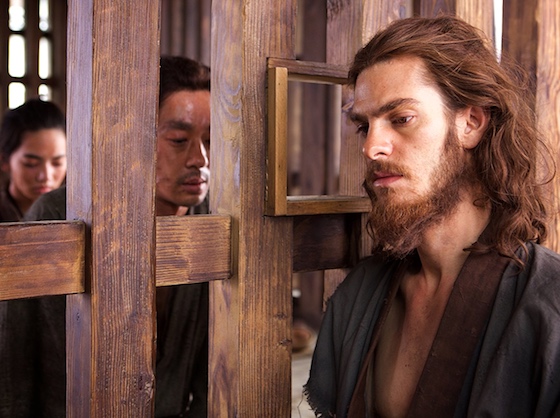
    Rodrigues in prison

    For all the violent torture depicted on screen, the hardest thing to take is the film’s slow, slow, slow pace. It does have some theological points to make, but they’re thin gruel for the time it takes to make them — or, rather, the time it wastes before it really starts to consider them. If the first hour was a lot shorter it would improve the whole film; indeed, it would’ve made me better disposed to the rest. It does improve, but by the time it improved I was already bored and annoyed with it. Its best qualities by far are visual: as well as stunning cinematography by Rodrigo Prieto, the whole production is beautifully mounted — the locations, sets, costumes, make-up, and so on, are all very well realised.

    To say Silence was not a box office success is an understatement: off a budget of $46 million, it took just $23.7 million worldwide, and only $7.1 million of that in America. I think it must’ve been promoted badly — I’m sure it’d appeal to the Bible Belt crowds who flock to that niche Christian shit that’s always turning up nowadays. And if you’re in any doubt that it’s meant to be a pro-Christian film: the premiere was held at the Vatican and it was screened early for 400 priests.

    2 out of 5

    Casino
    (1995)

    2018 #19
    Martin Scorsese | 178 mins | download (HD) | 2.35:1 | USA & France / English | 18 / R
    Casino

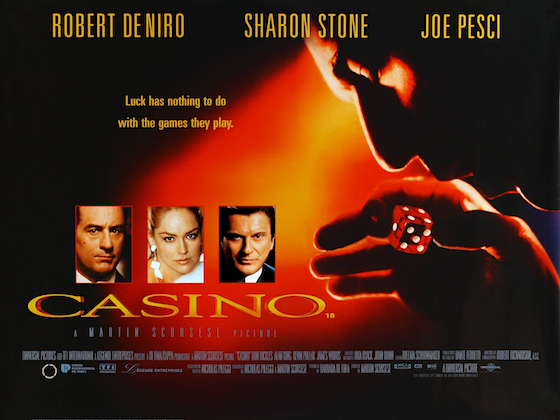
    “A fictional story with fictional characters adapted from a true story,” as the film’s own credits describe it, Casino tells of the rise of Sam ‘Ace’ Rothstein (Robert De Niro, of course) in Mob-controlled Las Vegas, whose life is made awkward by his loose-cannon Mob-enforcer best friend Nicky Santoro (Joe Pesci, of course) and his tumultuous marriage to hustler Ginger (Sharon Stone).

    “There’s no plot at all”, says Martin Scorsese in an interview included on Casino’s Blu-ray (per IMDb). “It’s three hours, no plot. […] There’s a lot of action, a lot of story, but no plot.” Well, er, he’s not wrong. Casino seems to skip around at random, devoid of a throughline to guide its narrative. It flies off on so many different tangents, it takes a while to get a handle on what it’s about — if it’s about anything. Or possibly it’s about too much. For example, there’s a lot of “how the casino business works” stuff early on, which is quite interesting in itself but only some of it has any relevance later on; and eventually the film gets sidetracked wholesale into De Niro and Stone’s marriage woes, which are at best a subplot earlier on. Whatever it was supposed to be, I was never hooked and never engaged.

    De Niro blows

    Part of this is the film’s storytelling style — I didn’t know Scorsese was in the business of making visuals to accompany audiobooks. Well, that’s what Casino felt like. Naturally there’s skill on display (they’re very, very good visuals to accompany an audiobook), but the voiceover-driven style really alienated me. It makes the characters feel at arm’s length: despite De Niro and Pesci constantly taking directly to us, I didn’t feel like I was getting to know or connect with them, I was just being told about them. The endless narration constantly skims through events too, making it feel like a summary rather than an actual story. You might think that would give it pace, but it does the opposite: the first hour drags and drags, and then drags some more, and eventually this three-hour film feels every minute of it.

    I read one review of Casino that concluded, “I don’t feel like watching it again, but it certainly made me want to watch Goodfellas again.” I know the feeling.

    3 out of 5

    Casino was viewed as part of my What Do You Mean You Haven’t Seen…? 2018 project.

    New York, New York
    (1977)

    2018 #88
    Martin Scorsese | 156 mins | DVD | 16:9 | USA / English | PG / PG
    New York, New York

    Once again, this is a lengthy Martin Scorsese movie that seemed terribly unfocused for so long that it lost me ages before it found what it wanted to be about. (Well, it predates the other two, but whichever order you put them in it’s looking like a definite pattern.)

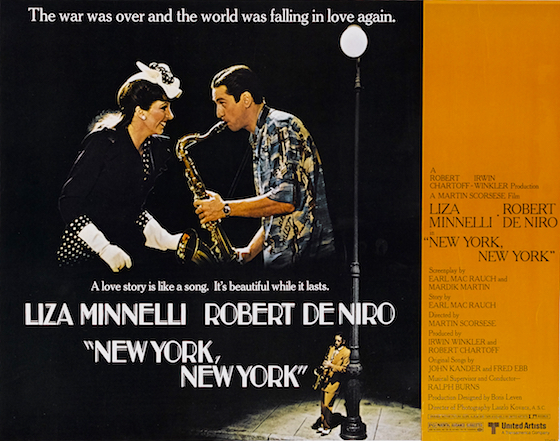
    Starting on VJ Day in New York, it stars Robert De Niro as a wannabe musician and Liza Minnelli as a wannabe singer who wind up in a romance and co-dependent career, until one outshines the other. De Niro is playing an angry young man who has talent but whose temperamental nature may well get in the way of success — yes, it’s Any Robert De Niro Movie. But, wow, his character is annoying, and I imagine his actions are only getting more distasteful with time — the way he badgers and cajoles Liza into going out with him (something she eventually agrees to) is the kind of behaviour that gets regularly criticised nowadays (rightly). Well, I don’t think he’s meant to be a nice guy — the film seems to be about their tempestuous relationship and how that helps and hinders their careers — but I wasn’t sure the film knew how unlikeable he was.

    I wasn’t sure the film knew much of anything, really. Apparently much of the dialogue was improvised, which in turn made it a nightmare to edit into a coherent narrative, which would explain the messiness — everything feels overlong, unfocused, and increasingly dull. Consequently there have been several cuts of the film, with this being the longest “director’s cut” released in 1981. It has some good bits, foremost being the extended Happy Endings musical interlude, which at one point was ditched to create one of the shorter versions. I like the idea of this film being less long, but don’t lose the only really good bit!
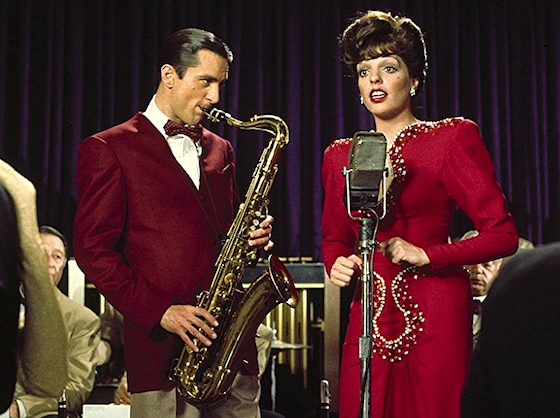
    So good they named it irrelevantly

    Just to wind me up further, the content has fundamentally nothing to do with the title. I mean, it begins in New York, and when the characters go on tour they’d like to get back there, and eventually they do and so some more of it’s set there, and occasionally they’re writing the titular song (which, I confess, I was unaware hailed from this film — I assumed the movie was named after the famous standard, not that it spawned it), and in the epilogue Liza performs said song (post-2016 observation: said epilogue is gosh-darn similar to La La Land’s!) Anyway, my point is: this film could’ve been set almost anywhere and not affected anything much, so why the title?

    2 out of 5

  • The Dark Tower (2017)

    2018 #25
    Nikolaj Arcel | 95 mins | streaming (HD) | 2.39:1 | USA / English | 12 / PG-13

    The Dark Tower

    The Dark Tower started life as a literary work that is, according to its author, Stephen King’s magnum opus: a series of eight novels, written over 30 years and spanning some 4,250 pages, that not only tell their own genre-mash-up story, but also reference or connect up many of King’s more widely-known works. Since 2007 there have been various efforts to try to wrangle such an epic work onto the screen, with perhaps the most high-profile being Ron Howard’s ambitious plan to spread it across both film and TV, alternating a trilogy of big-budget movies with seasons of TV on HBO in order to adapt the whole saga. This clearly proved to be too formidable a goal, but eventually paved the way for what was released: a single 90-minute film. From one extreme to the other, eh…

    It’s easy to imagine why fans of the books have found this film disappointing, then — I mean, there’s no way they’ve managed to accurately condense seven novels (and some of them very long novels at that) into an hour and a half. But, despite the series-encompassing title, it’s my understanding that it’s primarily an adaptation of the first novel, so surely fans would know they could expect the rest of the narrative if sequels were produced? The perceived problems must go deeper, therefore, and be more general: leaving aside fan reaction, the film has a Rotten Tomatoes score of just 16%.

    Strut

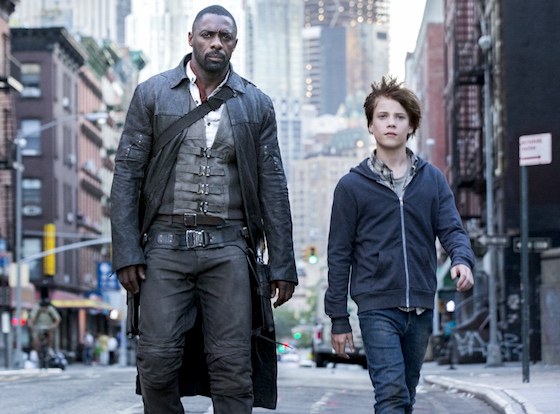
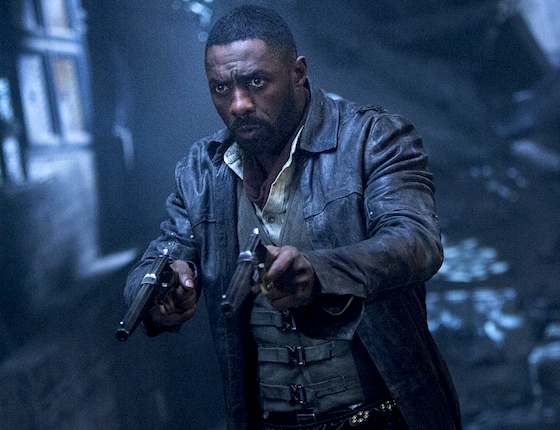
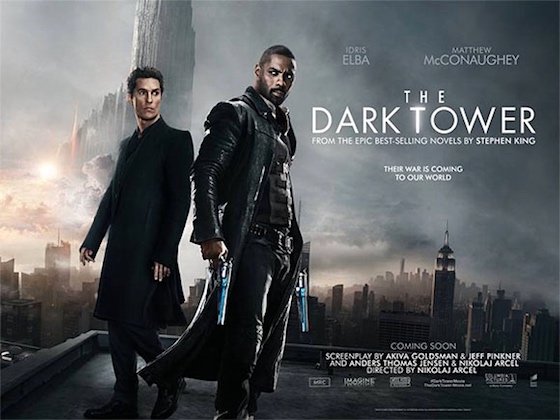
    Well, I don’t know what people were hating, because I thought it really wasn’t that bad. I can’t comment on its faithfulness or thoroughness as an adaptation, but as an action-fantasy movie in its own right I thought it held together pretty well. It only cost $60 million (a bargain for a blockbuster nowadays), but they got good value for money: it doesn’t look cheap, and it has a respectable lead cast as well. Idris Elba’s presence may’ve pissed off some people (his character has consistently been depicted as white in illustrations accompanying the books), but he seemed to fit the role. Matthew McConaughey makes for a decently unsetting bad guy. Our identification figure is a kid played by Doctor Foster’s Tom Taylor, who’s fine here but got to show more chops in that series.

    The relatively stringent budget probably explains why it’s a little light on things like epic action sequences, with those that are included feeling like the makers were probably doing their best on a limited expenditure — the action isn’t bad, but those scenes aren’t as awesome as the film thinks they are. Less readily excused is the plot, which is a bit slim — the story is very straightforward, despite the intricate fantasy gubbins dressing it up, moving directly from A to B to C with minimal complication. Similarly, familiar character arcs are efficiently executed. But if a film’s biggest crime is unoriginality, it’s no worse than the majority of Hollywood’s output for the past 20 or 30 (or more) years, is it?

    Slinging guns

    Well, according to script editor (and fan of the books) Andrew Ellard in his discussion of the movie, that’s precisely the problem. He argues the film represents “the exact same competent mediocrity we’ve seen before from — say — I, Robot or I Am Legend. Not a bad film especially. Just kinda nothing. Or like Inkheart or Assassin’s Creed, fantasy you won’t remember tomorrow. But the books are fascinating. Full of ideas & imagery that haunt you. To pick the blandest, most generic stuff? Dumb.” This, I do suppose, is what fans were primarily upset about. If you don’t know the books then the film we’ve been given is fine as just a reasonable time-passer, but if you feel that it could — should — have been something truly special, how frustrating that must be.

    The Dark Tower grossed $113 million, which, at less than double its budget, probably isn’t enough to secure the mooted sequel (especially when it’s put in comparison to 2017’s other Stephen King adaptation, It, which surpassed $700 million). I guess someday it’ll get re-adapted, probably as a TV series, maybe by Netflix, or Amazon, especially if they still haven’t found the Game of Thrones-beater they’re currently looking for. Until then, this version stands as a reasonably enjoyable quickie — not as bad as you may’ve heard, but apparently not all it could’ve been either.

    3 out of 5

    The Dark Tower is available on Sky Cinema from today.

    The Monster Squad (1987)

    2017 #43
    Fred Dekker | 79 mins | streaming (HD) | 2.35:1 | USA / English | 15 / PG-13

    The Monster Squad

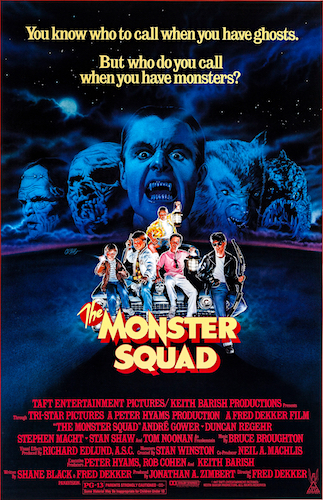
    When I rewatched The Nice Guys on Blu-ray, I also watched the (pathetic selection of) special features, in which Ryan Gosling mentions being a fan of Shane Black before he knew who Shane Black was because growing up he loved The Monster Squad. To cut to the obvious, that inspired me to watch the thing.

    It’s about a group of young kids who idolise classic monster movies, but basically find themselves in one when Dracula and friends come alive and set about finding an amulet that will allow them to control the world. The film wasn’t a success on its original release, but has gained a cult following since. It feels like that kind of movie, too.

    It’s also the kind of film I can imagine you’d love if you saw it at the right age, but the “right age” is not, it would seem, the one I am now. Really, it’s a kids’ movie, despite the BBFC’s 15 certificate. There’s more swearing and stuff than you’d typically expect from a kids’ movie, which I’m sure led to that classification, though as it’s not been submitted since 1990 perhaps they’d give it a 12 today. Nonetheless, the tone feels more aimed at, say, ten-year-olds — it stars kids who are 12 and under, and I bet they’re a moderately realistic version thereof, despite what ratings bodies would like.

    Frankie comes from Hollywood

    That’s not to say it’s without value for those of us coming to it late. There’s great make-up and creature effects, better than you might expect given the overall quality of the film, which is what you get when Stan Winston’s involved. It’s under 80 minutes long, which keeps things pleasantly fast — there’s very little titting about with bits of plot that we know where they’re going, it just gets there. There are some good lines too, as you’d expect from a Shane Black screenplay, although it’s surprisingly scrappily constructed. Perhaps that’s Fred Dekker’s limited skill as a director rather than Black’s screenplay? This was early in his career, mind, so maybe Black wasn’t up to scratch yet — it came out the same year as the film that made his name, Lethal Weapon… which I didn’t actually like much either, so…

    The Monster Squad wasn’t a huge success for me, then, but I imagine if you saw it at the right age it would become a nostalgic favourite.

    3 out of 5

    The Hurricane Heist (2018)

    2018 #60
    Rob Cohen | 99 mins | streaming (HD) | 2.39:1 | USA / English | 12A / PG-13

    The Hurricane Heist

    Billed as a “Sky Cinema Original Movie” here in the UK (which, I presume, is like half of Netflix’s “original” movies — i.e. they paid for exclusive rights to something already completed), The Hurricane Heist… does what it says on the tin, really: as a hurricane strikes Alabama, a gang of crooks plan to use it as cover to rob a Treasury facility and its $600 million of waiting-to-be-shredded old notes. What they didn’t count on was crack ATF agent Casey Corbyn (Maggie Grace), who attempts to stop them with the help of meteorologist Will Rutledge (Toby Kebbell) — who drives a tank-like hurricane-proof car — and his ex-military mechanic brother Breeze (Ryan Kwanten).

    Yes, a film called The Hurricane Heist has a main character called “Breeze”.

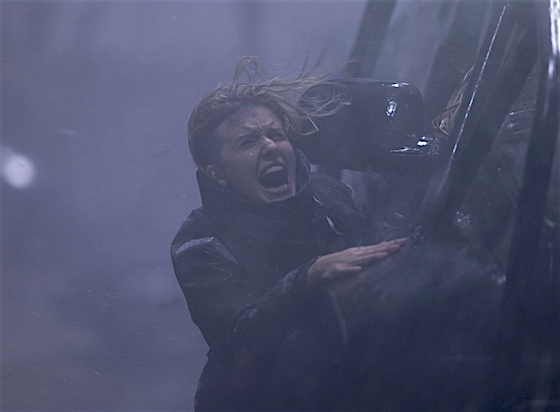
    I suppose that’s indicative of the tone the film’s shooting for, really. It’s not Sharknado, but you have to hope the filmmakers knew it was cheap and cheesy as hell and wanted to play up to that. It’s only sporadically successful — much of the dialogue is just bad rather than so-bad-it’s-good, for example — but it has its moments. About halfway through there’s a sequence where Will throws scrap hubcaps into the wind so that they fly at the bad guys like spinning discs of death, at which point the film looks like it might tip from “so mediocre it’s mediocre” into “utter genius”. Sadly, it doesn’t keep that inventiveness up for more than about ten seconds, but at least it means there’s something memorable here. And while it may generally look and feel kinda cheap, there’s a massive amount of practical wind and rain being thrown around to create the storm, which is pretty effective.

    The wet and the windiest

    Another success comes in a couple of amusing villain deaths during the climax, but to say more would spoil things. The chief villain is played by Ralph Ineson, whose basic skill as a performer at least elevates that role somewhat. Toby Kebbell is probably better than this too, though considering some of his other choices in the past couple of years (Ben-Hur, Warcraft, Fantastic Four) maybe he’s lucky to get this now. Certainly, this is more entertaining than the ones I’ve seen of those.

    If The Hurricane Heist had been made 20 years ago it probably would’ve been a major blockbuster. It certainly looks like the CGI was produced back then. Now… well, it’s gone direct to Sky Cinema, hasn’t it? Maybe it’ll find a cult following, but I’m not sure it’s quite barmy enough to achieve that so-bad-it’s-good love. It is pretty stupid and definitely cheesy, but… well, it’s not so much boring as… not exciting. Like, it’s middling. It’s okay. It’s kinda fun. You won’t remember much of it the day after, but for a bit of daft brain-off action on a lazy evening, it’s alright.

    3 out of 5

    The Hurricane Heist is allegedly in some UK cinemas now. It’s definitely available on Sky Cinema, and will be (presumably exclusively) until at least 5th April 2028.

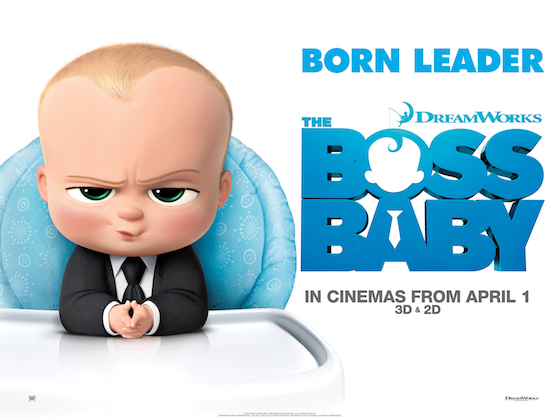
    The Boss Baby (2017)

    2018 #12
    Tom McGrath | 97 mins | download (HD+3D) | 2.39:1 | USA / English | U / PG

    The Boss Baby

    The Boss Baby was one of the top 20 highest grossing films of 2017, which earnt it a place on my ’50 Unseen’ list, thereby ensuring it would remain in my consciousness for as long as I referred to said list (i.e. for the rest of time). Then it went and got nominated for an Oscar too, displacing the likes of The LEGO Batman Movie and Ghibli heir Mary and the Witch’s Flower in the process. With those factors combined, I felt I had to witness it for myself. I chose to do so in 3D, to hopefully ameliorate at least some of the anticipated discomfort of watching the film itself. I needn’t have worried: despite what many people will tell you, I thought The Boss Baby was actually pretty good. Well, most of it.

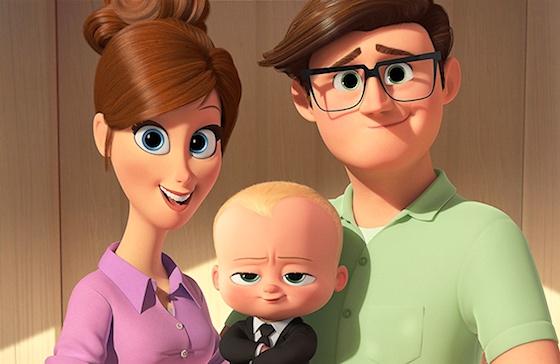
    It’s the story of Tim (voiced by Miles Bakshi and in narration by Tobey Maguire), a seven-year-old only child with a hyperactive imagination and two doting parents. But then a new baby arrives… As Tim’s parents’ affection shifts to their attention-demanding bundle of joy, he’s the only one who can see the truth: that the baby wears a suit, carries a briefcase, and is clearly a businessmanbaby on some kind of undercover mission. Obviously no one will listen to Tim, so he sets about exposing the truth.

    Sibling rivalry

    For all its daft humour, the reason The Boss Baby is so successful (for an adult viewer) is that it’s actually a really neat way of tackling the whole “sibling displaced by new baby” thing, from the kid’s point of view. That’s the thematic and subtextual meat that makes it more than just “wouldn’t it be funny if a baby was a businessman!” As part of this, it has a nice line in juxtaposing how an imaginative seven-year-old sees the world versus how it really is — showing us both Tim’s fantasies and the actual events they’ve launched off from. It allows the film to have exciting and kooky stuff (like talking business-babies and elaborate action scenes) while also remaining grounded. Watching in 3D heightens this further, incidentally: as with most computer-animated films, the 3D effect is generally pretty nice, but it really comes alive during the fantasy and action sequences.

    If that all sounds oddly serious, it isn’t. Arguably best known nowadays for his Trump impersonations, Alec Baldwin is an obvious choice to voice an infantile businessman. This one’s actually competent, though, so Baldwin plays it straight and thus is dryly witty. There are also plenty of amusing visual gags, one-liners, and so on to fulfil the expected comedy remit. Okay, some don’t land or are a bit juvenile, but it is a kids’ movie after all.

    Parents are so gullible

    Unfortunately, what works in the early sections begins to go awry later on. By the third act it’s lost the connection to plausible reality that made Tim’s imagined versions such fun — it’s impossible to translate the OTT action we’re witnessing into what might be really happening. I know it sounds daft to talk about plausibility in a film about a baby who’s a businessman, but it’s the relationship between Tim’s fantasies (i.e. the business-baby stuff) and real-life (i.e. really he’s just a new baby) that makes the earlier parts work.

    Arguably worst of all is the epilogue, which takes a very serious emotional issue (the loss of a baby) and tosses it aside to expedite the resolution the filmmakers want to reach. Maybe it’s a bit much to expect a kids’ movie to attempt to tackle the realities of losing a child, especially when it only introduces that element in its closing minutes, but then surely the solution is to not even go there; to find a better way to wrap up the story?

    It’s this increasing lack of attentiveness that ultimately led me to give the film a 3 instead of a 4. If it had kept up the early quality through to the end, I likely would have looked more generously on it. Nonetheless, thanks to the bits that worked really well, I generally found the film to be a pleasant surprise.

    3 out of 5

    Spin-off TV series The Boss Baby: Back in Business is available on Netflix from today.

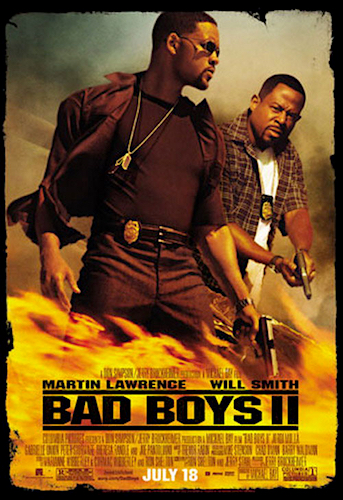
    Bad Boys II (2003)

    The 100 Films Guide to…

    Bad Boys II

    Country: USA
    Language: English & Spanish
    Runtime: 147 minutes
    BBFC: 15
    MPAA: R

    Original Release: 18th July 2003 (USA & Canada)
    UK Release: 3rd October 2003
    Budget: $130 million
    Worldwide Gross: $273.3 million

    Stars
    Martin Lawrence (National Security, Wild Hogs)
    Will Smith (Ali, I Am Legend)
    Jordi Mollà (Blow, Riddick)
    Gabrielle Union (Bring It On, Think Like a Man)

    Director
    Michael Bay (The Rock, The Island)

    Screenwriters
    Ron Shelton (White Men Can’t Jump, Hollywood Homicide)
    Jerry Stahl (Twin Peaks Episode 11, Urge)

    Story by
    Marianne Wibberley (The 6th Day, National Treasure)
    Cormac Wibberley (Charlie’s Angels: Full Throttle, National Treasure: Book of Secrets)
    Ron Shelton (Bull Durham, Tin Cup)


    The Story
    Miami’s finest (or, at least, funniest) narcotics cops attempt to stop the flow of ecstasy into the city, before the cartel masterminding it can escape to Cuba.

    Our Heroes
    Wisecracking Miami narcs Marcus Burnett and Mike Lowery. If you don’t like them, this isn’t the film for you — it spends an awful lot of time just hanging out with them rather than getting on with the plot.

    Our Villain
    Cuban drug lord Tapia. I guess they realised the first film’s villain didn’t get enough screen time, because there’s a lot more invested in this one. Unfortunately, he’s not very interesting, and Jordi Mollà’s performance is terrible.

    Best Supporting Character
    Marcus’ little sister, Syd, a DEA agent. She’s dating Mike, which is a secret from Marcus, and is undercover trying to catch Tapia’s gang, which is a secret from them both. (See also: Next Time.)

    Memorable Quote
    “We ride together, we die together. Bad boys for life.” — Mike Lowery

    Memorable Scene
    After a car chase, pile-up, and shoot out with our heroes, the gang of criminals hijack a car carrier to continue their pursuit of Syd. Marcus and Mike give chase along the freeway, at which point the criminals decide to start offloading cars…

    Previously on…
    The first Bad Boys was Michael Bay’s feature debut, and propelled Will Smith’s career towards movie stardom.

    Next time…
    A third film has been in on-and-off development for years — the last news seems to be that it might start shooting later this year. Definitely in the works this year is a spin-off series based around Marcus’ sister, Syd.

    Verdict

    Probably the Michael Bay-iest Michael Bay movie that Michael Bay ever Michael Bay-d— er, made. If the first Bad Boys suggested where Bay’s style would go, Bad Boys II is him in full flow. It’s got all the hyper-kinetic editing, vague sense of space, and demonstrates the same lack of restraint over length (as well as, well, everything else) that Bay would show again and again during the Transformers series. It’s just. So. Long. There are loads of skit-like comedy asides that could be cut. Keep some, sure — it’s an action-comedy, that’s the style — but all of them? I guess it’s something of a hang-out movie in that regard, more about spending time with the characters than getting on with the plot.

    It’s also packed to bursting with major action sequences, some of which border on classic but, again, are let down by Bay’s direction. For example, the freeway chase is good, but with a better sense of space and interrelation between its various elements (rather than the tumult of semi-connected images we do get) it could’ve been exceptional. Similarly, the climax is massively overblown in a way that only Bay (well, and now the Fast & Furious films) could do, and yet I didn’t recall a second of it from my previous viewing. It goes to show there’s more to making something memorable than just going Big.

    This Letterboxd review sums it up well: “It’s impossible to love, but also hard to hate. It’s ambitious, relatively well shot, too long to call a piece of chuck-on fun, and generally just weird.”

    For the record, although I’ve given both films a 3, the first is up towards a 3.5 and this is down towards a 2.5.

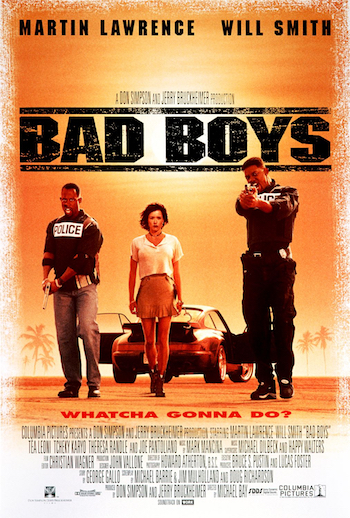
    Bad Boys (1995)

    The 100 Films Guide to…

    Bad Boys

    Whatcha gonna do?

    Country: USA
    Language: English
    Runtime: 119 minutes
    BBFC: 18
    MPAA: R

    Original Release: 7th April 1995 (USA)
    UK Release: 16th June 1995
    Budget: $19 million
    Worldwide Gross: $141.1 million

    Stars
    Martin Lawrence (Blue Streak, Big Momma’s House)
    Will Smith (Six Degrees of Separation, Independence Day)
    Téa Leoni (Deep Impact, Jurassic Park III)
    Tcheky Karyo (Nikita, GoldenEye)
    Joe Pantoliano (Empire of the Sun, Memento)

    Director
    Michael Bay (Armageddon, Transformers)

    Screenwriters
    Michael Barrie & Jim Mulholland (Amazon Women on the Moon, Oscar)
    Doug Richardson (Die Hard 2, Hostage)

    Story by
    George Gallo (Midnight Run, The Whole Ten Yards)


    The Story
    When millions of dollars’ worth of heroine is stolen from police evidence, the two cops that brought it in must find the thieves and retrieve the drugs, while also protecting the only surviving witness who’s seen the crooks.

    Our Heroes
    Marcus Burnett and Mike Lowery, a pair of wisecracking cop buddies, one a family man with a wife and kids, the other a smooth womaniser. Never seen that before.

    Our Villain
    Drug lord Fouchet. Murder happy and clearly a master at planning heists. Other than that, we barely get to know him.

    Best Supporting Character
    A witness to some of Fouchet’s crimes, Julie ends up in witness protection with Marcus, who she thinks is Mike, which they have to hide from Marcus’ family. Hilarity ensues!

    Memorable Quote
    Mike Lowrey: “Now back up, put the gun down, and get me a pack of Tropical Fruit Bubblicious.”
    Marcus Burnett: “And some Skittles.”

    Memorable Scene
    After a shoot-out at the airport, Fouchet escapes in a sports car. Marcus, Mike, and Julie give chase, with the normally slow Marcus driving, as they find themselves in a game of chicken with the concrete crash barriers at the end of the runway…

    Making of
    Bad Boys was a relatively low-budget production, but, fortunately for director Michael Bay’s ambitions, he was already a wealthy man from directing commercials and music videos — so when the budget ran out before shooting a key part of the climax, he was able to pay for it out of his salary; and when they needed a swish car for the heroes to drive, Bay lent his own Porsche 911 to the production.

    Next time…
    A sequel came eight years later, with a third in on-and-off development ever since — the last news seems to be that it might start shooting later this year. Definitely in the works this year is a spin-off series based around a character from the second film.

    Verdict

    The debut feature from director Michael Bay, Bad Boys displays a lot of the things he would become known for: fast-cut action scenes; a sense of style over substance; a little light lasciviousness… Even from his first film, some of his flourishes look over the top. Maybe they’ve just aged badly — it certainly feels of its time, i.e. the mid-’90s (with some ’80s holdovers). Anyway, it’s kept aloft by the buddy act of its two stars, who are pretty funny at times. Bay allows the film to run a mite too long though, and the villain is underdeveloped, both of which hold it back even more than Bay’s sometimes-cheesy direction.

    Make/Remake: Deaths at a Funeral

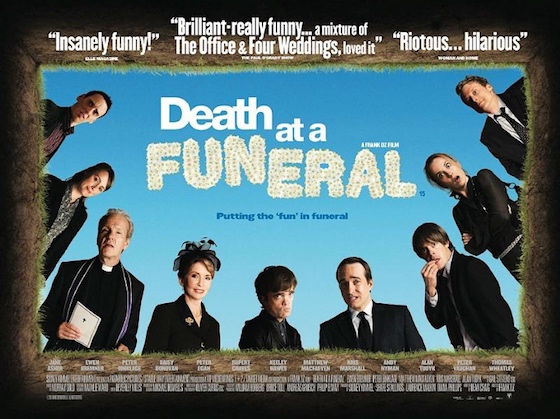
    In 2007, Frank Oz directed a gaggle of British thesps (plus Peter Dinklage) in a darkly comic farce set during an English funeral.

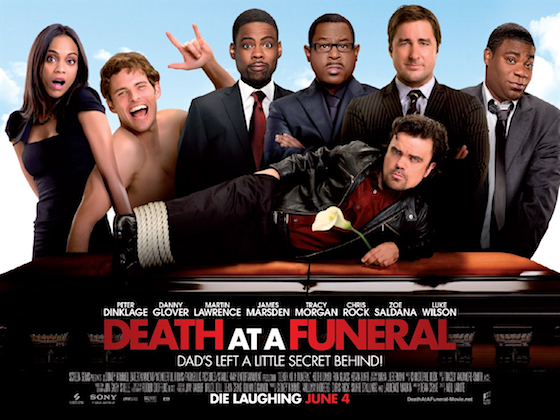
    Just three short years later, director Neil LaBute and a gaggle of American comedians (plus Peter Dinklage) remade it in the US.

    Why did they so speedily re-do an English-language film in English? Goodness only knows. But I watched both versions almost back to back, so here are my thoughts…

    Death at a Funeral
    (2007)

    2018 #44
    Frank Oz | 91 mins | streaming (HD) | 1.85:1 | UK, USA, Germany & Netherlands / English | 15 / R

    Death at a Funeral (2007)

    The plot of both versions is identical: a group of family and friends gather at the home of the family’s patriarch for his funeral. A variety of subplots unfold from there, but the main one revolves around the appearance of a guest that no one knows, and what he wants.

    The thing that surprised me most about Death at a Funeral is how well-liked it is online. I vaguely remember it coming out but thought it had been mostly ignored, but it has a fair amount of ratings on IMDb (a similar number to films like All About Eve or Dumbo), and relatively high user scores on sites like Letterboxd too. I thought maybe people (well, Americans) had come to it via the remake and it seemed a lot better by comparison, but that has less than half as many ratings on IMDb, so…

    I was mulling on this a lot because often I like films a bit more than the online consensus, but I wasn’t feeling it with this one. I certainly enjoyed it, but it takes a while to warm up, the laugh rate isn’t quite high enough, and some of the storylines feel overly familiar (how many times have we seen someone accidentally take drugs and try to hide it? I don’t know, but it feels like I’ve seen it a lot). Nonetheless, it develops into a decent little farce. I suppose it’s a black comedy too, what with it being set at a funeral and some of the events that unfurl, but other people have pushed the boundaries of “black comedy” so far in the past couple of decades that it didn’t feel that dark to me.

    Peter Dinklage with one of the few British actors who hasn't been in Game of Thrones

    The cast is a quality array of recognisable British faces, many of them not known for comedy (Matthew Macfadyen, Keeley Hawes, Rupert Graves), which lends some surprising strength to a couple of scenes. Others that are more familiar from the genre (Andy Nyman, Ewen Bremner, Kris Marshall) keep the guffawing in check. And there are some Americans too, including an exposed performance from Alan Tudyk (who’s doing a British accent) and a pre-Thrones Peter Dinklage (who isn’t), but they both fit in well.

    The film’s best gag, in my estimation, comes courtesy of the entire cast, in a way; an in-joke that I wasn’t 100% sure was deliberate: the end credits begin with each cast member’s name accompanied by a brief shot of them corpsing. Corpsing, during a film called Death at a Funeral. Well, I do like an in-joke.

    Anyway. Although this original British version of Death at a Funeral wasn’t quite as hilarious as I’d hoped for, it’s worth a watch as a well-performed and amusing farce. And it does improve somewhat when compared to to its remake…

    3 out of 5

    Death at a Funeral
    (2010)

    2018 #46
    Neil LaBute | 89 mins | streaming (HD) | 2.35:1 | USA / English | 15 / R

    Death at a Funeral (2010)

    Where the original was a little underwhelming, this is just kinda shit. It’s the most pointless remake since Gus Van Sant’s Psycho.

    That comparison isn’t a bad one, because this is a scene-for-scene remake — sometimes shot-for-shot, line-for-line. Even the title sequence is an inferior riff on the original. Not only that, but some bits aren’t even done as well. If it worked the first time, why are you changing it? Maybe the original cast and crew made it look more effortless than it was. Some of it doesn’t even translate very well. For example, there’s a joke in the original about how “tea may solve many things”. Here, that’s translated to be about coffee. Yes, it’s been adapted to suit the different culture, but in the process has lost the cultural significance (to Brits, tea is more than just a popular beverage).

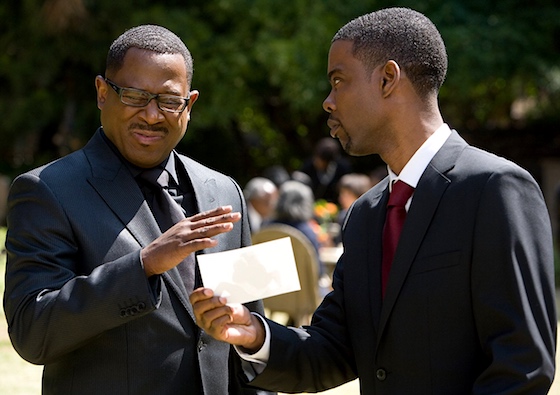
    I guess he's showing him the screenplay

    There are some new gags, most likely the result of the cast improvising (this version is more populated by comedians than the British one). Some of them are even funny. Unfortunately, more often the cast don’t hold up. Most of the performances are like an under-rehearsed am-dram version of the same screenplay. They certainly don’t have the acting chops to sell the more emotional moments. James Marsden is quite good in the Alan Tudyk role, though. Peter Dinklage plays the same part, but not as well — it’s less nuanced, less believable.

    Director Neil LaBute previously found notoriety as writer-director of the Nic Cage Wicker Man remake. This does nothing to rehabilitate his reputation (what is this guy’s obsession with re-doing and ruining British films?) Again like Van Sant’s Psycho, it’s more interesting as a cinematic exercise than as a film in its own right.

    2 out of 5

    Transformers: The Last Knight (2017)

    2018 #47
    Michael Bay | 155 mins | Blu-ray (3D) | 1.90:1 + 2.00:1 + 2.35:1* | USA, China & Canada / English | 12 / PG-13

    Transformers: The Last Knight

    Here we have the fifth Transformers film in 11 years from director Michael Bay. At this point you ought to know what you’re getting — the style hasn’t fundamentally changed since at least the third movie, arguably since the first, so if you dislike those then most probably there’s nothing for you here. I say “probably” because I’ve seen at least one review from someone who despised the fourth film but enjoyed this one, so clearly there’s always room for variability.

    We’re dealing with variations on a theme, then, and The Last Knight brings a few fresh-to-the-franchise plot spins to add a different flavour and texture this time out. Firstly, a prologue tells us that Transformers were already in England about 1,600 years ago, when they fought alongside King Arthur and Merlin, the latter of whom didn’t wield magic but actually Autobot technology (and is played by Stanley Tucci, hamming it up something rotten). This relates to the present day because… well, I could explain it to you, but it gets fiddly and, frankly, if you care then you’ll find out when you watch it. But, basically, in present day America Transformers are hunted and Cade (Mark Wahlberg) is an outlaw helping hide some of them and rescue others. When a MacGuffin from Arthurian times attaches itself to him, he winds up on his way to England to meet Sir Anthony Hopkins, the last in a long order of… oh, yeah, I said I wasn’t going to explain it. Anyway, only Marky Mark and Clever English Totty (Laura Haddock, playing the kind of Oxford professor who dresses like a secretary in a porn film) can save the world. Who do they need to save the world from? Optimus Prime! Dun dun duuuun!

    Now he's called Nemesis Prime, for no good reason

    It’s all nonsense, of course, but then the inherent concept of Transformers never made any sense so what does it matter? Adding in Arthurian legend and making Optimus Prime a baddie doesn’t make it any dafter than it already was. And that’s only the half of it — there are more disparate story threads and subplots than a particularly complicated miniseries. Despite being shorter than the last movie, it’s still indulgently long — and needlessly so, too. There’s a ton of stuff that could be cut to streamline the plot, from individual shots and lines (the Arthurian prologue is probably twice as long as it needs to be) to whole characters (a street girl Cade basically adopts, Izabella, contributes nothing of major significance in the end). After about an hour, the story basically stops and starts again — that’s how long it takes to get to Sir Hopkins. Stuff from the first hour remains relevant, certainly, but I’m sure there were other ways to handle it. By getting through the first hour of the movie in half the time, for one thing. For another, don’t introduce major-seeming characters that you’re then just going to set aside and ignore for the next hour while you introduce whole new ones.

    It’s remarkable how the Transformers movies can have way too much plot and not enough plot all at once. If you want to follow it you have to pay attention, not only because there’s a lot of mythology to take in, but also because Michael Bay chops it all up into bite-size chunks amongst frenetic action sequences. The film is cut like one long trailer — but that’s been Bay’s MO for a while, so, as I said at the start, no one should be surprised. It remains, in its own way, impressive. As I previously said in my review of Age of Extinction, it’s almost avant-garde: a tumble of images and sound that give you an impression of what’s occurring rather than straightforward traditional storytelling. And I say it’s impressive because it must be so much work to create — all the camera setups involved; events staged for a single, fleeting, couple-of-seconds shot; and then edited together with non-stop dynamism, rarely pausing for any notable period.

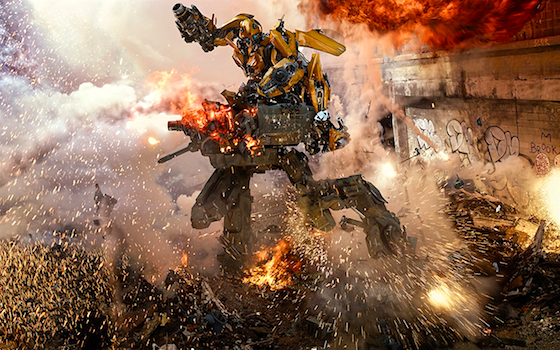
    Non-stop Bayhem

    And if you think that’s mad, wait until you see how Bay uses aspect ratios. Thanks to Christopher Nolan and The Dark Knight blazing a trail, we’ve now had a fair few movies that use the IMAX format for select sequences, and emulate that on home media by allowing the aspect ratio to change — for laypeople, that’s when the black bars at the top and bottom disappear and the picture fills the screen. As I say, generally this is used for specific sequences, or occasionally for a particularly grand individual shot; and usually there are two ratios, approximately 2.40:1 (with the black bars) and approximately 1.78:1 (without). Bay uses… more than that. And he does so almost indiscriminately. They’re so all over the place that you can’t miss them. Like, there are standard shot-reverse-shot conversations between two characters, but each character has a different aspect ratio… and then, as if that wasn’t bad enough, halfway through the scene one side will switch to another ratio! It just leaves you wondering why and how it ended up this way. What was the intention? What was the point? Well, that’s not a new question with Bay — he still uses five shots when one would do, so why not extend that same thinking to the film’s aspect ratio?

    Despite the faffing around, much of it still looks impressive in a purely visceral sense. Like every modern tentpole, it cost a fortune to make ($217 million), but at least it looks like it did: there are so many grand sets and large-scale set pieces, much of it built or performed for real — not the giant robots, obviously, but there are car chases and human stunts and so forth that they did in real-life rather than in a computer. The money is splashed all over the screen, to the nth degree. Is that inherently a good thing? Eh. But it makes you wonder where some other $200m+ movies spend their money — especially when you consider that apparently production difficulties resulted in a lot of material being filmed but never making it into the final cut. How much? Well, supposedly a whole hour of footage was ditched from the original cut to get to the theatrical version. As I’ve already said, the film’s too long as it is, but it’s a shame there are no deleted scenes available because I’d be kind of fascinated to know what more was meant to be there, and to see how much money it looks like they wasted on it.

    They really did hang Marky Mark out the side of a speeding vehicle, donchaknow

    In what we did get to see, the size of the endeavour and the impressive quality of the imagery is emphasised by how it was filmed. A large proportion of the movie was shot in IMAX 3D (apparently 98%, but I’m certain there was more than three minutes in non-IMAX aspect ratios), and there are innumerable moments that benefit from the depth and scope of the format. Post-conversion has come a long way, but I’m not sure it can always equal doing it for real, especially on a format with the quality of IMAX. That said, the visual splendour didn’t strike me as much as it did in Age of Extinction. Perhaps that’s because, as Richard Brody put it in his New Yorker review, Bay’s “sense of speed works against his sense of scale and of detail. All the best moments in the movie — pure images, devoid of symbol and, for that matter, nearly empty of sense — go by too fast, are held too briefly, are developed too little.” There are some great shots in here, but the rapid editing just races past them. If you wanted to find and appreciate the shots fully, you’d have to damn near go through the whole thing frame by frame. I’m not sure they’re that good.

    Although Bay and his directorial style always get a critical slating for these movies (more so than others he’s made in the same period — Pain & Gain and 13 Hours both attracted a reasonable amount of praise), they let him keep making them, and he keeps wanting to. The former makes sense: although you rarely find someone who admits to liking them, they keep making money (The Last Knight is the series’ lowest grosser worldwide, thanks to a particularly poor US showing, but it still took over $600m). As for the latter… no, I don’t know why he keeps coming back. Can you think of another blockbuster-level director who’s made five films in the same series? No one instantly comes to mind for me, and even those who are close (Lucas with Star Wars; Spielberg with Indiana Jones) did so over a long period of time with many films in between. I mean, if Bay wants to do it then why not — it’s his life and career — but I don’t quite understand it.

    The three-headed robot dragon that I almost forgot

    As I said nearly 1,500 words ago (I never imagined I’d have so much to say about this movie — and I haven’t even mentioned the three-headed robot dragon, or the C3PO-alike comic relief butler), everyone should know what they’re getting with the Transformers films by now. The Last Knight shares the same pros and cons as the other entries in the series, to one degree or another — by which I mean that, for instance, I found the plot a little more coherent than last time (though still totally barmy), but I wasn’t quite as bowled over by the visuals (which are at least half the point of these films, I feel). On balance, I’d say it’s one of the franchise’s better instalments.

    3 out of 5

    Transformers: The Last Knight is available on Sky Cinema from today.

    * The listed ratio for The Last Knight is 1.90:1, because that’s the tallest, but its shifts into various other ratios are very obvious, as I discuss in the review. The three I’ve listed are the most obvious, but one of the trailers was shown to use eight slightly different ratios, so who knows how many there really are? ^

    The Love Punch (2013)

    2018 #7
    Joel Hopkins | 94 mins | streaming (HD) | 2.35:1 | France & UK / English | 12 / PG-13

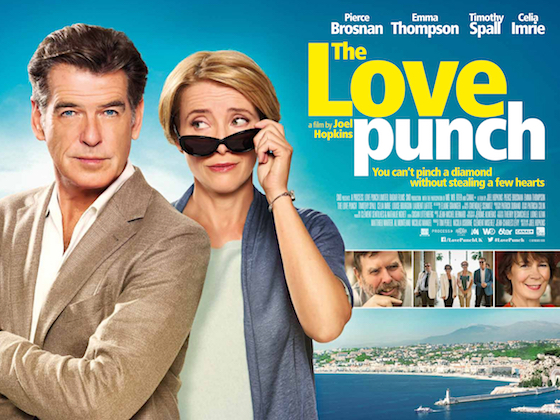
    The Love Punch

    In this very daft comedy heist thriller (calling it a thriller is a bit of a stretch, but anyway), Pierce Brosnan plays Richard, a businessman whose company is bought out by mysterious others, only for them to strip its asset and sink the employees’ pensions — as well as that of Richard’s ex-wife, Kate (Emma Thompson). When the man behind the buy-out, Kruger (Laurent Lafitte), refuses to play fair, Richard and Kate team up with their neighbours, Pen (Celia Imrie) and Jerry (Timothy Spall), to pilfer the extraordinarily expensive diamond Kruger has bought his fiancée (Adèle Blanc-Sec’s Louise Bourgoin).

    The Love Punch flirts with seriousness in its setup — what could be more current than unscrupulous moneymen buying a company and screwing over people’s pensions? — but quickly reveals its true nature as an implausible farce. Despite the lead cast, it seems to have been a French-driven production (even the UK-set scenes were filmed over there), so I suppose that style is only appropriate. While never scaling the heights of genuine hilarity, I don’t imagine anyone thought they were making anything other than a light romp.

    So if you like any (or all) of Brosnan, Thompson, Imrie, and Spall, as well as the idea of a bit of gently-farcical gadding about in the south of France, then The Love Punch is amiable fluff to while away 90 minutes on a Sunday.

    3 out of 5