
Christopher Cain | 102 mins | TV (HD) | 1.85:1 | USA / English | 18 / R
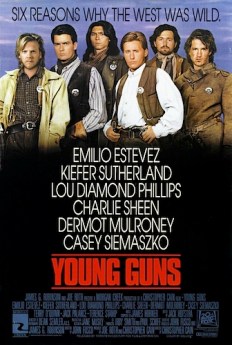 Way back in March, the ever-excellent Colin at Ride the High Country covered a series of films about Billy the Kid, including this late-’80s effort. To quote from the comments section: “I would have been in that target demographic too when I first saw it… around 20 years old or so… I wonder how it would play now to an audience of a similar age.” Well, as someone who watched it when closer to 20 than 30, I shall step up to the task.
Considering this is ‘the Brat Pack Western’, one might well expect a modernised, sanitised West; something like Wild Wild West or Jonah Hex; something rated PG-13. Instead the film seems to have begun life as a serious attempt at a Billy the Kid biography, right down to bloody violence that earns it an R in the US and even an 18 over here. This intention seems to survive — bar a music-video-styled opening, a couple of lines of dialogue, and the wailing ’80s guitar score — but how successful it was is another matter.
I don’t know about historical accuracy in this case, not knowing much more about Billy the Kid than I’ve gleaned from… well, this film, and Colin’s series. Playing loose with facts can work in a film’s favour — as many a filmmaker has noted in the past, they’re making entertainment not documentary — but it can be galling to one who knows the truth. In the way it presents events, this one feels accurate — things like characters appearing only to die immediately; the kind of thing that doesn’t sit well narratively but might be the truth. If it isn’t accurate, this is all the more dangerous: there’s a difference between changing facts so something works as a film narrative and presenting the wrong thing as the truth. 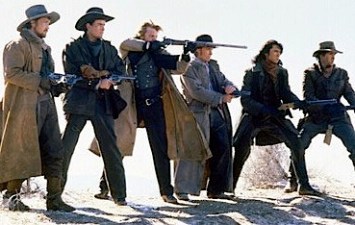 Though if someone was planning to use Young Guns to research the real-life facts of these events, more fool them in the first place. Wikipedia says (without citation) that “historian Dr. Paul Hutton has called Young Guns the most historically accurate of all prior Billy the Kid films”. We’ll leave it at that for now.
As a film in itself, then, the narrative is a bit scrappy. Our heroes wander around killing some people, racing about the country sometimes for no discernible reason and with chunks apparently missing. For instance, they head to Mexico just for the challenge of it — we’re told it’s a hard road, laden with bounty hunters out to get them — but the film cuts from their decision to make this journey to their arrival with a rapturous welcome. Eh? I have no idea if this stuff was shot and cut for time, or if someone needed to have a long hard look at the screenplay. Or even a quick glance.
The finale is also implausible. One assumes the characters who survive must have survived in reality and the others must’ve died, but the way it’s played here it doesn’t make a great deal of sense. How did they defeat those overwhelming odds? How did they pull off that escape? It might pass muster with The Hero Is Invulnerable movie logic, but not as a claim to depicting real-life events. 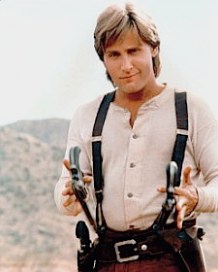 And that’s without mentioning the overuse of dated slow-motion that descends upon its eventual climax.
As for the Brat Pack themselves, Emilio Estevez’s version of Billy the Kid seems to descend during the film from above-himself hot-head out for revenge to giggling loon. This isn’t really character development, more as if halfway through Estevez realised how much fun it was to laugh and so kept doing it. Charlie Sheen gets the honour of (spoilers!) being killed off halfway through. As one of the most recognisable members of the ‘Brat Pack’, here playing the leader of the gang, it works as an effective surprise.
Kiefer Sutherland has the best part though. He’s given the only subplot that approaches anything meaningful and also almost all the best lines (not that there are many). The remainder go to Jack Palance, who isn’t around enough to create a great villain but makes a commendably good hash of it in his brief time. Equally brief is Terence Stamp’s part. I have to say I’m no fan of Stamp — everywhere I’ve seen him he seems awkwardly flat, often phoning it in — but here he’s not bad. This may be because his role’s quite small and relatively subdued as it is. Patrick Wayne appears as Pat Garrett for a knowing cameo; the kind of small role which any viewer can tell Means Something, but if you don’t know what he means there’s no explanation proffered (until the final scene, anyway, when Sutherland narrates a “what happened next” for the surviving characters).
 Young Guns is not a particularly likeable film, managing to miss both its potential target audiences: it’s not serious-minded enough for Western enthusiasts, let down by the Brat Pack cast and (it seems) historical accuracy; but it’s surely not fun or modernised enough to appeal to a younger (or younger-minded) crowd. Though clearly it did well enough as it spawned a sequel two years later. I didn’t hate it, I just didn’t particularly like it.

Young Guns is on Channel 5 tomorrow, Sunday 13th November, at 11:15pm.
Young Guns is on 5USA tonight, Tuesday 30th December 2014, at 9pm. It’s sequel, Young Guns II: Blaze of Glory, follows at 11pm.
After four years and three months doing 100 Films, this became the first new film I’ve seen which has a title beginning with the letter Y — the last unaccounted-for letter. Hurrah!
 What’s this, the
  With so many characters killed off in the preceding films we’re not left with anyone to really care about — certainly not the new gang of coppers we’re introduced to. Actually, to say we’re “introduced to” them is a kindness — they just turn up and begin to lead that part of the plot.
 a lot more regularly than they were in previous films, and bits of them swing in the direction of the camera, but that’s in keeping with the style of the series and doesn’t jar massively — if you didn’t know it was shot for 3D, you wouldn’t notice most of it.
 The worst side effect of 3D, however, is that the colour looks ridiculous in 2D. I’m glad they’ve shot it with 3D properly in mind — everyone knows the glasses make 3D films darker, but not every filmmaker seems to be compensating appropriately (see, for example, the criticism of
  It’s quite understandable if you haven’t heard of Browncoats: Redemption (well, other than for
 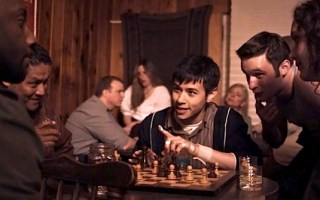 The characters are, thankfully, not carbon copies of Firefly’s cast — some effort has clearly been made to differentiate the line-up, and that goes beyond inverting most of the genders. They’re surely cut from the same cloth though, but that’s understandable: this isn’t trying to be radical with Whedon’s ‘verse, it’s trying to emulate it for the fans, and the fans like what they’ve already seen. Ironically, despite being the most obviously gender-swapped, it’s Redemption’s female captain who’s most like her Serenity counterpart: Laura is, to be blunt, Mal with breasts. Her backstory is at least completely different, but the end result — the character we meet in the film — is more or less the same. When your leads are too similar it can override how different the rest of the cast may be.
 The rest of Browncoats’s direction is a typical fan film minefield. Dougherty’s work is awkwardly flat: it’s all master shots and few close-ups; some sets are shot from the same two angles (and no more) in every scene; it ignores basic rules, like the 180 degree line; the camera is handheld or mounted indiscriminately; it’s loosely framed and poorly lit. And it’s loosely edited too, with some bits allowed to run indulgently long. There may be some places where it’s not so bad, but generally this is the work of someone who knows how to point a camera and press record, rather than direct.
 I’ve seen many people online flat-out slag Browncoats off, which is patently unfair. Maybe it’s a generational thing: having been a
  If I scored films for effort, or for heart-in-the-right-place-ness, then this would be an easy 5/5. I just hope no one involved is hoping they can launch a career in ‘real’ film or TV off the back of it, because it doesn’t make that grade. (They’re trying the same thing again, at least, this time with an original zombie movie (because there aren’t enough of those) called
 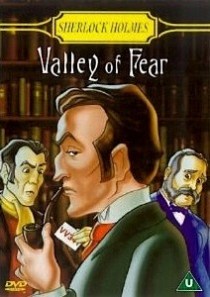 I don’t recall how exactly I came across these animated Sherlock Holmes adaptations starring the voice of Peter O’Toole as the eponymous detective, or how I came to decide to view all of them, but it’s been almost four years since I reviewed the first… and three years since I reviewed the third. Now, finally, I get to the final episode. Such is the erraticism of using LOVEFiLM. (At least I have an excuse for my dawdling here — my incredibly slow viewing of all the Rathbone/Bruce Holmses is entirely my own tardiness.)
 Jonah Hex is not a good film. Let’s just establish that, before I start being nice about it.
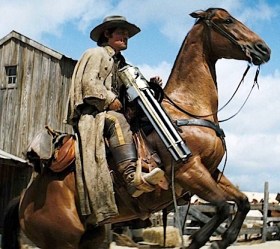 Much of the film rattles on in this way. And rattle it does: 73 minutes before credits. As blockbuster running times spiral out of control, such brevity is almost welcome. It doesn’t feel exceptionally short, mind, except for when the plot occasionally jumps forward.
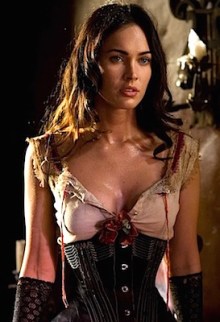 — usually improbably — or generally be a female. By “female” I mean “cleavage delivery device”. Considering her acting ability, her lack of presence is no real shame.
  The near future: most of mankind now lives through ‘surrogates’ — robots that look like perfect versions of ourselves (generally), which we control from elaborate machines sat around in our homes. The anonymity of the online world brought into the real one, essentially.
 while almost every plot ‘twist’ is startlingly unsurprising (though it does manage one half decent one).
 If you want to muse on what makes us human in a world of near-identical robotic replicas, watch
 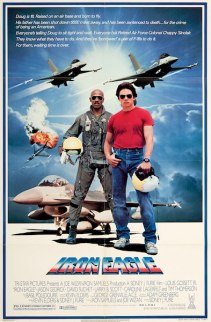 You know how sometimes you see a bit of a movie on TV and you end up watching just long enough to get caught up so much you’re in for the long haul, no matter what the quality? No? Maybe it’s just me (usually around
 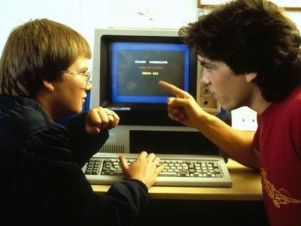 Like I said, daft and implausible. And that isn’t necessarily a problem, but as you watch Iron Eagle you can’t help but wonder if the filmmakers are trying to convince viewers it could be plausible. And it isn’t. Not in the slightest.
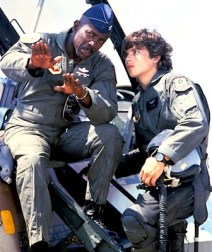 I’ve not seen that either, but I think we all know this is a serious step down. Poor man. His career went on to include
  As I mentioned in my review of the
 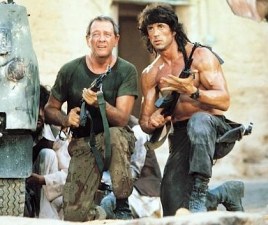 now occupy almost the same position the Russians did back then, for instance — but I’ll leave the specifics of such things to reviewers more versed in the last 25 years of Western intervention in the Middle East.
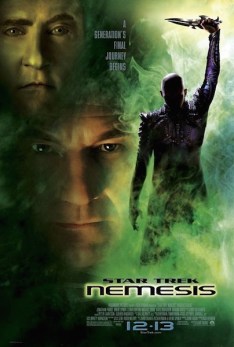 After the widespread disappointment with
  though the knowledge of better things to come means his presence somehow lifts his scenes a notch.
 There’s probably a worthwhile biopic to be made about Verity Lambert. In 1963, she became not only the youngest-ever producer of a BBC television programme, but the first female one too; the programme she was charged with launching was
  Before I set off really critiquing the film, let’s just remember this: it’s a student effort. In that context, I’ve seen far worse — heck, I’ve been involved in the production of worse. Cowell and Guy have set themselves an almost Herculean task by choosing a period tale, which obviously necessitates all sorts of extra effort in terms of costumes, locations, dialogue… And to make it worse, they’ve chosen the ’60s, evoked so faultlessly in almost 40 hours (and counting) of
  which he accepts with merely a muttered “damn” when she leaves. Sorry, what? There’s nothing believable in that scene, never mind accurate.
 Technically, the piece is just as much a mixed bag. Stephen Cheung’s direction picks out some decent angles, avoiding the flat point-and-shoot trap some student filmmakers are apt to fall into, while the sepia-ish wash helps the period tone and adds a small amount of welcome gloss. The editing is a little rough around the edges, particularly at scene changes and toward the end. YouTube claims it’s viewable in 1080p — whether something went wrong in shooting, editing or at YouTube’s end I don’t know, but it isn’t that high quality. (This last point doesn’t impact on my score at all, it’s just an observation.)
 100Films.co.uk