
Wilson Yip | 106 mins | TV (HD) | 2.35:1 | Hong Kong & China / Cantonese, Mandarin & Japanese | 15 / R
 I liked Ip Man, but as we know from experience there are times when I find myself with little to say about a film, or I fail to make any notes, and this was an example of both. So I’ve decided to try something a little different.
I’ve read several different reviews of the film, found by various means, and have compiled a selection of quotes from them below. These are all segments of those reviews that I agree with or found to be an interesting point — I’m not trying to accurately represent each reviewer’s opinion, but instead using their words to enlighten my own. Each quote is, of course, credited and linked, so if you want to know their full opinion you can click through.
They’re arranged in an order that I think makes sense, too — by which I mean, rather than just bundle a selection of quotes in any old order, I’ve sorted them so that if you read them through as presented they should form a structured (more or less) piece.
And so:
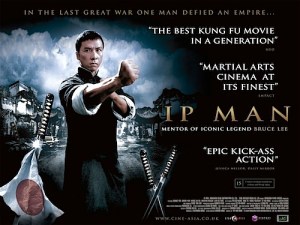
Biographical martial arts drama starring Donnie Yen. China in the 1930s: Ip Man’s reputation as a martial arts master has brought fame and fortune to the city of Foshan. But hard times are ahead, as the Japanese invasion brings the once prosperous city to its knees.
Donnie Yen plays the eponymous Wing Chun master, who stove off hunger, poverty and half the Japanese army during China’s WW2 occupation – by kicking ass!
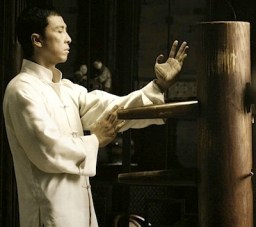 Though that’s an amusing thought, the film’s not quite that simplistic:
As he rallies his people to stand up for themselves, Ip Man becomes about how war pushes a peaceful man into action, but also how he tries to maintain his faith in what it means to be civilized.
Ip’s transformation from diffident bourgeois to symbolic man of the people is rendered as compelling period melodrama
There’s a pleasing playfulness about the opening scenes, which contrast… with the downbeat mood that follows during the occupation.
Not everyone was so impressed:
In transforming a humble real-life martial artist into the type of the reluctant hero (and nationalist icon), screenwriter Edmond Wong has turned his subject not only into something that he was not, but also into an overfamiliar kung fu movie cliche. This is an impression not helped by the film’s desaturated period look (yet another cliche), and a drift in the second, war-set half towards melodrama
a shameless hagiography that only bears a passing resemblance to history.
To elucidate:
The presence of young Zhun [Ip Man’s son] suggests an eyewitness veracity to the events as portrayed on-screen — after all, Zhun himself, now a much older man and a wing chun master in his own right, served as a consultant on Ip Man. The film, however, does not hesitate to sacrifice the truth to the demands of dramatic entertainment.
almost none of what you see in Ip Man actually happened, and in some sense that’s too bad, because the real Ip sounds like a fascinating figure. He was a pre-revolutionary police officer, a reported opium addict, and a refugee who fled the Communist takeover in 1949 for a new life in British Hong Kong. But all those factors make him undesirable as the hero of a work of rousing nationalist agitprop. So instead we get Yen’s remarkable performance as a man of prodigious Buddhist-Confucian composure and tranquility, who goes from wealth to poverty to near-slave status, and finally must fight a public gladiatorial match against a sinister Japanese general
disappointingly simplistic. Yip, Wong, and Yen never develop any real tension between Ip’s true story and the exaggerated myth-making of a martial-arts movie. But as an exaggerated, myth-making martial-arts movie, Ip Man is often thrilling.
True-to-life or not, action star Donnie Yen largely shines in the lead role:
Donnie Yen delivers a charismatic portrayal of Ip Man, the martial arts master of the title.
Man is the role Yen was made to play: a stoic tough guy that everybody in the community knows is the best
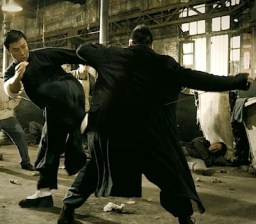
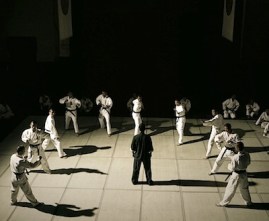
Yen’s performance is also a bit one-dimensional as the modest wing chun expert, but at least he gives a good account of himself in the finely composed and inventive close-combat scenes — an impressive highlight being when he wipes the floor with ten soldiers with methodical precision.
 Indeed, fighting is still what the film does best:
As a showcase for the distinctive moves of Wing Chun, or more generally for some formalised (if largely wire-free) chopsocky, Ip Man is exemplary, thanks to the action choreography of cult Hong Kong star Sammo Hung.
Hung’s fight choreography is clever and exciting, with sequences that have Ip felling a sword-wielding rival with a feather-duster, or holding off two men with a 10-foot pole.
That final conflict between evil General Sanpo and Man — who of course still has to fight the biggest bad guy since the locals are too incompetent to even fight a group of disorganized bandits — is also curiously ruthless. Sanpo is likened to Man’s coat rack-like training apparatus, making the flurry of blows Man rains down on Sanpo’s head a vicious attack on a dehumanized piece of furniture. It’s a fittingly abstract and totally brutal finale.
There are definitely better kung-fu flicks in terms of pure action spectacle, but Ip Man delivers as tremendous entertainment even if you don’t much care about martial arts.
It’s not all rosy:
The film was a box office hit in China… That may have had less to do with the excellent fight sequences, directed by Sammo Hung with the help of one of Mr. Ip’s sons, than with the appeals to nationalism and, particularly, the heavy-handed depiction of the occupying Japanese as giggling sadists or implacable killing machines.
The Japanese themselves couldn’t be more stereotyped in their presentation, with the honourable-but-brutal general and his cackling, sadistic henchman
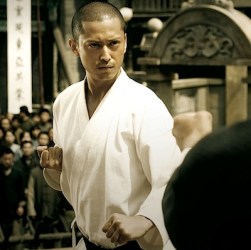 On the other hand, as that “sinister Japanese general”:
Hiroyuki Ikeuchi… imbues what could have been a cardboard villain role with dignity and grace
To revisit Film4’s point about the “desaturated period look (yet another cliche)”:
Yip’s aesthetics are more muted and traditional than those of well-known florid imports Hero and Crouching Tiger, Hidden Dragon. Yet such modesty is in tune with his soft-spoken protagonist, and also provides clean, sharp views of Yen’s awe-inspiring skills
But in conclusion:
a throwback to those chopsocky Hong Kong films of the 1970s – a period piece filmed on obvious but eye-pleasing studio sets with wall-to-wall kung fu and a simplistic, philosophical message.
I’m not qualified to judge whether [Ip Man] belongs among the top martial-arts films ever made, an opinion that’s been gaining credence as the movie bounced around the world… But there can be no doubt that director Wilson Yip has crafted a gripping, rousing, beautifully structured yarn, built around a calm but charismatic star performance by Donnie Yen and magnificent action sequences choreographed by the legendary Sammo Hung.

Consulted sources (including some unquoted)
- Abrams, Simon ‘Ip Man’ ushers in the return of the tough guys (New York Press)
- Adams, Derek Ip Man (2008) (Time Out)
- Cook, Simon IP Man 2 (Empire)
- Ebert, Roger Ip Man 2 (rogerebert.com)
- Film4 Ip Man Review
- Glasby, Matt Ip Man (Total Film)
- Hale, Mike Mastering Martial Arts (The New York Times)
- Healy, Jamie Ip Man (Radio Times)
- Johnson, G. Allen Review: ‘Ip Man’ is a fun kung-fu throwback movie (SFGate / San Francisco Chronicle)
- Jolin, Dan Ip Man (Empire)
- Murray, Noel Ip Man (A.V. Club)
- O’Hehir, Andrew “Ip Man”: A dazzling martial-arts epic (Salon.com)
- Schager, Nick Bruce Lee Mentor Ip Man Gets His Own Kickass Movie (The Village Voice)
 Part coincidence (in that I happened to notice it), part forced appropriateness (in that I then chose to post it now), 2000 AD was originally released in Hong Kong 12 years ago yesterday, tying in to Chinese New Year the last time it was (as it is now) the year of the Dragon.
 All that’s established in these parts could be done much more economically, which would result in far less viewer thumb-twiddling.
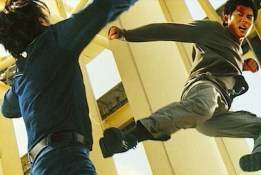 That might be being picky. The action feels slight at the time because it’s a good while coming, but in retrospect, considered on their own merits, there’s a lot of good stuff. There’s a good car chase, a couple of shoot-outs that err towards realism rather than balleticism (both have their merits, but something that feels realistically punchy is rarer), and a couple of solid punch-ups that play fairly nicely on the idea that our hero isn’t a martial arts expert. That concept isn’t mentioned in the film as much as it is in the DVD extras, but his style has a sort of scrambly feel that’s less honed than your usual kung fu bout; plus, as director Gordon Chan explains in the commentary, his apparent competency is how all kids fight in Hong Kong, because they’ve copied it from the movies!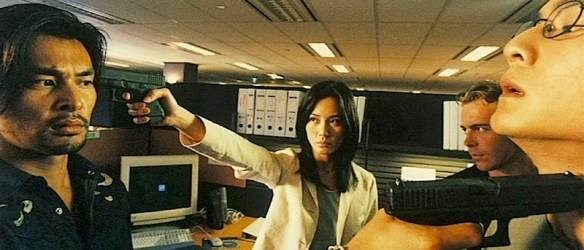
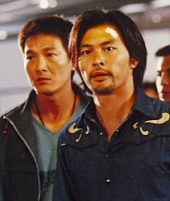 Talking of the action — it’s an 18? I know the BBFC used to be harsher, and particularly so on things featuring martial arts and whatnot, but I still don’t see how this makes an 18. A bit of swearing, a bit of blood — it’s a 15 surely? I watched this just days after
  As with any film heavily based in the realm of technology, certain things have dated. Two things work in its favour: one, as noted, it’s not actually got much to do with technology anyway; and two, it comes from the slightly later time when home computers were more commonplace, so it’s not as bad as those ’90s tech thrillers where computers could do pretty much anything a writer dreamed up. But there’s floppy discs, flight sims with flat graphics, and Magical Hacking Software that can Destroy Everything. An opening spiel about the future of warfare being cyber-attacks doesn’t feel like its quite come to pass (yet?), but then the film doesn’t wholly build on that. The computer software they’re chasing is as MacGuffiny a MacGuffin as they come — it may as well be a bomb or a file of information for all that would change the story.
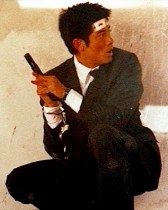 In the DVD’s special features, Chan notes that 2000 AD was an attempt to make an American-style action movie, to show there’s more to Hong Kong cinema than kung fu. Maybe that’s why it’s compromised at times — it’s an emulation of something else. It’s successful in places, but certainly not entirely. My score was awarded almost immediately after watching the film, but after looking back on it through the DVD extras I find I may have liked it a bit more. Am I being too harsh? Perhaps. But still, perhaps not.
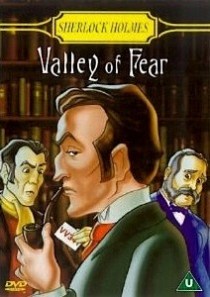 I don’t recall how exactly I came across these animated Sherlock Holmes adaptations starring the voice of Peter O’Toole as the eponymous detective, or how I came to decide to view all of them, but it’s been almost four years since I reviewed the first… and three years since I reviewed the third. Now, finally, I get to the final episode. Such is the erraticism of using LOVEFiLM. (At least I have an excuse for my dawdling here — my incredibly slow viewing of all the Rathbone/Bruce Holmses is entirely my own tardiness.)
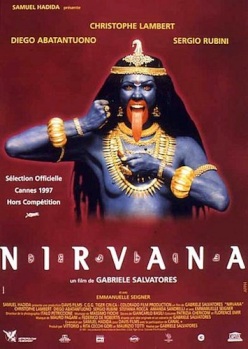 The Radio Times film section may be steadily going down the drain, but when anyone
  The most obvious point of reference for Nirvana is
  interacting with Solo merely though a series of screens on his journeys (and, one presumes, a series of microphones too). Cronenberg’s film was made a couple of years after this, so commending it for not doing the same thing would obviously be a bit rich. It is to be commended for not descending into a needlessly twist-strewn third act though, which I had thought was coming — there’s plenty of bits along the way that could be used to build a ‘surprise’ or two. There’s some ambiguity in the ending, but not too blatantly (unlike later versions of Blade Runner, for instance), and Emmanuelle Seigner’s ex-girlfriend character is never quite used in the way I expected.
 and I imagine subtitles could be easier to follow than this dubbed version, in which everyone’s covered by either the original actors straining with English (based on the accents) or the typically bad voice actors employed for such dubs. The
  Once, a few years ago, SFX published an anime special (it was their first, I think) with a rundown of the Best Ever Anime Films. You’d expect it to be topped by something regularly cited and, considering the source magazine, science-fiction/fantasy-y —
  It’s not scary in the slightest (well, maybe in the slightest, for some kids, but note the U and G ratings), but in terms of how it balances real-life dramas with the fantasy element. Only in both the real and fantasy worlds it’s a lot nicer, friendlier and cheerier than del Toro’s acclaimed fantasy-horror. To put it more succinctly, they share a similar structure and balance, but a completely different tone.
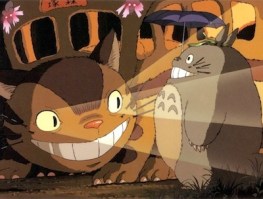 The English-friendly version has advantages too: I love any subtitles which use semicolons. It’s not inundated with them, but there was at least one. Semicolons are so underused. I love a good semicolon.
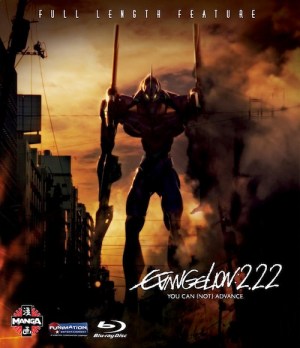 Just over a year since the
  For my money, the first 40 minutes or so of the film are (by and large) the best bits. It opens with a barnstorming action sequence, a great scene for newbies and fans alike as we’re introduced to Eva pilot Mari, who didn’t appear in the TV series. That she then disappears for most of the film, only to make a thoroughly mysterious return later, is one of those explanation-lacking flaws. I’m sure it won’t look so bad once the next two films provide us with answers. Well, I hope not.
 Then the gang take a trip to a scientific installation which is trying to preserve the oceans and their wildlife. It feels like animation shouldn’t be as effective for such a sequence as, say, the footage in a David Attenborough documentary, but nonetheless it feels extraordinary, in its own way. It also marks itself out with the interaction of the characters on a fun day out rather than their usual high-pressure monster-fighting world. And then it’s back to that world for another impressive three-on-one Angel attack.
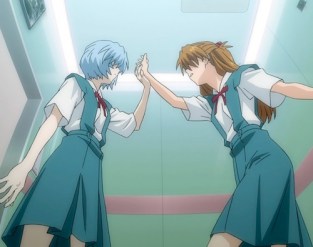 But it’s all building somewhere. For one, there’s another of the film’s best sequences — certainly, its most shocking, which readily earns the 15 certificate. I don’t want to spoil it for anyone yet to see the film, because it’s one of the plot points that differs from the TV series, but it involves the death of a main character in a brutal, deranged way. I say “death” — they pop up in the third film trailer that runs after the end credits, so there’s more to this yet…
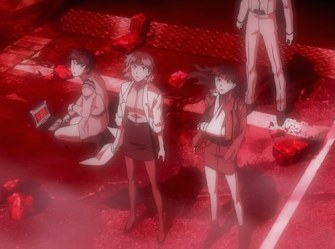 And then, after the end credits, there’s a brief scene that throws another spanner in the works! Double-cliffhanger-tastic… one might say…
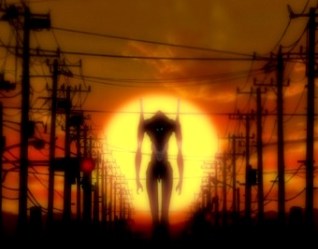 In short, if you’ve always liked Evangelion then you won’t be waiting for me to tell you this is a must-see reimagining; if
 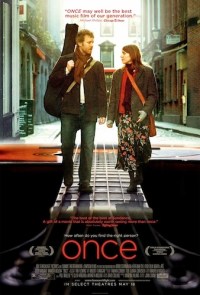 Once is a very modern indie musical. And I mean indie as in “indie film”, not “indie music”. Lord save us from a musical of indie music.
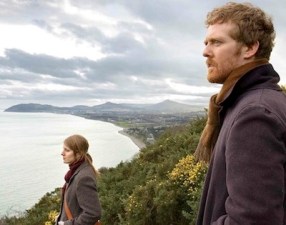 It’s a testament to the strength of the lead performances and the story they create that it’s not until the end credits roll you realise you never even knew their names.
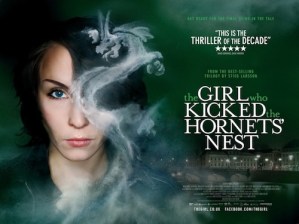 The Girl Who Kicked the Hornets’ Nest — or, in America, Hornet’s Nest (oh, Americans!) — or, translated from the original Swedish, The Pipe Dream That Was Blown Up — or, according to a different translation, The Air Castle That Was Blown Up (guess that’s a cultural thing…) — is the third and final part of Stieg Larsson’s Millennium trilogy.
 while the villains futilely attempt to stop the heroes publishing everything they already seem to know.
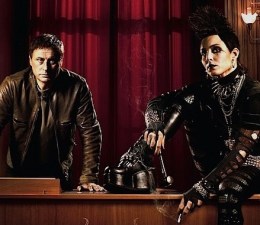
 The other cornerstone of the film is Lisbeth’s trial for the attempted murder of her father at the end of Played with Fire. The final third of the film is dominated by a series of immensely satisfying courtroom scenes in which the defence trounce the opposition, not through American-esque grandstanding but through a quiet and thorough application of facts and truth. You can see the satisfaction bubbling under Lisbeth’s almost-static face as the prosecution unknowingly hang themselves, the defence — Mikael Blomkvist’s sister Annika, for what it’s worth — holding back her killer evidence until the prosecution have dug themselves a pit so deep even this mixed metaphor would be buried. Both Lisbeth and Annika walk all over them by remaining calm and logical, dispatching the case against Lisbeth in a way that becomes an absolute joy for the viewer.
 It means Lisbeth remains an unknowable, elusive mystery, but then isn’t that part of what makes her so fascinating? The full exposure of her troubled (to say the least) history in this episode clears up some of her ambiguity without lessening her as a character. It’s a testament to the understated excellence of the performance that actions as little as a smile or saying “thank you” are huge revelations.
 the second balances on top of the events in its predecessor. The difference is, I properly enjoyed Hornets’ Nest. I wouldn’t watch it again in isolation (unlike Dragon Tattoo, which doesn’t need its two sequels to function as a story), and perhaps it had too much going on for its own good — or perhaps I’m being too demanding of the intricacies of the investigation — but it’s a solid final episode with a lot of satisfying moments.
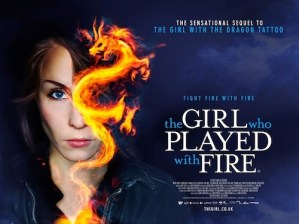 Creating any kind of sequel is hard — the endless array of failed attempts is testament to that — but I think creating a direct sequel to a successful crime thriller may be the hardest.
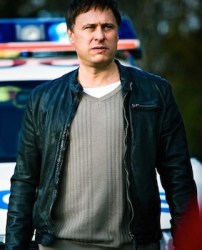 and they need a brand new case to become embroiled in. And it’s got to be as good as the last one, but it can’t be the same because we’ve had that mystery solved. You could have a different solution, of course; you could change some of the details, naturally; but police dramas on TV vary their types of murders every week for a reason. So in your new tale, the new characters have to be just as interesting as the first batch, the new mystery has to be just as intriguing too, and it really ought to be a notably different crime being investigated.
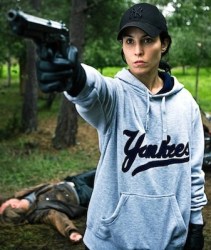 One solution to the sequel problem is to “make it personal”, and that’s exactly what we get in The Girl Who Played with Fire. A journalist and his girlfriend working for Mikael are murdered and Lisbeth is suspected of the crime. It’s somewhere around here that the coincidences begin to pile up. It makes perfect sense as a plot in itself, but in bringing Mikael and Lisbeth back together it doesn’t work — it’s not related to their previous encounter, so it’s entirely coincidental. Coincidence is a dangerous thing in fiction; it asks your audience to accept something that doesn’t fit our logic of how stories work. It happens all the time in real life of course, but in real life a flipped coin with a 50/50 chance of being heads or tails could turn up heads twenty times in a row, but a person asked to estimate twenty results of a flipped coin will never put more than two or three of one side in a row (unless they know to subvert it… look, this isn’t the point).
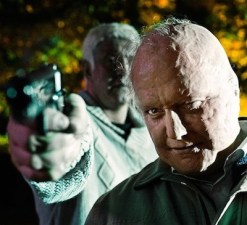 it’s never seriously looked into and, consequently, other dramas have tackled the issue with greater depth, sensitivity and insight. What Mikael and Lisbeth are actually looking into is a conspiracy of sorts around some murders. The way the trail is followed isn’t as clever as it was in Dragon Tattoo and, consequently, isn’t as interesting. The two protagonists go about their investigations independently. This is a long-held technique in novel writing — multiple strands allows the author to alternate which is followed from chapter to chapter, almost by itself providing momentum and the must-keep-reading factor as the reader has to race through the next chapter to rejoin the thread of the previous one (it’s not that simple or we’d all be churning them out… but look, I’m getting off the point again). The problem here is that Dragon Tattoo was largely at its best when the two were together, so keeping them apart is less satisfying. To top that off, they’re each finding out different things, which means as the audience we can feel a few steps ahead of the characters as we have the benefit of both sides of the case. That’s not always a bad thing, but it can be slightly disconcerting when you know the answers your hero is still searching for.
 Despite Lisbeth being the focus of much of the attention laden on these books/films/remakes, she’s a less engaging character when by herself. Here she shuffles around silently, digging up files that she and we stare at to reveal information. There are only a few moments for her (and, consequently, Noomi Rapace) to show off what endeared her to viewers before — her confrontation with a pair of arson-bent bikers, for instance.
 It also feels less filmic than the first film. Is it poor direction? Is it just the opened-up 1.78:1 ratio? I’ve read that all three films were shot like this, as they were intended for Swedish TV, meaning Dragon Tattoo’s Blu-ray is cropped to 2.35:1. You hardly ever see 2.35:1 on TV (
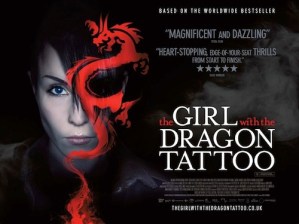 From the same production company that brought us the
  The original title translates as Men Who Hate Women, which is certainly very apt. The subject matter is grim and dark; horribly plausible, in fact. It’s unwaveringly depicted with some brutal, hard-to-watch scenes. They’re not exploitative though, as a lesser film merrily would be, and that makes them appropriate to the tale being told. Subplots about the two leads support the themes underpinning the main investigation — both about abuses of power, in different ways — justifying their apparent tangentiality, and consequently the film’s length.
 Despite the modern stylings, dark themes and attention-grabbing characters, much of the film unfolds as a procedural whodunnit like, for instance, the Wallanders, complete with piles of red herrings and last-minute twists. This is probably why the book has sold so well and the film has taken over $100 million worldwide: it tickles the same nerves as all those ever-popular TV police dramas. Indeed, this adaptation is rooted in a television miniseries (an extended version exists as two 90-minute TV episodes) but it doesn’t look like it: it’s quite beautifully shot; not showy or stylised, but there are some lovely shots of scenery in particular.
 With Dragon Tattoo featuring material that seems ideally suited to the director who gave us
  100Films.co.uk