aka Di Renjie: Tong tian di guo
2012 #52
Tsui Hark | 123 mins | Blu-ray | 2.35:1 | China & Hong Kong / Mandarin | 12 / PG-13
 This year’s 52nd film is, in many ways, thanks to DC’s The New 52 (the comic book initiative/publicity stunt that saw DC relaunch their entire universe across a series of 52 new #1 issues, for those who don’t do comics): it got me back into reading regular comics, and featured in multiple titles for several months was a cool-looking advert for the US release of Detective Dee, complete with the attractive review quote, “Crouching Tiger, Hidden Dragon meets Sherlock Holmes, only a lot more fun”. A little research finds it highly recommended in other arenas too: there’s a host of awards nominations and wins, from the Venice Film Festival to the Hong Kong Film Awards; an 81% rating on Rotten Tomatoes; Blu-ray.com furnished the UK BD release with a glowing write-up; Time ranked it the third best film for the whole of 2011 (behind The Artist and Hugo). Even the unreliable film section of the Radio Times saw fit to give it four stars.
All of which hopefully establishes how I found it to be a massive disappointment.
Days before the coronation of China’s first Empress, a high-ranked man is mysteriously burnt alive from the inside out. Then the man charged with investigating the case suffers the same fate. On advice (from who or what I shall mention later), the Empress assigns the case to Detective Dee — who has been in prison for eight years for rebelling against the Empress. Sounds like a good setup, eh? A super detective, at conflict with his employer, looking into supernaturally-tinged murders; and it’s a Hong Kong movie so you know there’s going to be some impressive action sequences.
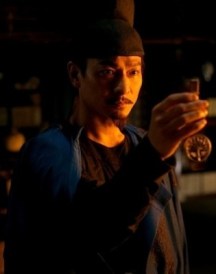 To take Time’s opinion as a starting point, I have to wonder if they would rank Detective Dee so highly if it had been an American-produced film with actors speaking English. I don’t mean if the film was Americanised, but exactly the same, just an American production. In that instance, I think it would very much be viewed as a summer blockbuster, because that’s definitely what it strikes me as. It’s one with lots of talky bits and an over-complicated story, certainly, but then it’s not unheard of for US blockbusters to confuddle the viewer with an under-written over-developed plot (less so these days, I grant you).
Apparently it makes commentary on the economic and political situation in modern China. It must be done quite subtly, then. That’s a good thing I suppose, but I imagine you’re only going to notice it if you already have a familiarity with what’s going on. I don’t. Best I can tell, the film’s message is, “even if you think your ruler’s a bad person who’s done bad things, they’re your ruler and you should let them get on with it and not rebel”. I could have misread it, of course, but that’s what I got from the ending. Not a position I’d personally agree with.
Naturally there are plenty of action sequences (choreographed by Sammo Hung), several of them tacked on for the sake of it. Personally I wasn’t impressed. They’re all clearly shot on digital video (the whole film was, but the smeary fights really show it up), several are under-lit, there’s too much Hollywood-style choppy editing, it felt like some had bits missing, others are stop-start in a way that adds up to not very much… Many of them left me confused about what was meant to be going on,  not in awe of the performer’s abilities or entertained. One of them features the hero fighting a gaggle of cheap CGI deer. Yes, deer. Why?
Detective Dee is a film of moments. There are some pretty shots, occasionally even sequences; the fight in the Phantom Bazaar, an underground river network, is guilty of some of my criticisms but also pulls off a few nice bits. The CGI is what you’d expect from a mid-range US miniseries, but (with exceptions such as the fighting deer) it works well enough, even creating some dramatic vistas, particularly of the 200-foot tall Buddha statue that’s central to the plot. Some of the sets are also incredibly impressive — again, the interior of the Buddha. Occasionally I was frustrated reading the subtitles (which fly by at a rate of knots, it felt to me) because I wanted to look at the detailed, busy production design.
I mention the fast subtitles because the film feels like it’s moving at quite a lick. There’s little room to get to know the characters, or the situation, or their relationships, or their political machinations, before it’s racing on to the next plot point. And yet despite that it feels incredibly slow as a whole — I was clock-watching before the hour mark.
Perhaps one of the things that suffers for this is the film’s relationship with the supernatural. It’s at first supposed that the deaths are some kind of divine intervention, but then this is kicked away — what a silly idea by some foolish characters! But then everyone’s more than happy to accept a talking magic deer (seriously; 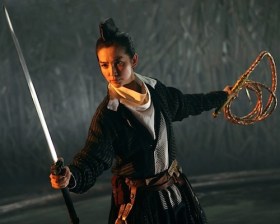 and they happily take its advice (see second paragraph)), a fighter whose arms fly off and turn into… something else (choppy editing means I’m not sure), facial transfiguration (imagine Mission: Impossible’s masks with face-churning magic instead of masks), and so on and so forth. Some of it ultimately has a rational explanation, but why is “divine intervention” so much less believable than “magic”? And why do you have to explain the talking deer and flying arms when the face-churning-thing is left untouched? I can take people flying unrealistically through the air — that’s the style of the genre, much like regular folk breaking out into perfectly-pitched musically-accompanied song is the style of the musical — but not internal inconsistency in other areas.
I’ve avoided the comparison so far, but Detective Dee is like a Chinese version of Guy Ritchie’s Sherlock Holmes, only a less inventive and comprehensible one. And it’s certainly not “a lot more fun”. Dee is a great deducer, a la Holmes, though the film gives him no opportunities to significantly show that off. The plot concerns a series of apparently-supernatural murders that actually have a rational explanation, and are ultimately all about taking control of the country. It stars a period detective who’s been reconfigured as younger and a man of action. But whereas Holmes kept things clear-cut and fast-moving, Dee (as I’ve noted) fudges and obscures motivation and plot and feels tediously long.
There are actually quite a few little things to like about Dee, and maybe there are a few big things too, but I feel like it’s making you work for them — 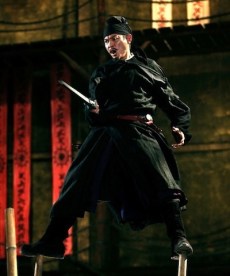 you could enjoy the characters, or the political machinations, but only if you take time to study them slowly and work out what was going on for yourself, because the film’s in too much of a rush to explain it to you. There’s something to be said for entertainment not spelling everything out — it’s often a highly-praised element of anything that achieves it — but Dee doesn’t do that, it rushes headlong past things that could do with more clarity. (One thing I should do is listen to Bey Logan’s commentary — there’s a fair chance he’ll have insights that illuminate me. But in a moment you’ll see why I haven’t done that before posting this.)
Believe it or not, I didn’t hate Detective Dee… but I didn’t exactly enjoy it either. Not fully. I started this review by saying it and I think it’s my key feeling: after getting a little hyped up about something I’d previously ignored the UK release of, I found it to be disappointing. Your mileage may vary.
The UK TV premiere of Detective Dee and the Mystery of the Phantom Flame is on Film4 and Film4 HD tonight, Friday 6th July, at 11:10pm.

 Picking up more or less where the first film left off, this sequel sees Ip and his family settled in Hong Kong, struggling to get by as he attempts to set up a Wing Chun school against opposition from the existing establishments.
 their presence and storyline drag the film down.
 Period sci-fi comedy/action/adventure Iron Sky is the 21st century answer to
 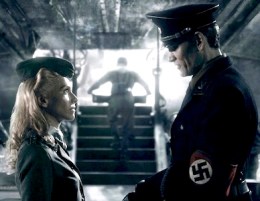 they’d be the gung-ho spotless heroes defeating that Natzees for a second time.
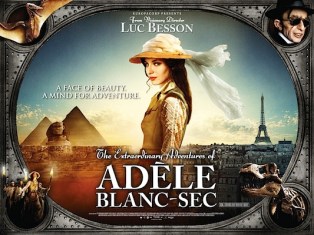 Based on the long-running bande dessinée (aka “comics”) by Jacques Tardi, The Extraordinary Adventures of Adèle Blanc-Sec is occasionally sold to English audiences with a handy quote
 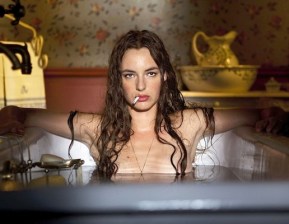 And if that doesn’t put you off, the introduction-heavy opening minutes might, dense with introductions for disconnected characters and locations. Stick with it, it sorts itself out.
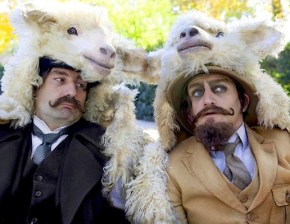 Director Luc Besson managed to build up something of a following with a regular output of films through the ’80s and ’90s, perhaps culminating artistically with the exceptional
 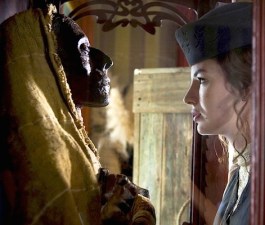 I suppose Adèle Blanc-Sec won’t be to everyone’s tastes. Comparisons to
 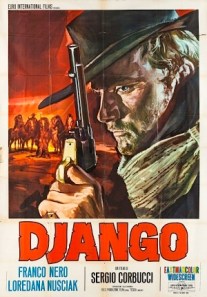 The ’60s were a pretty exciting time for cinema. In France, the Nouvelle Vague were tearing up the rulebook and pushing forward their own techniques; in Britain, the James Bond series was ditching kitchen sink drama in favour of reinventing the action movie, turning itself into a global phenomenon in the process; and in Italy (and Spain) they were pulling a similar trick on that most American of genres, the Western.
 Much of the film plays as an action movie. There’s a lot of atmospheric ponderousness at the start, but once things kick off they rarely let up. In just over 90 minutes the film rattles through a damsel-in-distress rescue; a blink-and-you’ll-miss-it shoot-out; a 40-on-1 massacre; a raid on a fort; a barroom brawl (one of the stand-outs, that — anyone who thinks handheld ShakeyCam fights are a modern invention should take a look); a tense, silent escape; a brutal punishment (or two); a valley ambush; and a graveyard stand-off. I think that’s all, but I may have missed some. It’s practically a definition of bang for your buck, which I’m sure goes a long way to explaining its popularity.
 but it’s like watching something on a not-quite-correctly-tuned analogue TV; like you’ve found the channel, but you’re one or two points off the optimum frequency. Or, to put it another way, it’s really snowy. As I said, I’m no expert in BD quality, but this looks like it needs a sympathetic dose of DNR. No one but fools want a
  Despite winning a bunch of Canadian film awards, this First World War drama seems to have been really poorly received by critics — the
 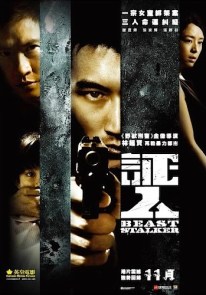 While in pursuit of an accused murderer, a cop (Nicholas Tse) accidentally kills the daughter of said murderer’s prosecutor (Jingchu Zhang). Three months later, just days before his trial, the accused has the prosecutor’s other daughter kidnapped, to persuade her to destroy the evidence proving his guilt. Despite having spent the intervening time in reclusive self doubt, the cop sets out to rescue the kidnapped little girl.
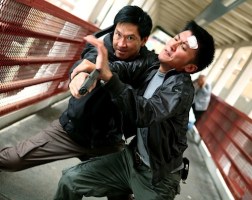 making them a little perfunctory — the real meat actually lies in the plot’s twists and turns. This is more one for fans of thrillers than beat-’em-ups.
 The top performance comes from Nick Cheung as a for-hire kidnapper with the Bondian trait of being blinded in one eye while the other only has black-and-white vision. He gets added complexity thanks to an invalided wife he tenderly cares for — he’s only in this life of crime to pay off his debts and medical bills, y’know. Cheung’s largely silent turn manages a fine balance of menace and sympathy. He won a couple of HK awards for it,
 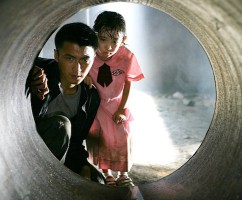 A brief couple of scenes with a bullied colleague play out nicely, though unfortunately they contrast with a painfully written bit in which another colleague tells Tse’s character what people think of him. “They said you were horrible, but I like working for you,” she tells him (I paraphrase), for no discernible reason. It doesn’t even matter that we’re told that, because we’ve already seen it. I just don’t get it.



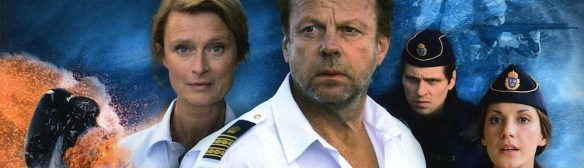
 Sometimes you watch one of the most acclaimed films of all time and find yourself with very little to say about it. La Règle du jeu — or, as it’s commonly known in America thanks to Criterion’s incessant title translation (in fairness, that’s probably the most sensible way to combat the mass attitude of “argh! it’s in Foreign!”), The Rules of the Game
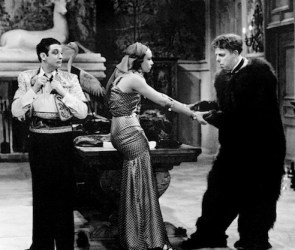 There’s a lot packed in, and I can see how multiple viewings could reveal even more going on. Perhaps a better researched awareness of the period (beyond the obvious Eve Of War, though that’s important) and of French class structure at the time is necessary to get the full richness of Renoir’s vision. The fact it was banned by the French government due to being bad for morale, then also banned by the occupying Nazis, suggests it did have a lot of social relevance.
 100Films.co.uk