
Tomm Moore | 94 mins | Blu-ray | 1.85:1 | Ireland, Denmark, Belgium, Luxembourg & France / English | PG / PG
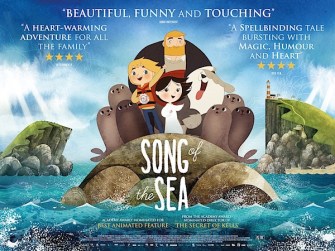 The second feature from director Tomm Moore and his pan-European team of animators (after the excellent, Oscar-nominated The Secret of Kells) sees ten-year-old Ben (voiced by Moone Boy’s David Rawle) growing up in a lighthouse off the coast of Ireland, with just his dad (Brendan Gleeson), his dog and best friend Cú, and his mute little sister Saoirse, after their mother disappeared on the night Saoirse was born. When Saoirse discovers a coat that turns her into a seal (as you do — this doesn’t come as out-of-the-blue in the film as I’ve made it here) and she washes up on the beach, their visiting grandmother (Fionnula Flanagan) insists she takes the kids to Dublin for a better life. Less than impressed at having to desert his father, his home, and most especially his dog, Ben escapes and, with Saoirse in tow, sets off to find his way home. However, it soon becomes apparent that Saoirse’s new-found transformative skills are of greater importance, and the survival of the entirety of Irish folkloric creatures depends on her getting home in time. Unfortunately, the witch Macha and her owl minions have other ideas…
There are quite a few different elements in the mix with Song of the Sea, as you can probably tell from that overlong plot description. On the surface, it’s an adventure story, as Ben and Saoirse — soon joined by Cú, too — trek across Ireland encountering various creatures and obstacles. It’s also a fantasy, thanks to said creatures, reconfiguring folk legends into a modern context where they exist on the periphery of the world, visible if only people would look. That’s one subtext. Other prominent ones include issues of grief and family: Ben has a realistically fractious sibling relationship with his sister, 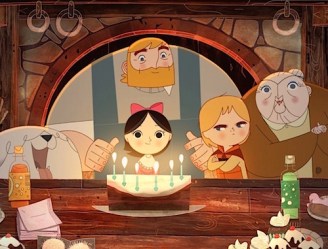 but the motivator for that is clearly resentment towards her for appearing the night his beloved mother left. Their father, too, is hamstrung by his grief, struggling to move on from his wife’s disappearance and fully engage with the world. His kids are his only connection, Saoirse in particular, but his mother makes him realise that clinging to them is damaging their lives too… or is it?
This depth of emotion and, if you like, thematic consideration probably marks Song of the Sea out over The Secret of Kells in some respects. Certainly, there seems to be a broad understanding that this is the better film, if only by a half-step; a more mature, complex work. I’ll be the dissenting voice, though, because while I did like Song of the Sea, I didn’t think it was as strong an overall experience as Kells. The problem perhaps lies in its episodic structure, which pings us from encounter to encounter. They’re connected but also self-contained, and at times it feels like there’s another one before we can get to the climax. For me, a bit of added speed would have helped things: kicking into gear faster (the first act goes on a little too long), trimming back each episode; overall, managing to speed the film up by maybe ten minutes would be to its benefit.
Maybe I’m wrong, though. There’s nothing specific that needs to be lost, no one scene that drags, just a sense that things could get a wriggle on. Perhaps in this respect the film would better reward repeated viewings? The realistic, thoughtful depiction of the main characters; the well-imagined, history-dense world; the weighty themes that are handled with a gentle touch —  all are factors that can, and do, elevate the film. Don’t get me wrong: this is a cut above your average animated adventure. I just didn’t enjoy it as much as The Secret of Kells.
Talking of thematic depth, however, this interview with Moore from The Telegraph is a must-read. To pull a particular highlight:
Moore wanted to stay true to the melancholic selkie myths. In the end, a series of test-screenings with his primary schoolteacher wife’s class helped him find the sweet spot.
“Those kids are way more intelligent than adult audiences,” he explains. The notes that older viewers gave him, he says, all tried to pinpoint flaws in the film’s dream logic: “They thought they could outwit the story, rather than go along with it.”
Moore’s young test audience, on the other hand, was more concerned with the relationships, and as a result of their feedback – they thought an exchange in which Ben tells his sister he hates her overstepped the mark, for instance – he dialled certain scenes down a bit. That’s a preteen audience asking for more subtlety.
Lesson: we train viewers to be less-intelligent film-viewing adults with dumbed-down kids’ movies. Anyway:
 For more positives, Song of the Sea’s animation and design is at least as strong as it was in Moore’s previous film. There’s the ‘house style’ flattened, animated storybook look; a description which could sound like criticism but absolutely is not. Some very beautiful scenes are evoked, meaning that at the very least there’s always imagery to tide you over. I’d list some favourites, but we’d be talking about most of the film. That said, the depiction of a run-down, smoggy Dublin stands out as something different from the countryside idylls of Kells and the rest of the locales in Song of the Sea, but it’s not exactly “beautiful”. Rather, look to the island home of our heroes, a tall rock surrounded by the blue sea; the home of the glowing-eyed long-haired Seanachai (the moment when it suddenly turns around in the montage after Saoirse uses her coat for the first time is my favourite shot in the film, a little sliver of fantasy imagery that magnificently teases what’s to come); or the small sanctuary surrounded by a field of stinging nettles — again, a kind of gentle, on-the-edge-of-the-real-world fantasy that quite appeals to me. The fact the countryside is littered with half-hidden stone figures, which we know to be frozen magical begins, is another nice touch; especially as they’re often surrounded by human litter, the analogy (as I see it) being both that people exist around them but don’t even see them, and also that, presumably through our modern disbelief, we’ve thrown these legends out with our trash.
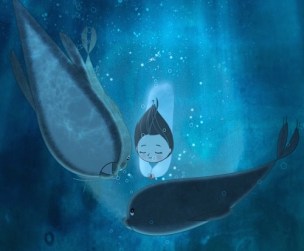 Even as I write, I’m talking myself round to liking Song of the Sea even more than I did on first viewing — and that was quite a lot, albeit coloured by my perception that I didn’t like it as much as The Secret of Kells. If you enjoyed Moore’s earlier film, this unquestionably merits seeking out (if you haven’t already, of course; I mean, I did). If you haven’t seen Kells, well, you’ve so far missed a treat; and now you’re missing two.

Song of the Sea is in UK cinemas from today.
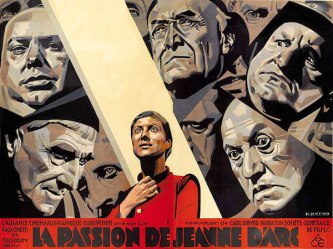 Widely regarded as one of the greatest movies of all time (look at
  Dreyer based his telling on the written records of Joan’s trial. Although that’s grand for claims of historical accuracy, it’s hard to deny that silent cinema is ill-suited to thoroughly portraying something dialogue-heavy. There are many things silent film can — and, in this case, does — do very well indeed, but representing extensive verbal debate isn’t one of them. Bits where the judges argue amongst themselves — in silence, as far as the viewer is concerned — leave you longing to know what it is they’re so het up about. Sometimes it becomes clear from how events transpire; other times, not so much.
 neutral costumes on sparsely-decorated sets, and are almost entirely shot in close-ups — all elements that avoid the usual grandiosity of historical movies, both in the silent era and since. What we perceive as being ‘grand’ changes over time (things that were once “epic” can become small scale in the face of increasing budgets, for instance); pure simplicity, however, does not age much.
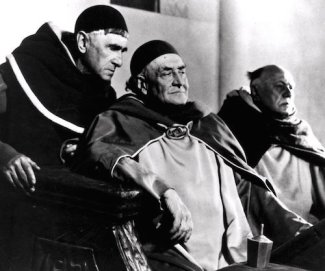 The actors playing the judges may be less individually memorable than Joan, but it’s their conflict — the personal battle between Joan and these men, as Dreyer saw it — that drives the film. Dreyer believed the judges felt genuine sympathy for Joan; that they did what they did not because of politics (they represented England, and she had led several successful campaigns against the Brits) but because of their devout belief in religious dogma. Dreyer says he tried to show this in the film, though it strikes me the judges still aren’t portrayed too kindly: they regularly seem contemptuous of Joan, and are outright duplicitous at times. Maybe that’s just religion for you.
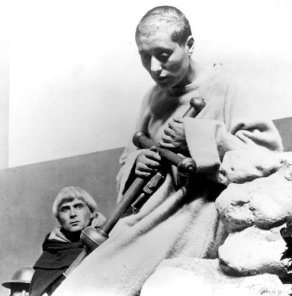 however, so I have no opinion. Instead, they offer two alternatives. On the correct-speed 20fps version, there’s a piano score by silent film composer Mie Yanashita. Apparently this is the only existing score set to 20fps, and Masters of Cinema spent so much restoring the picture that there was no money left to commission an original score. Personally, I don’t think they needed to. Yanashita’s is classically styled, which works best for the style of the film, and it heightens the mood of some sequences without being overly intrusive, by and large. Compared to Dreyer’s preferred viewing method, of course it affects the viewing experience — how could it not, when it marks out scenes (with pauses or a change of tone) and emphasises the feel of sequences (with changes in tempo, for instance). That’s what film music is for, really, so obviously that’s what it does. Would the film be purer in silence? Maybe. Better? That’s a matter of taste. This particular score is very good, though.
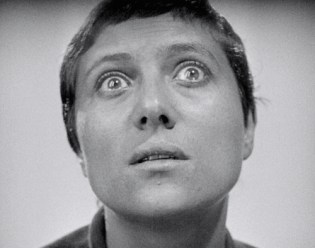 Some viewers describe how they’ve found The Passion of Joan of Arc to be moving, affecting, or life-changing on a par with a religious experience. I wouldn’t go that far, but then I’m not religious so perhaps not so easily swayed. As a dramatic, emotional, film-viewing experience, however, it is highly effective. As Dreyer wrote in 1950, “my film on Joan of Arc has incorrectly been called an avant-garde film, and it absolutely is not. It is not a film just for theoreticians of film, but a film of general interest for everyone and with a message for every open-minded human being.” A feat of visual storytelling unique to cinema, it struck me as an incredible movie, surprisingly accessible, and, nearly 90 years after it was made, timeless.
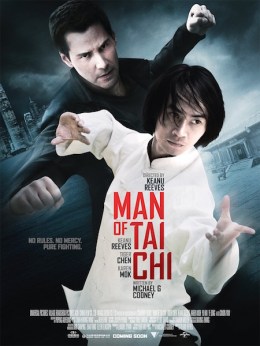
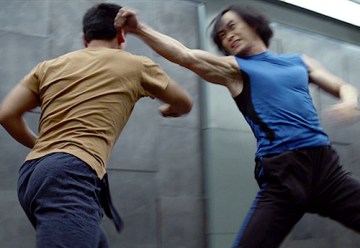 Some have opined that it’s over-edited. Early on I thought it was a mite too chopped up (during a plain old dialogue scene, funnily enough), but for most of the film it’s fine. Fast at times, sure, but so’s the fighting. There’s a style and rhythm to it all — some near-montage-like sequences are surely meant to be exactly that — and the fighting is never needlessly obscured, because (unlike in so many Hollywood action movies) these guys can actually do it and Reeves wants to show us that. He really focuses on them, too. These aren’t fights as part of elaborate chase sequences, or action interludes whose drama is reliant on the sheer volume of competitors being offed. Nearly every bout is one-on-one (there’s a single instance of two-on-one), all executed in nondescript rooms or arenas. It’s the straight-up fight choreography that does the talking here.
 A mention also for the score by Kwong Wing Chan. Apparently it’s made up of “Techno-styled, bass-heavy beats” or something (I got that from another review). Not the kind of music I normally listen to for pleasure, but its pounding electronic rhythms fit here, making their presence felt while never crossing into the over-dominance that kind of music is wont to do.
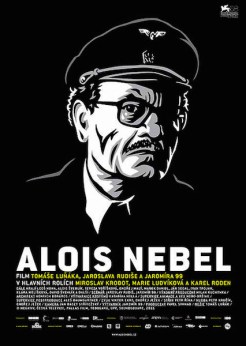 A Czech noir animation, set around Christmas 1989 to the backdrop of the country’s Velvet Revolution. Eponymous character Alois Nebel is a train station guard whose flashbacks to an event at the end of World War 2 see him sectioned, though possibly for other nefarious purposes. Having lost his job, he travels to head office in Prague to try to reclaim it, where he meets a ragtag gang of social misfits. Finally returning home, the mystery of what happened 44 years earlier may be resolved…
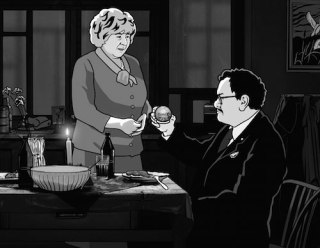 Perhaps the whole film is Deeply Thematic, then? It may be to do with the country moving on and making peace with its past, seen in a microcosm in the actions of Nebel (moving past the flashbacks, having new experiences, finding love, etc) and the people around him (finally getting revenge for something that happened nearly half a century ago). Maybe that’s all more clear if you know the Czech mindset, or the history of the Velvet Revolution. The second post in
 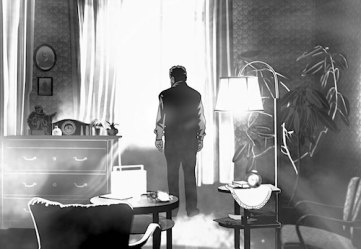 With some attractive black-and-white animation and a sporadically engaging mystery plot, Alois Nebel is far from meritless. However, its firm grounding in a wide spread of Czech history and attitudes suggests it may be best suited to those already well-versed in that country’s history and culture.
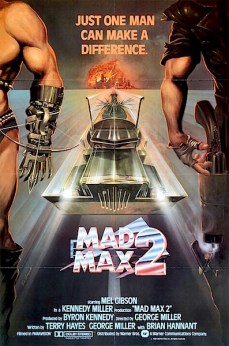 Roaming the outback of a gasoline-desperate post-apocalyptic Australia, “Mad” Max Rockatansky (Mel Gibson) comes across a commune-like oil refinery, whose inhabitants are under siege by a brutally violent gang. Max strikes a bargain: he’ll help them escape with their oil, in exchange for a tank full for himself.
 The most memorable part, however, is the climax. They escape the oil refinery, Max driving the tanker — fitted out with weaponry and defences — and the gang give chase. An almighty action sequence follows, a speeding battle through the outback. It feels wrong to just call it “an action sequence”, like that’s selling it short. You get the sense that this is why the movie exists; that co-writer/director George Miller’s goal with the entire rest of the film has been to get us to this point. It’s not just “the climax”, it’s “the third act”, and it’s stunning — the choreography of it, the editing, the stunts, as dozens of vehicles chase each other, people run around on top of them, jump between them… I don’t think it’s hyperbolic to say it must be one of the greatest action sequences ever committed to film. One of the reasons
  That quote comes from Thomas Elsaesser in the introduction to his Criterion essay “
 The plot, such as it is, concerns an actress (Liv Ullmann) who has decided to become mute and her nurse (Bibi Andersson), who travel to a seaside summerhouse to attempt recuperation. After we’re told how they grew closer, events concern the breakdown of the relationship between the two women… or is there only one woman? We might end up inside one of their heads… but whose? Or is it both of their heads? Or…
 The film’s other most famous bit is a monologue Andersson delivers one night about a foursome she found herself in. As with most of the film its exact meaning is debatable, but it’s another unusual behind-the-scenes story: it was nearly cut, apparently, even though it’s in many respects the pivotal scene. It’s where the nurse opens up the most, leading to the actress’ ‘betrayal’ by repeating the story in a letter, which is what leads to the disintegration of their relationship and all the confusion/weirdness/’deep psychological filmmaking’ that follows. Later, Bergman lets a monologue (yes, another one) play in full twice. The meaning? He had intended to cut back and forth between the two actresses, but couldn’t decide which shots to discard, so just let it all run twice. At least that’s some confusion cleared up, then.
 Sherlock Holmes has appeared in more films than any other fictional character (yep, even those Marvel ones that are everywhere), which also means that Sir Arthur Conan Doyle’s Great Detective has been portrayed by a staggering number of actors. “Who’s the best?” debates usually settle around Basil Rathbone, Jeremy Brett and, these days, Benedict Cumberbatch, though there are ardent fans of Douglas Wilmer, Peter Cushing, Robert Downey Jr… I could go on. In certain rarified circles, however, the “Sherlockian’s Sherlock” is, believe it or not, a Russian: Vasily Livanov, who starred in five popular (in their homeland) Russian miniseries/TV movies between 1979 and 1986 that some regard as definitive adaptations. We even gave him an MBE for them in 2006, so I guess he’s state-recognised.
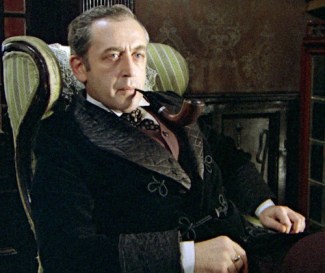 As many a Holmes fan will know, Baskervilles is not the best choice to get a handle on an actor’s interpretation of Holmes. Written by Doyle in the period after he’d killed Holmes off because he was tired of writing him, but before he later brought him back to life (as it were), presumably the author was still a bit bored with his creation, because Holmes disappears for a good chunk of the tale — in this adaptation, cited by many as the most faithful yet made, he’s in roughly the first and last half-hours, leaving a 72-minute stretch in the middle where he doesn’t appear at all. From what we do see of him, Livanov portrays a nicely understated Holmes. Clearly fiercely intelligent, but without the terseness of Cumberbatch’s version or the somewhat-jolly-hockey-sticks take of Rathbone. I’m compelled to get hold of the rest of the series to see what else he had to offer. (Sadly, only Baskervilles has reached UK DVD, but English-friendly imports are available. It’s also been released on Blu-ray, but I believe without English subtitles.)
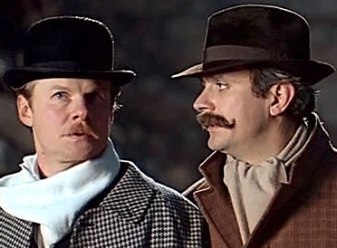 Several other cast members manage to be both faithful to the novel and different to how their characters are usually depicted on screen. For instance, Dr Mortimer is usually played as an older gent, but is quite young in the novel — this is a rare (the only?) instance of that being followed. It’s the first time I’ve seen him played as being a bit shifty and suspicious, too. It benefits the storytelling here, because there really aren’t many suspects — it’s abundantly clear whodunnit, even if you don’t know, because there are no other options! Perhaps most memorable from the supporting cast is “internationally acclaimed actor/director” Nikita Mikhalkov as Henry Baskerville. The role is usually played as young, handsome, keen and brave (in
  There’s more of an emphasis on people spying on each other suspiciously, which at least is rather appropriate to a murder mystery.
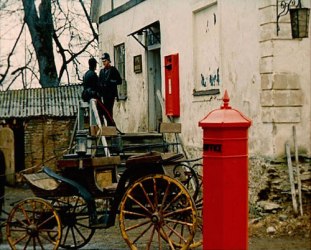 including scattering iconic red VR post boxes around willynilly. The Russian countryside probably doesn’t look very much like Dartmoor either, but its qualities work for the story: very desolate, barren, bare trees, waterlogged dirt tracks for roads, rubble strewn around, the buildings rundown… All very atmospheric for a Gothic horror-tinged mystery, and far superior to the picture-postcard look of some adaptations.
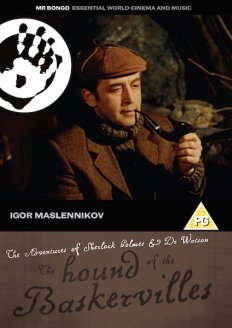 The Hound of the Baskervilles has been filmed far too many times (a
 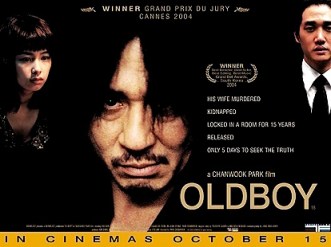 Perpetual drunkard, but also loving husband and father, Oh Dae-su (Min-sik Choi) is snatched off the street and imprisoned in a shabby bedsit without explanation. He learns that his wife has been murdered and he’s being blamed. His daughter lives, but he doesn’t know where. Then, 15 years later, and equally inexplicably, he’s released. He befriends a sushi chef, Mi-do (Hye-jung Gang), before being contacted by Woo-jin (Ji-tae Yoo) who claims to have been his captor. Dae-su is given just five days to discover why he was locked up. If he succeeds, Woo-jin will kill himself; if he fails, he will kill Mi-do. Dae-su’s investigations lead him to dark secrets, shocking revelations, and violent retribution.
 Choi is excellent in the lead role, deserving of all the praise he’s garnered. It’s a highly unusual role with a lot of different and sometimes conflicting facets, but he pulls it all off with aplomb. He maintains a sense of mystery and unknowableness throughout, whilst also being a plausible human being in an implausible situation. As his adversary, Yoo makes for an excellent villain: calm, businesslike, always with the upper hand. The final confrontation is a scene to be savoured, calling to mind everything from James Bond to David Fincher (for me, at least) in terms of the villain’s slick lair and the twisted events that unfold in it.
 In Oldboy’s case, however, so much of what makes it special, unique and exceptional lies in the direction. So do you copy that wholesale? If you do, what’s the point — just watch the original. But if you don’t, what’s the point — you’re losing a large chunk of what’s special. I guess this is why the US version didn’t go down so well — whichever path it took, it was on a hiding to nothing. I look forward to seeing it to judge for myself.
 An unnamed woman (Martina Gedeck) goes to stay with some friends at their lodge in the Alps. The friends pop into town, leaving their dog behind with the woman. When she wakes up the next morning, they’ve not returned, and she finds an invisible wall surrounding the mountain. Exploring its boundaries, she sees people outside, paused mid-life, as if frozen. As hours turn into days turn into weeks, she begins to realise the need to fend for herself, farming the land and caring for her animals, which come to also include a cow and a cat. As weeks turn into years, she comes to accept her new life, from which it seems there may be no end…
 The Wall starts out with a compelling mysterious premise, but seems to have no interest in exploring it or answering the many questions it raises. In some respects that’s better than the kinds of rote explanation offered by lesser films — you know, “Aliens did it. Why? Because.” — but it’s a bit like a joke without a punchline. Taking the setup as a mere excuse for an exploration of the human condition, I don’t know that it’s that illuminating. Either way, it makes for a sporadically interesting but ultimately unsatisfying experience.
 You know the kind of people who wait ages and ages for something and really want it and pre-order it or whatever and then when it finally arrives they… add it to a pile and don’t get round to watching/reading/listening to it for even longer than the ‘forever’ they were waiting in the first place? If you don’t, you do now — that’s me.
 To be precise, Panahi’s ban is from filmmaking, writing screenplays, leaving the country, or giving interviews, so they conclude that reading aloud an existing screenplay while someone else films him doesn’t contravene any of those rules. Nonetheless, the edited (not-a-)film was smuggled out of Iran on a USB stick hidden in a cake in time for its Cannes premiere.
 In fact, despite the singular input and focus put into this ‘project’, it could be used quite successfully as part of an argument against auteur theory. But that isn’t what it sets out to do either.
 questions that are always worth asking about purported documentaries.
 100Films.co.uk