
Hideaki Anno, Masayuki, Mahiro Maeda & Kazuya Tsurumaki | 97 mins | Blu-ray | 2.35:1 | Japan / English | 15
 Well now, hasn’t this been a long time coming? Just over two years since its western disc release was first announced, just over three years since it debuted in Japanese cinemas, and just over four-and-a-half years since the previous instalment’s English-language release, those of us in the UK who don’t attend anime conventions (where it’s had a few screenings in that time) are finally able to see the penultimate part of creator Hideaki Anno’s Rebuild of Evangelion tetralogy. As to whether it’s worth the wait… well, your mileage will vary.
The “rebuild” movies started out with a literal interpretation of that moniker: the first movie is a faithful (though condensed and sometimes slightly rearranged) retelling of the series’ early episodes, even using the original art from the show. The second movie deviated much further: familiar characters were introduced in completely different ways, wholly original characters appeared, and some subplots became more prominent. It culminated in a climax that was a drastic departure from the series, and now this third movie forges into entirely new territory — so new that I’m not going to give any kind of plot summary, for the sake of readers avoiding any spoilers. Good luck to you if so: not only do most reviews divulge the first major divergence, but so does the film’s own blurb.
Maybe that’s for the best — I’ve read more than one review bemoaning the confusion at the opening of the film, which stems from not knowing that thing I’m not telling you that the blurb does tell you. It’s surely deliberate, though: hero Shinji is in a similarly confused position, and we’re clearly being aligned with him in this strange new situation. Besides, for me this was the most engaging and exciting segment of the movie. As well as a couple of thrilling action scenes, it juggles character relationships in interesting ways, establishing a new status quo unlike that we’ve seen before in the franchise. It culminates in a fantastic stand-off between former allies — indeed, former friends. How times change.
 Change, and the embracing or rejection of it, is surely one of the major themes of Evangelion. This is more explicitly debated as 3.33 moves into its middle section, where we get an extended dose of Shinji’s traditional insecurities. Hey, it wouldn’t be Evangelion without Shinji having a self-pitying whinge, right? Fortunately there’s more going on than that, but this is a section light on action and heavy on the series’ more thoughtful elements. There are answers to some of the mysteries, but it again wouldn’t be Evangelion if it all made easy sense. At the same time, Shinji bonds with new Eva pilot Kaworu. A controversial character, apparently, and not just because of the homosexual overtones (which some reviewers claim to miss, presumably because they’re blind), but the scenes where they harmonise by playing piano together are quite fantastically animated.
Indeed, whatever else you can say about 3.33, it looks glorious. The choice of a 2.35:1 aspect ratio for the first time helps emphasise the story’s epic qualities, but that’s incidental to the fantastic images conjured up by the animators. Various techniques are hurled at the screen — there’s a lot of CGI as well as traditional hand-drawn art, and they even used motion-captured stuntmen for one scene — but it marries perfectly, allowing camera angles and moves that are incredibly filmic and more dynamic than you normally find in 2D animation. The makers of the Rebuild have always talked about wanting to create innovative, memorable imagery, and they’ve once again succeeded here.
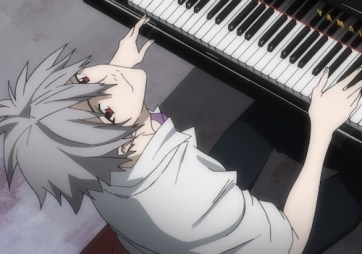 3.33 divides quite neatly into three half-hour sections. I guess that should be expected, as the whole tetralogy has been based in traditional Japanese ideas of narrative/musical structure, hence the films’ Japanese titles incorporating the names for the three movements: jo, ha, and kyū (序破急), which roughly equate to “beginning”, “middle”, and “end”. As discussed, the first is fantastic, some of the best material in the entire series, in my estimation. Also as discussed, the second is a lot slower, but has its plus points too. The third… ah, the third. Here we get some more action, which will please anyone who thrills to Eva combat, but it is also utterly mind-boggling. I’ve been reading up on a few fan sites since watching, and I’m still not absolutely sure what was going on or what it signified. You won’t find any enlightenment in the disc’s special features, which present a long list of extras at first glance, but turn out to be 19 repetitive trailers, TV spots, and promo reels. Yes, nineteen.
After all that, it ends on a rather low-key cliffhanger, making it feel like one of those two-part finales that Hollywood YA adaptations are so fond of at the moment (cf. Harry Potter, Twilight, Hunger Games, etc). In some respects that’s actually true: it was originally said that films 3 and 4 would be half-length movies released together. Obviously that plan disappeared a long time ago. Still, it does make you wonder if that confusing third act will play better when paired up with the tetralogy’s concluding instalment. In the meantime, it’s hard to call 3.33 a completely effectual film in its own right. It quite successfully introduces us to an entirely new era for Evangelion, and teases that various groups’ plans are entering their final stages, but a possibly-indecipherable climax and a “we’ll just have to pause here”-level “to be continued” leave you wanting the next part more than feeling that was a fulfilling, finite experience.
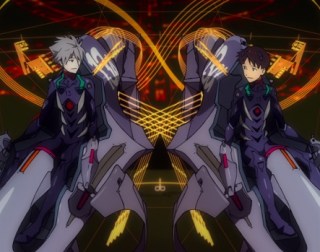 So when will that conclusion come? Well, a few years ago Anno ‘joked’ that the finale might be released “four to six years” after 3.33. As we’re already almost at four years with no sign of a release date, I guess it wasn’t so much of a ‘joke’ after all. An English-friendly DVD/Blu-ray will inevitably take an additional couple of years, too. So an indefinite, but undoubtedly lengthy, wait begins…

Evangelion: 3.33 is out today on DVD, Blu-ray, and dual format Collector’s Edition.
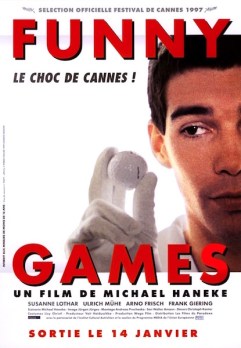 Arthouse favourite Michael Haneke criticises audience’s enjoyment of screen violence. It certainly achieves its aim of being a grim, brutal depiction of violence in real-life, creating a situation that feels inescapable not only for the characters but the audience too. Some cinematic trickery is also deployed to striking, if divisive, effect.
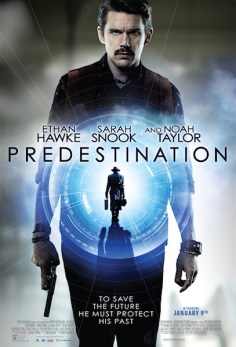 A man walks into a bar in ’70s New York. The bartender strikes up a conversation, which leads to a wager: if the man’s story is the most incredible the bartender has ever heard, he’ll give him a free bottle of whiskey. It had better be pretty good, because what we know that the man doesn’t is that the bartender, played by Ethan Hawke, is an agent for the Temporal Agency, travelling through time to stop crime before it happens; and he’s just had his face burnt off and completely rebuilt while failing to stop a notorious terrorist known as the Fizzle Bomber. Beat that.
 I don’t know how many people will remember, but the pair got a bit of attention back in the early ’00s with their debut feature
 Mumble and his penguin pals return for another adventure, in a series the Australian film industry are reportedly inordinately proud of.
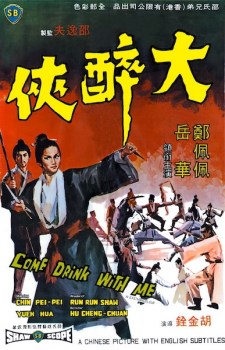 The first wuxia film directed by King Hu (King Chuan, that’s Hu! #MildlyRacistHomophoneJoke), the success of which allowed him to make his next even-more-significant movies in the genre, Come Drink with Me sees a gang kidnap the governor’s son to use him as leverage to release their leader. Instead, the governor sends his daughter, Golden Swallow (Cheng Pei-pei), to rescue her brother. She receives some help from local drunkard Fan Da-Pei (Yueh Hua), who may be more than he’s letting on…
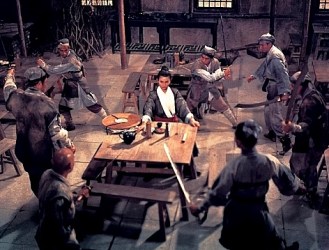 But this is a structural niggle, really. There’s so much else to enjoy — not just the action, but some amusing scenes, engaging characters, strikingly brutal villains (they not only kill a child (you wouldn’t get that in most movies) but they do it for no particular reason), and beautiful widescreen Technicolor cinematography — that it doesn’t grate too much.
 The word “prequel” was first coined in the ’50s, arguably entered the mainstream in the ’70s, and was firmly established as a term everyone knew and used in the ’90s by the Star Wars prequel trilogy. Works that can be defined as prequels predate their naming, however, and surely one of the earliest examples in the movies must be this silent German horror.
 Regarded as one of the first horror films, The Golem is more of a moderately-dark fantasy, or a fairytale-type myth. There are clear similarities to Frankenstein, though I don’t know if either influenced the other. However, it does feature what I presume is one of first instances of that most daft of horror tropes: running upstairs to escape the monster. It goes as well here as it ever does, i.e. not very. Said monster looks a bit comical by today’s standards. Built by the rabbi to defend the Jewish people, he immediately uses the hulking chap to chop wood and run errands — he doesn’t want a defender, he wants a servant! A terrifying beast nonetheless, it’s ultimately defeated because it picks up a little girl for a cuddle and she casually removes its magic life-giving amulet.
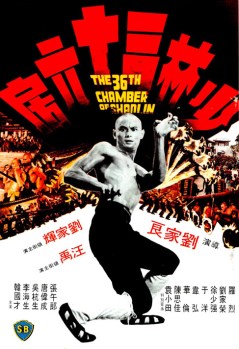 Widely regard as one of (if not the) greatest kung fu movies ever made, The 36th Chamber of Shaolin introduces us to San Te (Gordon Liu), a student whose hometown is oppressed by forces of the ruling Qing dynasty. He and his classmates join the underground resistance run by his teacher, only to wind up witnessing his friends and mentors be hunted, tortured, and killed. Faced with a similar fate, San Te escapes to the Shaolin Temple, widely known for being home to the best kung fu around. The temple’s monks refuse to teach martial arts to normal folk, nor help by joining the fight — they’re Buddhists, after all. Nonetheless, San Te manages to inveigle his way in to their company, and years of training begin.
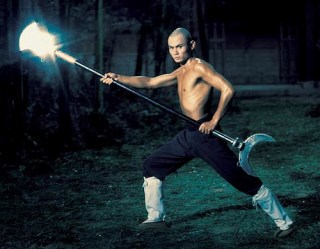 San Te is eventually learning how to use weapons, and when he finally graduates from the 35th chamber he has to prove himself in combat, first against the temple’s justice, then when he returns to the outside world and seeks vengeance. Fights both with and without weapons are imaginatively choreographed and executed with the customary speed and precision.
 Le Mépris establishes its two main themes with its two opening shots. First, a static shot of the film’s cinematographer, Raoul Coutard, filming a scene from the film, over which writer-director Jean-Luc Godard reads out the credits, which never appear on screen. This is a movie about moviemaking, and its inherent artifice. Second, a shot of Brigitte Bardot’s naked bottom. This is a movie about a man being in love with Bardot (well, the character she plays), and another man lusting after her, and what happens when the first man pats a different bottom. Maybe.
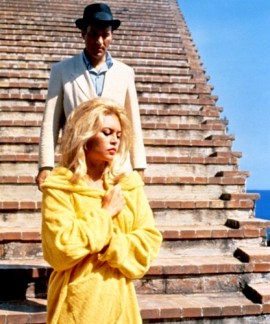 They go round in circles about staying together or being apart. The point? Your guess is as good as mine. Perhaps it’s the unknowableness of the other gender (whichever gender you are). Perhaps it’s just the unknowableness of other people fullstop. Perhaps it’s the unknowableness of our own emotions — eventually Bardot decides she does want to leave the playwright to run off with the producer, but no one seems to know why.
 Essie Davis is best known for playing the sassy title role in
 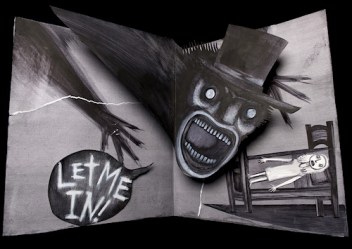 a horror film for people who think about what they’re watching, rather than just waiting for something to be thrown at the screen to make them jump. The slow burn tension will bore those content with the latter, who I suspect don’t tend to think a great deal (for one thing, they’d spot most of the jumps coming if they did).
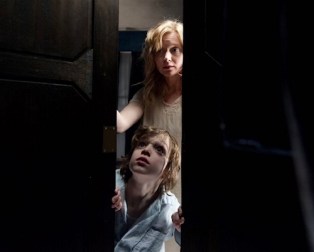 There is little in The Babadook that will make you jump, and even less that will make your stomach turn in disgust, but that’s absolutely fine. What it will do is chill your blood, make your hair stand on end, make you worry about every little creak or thump you hear elsewhere in the house after dark, and make you want to sleep with the lights on. Not just the bedroom lights, all the lights. Because once you’ve seen it, you can’t get rid of the Babadook.
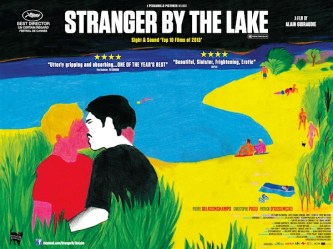 Iiiiiit’s the arthouse gay sex thriller!
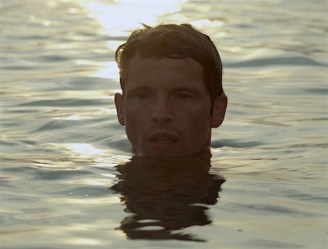 In this regard it has a very particular speed and style — even if there was a version without copious full-frontal male nudity and explicit sex, it still wouldn’t be for everyone. It helps to evoke both a certain time and place (lazy summer days on holiday) and a particular lifestyle (that of gay cruising — which, much to the (presumably straight) policeman’s bafflement, continues virtually unabated even after one of their number is murdered in unexplained circumstances). This is further emphasised by the gorgeous cinematography. Claire Mathon apparently shot it using only natural light, and it looks fantastic — understated (this isn’t a heavily-graded hyper-real kind of beauty), but sumptuous.
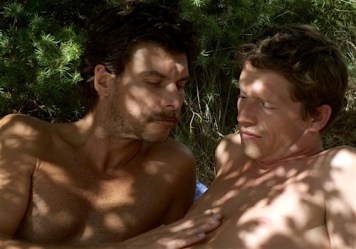 The style is supported by strong performances. I suppose some would say “brave”, by which they’d mean “they’re naked a lot and having gay sex”… so, I mean, maybe it is brave, but, still, that’d be a euphemistic description. What I mean is that they’re strong because they’re calm, understated, realistic, and believable without tipping over into amateurish. You feel Franck’s complex mix of fear and excitement, his lust overpowering common sense; there’s a certain timidity, maybe even naïvety, present in his eyes. Conversely, his lover Michel is unreadable; a closed book, where you never know what he’s thinking, feeling… plotting. Franck’s new friend Henri is similarly tricky to get an accurate handle on, but he’s the yin to Michel’s yang (or vice versa). He’s not plotting, he just is. Or maybe he was plotting all along…?
 100Films.co.uk